
Work Visa Apostille: A Canadian Applicant's Step-by-Step Guide
Work Visa Apostille: A Canadian Applicant's Step-by-Step Guide ! Hand applying official seal to diploma Most Canadian work-visa applicants need at least one document apostilled or authenticated, but not every document requires it.
Work Visa Apostille: A Canadian Applicant's Step-by-Step Guide
Most Canadian work-visa applicants need at least one document apostilled or authenticated, but not every document requires it. Public records like RCMP criminal record checks, diplomas, transcripts, and birth or marriage certificates usually go through Canada's authentication process. Private documents like bank statements or employer reference letters usually just need translation, sometimes with notarization.
Two things to do right now: check the destination country's embassy or your employer's document checklist for their exact requirement, and sort your paperwork into public records versus private documents.
Commonly authenticated documents for work visas:
- RCMP criminal record checks
- Diplomas and academic transcripts
- Birth and marriage certificates
- Professional licenses and certifications
Pro Tip: Authenticate the original document first, then translate the final authenticated packet. Translating before authentication means redoing the translation once the apostille or allonge adds pages, stamps, or seals.
Key Takeaways
A work visa apostille is required for most public Canadian records used abroad, but the right authority, sequence, and timing determine whether it clears in days or drags into weeks.
| Point | Details |
|---|---|
| Public vs. private documents | Diplomas, RCMP checks, and civil records usually need authentication; bank statements and reference letters usually don't. |
| Correct authority matters | Provincial competent authorities handle provincially notarized documents; Global Affairs Canada handles federal and RCMP documents. |
| Authenticate before translating | Translate only the final authenticated packet so it matches every seal, stamp, and allonge page. |
| Build in buffer time | Government processing windows vary by season, so plan 8 to 10 weeks ahead of a visa interview when possible. |
| Expedited help exists | Speedyapostilleservices offers all-in pricing and a typical 2 to 3 day turnaround for standard work-visa document packages. |
Table of Contents
- Do You Actually Need a Work Visa Apostille?
- Who Issues Apostilles or Authenticates Documents in Canada?
- Step-by-Step: Preparing and Submitting Your Documents
- Where to Send Documents, Processing Times, and Fees
- Common Reasons for Delays or Refusal
- Timing Strategy for Work-Visa Applicants
- How an Accredited Expedited Apostille Service Can Help
- If You Need a Work Visa Apostille Quickly
- Sources
- FAQ
Do You Actually Need a Work Visa Apostille?
Canadian document rules split into two categories: public documents and private documents. Public records issued by a government body, court, or vital statistics office typically need authentication before a foreign visa authority will accept them. Private documents, like a letter from your employer confirming your job offer or a personal bank statement, usually skip authentication and go straight to certified translation instead.
Here's how that plays out in practice:
- An RCMP criminal record check headed to a foreign labor ministry: authentication required.
- A university transcript needed for credential recognition: authentication required.
- A private employer reference letter: translation only, no authentication needed.
- A personal savings statement: translation only, rarely notarization.
Don't guess. Confirm requirements with the destination country's consulate, the hiring employer, or your visa category's checklist. If you're applying for a Canadian work permit from outside Canada, IRCC's Guide 5487 lays out exactly which supporting documents IRCC expects and confirms that anything not in English or French needs a certified translation.
Who Issues Apostilles or Authenticates Documents in Canada?
Canada doesn't have a single office handling every document. Which authority you use depends on where your document was issued and what kind of document it is.
Global Affairs Canada handles authentication for documents issued by federal departments and for many notarized documents. Provincial competent authorities, such as ServiceOntario's Official Documents Services, Alberta's Ministry of Justice, British Columbia's Ministry of Attorney General, Quebec's Ministère de la Justice, and Saskatchewan's Ministry of Justice, handle documents issued or notarized within their own province.
The routing logic breaks down like this:
- Documents notarized by a notary public in a province with its own competent authority go to that provincial office first.
- Federal documents, RCMP-issued criminal record checks, and documents from provinces without their own authentication office go to Global Affairs Canada Authentication Services.
- Since Canada joined the Apostille Convention, Global Affairs Canada issues the apostille as an allonge attached to your authenticated document rather than a stamp on the page itself.
That allonge is what over 120 Hague Convention member countries will recognize. Countries outside the convention may still require additional consular legalization on top of it.
Step-by-Step: Preparing and Submitting Your Documents
Getting a work visa apostille right the first time comes down to sequence. Skip a step or do them out of order, and you'll be redoing work.
- Confirm the requirement. Check the destination embassy, consulate, or your employer's checklist for exactly which documents need authentication.
- Gather originals or certified true copies. Photocopies and scans are almost always rejected.
- Get notarization if required. A notary public certifies the document is genuine before it moves to authentication.
- Request your RCMP criminal record check early. RCMP processing takes time on its own, separate from authentication.
- Send to the correct competent authority. Provincial office for provincially notarized documents, Global Affairs Canada for federal documents and RCMP checks.
- Receive your authenticated document with its apostille allonge attached.
- Translate the finished, authenticated packet if the destination country doesn't accept English or French.
- Assemble and submit to the visa authority or visa application center.
Build in buffer time at every stage. Government processing windows fluctuate by season and by document volume, and RCMP checks alone can take longer than expected if there's any name-matching issue on file.
Pro Tip: Never translate before authentication. The apostille allonge adds seals, numbers, and sometimes extra pages. Translate the final authenticated version, not the original, so the translation matches everything the authority stamped onto it.
If you're also authenticating an academic credential, Speedyapostilleservices' degree and transcript apostille guide covers the extra verification steps universities sometimes require.
Where to Send Documents, Processing Times, and Fees
Sending your paperwork to the wrong office is one of the most common ways applicants lose weeks. Match the document to the office:
- Provincially notarized documents (Ontario, Alberta, British Columbia, Quebec, Saskatchewan): send to that province's competent authority, such as ServiceOntario's Official Documents Services.
- Federal documents and RCMP criminal record checks: send to Global Affairs Canada Authentication Services.
- Documents from provinces without a competent authority: also route to Global Affairs Canada.
Processing time is the variable most applicants underestimate. Government offices publish target turnaround windows, but actual timing shifts with seasonal volume, so treat published estimates as a floor, not a promise. Speedyapostilleservices tracks Ontario processing times to help applicants plan realistic submission dates around a visa interview.
Both mail-in and in-person submission are usually available depending on the office, and some provincial authorities are expanding online submission options. Whichever route you use, keep every receipt and tracking number. If your document gets held up or lost in transit, that paperwork is your only proof of submission. When your timeline is too tight for standard processing, an accredited expedited service can compress the routing and pickup steps that otherwise eat several days.
Common Reasons for Delays or Refusal
Most rejected authentication requests fail for avoidable reasons, not because the underlying document was wrong.
- Submitting a photocopy or laminated document instead of an original or certified true copy.
- Sending the document to the wrong competent authority (provincial office instead of Global Affairs Canada, or vice versa).
- Missing an original signature or seal from the notary or issuing body.
- A translation that doesn't match the authenticated version, including missing certificate pages.
- An incomplete RCMP check, often from a name or date-of-birth mismatch on file.
Pro Tip: Keep the apostille allonge attached to the original document at all times, in the original page order. Separating them, or scanning them out of sequence, is one of the most common reasons a receiving authority flags a packet for review.
Timing Strategy for Work-Visa Applicants
Work backward from your visa interview date or IRCC submission deadline, not forward from today.
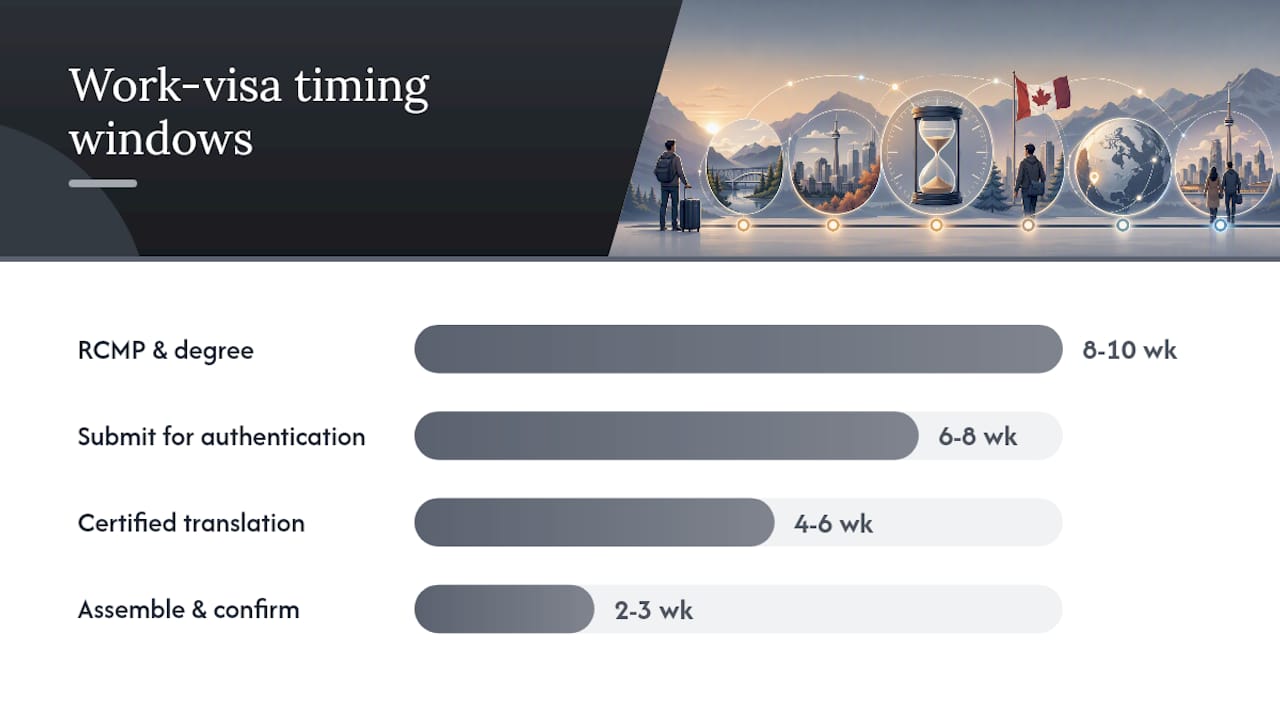
- 8 to 10 weeks out: Order your RCMP criminal record check and request degree or transcript verification from your school. Both can take longer than expected.
- 6 to 8 weeks out: Submit authenticated documents to Global Affairs Canada or the relevant provincial competent authority as soon as the RCMP check and any notarizations are in hand.
- 4 to 6 weeks out: Once authentication comes back with the apostille allonge attached, send the final packet for certified translation if needed.
- 2 to 3 weeks out: Assemble the full submission and confirm every document matches your employer's or IRCC's checklist before sending it to the visa authority.
IRCC's own guidance around passport and biometric windows assumes government processing times can shift, which is exactly why a buffer matters more than optimism here.
Pro Tip: While you wait on authenticated public records, get your private documents translated and notarized in parallel. There's no reason to let independent tasks sit idle in a queue.
How an Accredited Expedited Apostille Service Can Help
A professional apostille service exists to remove the routing guesswork and the waiting-in-line reality of government offices.
- Reviewing your documents before submission to catch errors that cause rejection.
- Handling required notarization through a licensed notary public.
- Routing each document to the correct competent authority, provincial or federal.
- Managing secure handling, tracking, and delivery of originals.
- Referring you to certified or sworn translation when your destination country requires it, a distinction explained well in this guide to sworn translation.
This kind of service earns its cost when you're staring down a fixed visa interview date, a passport expiry window with no slack, or a packet that touches two provinces and a federal office at once.
Speedy Apostille Services built its process around all-in pricing that includes government fees upfront, with a typical turnaround of a few days on standard packages and secure handling backed by a large number of positive customer reviews.
A Note From the Publisher
We've spent years helping Canadian applicants sort out exactly which documents need authentication versus translation before a work-visa deadline. This guide reflects what actually trips people up in that process, not textbook theory.
If You Need a Work Visa Apostille Quickly
When your visa interview is weeks away and you're still waiting on an RCMP check or a provincial authentication office, the calendar becomes the real obstacle. Speedyapostilleservices exists for exactly that pressure point: instead of routing your own documents through provincial and federal offices and hoping the timing lines up, you hand the packet to a service built around getting it back fast, with the government fee already built into one transparent price.
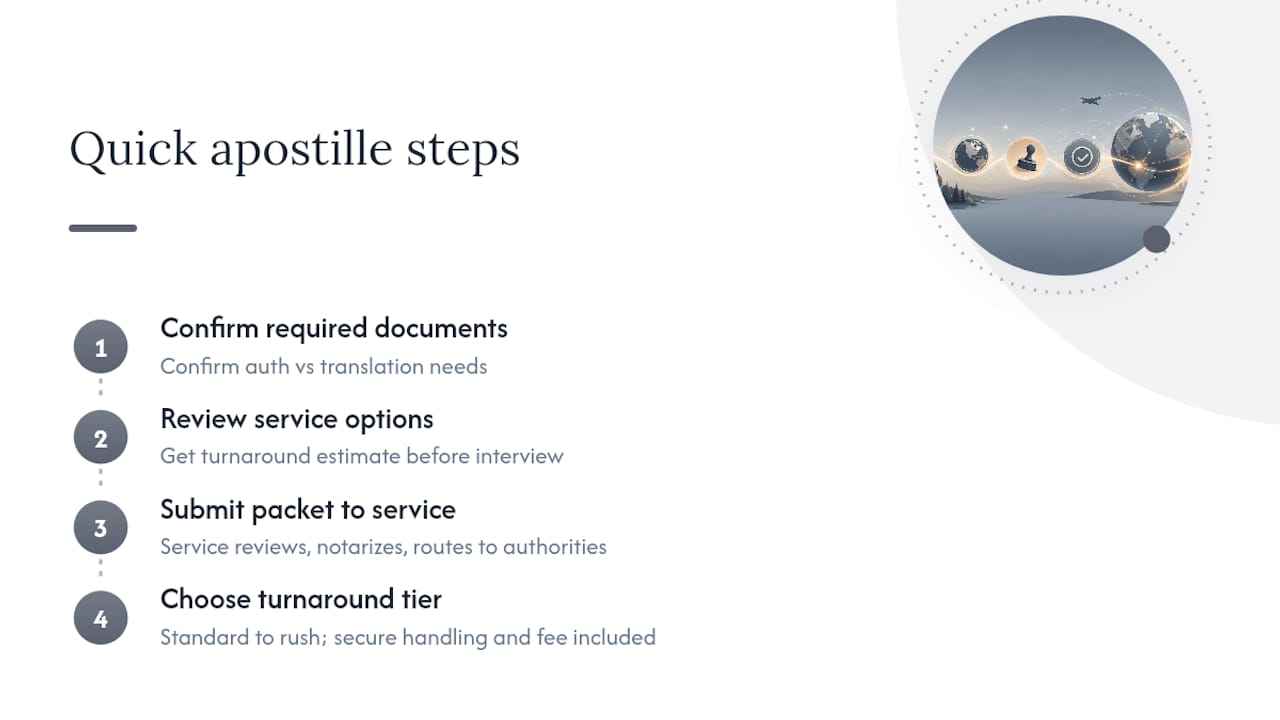
The service covers document review, required notarization, correct routing to Global Affairs Canada or your provincial competent authority, secure handling, and turnaround tiers from standard to rush, depending on how close your deadline is. Before booking, always confirm with your destination country's embassy, consulate, or employer exactly which documents need authentication versus translation. Use an expedited service only for the documents that genuinely require it.
If your timeline is tight, start by reviewing your document list against Speedyapostilleservices' order options and get a turnaround estimate before your visa interview date locks in.
Sources
Always confirm final requirements directly with the receiving authority, since acceptance rules vary by country.
- Authenticate your documents - Before you start (Step 1)
- Guide 5487 - Applying for a Work Permit outside of Canada
FAQ
Who can apostille documents in Canada?
Global Affairs Canada Authentication Services issues apostilles for federal documents, while provincial competent authorities, like ServiceOntario's Official Documents Services, handle documents issued or notarized within their own province.
How long does an apostille take in Canada?
Processing times vary by office and season, so applicants should build in several weeks of buffer rather than relying on the shortest published estimate. Expedited services can shorten this window for urgent deadlines.
Does ServiceOntario do apostille?
ServiceOntario's Official Documents Services acts as Ontario's competent authority for authenticating documents issued or notarized in the province, functioning as the provincial equivalent of an apostille office.
Does Global Affairs Canada provide apostille services for Canadian documents?
Yes. Global Affairs Canada issues apostilles as an allonge attached to authenticated Canadian documents, since Canada is a party to the Hague Apostille Convention.
Do I need a notary before I can get an apostille?
Some documents, particularly private ones or copies certified by a lawyer or notary public, need notarization before authentication; public records like birth certificates and RCMP checks typically go straight to the competent authority.