
Can You Get an Apostille in Canada for Work Abroad?
Can You Get an Apostille in Canada for Work Abroad? !

Can You Get an Apostille in Canada for Work Abroad?
Yes. Canadians can get an apostille for eligible Canadian public documents, and the process is faster than most people expect once you know where to send your paperwork. The single most important step comes before you submit anything: confirm your destination country is a Hague Apostille Convention signatory, and identify the correct competent authority for your specific document, either Global Affairs Canada (GAC) or the province's own authentication office, such as Ontario's Official Documents Services (ODS). Canada joined the Apostille Convention on January 11, 2024, which changed this process for good.
Before you submit anything, check three things:
- Destination country: is it a Hague Apostille Convention signatory?
- Issuing or notarizing jurisdiction: was your document issued or notarized federally, or in a specific province?
- Format: does the recipient require an original, a certified copy, or a notarized copy?
Get these three right and the rest of the process, including a service like Speedyapostilleservices, moves quickly.
Key Takeaways
Getting an apostille for work abroad in Canada requires matching your document to the correct federal or provincial authority before anything else.
| Point | Details |
|---|---|
| Confirm Hague status first | Check whether your destination country accepts apostilles before starting the process. |
| Match jurisdiction correctly | Route documents to Global Affairs Canada or the issuing province's authority based on where they were signed or notarized. |
| Prepare the right format | Use originals or properly certified copies; laminated or photocopied pages get rejected. |
| Verify before you rely on it | Confirm an apostille's validity using the issuing authority's number and date, since it only certifies the signature, not content. |
| Expedited service saves time under deadline | Speedyapostilleservices bundles government fees into all-in pricing with typical one to seven business day turnaround. |
Table of Contents
- What Is an Apostille and What Changed in 2026?
- Which Authority Issues Your Apostille: Federal or Provincial?
- What Documents Qualify and How Should You Prepare Them?
- How Do You Actually Submit an Apostille Request?
- How Long Does It Take and What Does It Cost?
- What If Your Destination Country Isn't in the Apostille Convention?
- How Do You Verify an Apostille Is Genuine?
- What Mistakes Cause Apostille Rejections?
- A Straight Take on the Apostille Process Since 2026
- How Speedyapostilleservices Handles the Routing and the Paperwork for You
- Sources
- FAQ
What Is an Apostille and What Changed in 2026?
An apostille certifies that a signature or seal on a public document is genuine. It says nothing about whether the contents of the document are true. That distinction trips up a lot of employers and immigration officers who assume the apostille vouches for the diploma's grades or the criminal record check's findings. It doesn't. It only confirms the signing official had the authority to sign it.
Before January 2024, Canadians needing a document recognized abroad went through a two-step process: authentication by a Canadian authority, then legalization by the destination country's embassy or consulate. That changed when Canada formally joined the Apostille Convention, replacing that two-step chain with a single apostille certificate for signatory countries. Many countries now accept apostilles under the convention.
That said, an apostille isn't a universal passkey:
- Some employers still want certified translations attached.
- Some foreign government offices ask for a fresh certified copy rather than the original.
- Some destination countries outside the convention still require the older authentication and legalization route.
Check with the recipient directly rather than assuming the apostille alone closes the file.
Which Authority Issues Your Apostille: Federal or Provincial?
This is where most delays happen. Canada doesn't have one office that handles every apostille. The authority depends on who issued or notarized your document, and sending it to the wrong one is the leading cause of rejected applications.
Global Affairs Canada handles documents issued by federal departments, federally incorporated companies, and documents from provinces or territories that don't have their own competent authority.
Several provinces run their own authentication offices for documents issued or notarized within their borders:
- Ontario — handled by Official Documents Services (ODS)
- Alberta — provincial authentication office
- British Columbia — its own apostille authentication process
- Quebec — provincial competent authority
- Saskatchewan — provincial competent authority
If your document was issued or notarized outside these five provinces, it likely routes to GAC.
Pro Tip: If a lawyer or notary in Alberta notarized your power of attorney, submit it under Alberta's rules, not Ontario's, even if you now live in Ontario. The notarizing province governs, not your current address.
When in doubt, use the competent-authority lookup tools on the GAC authentication site before you mail anything.
What Documents Qualify and How Should You Prepare Them?
Most work-abroad applicants apostille some combination of these: diplomas and transcripts, employment reference letters, professional licenses, birth and marriage certificates, RCMP criminal record checks, and powers of attorney. Format matters as much as content. Photocopies, laminated pages, or documents with staples removed and reattached commonly get rejected.
| Document Type | Format Usually Required | Notarization Needed? |
|---|---|---|
| Birth or marriage certificate | Certified copy from vital statistics registry | No, if issued by the registry |
| Diploma or transcript | Certified copy from the institution | Sometimes, if the institution won't certify directly |
| RCMP criminal record check | Original | No |
| Power of attorney | Original signed document | Yes, always |
| Employment reference letter | Original on letterhead | Sometimes, depending on recipient |
Translations matter too. If your document isn't in English or French and the destination requires it in another language, a certified translation professional handles both accuracy and the formal compliance stamp many governments expect.
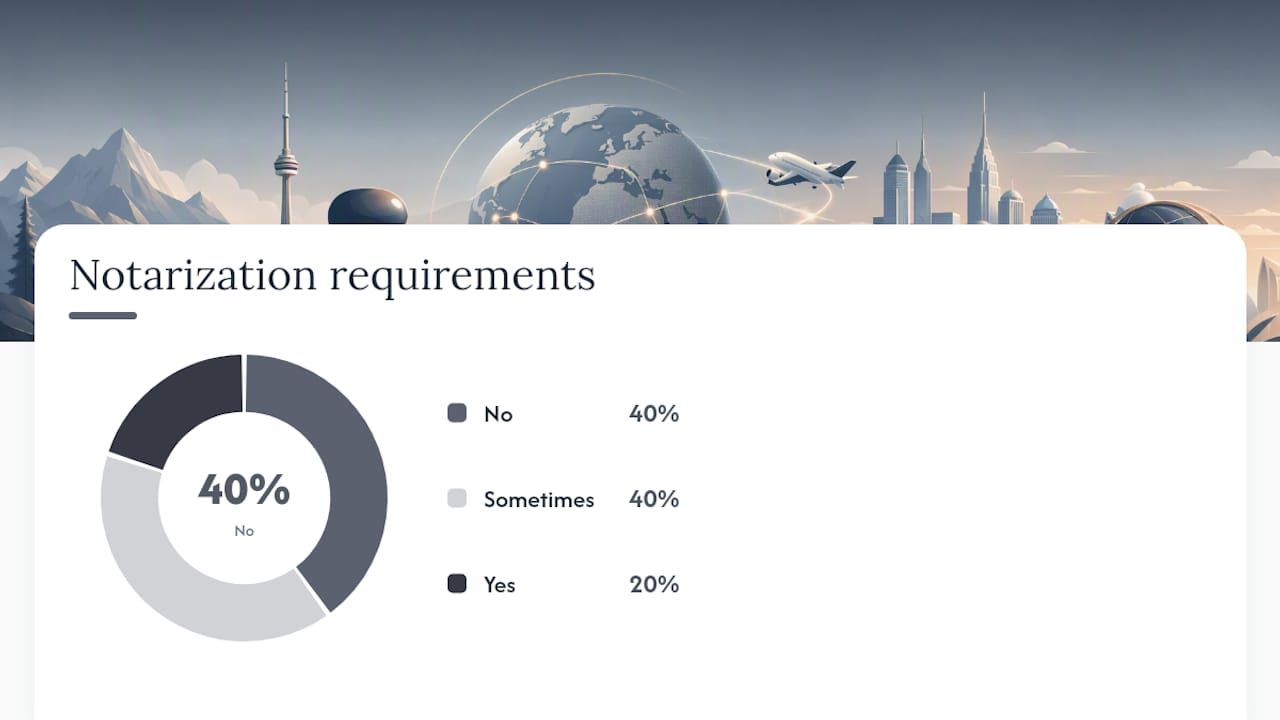
One frequently missed detail: remote online notarization is often rejected by competent authorities. Most provinces still want a wet ink signature from the notary, not a video-call notarization, even when that notarization is otherwise legally valid in your province. Check our document checklist generator before you book a notary appointment.
How Do You Actually Submit an Apostille Request?
Follow this order and you'll avoid the most common rejection triggers:
- Confirm recipient requirements. Call or email the employer, school, or government office abroad and ask exactly what they need: apostille only, translation, certified copy, or all three.
- Confirm the destination is a Hague signatory. Use the Hague country checker to verify before you spend money on the wrong process.
- Determine your competent authority. Match the issuing or notarizing jurisdiction to GAC or the correct provincial office.
- Get notarization or certified copies done first, if your document type needs it.
- Arrange translations, if the recipient requires the document in a language other than English or French.
- Submit your package. Some authorities accept in-person drop-off; most process by mail. Include the completed application form, government fee payment, and a prepaid return envelope or waybill.
- Track and verify. Most competent authorities issue a reference number so you can check status before it ships back.
Pro Tip: Use a trackable, insured courier for the return leg, especially if you're shipping internationally. A lost original birth certificate mid-transit can set you back weeks you don't have before a visa deadline.
Urgent requests are usually possible. Ontario ODS, GAC, and most provincial offices offer expedited service for an added fee, often turning a multi-week wait into a few business days. If you're on a tight visa or employment start date, same-day urgent processing through a service provider can be worth the premium.
How Long Does It Take and What Does It Cost?
Processing time depends entirely on which authority you use and whether you pay for expedited service.
- Standard mail-in processing through GAC or provincial offices commonly runs several weeks; always confirm the current timeline on the issuing authority's own page, since these windows shift.
- Expedited or in-person service can shrink that to a few business days in many provinces.
- Ontario ODS publishes its own processing guidance and verification steps directly on its site.
Government fees are separate from any service provider fee you might pay. GAC and the provinces post their own fee schedules, and a service provider's fee sits on top of that as payment for the legwork, not a replacement for it. Always ask whether a quoted price is all-in or government fees plus service fees layered on separately.
For return shipping, ask about prepaid international waybills if you're already abroad when you file, and confirm whether in-person pickup is available if you're local to the issuing office.
What If Your Destination Country Isn't in the Apostille Convention?
Not every country signed on. If your destination isn't a Hague member, you still need the older two-step process: authentication by the competent Canadian authority, followed by legalization at that country's embassy or consulate in Canada.

The practical difference is timing and coordination. An apostille is one certificate from one office. Authentication plus legalization means two separate offices, two separate fee schedules, and often two separate mailing steps.
Pro Tip: Start the embassy leg early. Some consulates only accept legalization requests on specific days or by appointment, and that scheduling constraint often adds more delay than the actual processing time.
Watch for extra scrutiny on documents involving religious authorities, foreign-issued source documents, or unusual notarization chains. Confirm with both the embassy and the end recipient exactly what they'll accept before you submit.
How Do You Verify an Apostille Is Genuine?
Ontario ODS and GAC both offer verification tools covering apostilles issued by GAC, Alberta, British Columbia, Saskatchewan, and Ontario. You'll typically need the apostille number and issuance date.
Remember: verification confirms the signature and seal are real, not that the underlying document's content is accurate. Recipients may still ask for translations or certified copies on top of a verified apostille. If verification fails or returns no match, contact the issuing authority directly rather than the recipient.
What Mistakes Cause Apostille Rejections?
- Wrong competent authority: sent to GAC when the province should have handled it, or vice versa. Fix: match the issuing/notarizing jurisdiction first.
- Photocopies or laminated pages: many offices reject anything not an original or properly certified copy. Fix: request fresh certified copies.
- Missing notarization: powers of attorney and affidavits almost always need it. Fix: notarize before submitting, not after rejection.
- No translation when the destination requires one. Fix: arrange certified translation upfront.
- Insufficient return postage: a common reason documents sit unprocessed. Fix: include a trackable prepaid envelope or waybill.
A Straight Take on the Apostille Process Since 2026
The biggest misconception about Canada's apostille shift is that it made things simple. It made things faster, not simpler. You went from one predictable two-step process (authenticate, then legalize) to a system where the correct path depends entirely on which province touched your document first. That's a bigger cognitive load, not a smaller one, even though the end result usually lands faster on your desk.
The federal and provincial split is the part nobody explains well. Most guidance treats "get an apostille" as a single action. It isn't. It's a routing decision first, then an action. Get the routing wrong and you lose the time savings the 2024 change was supposed to give you.
If there's one thing worth doing differently than the conventional advice suggests, it's this: verify recipient requirements before you touch a notary or a government form. Too many applicants apostille first and ask questions later, then discover the employer wanted a certified translation attached the whole time.
For readers under real deadline pressure, using an expedited service like Speedyapostilleservices to handle the routing decision and the paperwork removes the single biggest source of error in the entire process.
How Speedyapostilleservices Handles the Routing and the Paperwork for You
The hardest part of this process isn't the government fee or the wait. It's figuring out whether your document goes to GAC or to a provincial office, then getting the notarization, translation, and format exactly right on the first attempt. Speedyapostilleservices is based in Toronto and handles that routing decision directly, reviewing your document, confirming which competent authority applies, and arranging in-house notarization referral where needed before submission.

Speedyapostilleservices runs on all-in pricing, meaning the government fee is bundled into your quote upfront instead of showing up as a surprise add-on later. Turnaround typically runs one to seven business days depending on the document and the authority involved, with expedited options for tight visa or job-start deadlines. That's backed by more than 1,000 client reviews and a 5.0 rating.
Before you send anything to a government office yourself, compare the government fee alone against a bundled service quote so you know exactly what you're paying for. Get an instant quote to see the full cost and expected turnaround for your specific document.
Sources
- Authenticate your documents - Before you start (Step 1)
- Canada joins Apostille Convention to facilitate use of public documents abroad
- Apostille Convention - Province of British Columbia
- Authentication of documents
FAQ
Can I get an apostille on Canadian documents?
Yes. Since January 11, 2024, Canada issues apostilles for eligible public documents through Global Affairs Canada or provincial competent authorities like Ontario ODS, depending on where the document was issued or notarized.
How long does it take to get an apostille in Canada?
Standard processing commonly takes several weeks by mail, though this varies by authority and document type; expedited service through a provider like Speedyapostilleservices can reduce that to a few business days.
Does Global Affairs Canada provide apostille services for Canadian documents?
Yes. GAC handles apostilles for federally issued documents, federally incorporated company records, and documents from provinces without their own competent authority.
Does Service Ontario do apostille?
Not directly. Ontario's Official Documents Services (ODS), a separate provincial office, handles authentication and apostilles for documents issued or notarized in Ontario.
What's the difference between an apostille and authentication plus legalization?
An apostille is one certificate accepted by Hague signatory countries. For non-signatory destinations, you still need Canadian authentication followed by legalization at that country's embassy or consulate.