
Who Can Certify True Copy of Documents in Canada
Who Can Certify True Copy of Documents in Canada ! Lawyer certifying document in legal office Who can certify a true copy of documents in Canada?

Who Can Certify True Copy of Documents in Canada
Who can certify a true copy of documents in Canada?
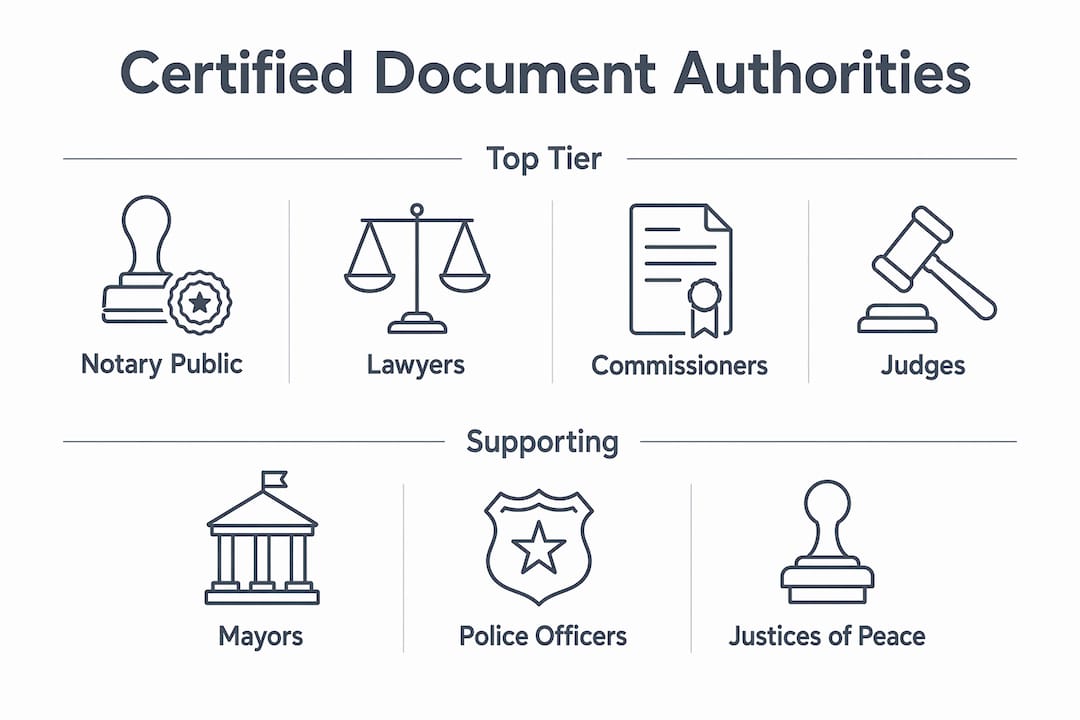
In Canada, only professionals holding recognized public trust roles are authorized to certify true copies of documents. Accepted certifiers include judges, magistrates, justices of the peace, lawyers who are members of provincial bar associations, notaries (including Quebec's notaires), mayors, police officers, and commissioners of oaths holding a government appointment and seal.
The certifier must personally compare the original document with the photocopy. They must attach a formal declaration, sign and date the copy, and clearly print their name and official title. The required declaration wording is: "This photocopy is a true copy of the original document which has not been altered in any way." Self-certification is not permitted, and neither is certification by a family member.
Key points to know before you proceed:
- Judges, magistrates, justices of the peace, lawyers, notaries, mayors, police officers, and commissioners of oaths are all recognized certifiers.
- The certifier must physically compare the original and copy before signing.
- The declaration, signature, date, and printed name with title are all required.
- Self-certification and certification by relatives are prohibited.
- Acceptance varies by institution, so confirm requirements with the receiving organization before proceeding.
Table of Contents
- Why public trust matters and how institutional policies affect acceptance
- What to expect for timelines and costs
- Legal requirements governing document certification in Canada
- Authorized professionals and agencies by province or territory
- Documents commonly certified and special rules for each
- Consequences of improperly certified copies
- Speedyapostilleservices handles certification and apostille together
- FAQ
- Key Takeaways
Why public trust matters and how institutional policies affect acceptance
The authority to certify a true copy is tied directly to the certifier's role of public trust. Institutions prioritize certifiers they can verify through professional registries or government records. This reduces fraud risk and makes the certification traceable.

Beyond the standard list, some institutions accept a broader range of professionals, including accountants, professional engineers, medical practitioners, teachers, and university professors. Acceptance depends entirely on the receiving organization's own policies.
Provincial distinctions also matter. Quebec's notaire is a civil law professional with a distinct legal status, different from a common law notary in other provinces. Some institutions specifically require a Quebec notaire for documents originating from that province.
A common misconception is that a notary public is the only valid certifier in Canada. That is not accurate. Many institutions accept lawyers, commissioners of oaths, or other designated officials. However, for documents intended for international use or apostille processing, a notary public is generally the most widely recognized option and tends to simplify subsequent authentication steps.
To verify a certifier's credentials, check with the relevant provincial law society, the Commissioner of Oaths registry, or the certifier's professional association. An invalid or unverifiable certifier will result in rejection.
Pro Tip: Always contact the receiving institution before getting a document certified. Ask specifically which certifier types they accept and whether a stamp or seal is required. This one step prevents most rejections.
What to expect for timelines and costs
Timelines for document certification in Canada can vary from same-day service for in-person visits to longer periods when applying by mail or when apostille processing is included. For passport certified true copies, Immigration, Refugees and Citizenship Canada offers turnaround options ranging from next business day to 10–20 business days depending on the method and urgency.
Cost factors include:
- Certifier fees, which vary by professional type and province.
- Government fees, which apply when apostille or additional authentication is required.
- Expedited service fees for faster processing.
Choosing a notary public for certification tends to reduce friction in subsequent apostille steps, since notaries are broadly recognized by government authentication offices. Professional services such as Speedyapostilleservices offer a 2–3 day turnaround with all-in pricing that covers government fees and secure handling, removing the need to coordinate multiple steps separately.
Legal requirements governing document certification in Canada
Document certification in Canada is governed by a combination of federal guidelines, provincial legislation, and institutional policy. There is no single national statute that defines all certification rules. Instead, the rules come from provincial notary acts, commissioner of oaths legislation, and the policies of federal bodies such as Service Canada and Immigration, Refugees and Citizenship Canada.
Service Canada's guidelines for Canada Pension Plan and Old Age Security applications specify an accepted list of certifiers and require that each certified copy include the certifier's signature, printed name, title, and the date of certification. Omitting any one of these elements can invalidate the copy entirely.
For international use, certification alone is not sufficient. Documents intended for use in Hague Convention countries require an apostille issued by a Canadian government authority. The certifier's stamp or signature is a necessary first step, but the apostille is what gives the document legal standing abroad.
Authorized professionals and agencies by province or territory
The table below shows the primary certifier types recognized across Canadian provinces and territories. Specific institutional requirements may expand or restrict this list.
| Province / Territory | Primary Authorized Certifiers |
|---|---|
| Ontario | Notary public, lawyer, commissioner of oaths |
| Quebec | Notaire (civil law notary), lawyer, commissioner of oaths |
| British Columbia | Notary public, lawyer, commissioner of oaths |
| Alberta | Notary public, lawyer, commissioner of oaths, judge |
| Manitoba | Notary public, lawyer, commissioner of oaths |
| Saskatchewan | Notary public, lawyer, commissioner of oaths |
| Nova Scotia | Notary public, lawyer, commissioner of oaths |
| New Brunswick | Notary public, lawyer, commissioner of oaths |
| PEI | Notary public, lawyer, commissioner of oaths |
| Newfoundland & Labrador | Notary public, lawyer, commissioner of oaths |
| Northwest Territories | Notary public, lawyer, justice of the peace |
| Yukon | Notary public, lawyer, justice of the peace |
| Nunavut | Notary public, lawyer, justice of the peace |
Judges, magistrates, police officers, and mayors are also recognized certifiers in most jurisdictions, though their availability for routine document certification varies.
Documents commonly certified and special rules for each
Different document types carry different certification requirements.
Birth certificates and vital records. A birth certificate notarized by a notary public is the standard approach for international use. The original government-issued certificate must be presented. The notary certifies the copy; they do not alter or re-issue the document. For apostille purposes, the notarized birth certificate then goes to the relevant provincial authority for authentication.
Passports and travel documents. Certified true copies of passports are commonly requested by financial institutions and immigration authorities. IRCC handles passport certification directly for official purposes. Some organizations require a stamped (wet seal) copy, which requires a specific application process through IRCC.
Academic credentials. Diplomas and transcripts are frequently certified by notaries or commissioners of oaths for use in foreign credential recognition processes. Some receiving institutions abroad require the certified copy to also carry an apostille.
Corporate and legal documents. Contracts, articles of incorporation, and powers of attorney are typically certified by a lawyer or notary. For international business use, these documents often require both notarization and apostille processing. Detailed procedures for overseas legalization, including apostille steps, are outlined in guides such as the marriage certificate attestation process for Dubai, which illustrates the multi-step authentication chain common across many countries.
RCMP background checks. These require certification by a notary public before apostille processing. The original RCMP certificate must be presented to the certifier.
Consequences of improperly certified copies
An improperly certified document will be rejected by the receiving institution. Common outcomes include outright refusal, requests for re-certification, and delays to legal or immigration processes. In cases where the document was needed for a time-sensitive application, rejection can result in missed deadlines.
Using an unrecognized certifier, omitting required declaration language, or failing to include the certifier's printed name and title are the most frequent errors. A certifier who lacks the legal authority to certify in a given province, or whose credentials cannot be verified, will produce a copy that carries no legal weight. Submitting such a copy to a government body or foreign institution can also raise questions about the applicant's good faith.
Speedyapostilleservices handles certification and apostille together
Getting a document certified is only the first step when the end goal is international use. Coordinating certification, notarization, and apostille processing separately takes time and increases the risk of errors between steps.

Speedyapostilleservices, based in Toronto, handles the full process for Canadian documents including birth certificates, marriage licenses, diplomas, RCMP background checks, and corporate records. The service covers document review, required notarization, and government-issued apostille for use in over 120 Hague Convention countries. Pricing is all-in, with government fees included upfront. The standard turnaround is 2–3 days. The service has over 1,000 reviews with a 5.0 rating. To get started, submit your documents directly through the Speedyapostilleservices website.
FAQ
Who can certify a true copy of a document in Canada?
Judges, lawyers, notaries, commissioners of oaths, justices of the peace, mayors, and police officers are all recognized certifiers in Canada. The specific certifier accepted depends on the receiving institution's requirements.
Can a notary certify any document in Canada?
A notary can certify most private documents, but vital records such as birth certificates must be presented as government-issued originals. The notary certifies the copy, not the document itself.
Is a certified true copy enough for use in Hague Convention countries?
No. A certified true copy requires an additional apostille issued by a Canadian government authority before it is legally recognized in Hague Convention countries.
How long does it take to get a certified true copy in Canada?
Timelines range from same-day for in-person service to up to 20 business days by mail. Speedyapostilleservices offers a 2–3 day turnaround including apostille processing.
What happens if a document is improperly certified?
The receiving institution will reject the document and may request re-certification. This can delay legal, immigration, or international business processes significantly.
Key Takeaways
In Canada, only professionals holding recognized public trust roles can certify true copies, and certification alone is not sufficient for international use without an apostille.
| Point | Details |
|---|---|
| Recognized certifiers | Judges, lawyers, notaries, commissioners of oaths, mayors, and police officers are all accepted in Canada. |
| Mandatory certification steps | The certifier must compare original and copy, include the formal declaration, and print their name, title, and date. |
| Institutional variation | Acceptance depends on the receiving organization's policy; always confirm before getting a document certified. |
| International use requires more | A certified true copy needs a government-issued apostille for legal recognition in Hague Convention countries. |
| Speedyapostilleservices | Handles certification, notarization, and apostille in 2–3 days with all-in pricing and over 1,000 five-star reviews. |