
Avoid a Month's Delay: Apostille a Child's Travel Consent in Canada
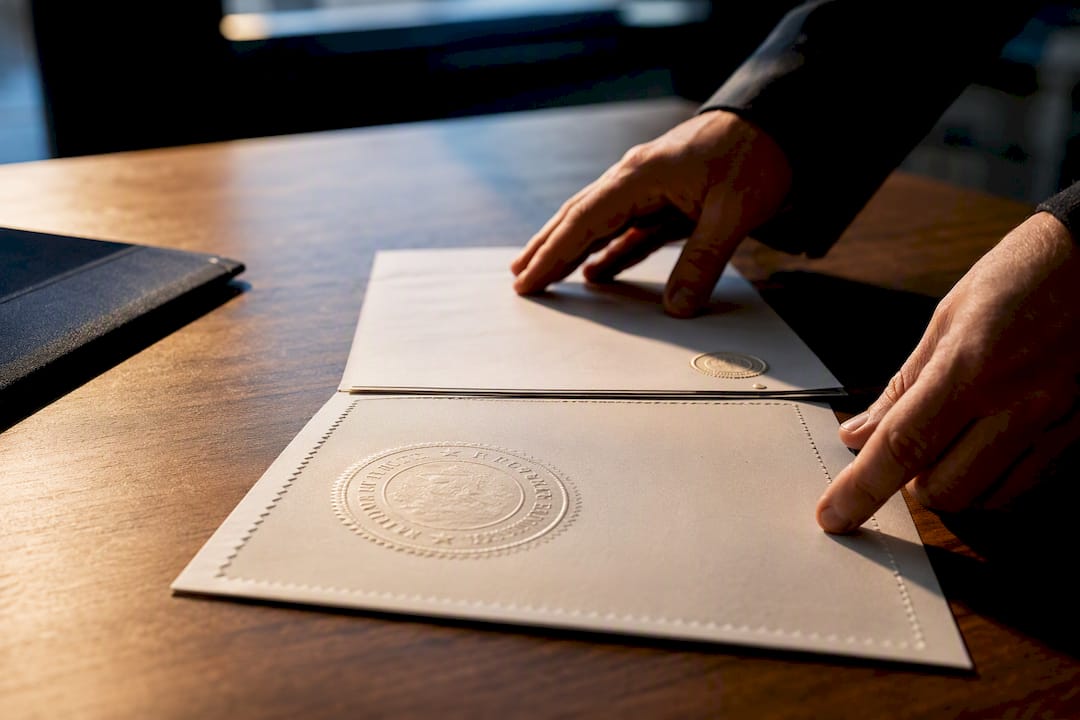
Avoid a Month's Delay: Apostille a Child's Travel Consent in Canada ! Notarized child travel consent with apostille Whether you need an apostille for a child's travel consent letter depends on where the child is going, not on Canadian law.
Avoid a Month's Delay: Apostille a Child's Travel Consent in Canada
Whether you need an apostille for a child's travel consent letter depends on where the child is going, not on Canadian law. The Government of Canada recommends a signed consent letter for minors traveling without both parents or legal guardians, but it does not require one. If the destination country demands authentication, notarize the original letter first, then send it for apostille or legalization.
TL;DR:
- Only destination country requirements determine if an apostille is necessary for a child's travel consent letter, not Canadian law.
- Notarization, though not legally required, significantly increases the letter’s credibility and is advised before mailing or notarizing it.
- The apostille process can take over 25 business days unless handled by an expedited service that reviews documents beforehand.
- Sending an original signed and properly routed document with correct details avoids delays caused by laminations, photocopies, or incorrect authorities.
- Confirm the destination country's acceptance of apostilles versus full legalization to avoid unnecessary or mismatched procedures.
Table of Contents
- When and Why Parents Should Carry a Signed Consent Letter
- What to Include in a Travel Consent Letter (And When to Notarize It)
- How to Get an Apostille or Authenticate a Consent Letter in Canada
- When Is an Apostille Actually Required?
- Timeline, Costs, and Mistakes That Cause Delays
- Expert Perspective: When an Expedited Apostille Service Makes Sense
- How Speedy Apostille Services Can Help
- Sources
- FAQ
When and Why Parents Should Carry a Signed Consent Letter
Border agents and airline staff often ask for proof that a traveling parent has permission to take a child abroad. The Government of Canada recommends a consent letter for anyone under the age of majority crossing a border without both parents or legal guardians present. This isn't a legal mandate. It's a precaution that prevents delays and, in rare cases, prevents accusations of child abduction.
Several travel situations tend to trigger a request for this letter:
- A single parent traveling with a child, especially after divorce or separation.
- A grandparent, aunt, uncle, or family friend accompanying a child.
- A school trip, sports team, or other group travel involving unaccompanied minors.
- A child flying alone to meet a parent already at the destination.
Without a letter on hand, families risk secondary screening at the border, a phone call to the absent parent for verbal consent, or in some cases, the child being denied travel entirely. None of that is a fun way to start a vacation.
What to Include in a Travel Consent Letter (And When to Notarize It)
A consent letter only works if it answers the questions a border officer or airline agent will actually ask. Cover these fields:
- The child's full legal name and date of birth.
- The child's passport number and expiry date.
- Exact travel dates and destination country or countries.
- The accompanying adult's full name and passport number.
- Contact information for the parent or guardian who is not traveling.
- Any custody arrangement or court order details, if they apply to the family.
An original signed letter carries far more weight than a photocopy or a digital-only version. Border staff can question a scanned copy, and as of early 2026, digital documents can no longer be apostilled in Canada at all. Print it. Sign it in ink. Keep it in the folder with the passports.
Notarization is not legally required for the letter itself, but it's strongly advised. A notary public confirms the signer's identity and adds a layer of credibility a plain witness signature doesn't carry. Travel.gc.ca notes that notarization is often accepted but not uniform, so a witnessed signature alone is more likely to draw questions than a notarized one.
Pro Tip: Book your notary appointment before you book your flights. Notaries in busy cities can have a multi-day wait during peak travel seasons, and a rushed appointment increases the odds of a signature or date mismatch on the letter.
How to Get an Apostille or Authenticate a Consent Letter in Canada
If the destination country requires formal authentication, the process runs through a few defined steps.
- Notarize the original letter. Skip this only if you've confirmed the destination doesn't require it.
- Confirm the destination's rules. Contact that country's embassy or consulate in Canada to find out whether it accepts an apostille under the Hague Convention or requires a separate legalization process.
- Identify the correct competent authority. Global Affairs Canada explains that some provinces issue apostilles directly, while other documents route through Global Affairs Canada itself. Ontario and Quebec, for example, have their own provincial authorities for documents issued there.
- Submit the right format. Authentication requires a paper document with an original signature, sent by mail or in person. Photocopies and PDFs are rejected outright.
Provinces without their own authority send documents to Global Affairs Canada in Ottawa, which adds mailing time on both ends. This is exactly where the gap between official processing and expedited third-party handling shows up: a courier service or apostille provider can tighten the paperwork and shipping side of the process, but nobody can shorten the government's own queue. For a fuller walk-through of the routing rules, see how to apostille a Canadian document step by step.
When Is an Apostille Actually Required?
The apostille exists because of the Hague Apostille Convention, a treaty that lets member countries accept one standardized authentication stamp instead of requiring full embassy legalization. Canada joined the Convention, so a document apostilled here is recognized in over 120 member countries without further embassy sign-off.
Countries outside the Convention still require full legalization through their embassy or consulate, a longer process involving both Global Affairs Canada and the destination's diplomatic office. The only reliable way to know which path applies is to ask directly.
- Check the destination country's embassy or consulate website for its stated document requirements.
- Call the embassy if the website is vague. Global Affairs Canada's own FAQ makes clear that the destination country decides what it will accept, not Canada.
- Ask the receiving school, court, or institution abroad directly if the consent letter is tied to a specific enrollment or custody matter.
Skipping this check is how families end up apostilling a document that never needed it, or worse, arriving without the one that did. For a clearer breakdown of the two paths, apostille versus legalization explains the practical difference.
Timeline, Costs, and Mistakes That Cause Delays
Global Affairs Canada's own estimate runs about 25 business days for processing, plus mailing time that can add several more business days, totaling over a month from drop-off to delivery in some cases, see source. That's over a month from drop-off to delivery if you're not using an expedited option. Budget for these costs as you plan:
- A notary public fee, typically a flat charge per signature.
- The government authentication fee itself.
- Courier or mailing costs, both to and from the competent authority.
- Embassy legalization fees, if your destination isn't a Hague member.
The most common reasons documents get bounced back: laminated or photocopied letters, missing original signatures, sending the document to the wrong competent authority, or apostilling a document type the destination never asked for. Any one of these can add another full cycle to your timeline. For province-specific expectations, Ontario's apostille processing times are a useful benchmark even outside Ontario.
Expert Perspective: When an Expedited Apostille Service Makes Sense
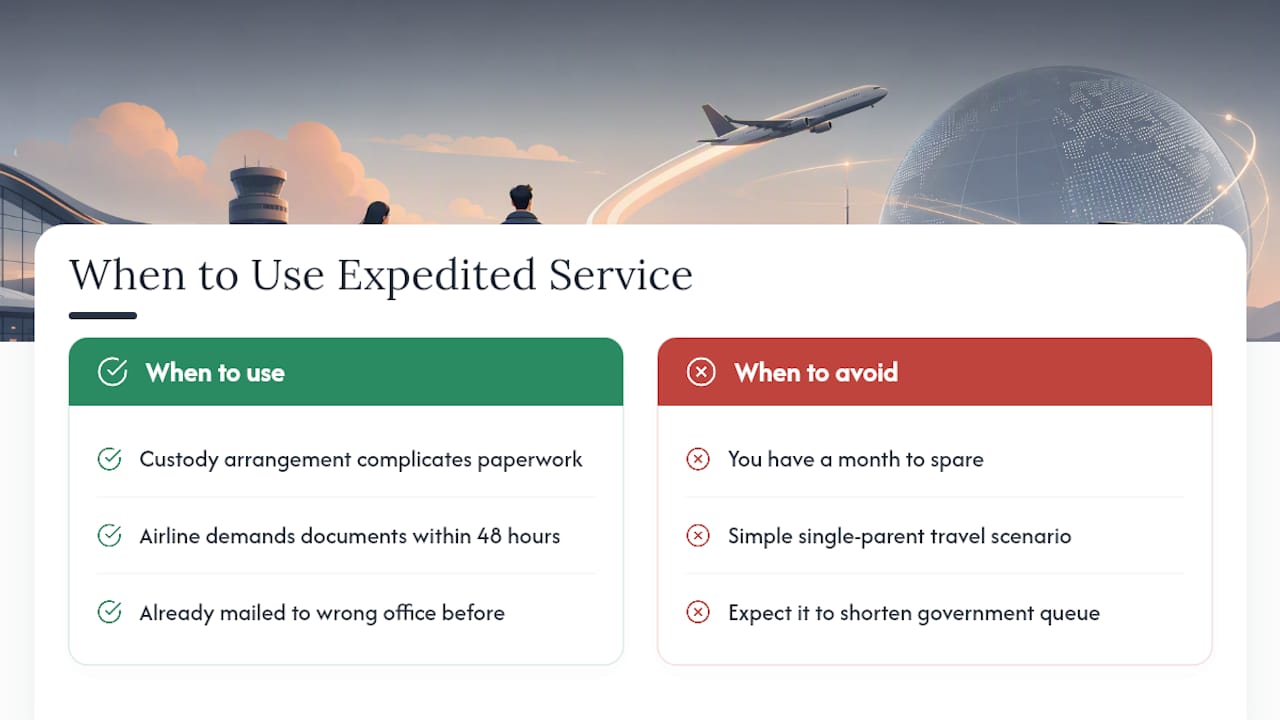
Doing this yourself works fine when you have a month to spare and a straightforward, single-parent travel scenario. It stops working when a custody arrangement complicates the paperwork, an airline demands documents on 48 hours' notice, or you've already mailed a letter to the wrong office once and can't afford to do it again.
What a paid service changes is the pre-submission review and routing. A document reviewed for errors before it's mailed is a document that doesn't bounce back three weeks later. Speedy Apostille Services advertises an all-in pricing model, a typical 2 to 3 day handling turnaround, and over 1,000 client reviews at a 5.0 rating. No service, paid or free, can shorten the government's own processing queue. What it can do is make sure your submission only has to go through that queue once.
— Ken
How Speedy Apostille Services Can Help
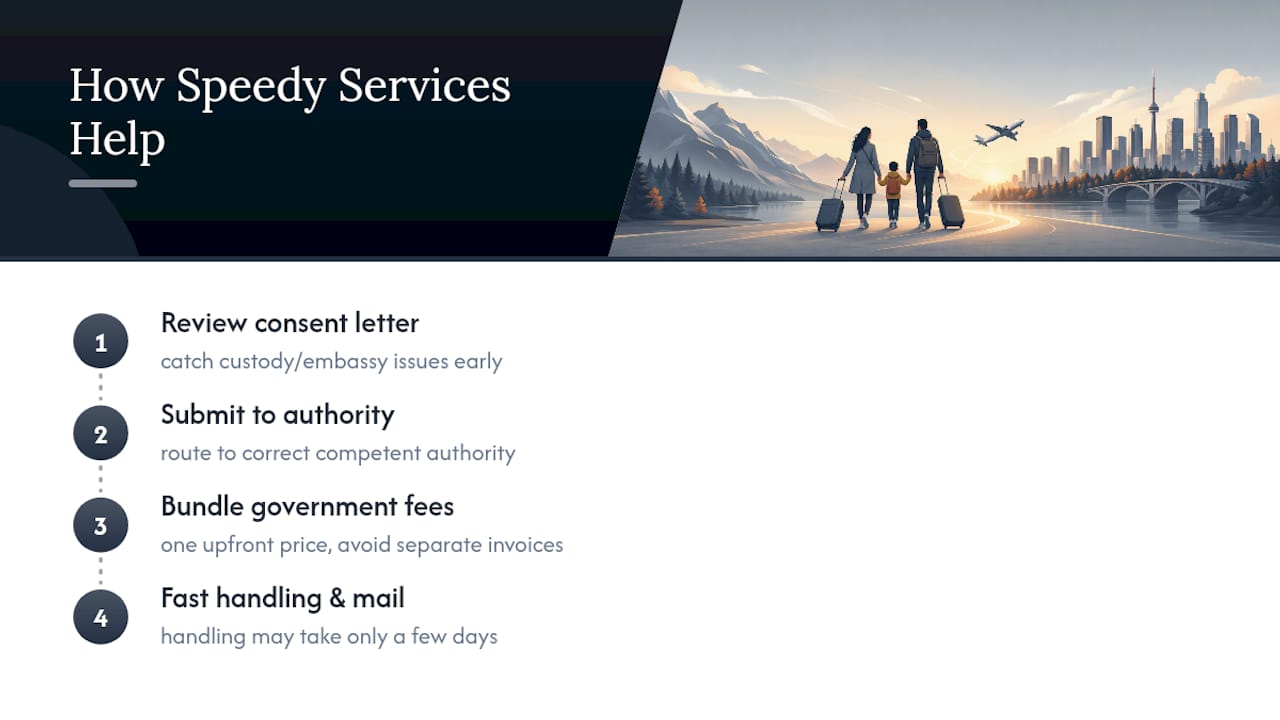
Certain apostille services can help when a custody detail, a last-minute embassy request, or a tight departure date leaves no room for a mailing error. These services may review your consent letter, submit it to the correct competent authority, and bundle government fees into one upfront price, avoiding separate invoices.

With straightforward, well-documented travel, the handling portion may take only a few days, on top of the government's own processing time. That part is within anyone's control: ensuring a document is correctly routed the first time.
If your departure date is close, or your paperwork involves a custody order or a destination outside the Hague Convention, start an order with Speedy Apostille Services and get your documents reviewed before they're mailed anywhere.
Sources
Before apostilling anything, review the Government of Canada's consent letter guidance and Global Affairs Canada's authentication requirements. Always confirm the destination embassy's own rules before submitting.
FAQ
How Can I Apostille a Document in Canada?
Notarize the original document if required, then submit it either to your province's own competent authority (Ontario and Quebec issue apostilles directly) or to Global Affairs Canada, depending on where the document was issued.
Do I Need a Consent Letter for My Child to Travel Abroad From Canada?
It's not legally required, but the Government of Canada recommends one for any child under 19 traveling without both parents, since border officials may ask for it.
Is a Consent Letter Required to Travel Within Canada?
No law requires it for domestic travel, but carrying one is a reasonable precaution if a child is flying or crossing provincial lines with only one guardian.
How Do I Write a Letter of Consent for Travel?
Include the child's legal name and birthdate, passport number, travel dates and destination, the accompanying adult's details, and contact information for the absent parent, then sign it in front of a notary public whenever possible.