
Confirm Eligibility Fast for Canadian Tax Document Apostilles
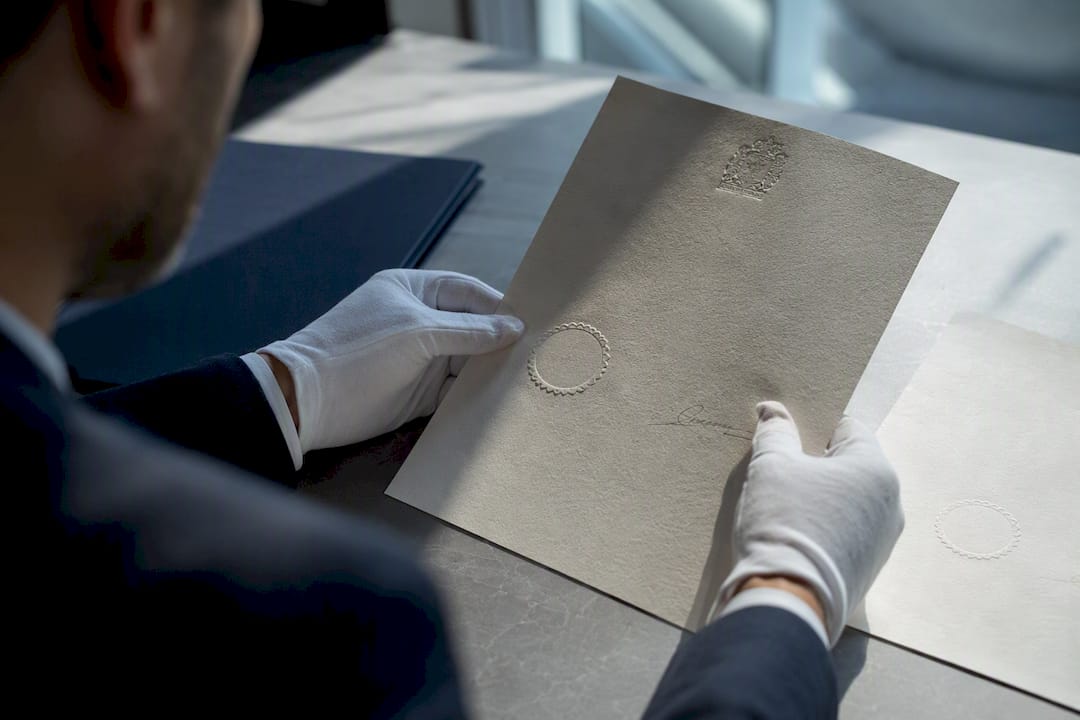
Confirm Eligibility Fast for Canadian Tax Document Apostilles ! Hands checking a Canadian tax certificate Yes, but only for certain formats.
Confirm Eligibility Fast for Canadian Tax Document Apostilles
Yes, but only for certain formats. Official certificates and agency-issued tax letters carrying an original signature and seal can get an apostille; standard tax return printouts and downloaded PDFs usually cannot. Your first move is to confirm two things: whether your destination country belongs to the Hague Apostille Convention, and the exact document name and format the foreign recipient will accept.
TL;DR:
- An apostille only applies to official certificates or agency-issued tax letters with original signatures and seals, not standard returns or PDFs.
- Canada joined the Hague Apostille Convention in January 2024, simplifying the process to a single certificate for documents going to member countries.
- Most tax documents qualify if they carry an original signature and seal; scanned copies, self-certified photocopies, or printouts are generally ineligible.
- Sending the correct document to the right authority and confirming destination country requirements upfront can prevent significant delays and rejections.
- Professional apostille services can reduce processing time to a few days and provide fixed quotes, avoiding common mistakes and administrative bottlenecks.
Table of Contents
- What Does an Apostille Actually Do for Canadian Documents?
- Which Tax Documents Can Actually Be Apostilled?
- How to Prepare and Submit Your Tax Document for an Apostille
- How Long Does It Take and What Does It Cost?
- Avoiding the Most Common Apostille Mistakes
- When Hiring a Professional Apostille Service Makes Sense
- What Actually Matters When You're Apostilling a Tax Document
- Get Your Tax Document Apostilled Without the Guesswork
- Sources
- FAQ
What Does an Apostille Actually Do for Canadian Documents?
An apostille is a government-issued certificate that confirms a document's signature, seal, or stamp is genuine. It replaces the older, slower process of embassy or consular legalization for any document headed to a country that belongs to the Hague Apostille Convention.
Canada joined the convention in January 2024, which changed the process for millions of documents sent abroad each year. Before that, Canadians needed multi-step legalization through Global Affairs Canada and the destination country's embassy. Now, for documents going to Hague Convention member countries, one apostille certificate is typically enough.
A few things to keep in mind before you assume you're covered:
- The apostille only works if the destination country is also a Hague member.
- Non-member countries still require full embassy or consular legalization, not an apostille.
- The document itself still has to qualify for authentication in the first place, which is where a lot of tax paperwork runs into trouble.
Which Tax Documents Can Actually Be Apostilled?
Not every piece of tax paperwork qualifies, and this is where most people get stuck. Foreign authorities generally want a document that carries an original signature and, where applicable, an official seal from a Canadian government office or agency. That standard rules out a lot of what people try to submit first.
Documents that typically qualify include:
- Certificates of residency issued by the Canada Revenue Agency
- Official tax authority letters bearing an original signature and agency seal
- Notarized copies of tax-related records, when notarization is genuinely required by the destination country
- Corporate tax filings certified by the issuing government body, not printed from an online portal
Documents that typically do not qualify:
- Scanned or downloaded tax returns
- Ordinary printouts from CRA's online portal
- Self-certified photocopies of any tax record
One pitfall shows up more than any other in apostille requests: submitting the wrong document type entirely. Foreign agencies almost always want an official certificate or agency-issued letter, not a tax return printout, no matter how official the printout looks on your screen.
If your first document doesn't qualify, contact the issuing agency directly and request the specific certified version they issue for international use. This usually means asking the CRA or a provincial tax office for a formal letter or certificate rather than trying to authenticate what you already have on file.
How to Prepare and Submit Your Tax Document for an Apostille
Getting this right the first time saves you weeks. Here's the sequence that works.
- Confirm the exact requirement. Contact the foreign institution or check its guidance to find out precisely what document name and format it wants, and verify the destination country's Hague status using a country checker tool.
- Get the original or certified copy. Request the document directly from the issuing agency; a certified true copy from the source authority is acceptable when an original isn't available, but a self-made photocopy is not.
- Decide if notarization is needed. Many agency-issued tax letters already carry the signature and seal required for apostille, and adding an outside notary stamp can actually complicate the submission. Notarize only when the destination country specifically requires it.
- Send it to the right authority. Federal documents go to Global Affairs Canada, while some provincially issued records go through the correct provincial competent authority instead. Sending to the wrong office is one of the most common causes of delay.
- Track, insure, and expedite if needed. Use a courier with tracking and insurance for anything irreplaceable, and request rush handling if your deadline is tight.
Pro Tip: Call the receiving institution before you submit anything. A five-minute phone call confirming their exact document requirement can save you weeks of resubmission if your first attempt gets rejected.
How Long Does It Take and What Does It Cost?
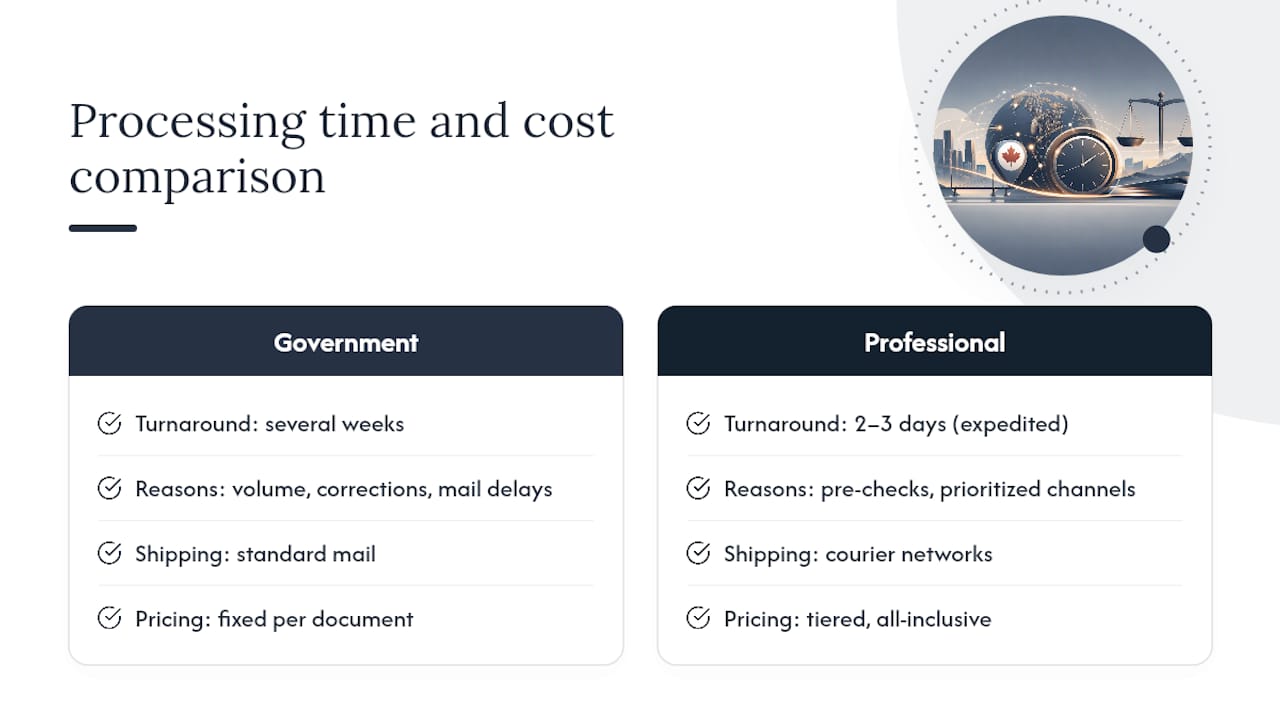
Government-direct processing through Global Affairs Canada or a provincial authority commonly takes several weeks, depending on volume, document type, and whether anything needs correction along the way. Mail delays and incomplete submissions add more time on top of that.
Professional apostille services generally move faster because they pre-check documents before submission, use courier networks instead of standard mail, and often have prioritized channels with government offices. Turnaround claims in the range of two to three days aren't unusual for expedited service tiers, compared to the multi-week timeline of handling it yourself.
Cost structures vary. Government fees are typically fixed per document, but professional providers commonly bundle everything into tiered, all-inclusive pricing that covers document review, government fees, and shipping in one quote. That transparency matters because piecemeal pricing (a fee here, a courier charge there, a rush surcharge you didn't see coming) is how apostille costs quietly balloon. A breakdown of typical apostille costs by issuing authority gives a useful reference point before you commit to a provider.
Avoiding the Most Common Apostille Mistakes
Most rejected submissions trace back to a small handful of repeat mistakes, not bad luck.
The usual culprits:
- Submitting a document type the recipient never asked for
- Notarizing a document that didn't need it, or skipping notarization on one that did
- Sending photocopies or PDFs instead of originals or certified copies
- Missing an official signature or seal on the document
- Mailing to the wrong authority, federal instead of provincial or vice versa
| Checklist item | Why it matters |
|---|---|
| Original or certified true copy | Photocopies and PDFs are typically not eligible for authentication |
| Signature and seal present | Missing either one is an automatic rejection |
| Correct authority identified | Federal and provincial documents go to different offices |
| Destination Hague status confirmed | Non-member countries need full legalization, not an apostille |
| Translation requirements checked | Some destinations require certified translation alongside the apostille |
| Insured return shipping arranged | Originals are often irreplaceable if lost in transit |
If a document comes back rejected, don't resend it as-is. Contact the issuing agency to confirm you have the correct version, verify the requirement again with the destination country using Travel, and only resubmit once both are confirmed.
Pro Tip: Keep a digital copy of every document you send, along with tracking numbers and dates. If something goes missing in transit or gets rejected, you'll need that paper trail to sort it out quickly.
When Hiring a Professional Apostille Service Makes Sense
Some situations call for a professional, and it's not just about convenience. A managed service typically handles document review, coordinates notarization only when actually required, submits to the correct competent authority, and manages secure handling and return shipping from start to finish.
Hiring out makes the most sense when:
- Your deadline is tight and government processing timelines won't work
- You're dealing with federal-level documents that require exact routing
- The original document is irreplaceable and you don't want to risk mail loss
- Your destination country requires additional embassy legalization on top of the apostille
Speedy Apostille Services, based in Toronto, offers a document checklist resource that helps clients confirm they have the right paperwork before anything gets submitted, which cuts down on the wrong-document problem covered earlier.
A qualified pre-submission review checks for correct signatures, seals, and proper authority routing before a document ever leaves your hands, which is exactly where most tax-document apostille requests go wrong.
That kind of review matters more for tax paperwork than for something like a birth certificate, because the range of acceptable formats is narrower and the room for error is smaller.
What Actually Matters When You're Apostilling a Tax Document
Most guides on this topic bury the one thing readers need first: whether their specific document even qualifies. That should be question one, not question five, because there's no point mapping out submission steps for a document that's going to get rejected on format alone.
The conventional advice tends to overweight process and underweight document identification. People get detailed instructions on notarization and courier tracking, then get blindsided when their tax return printout bounces back weeks later because nobody told them upfront that it was never eligible.
Here's what I'd prioritize differently: spend your first ten minutes confirming the exact document name the recipient wants and checking Hague status, not researching courier options. Everything downstream depends on getting that right. The steps themselves aren't complicated. Notarize only when required, send to the correct authority, insure your originals. What separates a clean submission from a rejected one is almost always a document mismatch caught too late.
If your timeline is tight or the document is irreplaceable, a professional review earns its cost by catching that mismatch before submission, not after.
— Ken
Get Your Tax Document Apostilled Without the Guesswork
Speedy Apostille Services gives you a fixed, all-in quote before you send anything, so there's no separate government fee, courier charge, or rush surcharge showing up later.

That matters most for tax paperwork, where the wrong document format is the single biggest cause of delay. A professional service can review your document first, confirm it's the right type and format for your destination country, and handle notarization coordination only when actually required. Turnaround times may be measured in days depending on service tier, often supported by positive customer feedback. To get started, request a quote through the apostille services page with your document type and destination country, and you'll get a fixed price that already includes government fees before you commit to anything.
Sources
- Authentication of documents - Global Affairs Canada
- Five Tips for Authenticating Canadian Documents to Use Abroad
- Document Authentication and Legalization Services - Commissionaires
- Travel
FAQ
Can I Get an Apostille on Canadian Tax Documents?
Only certain formats qualify. Official certificates and agency-issued tax letters with an original signature and seal can be apostilled, but standard tax return printouts and downloaded PDFs generally cannot.
Does Canada Require an Apostille for Documents Sent Abroad?
Canada requires an apostille (or full legalization for non-member countries) whenever a foreign institution needs proof that a Canadian document's signature or seal is authentic. Since joining the Hague Apostille Convention in January 2024, most documents headed to member countries need only a single apostille certificate.
How Long Does It Take to Get an Apostille in Canada?
Government-direct processing through Global Affairs Canada or a provincial authority commonly takes several weeks. Expedited professional services often bring that down to two to three days by pre-checking documents and using prioritized submission channels.
How Much Does It Cost to Apostille a Document in Canada?
Government fees are generally fixed per document, while professional providers commonly charge tiered, all-inclusive pricing that bundles government fees, document review, and shipping into one quote. Costs vary by document type, urgency, and whether you handle submission yourself or use a managed service.
What Happens If My Tax Document Gets Rejected for Apostille?
Contact the issuing agency to confirm you have the correct certified version, then reverify the destination country's exact requirement before resubmitting. Resending the same rejected format without changes almost always results in a second rejection.