
Student Visa Apostille Canada: What You Actually Need
Student Visa Apostille Canada: What You Actually Need ! Hands arranging documents and passport on desk You do not need an apostille for a Canadian study permit application.

Student Visa Apostille Canada: What You Actually Need
You do not need an apostille for a Canadian study permit application. IRCC does not require apostilled or legalized documents for study permits, visas, permanent residence, or citizenship applications. Apostilles come into play when a foreign university, embassy, or consulate asks for one to verify Canadian-issued documents such as diplomas or police checks. Canada joined the Hague Apostille Convention on January 11, 2024, and Canadian apostilles are now accepted in over 120 member countries.
- For IRCC study permits: follow IRCC's document checklist, not an apostille process.
- For foreign universities or consulates: check their specific document authentication rules first.
- Next step: confirm which authority applies to your document, then prepare notarization or translation before submitting.
Key Takeaways
Getting a Canadian document properly apostilled or authenticated depends on matching the right competent authority, notarization order, and destination country rules before submission.
| Point | Details |
|---|---|
| IRCC doesn't require apostilles | Study permit applications need certified scans and translations, not apostilled documents. |
| Confirm the destination requirement first | Foreign universities and consulates, not IRCC, are usually the ones requesting apostilles. |
| Match document origin to authority | Global Affairs Canada handles federal documents; provincial ODS offices like Ontario's handle provincially issued or notarized ones. |
| Sequence notarization and translation carefully | Translating before authentication can invalidate acceptance in some destination countries. |
| Consider an expedited service for tight deadlines | Speedy Apostille Services offers all-inclusive pricing and expedites processing within a few days for students who can't afford a rejected submission. |
Table of Contents
- Do You Need a Student Visa Apostille for Canada Study Permits?
- What Is an Apostille, and How Does It Differ From Legalization?
- Who Issues Apostilles in Canada: Federal vs. Provincial
- Which Student Documents Actually Need an Apostille?
- How to Get a Document Apostilled or Authenticated in Canada
- Processing Times, Fees, and Why Applications Get Rejected
- When a Private Apostille Service Makes Sense
- Why Canada Issues Authentications, Not Apostilles for Every Case
- Trusted Options for Canadian Document Authentication
- How to Confirm a Destination Country Will Accept Your Document
- How Speedy Apostille Services Helps Students Get It Right the First Time
- Where to Verify Requirements and Submit Documents
- Sources
- FAQ
Do You Need a Student Visa Apostille for Canada Study Permits?
The short answer is no. IRCC's study permit document guidance lists a letter of acceptance, proof of funds, a provincial attestation letter, and proof of identity. Nowhere in that list does IRCC ask for an apostille. It wants clear scans and certified translations where a document isn't in English or French.
Apostilles matter when the requirement comes from somewhere else entirely: a foreign university's admissions office, a consulate processing your study permit for a different country, or a visa office abroad that wants your Canadian transcripts or police check authenticated. Local visa offices can add extra document demands specific to their region, and those extra demands are usually where apostille requests show up.
Before paying for anything, check three things:
- The destination university or consulate's own document checklist.
- Whether they use the word "apostille," "legalization," or "authentication" specifically.
- Whether your document was issued in Canada (only Canadian-issued public documents get a Canadian apostille).
Pro Tip: Email the admissions office or consulate directly and ask for their exact wording. "Certified copy," "notarized copy," and "apostille" are not interchangeable, and using the wrong term when you ask for a quote wastes both time and money.
What Is an Apostille, and How Does It Differ From Legalization?
An apostille is a certificate, physically attached to your document as an allonge, that verifies the signature or seal of the Canadian official who signed it. It says nothing about whether your degree is real or your grades are accurate. It only confirms that the signature belongs to a legitimate, registered public official.
Legalization is the older, two-step process still used for documents headed to non-Hague countries: authentication by a Canadian authority, then a second stamp from the destination country's embassy in Canada. Authentication and apostille now largely overlap for Hague member countries since January 2024, but legalization survives for the smaller number of countries outside the Convention.
Students run into this distinction most often in two scenarios:
- Applying to a university in a Hague country that wants your transcript apostilled before it will process an application.
- Applying for a student visa at a foreign consulate that wants a police clearance certificate authenticated before issuing the visa.
Who Issues Apostilles in Canada: Federal vs. Provincial
Canada has two tiers of competent authority, and picking the wrong one is the single biggest cause of delay. Global Affairs Canada handles documents issued by the federal government, along with documents from provinces or territories that have no designated provincial authority of their own.
Several provinces run their own authority instead. Ontario's Official Documents Services (ODS) processes documents issued or notarized in Ontario. Alberta, British Columbia, Quebec, and Saskatchewan have their own equivalents. Where your document was issued or notarized determines which office you send it to.
- Document issued by a federal department → Global Affairs Canada.
- Document issued or notarized in Ontario → Ontario ODS.
- Document from a province with no designated authority → Global Affairs Canada by default.
Global Affairs Canada has also been working to improve authentication services, including clearer routing guidance, so check their current pages rather than relying on older forum posts or outdated PDFs.
Pro Tip: If you notarize a document before confirming which office handles it, you might notarize it in the wrong jurisdiction. Confirm the competent authority first, notarize second.
Which Student Documents Actually Need an Apostille?
Foreign universities and consulates most commonly ask students to apostille:
- Diplomas and degree certificates
- Academic transcripts
- Police clearance certificates (RCMP checks)
- Birth certificates
- Marriage certificates, if a dependent is included on the application
- Notarized affidavits, when a program specifically requires one
Canadian authorities will only apostille documents that carry an original signature or seal from a recognized Canadian official. A document issued abroad, even if you're holding the Canadian copy, cannot get a Canadian apostille. Photocopies and laminated documents are routinely rejected for the same reason: the original signature has to be verifiable.
On translations: order of operations matters. Some receiving countries want the apostille applied first, then the certified translation attached afterward. Translating before authentication can invalidate acceptance in certain jurisdictions, so confirm the sequence your destination country expects before you pay a translator.
How to Get a Document Apostilled or Authenticated in Canada
- Confirm the destination requirement. Get the exact wording from the university, embassy, or consulate before you do anything else.
- Identify the competent authority. Match the document's origin to Global Affairs Canada or your province's ODS equivalent.
- Confirm notarization needs. Some public records should not be notarized before submission; others require it. This varies by document type, so verify each one individually rather than assuming.
- Confirm translation timing. Apostille first or translate first, depending on the destination country's rules.
- Prepare originals. Gather the original document with the original signature and seal, plus any required notarizations.
- Submit to the correct office. Mail, courier, in-person drop-off, or an authorized third-party service, depending on the authority and your location.
- Track and arrange return. Processing takes time; build in a buffer and use a trackable return method.
What to include in your submission package: the original document, any notarized copies required, translations where applicable, a cover letter with your contact information, and a prepaid, trackable return envelope if mailing.
Pro Tip: Start the process at least four to six weeks before your application deadline once you add up government processing time, translation turnaround, and mailing both ways. If your deadline is inside that window, an expedited service is often the only realistic option left.
Processing Times, Fees, and Why Applications Get Rejected
Turnaround varies by authority and document volume, and government guidance recommends applying well ahead of travel or study deadlines rather than assuming a quick turnaround. Budget separately for notarization fees, certified translation costs, and return shipping on top of the government authentication fee itself.
The most common rejection reasons students hit:
- Submitting to the wrong competent authority for where the document was issued.
- Missing an original signature or seal (photocopies don't qualify).
- Notarizing a document that shouldn't have been notarized, or skipping notarization on one that needed it.
- Translating before authentication when the destination country wanted it done in the other order.
Canada's apostille system, live since January 2024, now covers more than 120 member countries, but a single misrouted submission can undo that speed advantage entirely.
If your document comes back rejected, don't resubmit blindly. Call the authority, ask exactly why, and fix that specific issue before trying again. A second rejection on the same document usually means the underlying issue was never identified in the first place.
When a Private Apostille Service Makes Sense
A private service handles the parts students find most confusing: confirming which authority applies, coordinating notarization correctly, and routing the document so it doesn't bounce back. Document review catches errors before submission instead of after a rejection letter arrives weeks later.
What a reputable provider should offer:
- Transparent pricing that includes the government fee upfront, not added later as a surprise.
- Secure handling of original documents, since these can't easily be replaced.
- Realistic turnaround estimates, stated plainly rather than as a best-case guess.
Consider paying for expedited help when your deadline is tight, your document needs notarization and translation in a specific sequence, or you're applying from outside the province where the document was issued and can't easily go in person. Speedy Apostille Services offers same-day options in the Toronto area for exactly these situations.
Why Canada Issues Authentications, Not Apostilles for Every Case
Here's where a lot of confusion starts. Canada is a full member of the Hague Apostille Convention as of January 2024, which means Canadian competent authorities do issue genuine apostilles for documents headed to the more than 120 member countries. That's a real change from the old system.

But "apostille" and "authentication and legalization" aren't fully interchangeable even now. If your document is headed to a country that has not joined the Hague Convention, Canada's competent authorities still perform the older two-step process: authentication by Global Affairs Canada or a provincial authority, followed by legalization at that country's embassy or consulate in Canada. No apostille certificate is issued in that case, because the receiving country doesn't recognize apostilles at all.
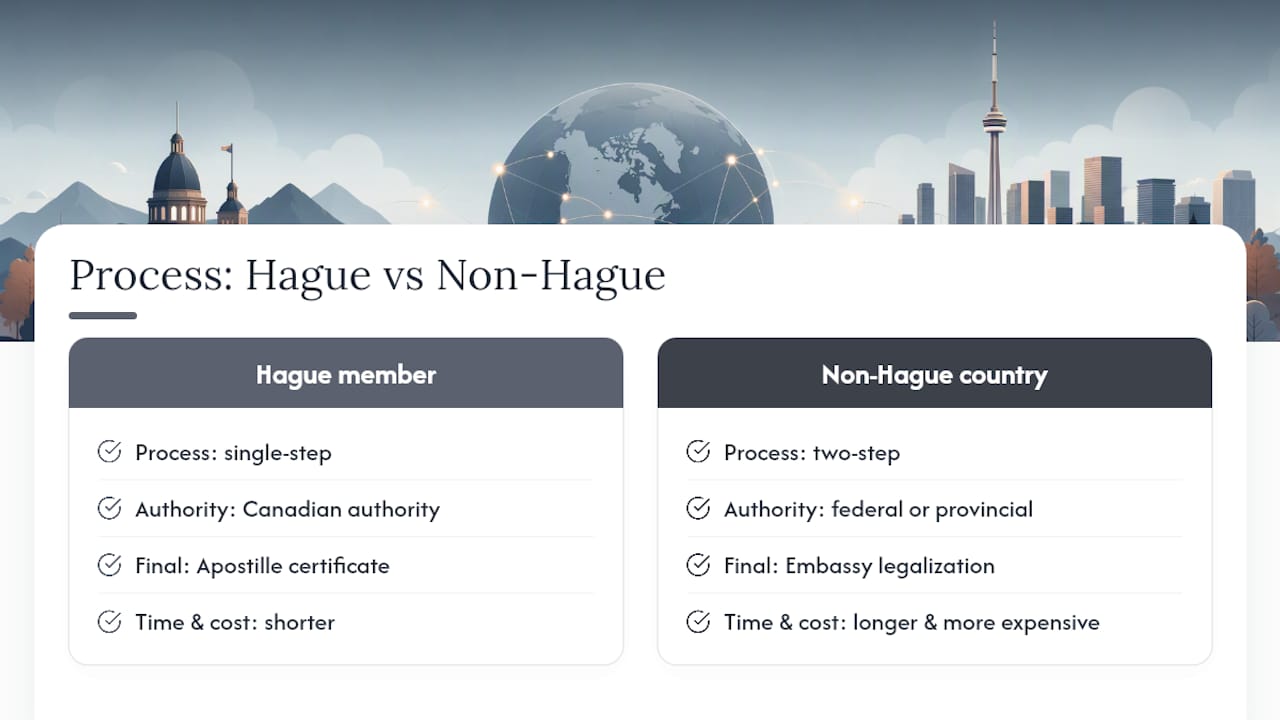
This distinction trips up students constantly. You might see a university checklist that says "apostille required" when the country in question isn't actually a Hague member, which means what they really need is legalization, not an apostille. Or you might assume every Canadian document now gets an apostille automatically, when the correct process still depends entirely on where the document is going.
The practical fix is simple: identify your destination country's Hague status before assuming which process applies. If it's a member country, you'll get an apostille. If it's not, you're looking at authentication plus embassy legalization, a longer and more expensive route. Global Affairs Canada's authentication pages list Hague member countries and clarify which process applies to yours.
Trusted Options for Canadian Document Authentication
Students generally have three routes for getting a Canadian document authenticated or apostilled: handling it directly through the government, going through a provincial ODS office, or using a private expediting service.
Global Affairs Canada is the federal route for documents issued by federal departments or from provinces without a designated authority. It's free of service markups but requires you to manage notarization, mailing, and tracking yourself.
Provincial competent authorities, such as Ontario's ODS, handle documents issued or notarized within that province. Ontario students dealing with provincially notarized affidavits or Ontario-issued records typically go through ODS rather than the federal office.
Private services like Speedy Apostille Services sit on top of both government channels. Rather than replacing Global Affairs Canada or ODS, a service like this manages the paperwork, confirms the correct authority, coordinates any notarization, and handles submission and return so students don't have to figure out the routing rules alone. This matters most for international students juggling coursework, application deadlines, and a system they've never navigated before.
Whichever route you choose, verify that the provider or office you're using actually has authority over your specific document type. A service that specializes in corporate records isn't necessarily the right fit for a birth certificate or an academic transcript, even if both fall under the same general apostille umbrella.
How to Confirm a Destination Country Will Accept Your Document
Getting an apostille doesn't guarantee acceptance. The receiving country can still impose its own internal rules on top of the apostille, and some ask for additional steps even after a valid Canadian apostille has been issued.
Before you submit anything, verify acceptance directly with the receiving party:
- Contact the university's international admissions office and ask specifically whether an apostille alone is sufficient, or whether they also require notarized translations or additional certifications.
- Contact the consulate or visa office processing your application and request their current document checklist in writing.
- Check the Hague Convention member list to confirm the destination country actually participates, since document requirements at non-member countries follow the older legalization process instead.
Requirements can also shift based on your specific circumstances. A student applying to a graduate program may face different document demands than one applying to an undergraduate program at the same institution. A visa office in one country may accept documents that a consulate in a neighboring country rejects for the same program.
Save every confirmation in writing, whether it's an email from an admissions officer or a screenshot of an official checklist. If a document gets questioned later in the process, that written confirmation is what protects you from having to restart the entire authentication process from scratch.
A Specialist's Take on the Biggest Student Mistake
The mistake I see repeatedly: students notarize a document before confirming which authority handles it, then discover it was notarized in the wrong province. One international student redid an entire notarization after learning her document needed Ontario ODS, not Global Affairs Canada. Confirm the authority first. Always.
How Speedy Apostille Services Helps Students Get It Right the First Time
Speedy Apostille Services exists for exactly the situation this article describes: a student with a tight deadline, an unfamiliar government process, and no room for a rejected submission. The service reviews your document, confirms whether Global Affairs Canada or a provincial ODS office like Ontario's applies, coordinates any required notarization, and handles secure submission and return.
Pricing is all-inclusive from the start. Government fees are built into the quote upfront, so there's no surprise add-on once your document is already in process. Typical turnaround runs 1 to 7 days depending on the service tier you choose, with faster options available for students facing an imminent application deadline. The company has processed numerous student and family documents with verified positive reviews and a strong reputation.
If you're staring down a foreign university's document checklist or a consulate's apostille request and aren't sure where to start, get a quote through Speedy Apostille Services and confirm your document's routing before you notarize anything.
Where to Verify Requirements and Submit Documents
Use these official sources to confirm your specific requirements rather than relying on secondhand advice:
- Global Affairs Canada authentication guidance — confirms which authority handles your document and how the apostille process works.
- Global Affairs Canada's update on authentication services — explains recent changes to routing and processing.
- IRCC's study permit document checklist — the actual list IRCC requires, with no apostille listed.
- Speedy Apostille Services' guide to apostilles for student visas — document lists tailored to student scenarios.
This article is general information, not a substitute for advice from a qualified lawyer. Consult a qualified legal professional about your own circumstances before acting on anything here.
Sources
- Authenticate your documents - Before you start (Step 1)
- Canada
- Improving authentication services in Canada
FAQ
Who can apostille documents in Canada?
Global Affairs Canada apostilles federally issued documents and those from provinces without their own designated authority. Provinces including Ontario, Alberta, British Columbia, Quebec, and Saskatchewan have their own competent authorities for documents issued or notarized there.
How long does an apostille take in Canada?
Processing time varies by authority and document volume, and government guidance recommends applying well ahead of any travel or study deadline. Services like Speedy Apostille Services offer expedited options with turnaround as fast as 1 to 7 days for students facing tighter timelines.
Does Global Affairs Canada provide apostille services for Canadian documents?
Yes. Since Canada joined the Hague Apostille Convention on January 11, 2024, Global Affairs Canada issues apostilles for documents it has authority over, accepted in more than 120 member countries.
How do I get documents apostilled in Ontario, Canada?
Documents issued or notarized in Ontario go through Ontario's Official Documents Services (ODS) rather than Global Affairs Canada. Confirm your document's origin before submitting, since sending it to the wrong authority is the most common cause of delay.
Do I need an apostille for my Canadian student visa application?
No. IRCC does not require apostilled documents for study permit applications, though a foreign university or consulate involved in your broader plans might request one for specific documents like transcripts or police checks.