
Single Status Affidavit: Canada Guide for 2026
Single Status Affidavit: Canada Guide for 2026 ! Woman reviewing single status affidavit documents at home A single status affidavit is a sworn legal document in which an individual formally declares they are unmarried and free to marry.

Single Status Affidavit: Canada Guide for 2026
A single status affidavit is a sworn legal document in which an individual formally declares they are unmarried and free to marry. Countries like Canada and the United States lack centralized marital status registries, which is exactly why foreign governments require this sworn statement before recognizing an international marriage. Without it, a foreign civil registrar has no official record to consult. The document fills that gap directly. Canadians planning to marry abroad, apply for a spouse visa, or complete a religious ceremony in another country will almost always need one.
What does a single status affidavit contain?
The affidavit of single status is a formal promise, comparable to what legal practitioners call a Statutory Declaration or Letter of Freedom. Foreign civil registries treat it with the same weight as a court oath. The document must be complete and accurate, because false statements can lead to perjury charges.
A standard affidavit includes:
- Full legal name, date of birth, and citizenship — exactly as they appear on your passport or government-issued ID
- A formal declaration of unmarried status — confirming no current legal marriage exists
- Prior marriage details, if applicable — including divorce decree references or a deceased spouse's death certificate
- Intended spouse information — some destination countries require the name and nationality of your future partner
- Notary signature and seal — the document has no legal standing without this
Pro Tip: Match every name and date on your affidavit exactly to your passport. A single discrepancy, such as a middle name appearing on one document but not the other, is enough for a foreign registrar to reject the entire file.
The level of detail required varies by destination country. Some foreign authorities accept a simple one-page declaration. Others require a multi-page affidavit with supporting exhibits attached. Confirming the exact format with the destination country's embassy before drafting saves significant time.
How to obtain and notarize your affidavit
Preparing a single status declaration follows a clear sequence. Skipping any step typically results in rejection abroad.
- Draft the affidavit. Write the document yourself or use a legal template. No universal template exists, so check whether the destination country's embassy provides a required format. If it does, use that format exactly.
- Gather your supporting documents. Bring a valid government-issued photo ID, your passport, and any prior divorce decrees or death certificates if you were previously married.
- Book a notary public or commissioner of oaths. In Canada, both can witness and certify the affidavit. Many law offices, banks, and dedicated notary services offer this.
- Sign in the notary's presence. Do not sign the document beforehand. The notary must witness your signature and administer the oath.
- Receive the notary's seal and signature. The notary certifies your identity and the authenticity of your signature. Nothing more.
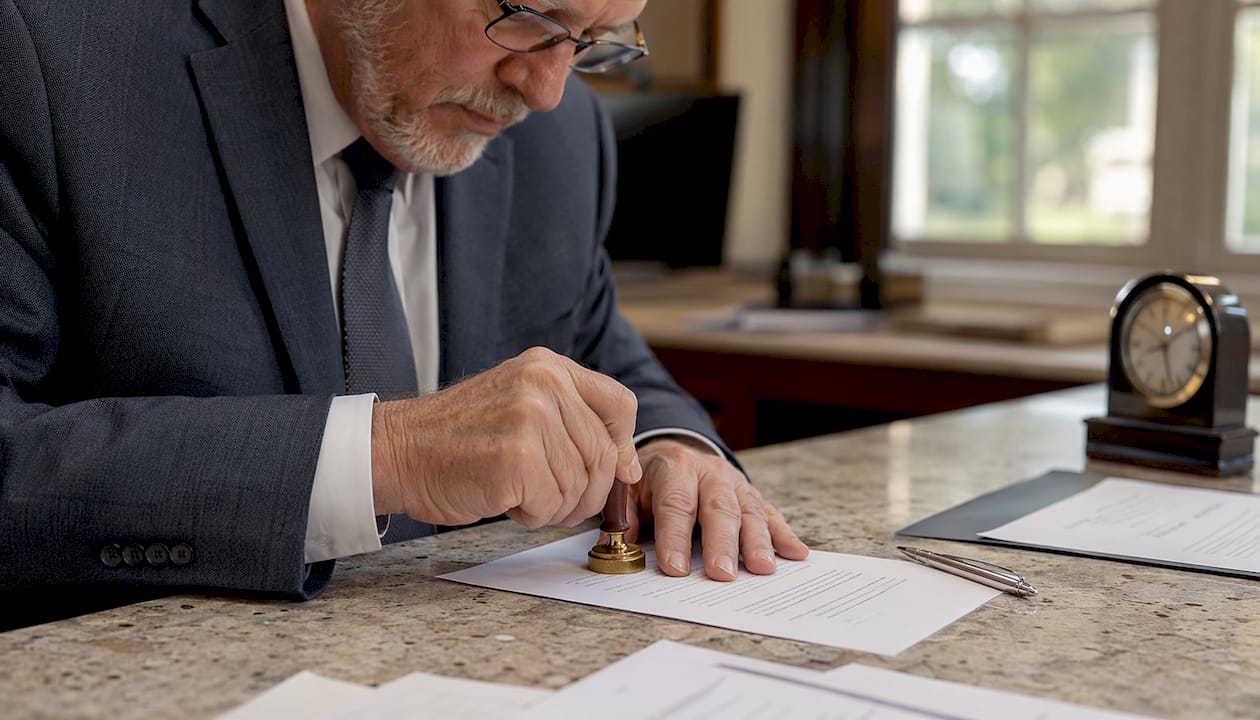
The notary's role is identity verification and witnessing the signature, not validating the truthfulness of the affidavit contents. The declarant assumes full legal responsibility for every statement made. That distinction matters. Many people assume a notarized document is "verified" by an official. It is not. You are the one making the sworn statement under penalty of law.
Pro Tip: Ask the notary to use a wet ink seal rather than a stamp-only certification. Several countries, including Italy and Spain, reject affidavits that lack a raised or wet seal on the notarized page.
How is an affidavit authenticated for international use?
A notarized affidavit alone is rarely sufficient for foreign use. Authentication confirms the notary's authority to a foreign government. The method depends entirely on whether the destination country is a member of the Hague Convention.
Hague Convention countries (over 120 nations, including France, Italy, Mexico, and Australia) accept an apostille. An apostille is a standardized certificate attached to the document by a designated government authority. In Canada, Global Affairs Canada issues apostilles for federal documents, while provincial authorities handle provincially issued documents.
Non-Hague countries require consular legalization instead. This is a multi-step process:
- Notarization by a notary public
- Certification by the provincial government (varies by province)
- Authentication by Global Affairs Canada
- Legalization by the destination country's embassy or consulate in Canada
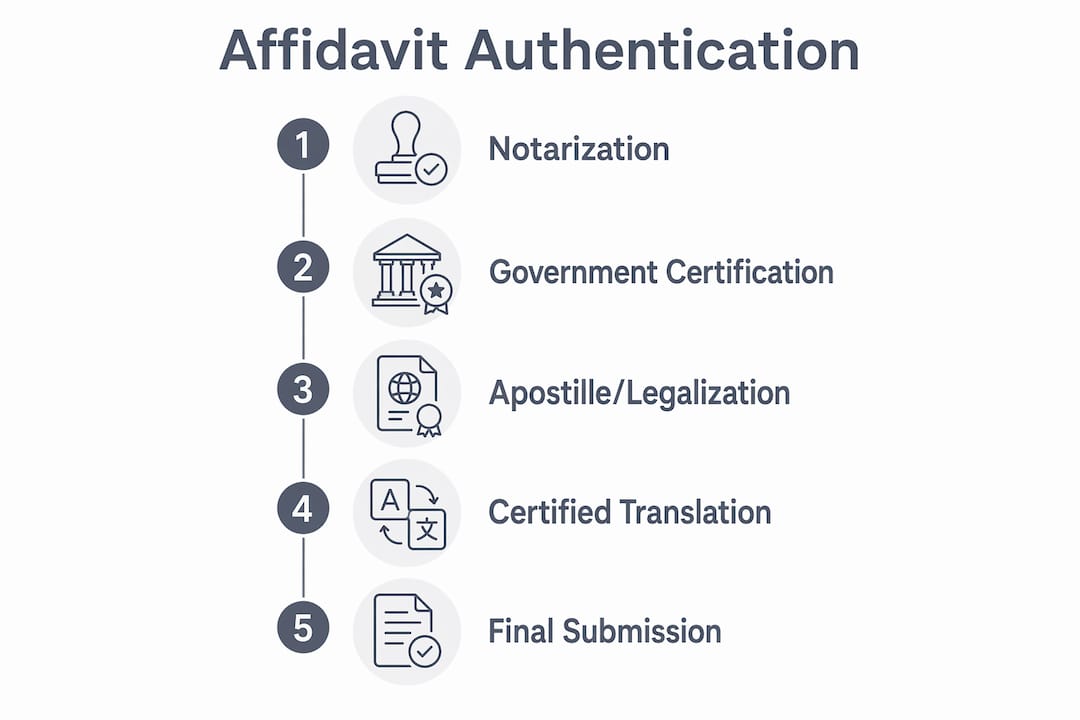
The standard validation process moves from notarization through government certification to apostille or legalization. Each step must be completed in order. Skipping the provincial certification step, for example, will cause the apostille application to be rejected.
Timing is critical. Affidavits are generally valid for 3–6 months because marital status can change. Issuing an apostille too early creates a real risk of the document expiring before the marriage date. Coordinate the apostille issuance to fall within the validity window of your ceremony date.
Most non-English-speaking countries also require certified translations. Certified translations often require notarization themselves to be accepted by foreign authorities. Budget time for this step separately.
For Canadians specifically, understanding which documents are required for your destination country before you begin the apostille process prevents costly restarts.
Country-specific requirements and common pitfalls
Foreign authorities do not apply a single standard. Requirements shift significantly from one country to the next, and arriving unprepared is the most common reason affidavits get rejected.
Canada does not issue a national single status certificate. Instead, Canada relies on a combination of sworn affidavits, Global Affairs statements, and provincial marriage searches. Each document serves a different proof function. Foreign registrars often require all three together.
The government-issued document Canadians use is called the Statement in Lieu of a Certificate of Non-Impediment to Marriage. This statement explains to foreign authorities why Canada cannot produce a centralized marital status certificate. It does not confirm your personal marital status. That is the job of your sworn affidavit. Both documents are typically required together to satisfy foreign marriage offices.
Common pitfalls include:
- Using a generic template. Some countries mandate specific wording and formats. A generic affidavit drafted without checking the destination country's requirements is frequently rejected.
- Missing supporting documents. Foreign countries often demand apostilled divorce decrees or death certificates if you were previously married. These must be authenticated separately.
- Relying on one document. Arriving with only the affidavit risks rejection. The non-impediment statement and, in some cases, a marriage search letter from the provincial vital statistics office are also required.
- Not verifying requirements in advance. Contact the destination country's embassy or marriage authority before preparing any documents. Requirements change, and embassy staff provide the most current guidance.
A marriage search letter, sometimes called a marriage registration search, is a provincial record check confirming no marriage is registered in your name. Some countries accept this as supplementary proof. Others require it as a mandatory part of the file. Check which category your destination falls into.
A religious ceremony alone does not satisfy civil marriage requirements in most countries. Understanding why a religious ceremony is insufficient for a visa helps clarify why the full document package matters for immigration purposes as well.
Key Takeaways
A single status affidavit is a sworn declaration of unmarried status, and Canadian applicants almost always need it paired with a Statement in Lieu of a Certificate of Non-Impediment to Marriage and supporting provincial records to satisfy foreign authorities.
| Point | Details |
|---|---|
| Affidavit definition | A notarized sworn statement declaring you are legally single and free to marry. |
| Canada has no national registry | Canadians must combine a sworn affidavit with the Statement in Lieu of a Certificate of Non-Impediment. |
| Authentication method varies | Hague countries require an apostille; non-Hague countries require consular legalization. |
| Validity window is limited | Most affidavits are valid for 3–6 months, so time apostille issuance close to your marriage date. |
| Verify before you draft | Contact the destination country's embassy to confirm required formats and supporting documents. |
What I've learned from watching affidavit files get rejected
Most rejections are not caused by fraud or dishonesty. They are caused by preparation errors that were entirely avoidable. The single most common mistake is treating the affidavit as the only document needed. Foreign registrars in countries like Italy, the Philippines, and Mexico operate with detailed checklists. If one item is missing or formatted incorrectly, the entire file comes back.
The second mistake I see repeatedly is timing. People complete the notarization and apostille months before the wedding, then discover the document has expired by the time they arrive at the foreign registry. The 3–6 month validity window is not a suggestion. It is a hard cutoff. Plan backward from your ceremony date and work out exactly when to sign and authenticate.
The third issue is the assumption that a notary has verified your marital status. The notary has done nothing of the sort. You have made a sworn statement. You are legally responsible for its accuracy. If you were previously married, include the divorce decree or death certificate in the file. Do not assume the affidavit alone covers it.
My practical advice: call the destination country's consulate in Canada before you draft a single word. Ask for their current document checklist in writing. Then build your file from that list, not from a general template you found online. That one phone call eliminates most of the risk.
— Ken
Speedyapostilleservices can handle your apostille authentication
Speedyapostilleservices, based in Toronto, processes apostilles for Canadian documents with a typical turnaround of 2–3 days. The service covers notarized affidavits, supporting documents like divorce decrees, and related certificates required for international marriage or visa applications.
All-in pricing includes government fees upfront, so there are no unexpected costs at the end of the process. Speedyapostilleservices has over 1,000 verified reviews and a 5.0 rating. The process is straightforward: submit your documents through the online portal, and the team handles document review, authentication, and secure return. For Canadians preparing a single status affidavit package for use in any of the 120+ Hague Convention countries, Speedyapostilleservices provides a direct path to compliance.
FAQ
What is a single status affidavit?
A single status affidavit is a sworn, notarized document in which a person declares they are legally unmarried and free to marry. It is required by foreign governments because countries like Canada do not maintain a centralized national marital status registry.
Where can I get a single status certificate in Canada?
Canada does not issue a single status certificate. Canadians use a combination of a personal sworn affidavit, the Statement in Lieu of a Certificate of Non-Impediment to Marriage from Global Affairs Canada, and a provincial marriage search letter to satisfy foreign authorities.
How long is a single status affidavit valid?
Most foreign authorities accept affidavits issued within the past 3–6 months. Issuing the apostille too far in advance of your marriage date risks the document expiring before it is used.
Does a notary verify my marital status?
No. A notary public verifies your identity and witnesses your signature only. The legal responsibility for the truthfulness of every statement in the affidavit rests entirely with the person signing it.
Do I need an apostille on my single status affidavit?
Yes, if your destination country is a member of the Hague Convention. For non-Hague countries, consular legalization is required instead. The authentication method depends entirely on the destination country's treaty status.