
Real Estate Apostille Canada: A Guide for Property Buyers
Real Estate Apostille Canada: A Guide for Property Buyers ! Notary stamping real estate document Yes, Canadian real estate documents can receive an apostille, as long as they meet Canada's authentication rules.

Real Estate Apostille Canada: A Guide for Property Buyers
Yes, Canadian real estate documents can receive an apostille, as long as they meet Canada's authentication rules. The apostille is issued as an allonge, a certificate attached to the document, and it confirms that a signature or seal is genuine. It does not confirm that the underlying real estate transaction is legally valid.
Before you submit anything, take these steps:
- Confirm the destination country belongs to the Hague Apostille Convention.
- Identify the competent authority for your document: a provincial office or Global Affairs Canada.
- Get the document properly notarized or witnessed before submission.
- Consider a service like Speedy Apostille Services if your timeline is tight or your paperwork is complex.
Key Takeaways
Canadian real estate documents qualify for an apostille when properly notarized and routed to the correct provincial or federal authority, but the apostille verifies signatures only, not the transaction's legal validity.
| Point | Details |
|---|---|
| Apostille confirms signatures, not legality | An apostille verifies a notary's or official's signature; it does not validate the property transaction itself. |
| Routing depends on notarization location | Provincial competent authorities or Global Affairs Canada process apostilles based on where the document was signed. |
| Power of attorney causes most rejections | POA wording must match the destination land registry's expected terms, witnesses, and signing order. |
| Wet-ink signatures often required | Some provincial authorities reject remote online notarization for apostille purposes. |
| Speedy Apostille Services offers document review | The provider checks eligibility, routes documents correctly, and bundles government fees with a 2 to 3 day turnaround. |
Table of Contents
- What Is the Process for Getting a Real Estate Apostille in Canada?
- How Long Does It Take and What Does It Cost?
- What Mistakes Trip Up Real Estate Apostille Applications?
- How Do You Know If Your Document Qualifies for an Apostille?
- What Changed With Canada's 2026 Hague Convention Accession?
- Where Do You Get an Apostille for Real Estate Documents in Canada?
- What Notarization Do Real Estate Documents Need Before an Apostille?
- Do Provincial Rules Affect Apostilling Real Estate Documents?
- How Do You Avoid Rejection When Preparing Real Estate Documents?
- Real Estate Apostilles for Canadian Property Buyers
- How Speedy Apostille Services Handles Real Estate Document Apostilles
- Useful Resources for Real Estate Apostilles
- Sources
- FAQ
What Is the Process for Getting a Real Estate Apostille in Canada?
The process runs in four stages: preparation, notarization, submission, and issuance. First, the document needs to exist in its final, signed form. A power of attorney, deed, or affidavit has to carry an original signature. Photocopies without a notary's fresh certification are a common rejection point.
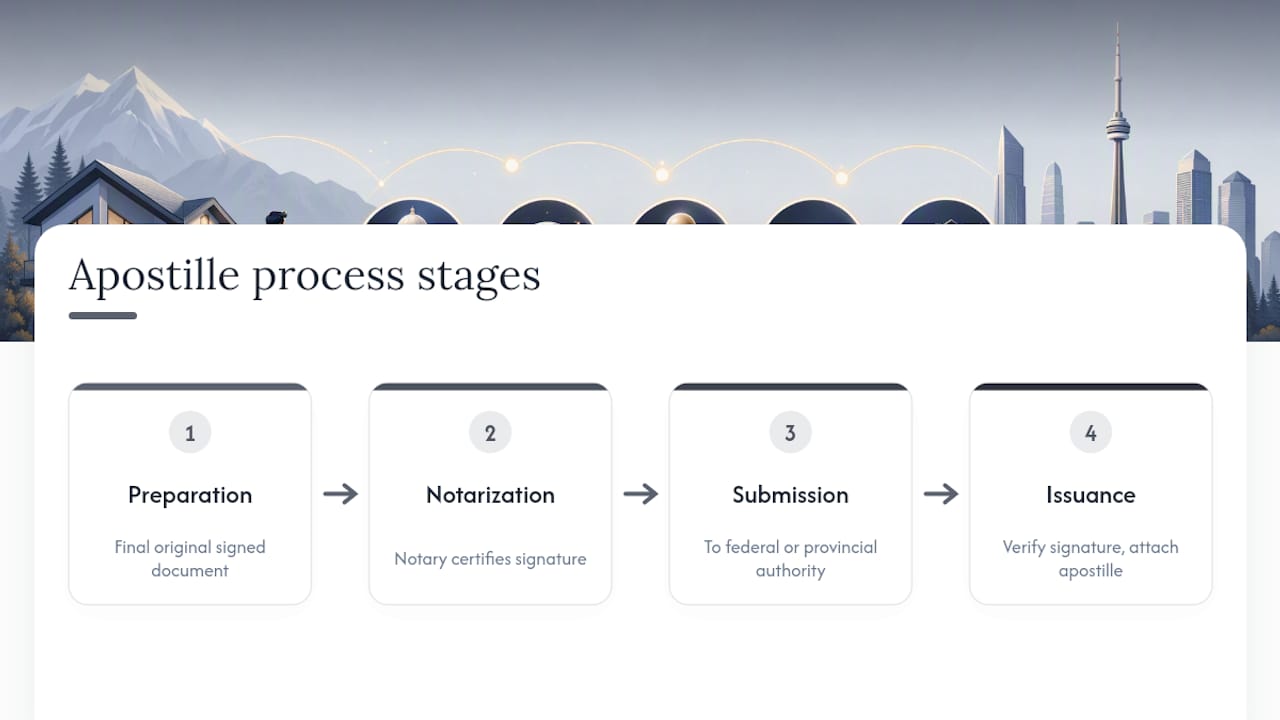
Next comes notarization. A notary public or lawyer certifies the signature, often adding a stamp and a statement confirming the signer's identity. This step is separate from the apostille itself but is required before the apostille can be issued.
Submission depends on where the document was signed or notarized. Canada splits this responsibility between Global Affairs Canada and designated provincial competent authorities. Federal documents and paperwork from certain provinces go to Global Affairs Canada. Other provinces process their own apostilles for documents issued or notarized within their borders.
Once submitted, the authority verifies the notary's or official's signature against its records, then attaches the apostille allonge. Turnaround varies by office and submission method, which we cover in the next section.
Getting this sequence wrong, submitting to the wrong office, skipping notarization, or using an uncertified copy, is the single most common reason documents get sent back for correction. Check our step-by-step 2026 guide for a fuller walkthrough of each stage.
How Long Does It Take and What Does It Cost?
Timing varies more than most people expect. Some provincial offices process apostilles for real estate documents in a matter of days. Global Affairs Canada can take a significantly longer processing time, depending on submission volume and whether you mail in the document or use expedited courier options.
For a real estate closing with a firm deadline, that spread matters. A deed that needs signing, notarizing, and apostilling within two weeks leaves little room for a mailed submission that sits in a queue for three or four weeks at a federal office.
Costs come in layers. There's the notary's fee for certifying the signature, which varies by province and by the complexity of the document. Then there's the government fee for the apostille itself, charged per document by the issuing authority. On top of that, courier or expedited handling adds its own charge if you need faster turnaround than standard mail-in processing offers.
Bundled, all-in pricing models, where government fees are included upfront rather than added as surprises later, tend to work better for real estate transactions specifically because closings run on fixed dates. Knowing the full cost before you submit lets you budget against a closing date instead of guessing at fees mid-process.
If your destination country is not a Hague Convention member, budget differently. Apostilles don't apply there. You'll need full consular legalization, which usually costs more and takes longer than an apostille alone.
What Mistakes Trip Up Real Estate Apostille Applications?
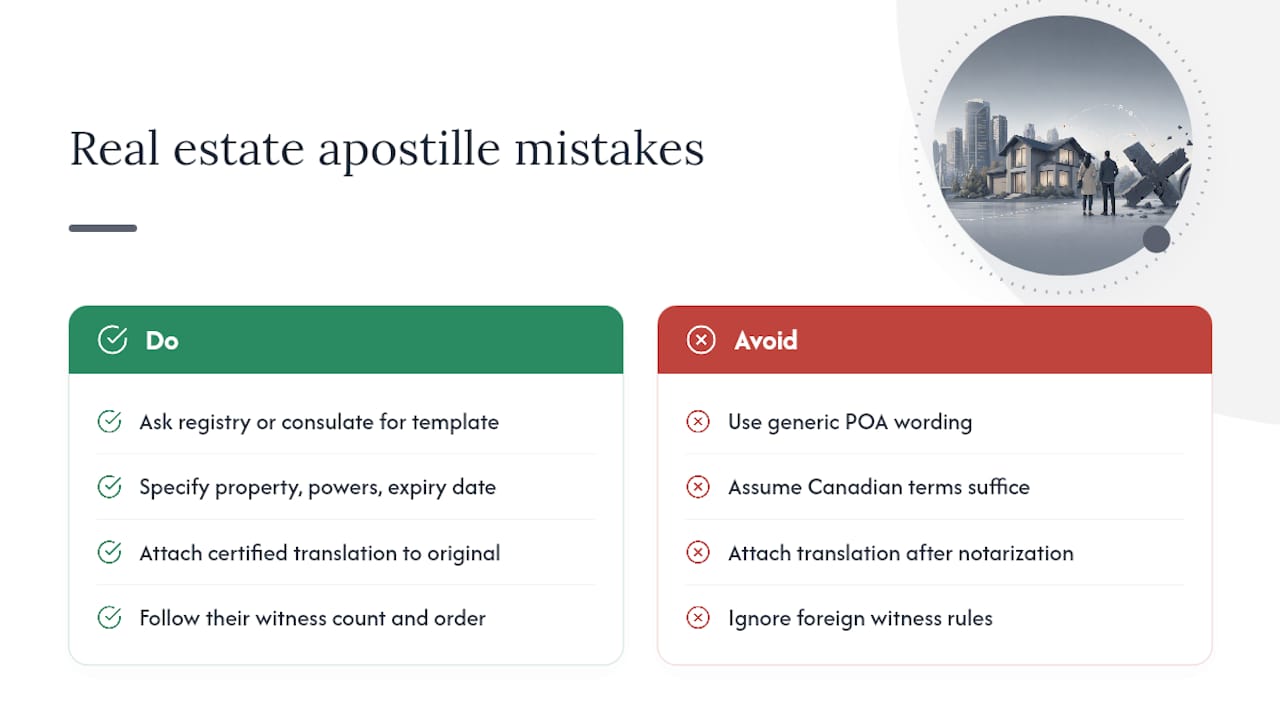
Power of attorney documents cause more rejections than any other real estate paperwork. A POA drafted for use in Canada often uses wording a foreign land registry doesn't recognize. Terms like "attorney" or "grantor" translate differently across legal systems, and some countries require specific language identifying the exact property, the powers granted, and an expiry date.
Witness requirements trip people up too. Canadian notarization standards don't always match what a receiving country's registry expects. Some jurisdictions want two witnesses in addition to the notary. Others require the document to be signed in a specific order, with the notary as the final signature.
Translation is another blind spot. If the destination country doesn't operate in English or French, you likely need a certified translation attached to the apostilled original, not translated separately after the fact. Attaching translation as an afterthought instead of building it into the notarization sequence causes delays that catch people off guard.
Terminology matters more in real estate than in most other document types. A "deed" in Ontario isn't structured the same way as a foreign land registry's transfer instrument. Naming conventions for property descriptions, legal versus civic addresses, and registration numbers should match what the receiving registry actually asks for, not just what a Canadian title document happens to say.
Pro Tip: Ask the foreign land registry or its consulate for a sample-accepted document before you draft your power of attorney. Matching their template avoids a second round of notarization.
How Do You Know If Your Document Qualifies for an Apostille?
Not every piece of paper related to a property sale needs, or qualifies for, an apostille. Public documents, ones issued by a government office, a court, or a notary acting under statutory authority, generally qualify. That covers notarized deeds, certified powers of attorney, sworn affidavits, and corporate resolutions authorizing a real estate transaction on behalf of a company.
Private documents that haven't been notarized don't qualify on their own. A signed but unnotarized agreement of purchase and sale, for instance, needs to go through notarization first before an apostille can attach to it.
The safest check is to look at who issued the document and in what capacity. If a notary public, commissioner of oaths, or government registrar signed it in an official capacity, it's likely eligible once that signature is on file with the relevant competent authority. If the signature belongs to a private individual with no official capacity, notarization has to happen first.
Corporate authorizations related to a property purchase, board resolutions, certificates of incumbency, need the same treatment: a corporate officer's signature notarized by a lawyer or notary, then submitted for apostille through the office responsible for that province.
When in doubt, a quick document review from an apostille specialist before submission catches eligibility problems early, rather than after a rejected application costs you a week.
What Changed With Canada's 2026 Hague Convention Accession?
Before Canada joined the Hague Apostille Convention, authenticating a Canadian document for use abroad meant a two-step chain: authentication by Global Affairs Canada, followed by legalization at the destination country's embassy or consulate in Canada. That process could take weeks and required coordinating with a foreign consulate's own hours and fees.
Since accession, documents headed to any of the a large number of countries that are members of the Hague Apostille Convention skip the consular step entirely. One apostille, issued by the correct Canadian competent authority, is enough.
The practical difference for real estate transactions is significant. A power of attorney for a property purchase in a Hague member country used to require a trip or courier exchange with that country's consulate on top of federal authentication. Now it requires one submission to the right Canadian office.
The catch: the old consular legalization route hasn't disappeared. It still applies for documents headed to non-Hague countries. Readers dealing with a destination country outside the convention need to plan for the longer, older process, not the streamlined one.
Where Do You Get an Apostille for Real Estate Documents in Canada?
Where you send a real estate document depends on where it was signed or notarized, not where you live. Several provinces are designated competent authorities and process apostilles for documents originating or notarized within their own borders. Others route through Global Affairs Canada instead.
Ontario, British Columbia, Quebec, and other provinces each maintain their own processing office for documents notarized inside that province. Quebec in particular has its own notarial system with civil law notaries, which changes both the notarization step and, in some cases, the office a document routes through. Our Quebec-specific process guide covers that distinction in more detail.
Federal documents, RCMP background checks, federal corporate records, and documents notarized in provinces without their own designated authority go to Global Affairs Canada's authentication office instead.
This split confuses more applicants than any other part of the process. Assuming a single federal office handles every apostille is the most common planning mistake we see, and it causes automatic rejection when a document lands at the wrong desk. Confirming the correct office before you notarize, not after, saves a full resubmission cycle.
What Notarization Do Real Estate Documents Need Before an Apostille?
Real estate documents carry a higher notarization bar than routine paperwork because they authorize legal transfers of property or grant someone the power to act on your behalf. A power of attorney for a property sale needs the notary to confirm your identity, witness your signature in person, and often add a statement describing the specific transaction the POA covers.
Deeds and transfer documents typically require notarization by a lawyer or notary licensed in the province where the property or the signer is located. A generic notarization, one that just confirms "a signature was made in my presence," sometimes isn't enough for foreign registries that expect language matching their own legal standards.
Here's a detail that surprises a lot of readers: some competent authorities require hard-copy documents with original wet-ink signatures. Documents notarized purely through remote online notarization aren't accepted for apostille purposes in every province. If your notary offered a video call and a digital stamp, confirm with the receiving authority that this format qualifies before you rely on it for a property closing.
Affidavits supporting a real estate transaction, sworn statements about marital status or residency, for example, need the same in-person, wet-signature treatment. Skipping this step because a document "looks official enough" is exactly how applications get bounced back.
Do Provincial Rules Affect Apostilling Real Estate Documents?
Provincial rules shape almost every stage of this process, from who can notarize your document to which office issues the apostille. This is the part of Canadian apostille work that trips up people moving between provinces or working with a lawyer in one province while property paperwork gets signed in another.
Quebec's civil law system uses notaries with broader authority than common law notaries in other provinces, which changes how a real estate power of attorney gets drafted and certified. A document notarized in Quebec often routes differently than an identical document notarized in Alberta or Nova Scotia.
Some provinces have designated their own competent authority office for apostilles; others rely on Global Affairs Canada for documents notarized within their jurisdiction. That means two people buying property abroad, one in a designated province and one in a province without its own office, follow different submission paths for the exact same type of document.
Fee structures also vary provincially, since notarization costs are set by individual notaries or lawyers rather than a fixed national rate. Budgeting for a real estate apostille means checking the notarization cost in your specific province first, then adding the apostille fee charged by whichever authority handles your submission.
How Do You Avoid Rejection When Preparing Real Estate Documents?
Most rejections trace back to a handful of preventable errors. Get these right and your application moves through cleanly.
- Submit original documents with wet-ink signatures, not photocopies, unless the receiving authority explicitly accepts certified copies.
- Confirm your notary's signature is on file with the competent authority you're submitting to; an unregistered notary's stamp is grounds for rejection.
- Match the document's wording to what the destination land registry expects, especially for powers of attorney and property descriptions.
- Send the document to the correct office the first time. A deed notarized in one province but mailed to the wrong authority gets bounced, not forwarded.
- Attach certified translations where the destination country doesn't operate in English or French, rather than adding translation as an afterthought.
Building this checklist into your preparation, before you notarize anything, cuts out the back-and-forth that turns a two-week timeline into a two-month one.
Real Estate Apostilles for Canadian Property Buyers
The gap between how people expect this process to work and how it actually works comes down to one assumption: that "getting an apostille" is a single government errand. It isn't. It's a notarization decision, a jurisdiction decision, and a wording decision, made in that order, and getting any one of them wrong resets the clock.
Conventional advice treats the apostille step as the hard part. It's usually the easiest part, once a properly notarized, correctly worded document reaches the right office. The real risk sits earlier, in a power of attorney drafted with Canadian phrasing a foreign registry won't recognize, or a notarization done remotely when the receiving authority wanted wet ink.
If you're buying property abroad, prioritize the drafting and notarization stage over the apostille stage. Talk to someone familiar with your destination country's registry requirements before you sign anything. A well-prepared document clears an apostille office in days. A poorly worded one bounces back no matter how fast the office processes it.
How Speedy Apostille Services Handles Real Estate Document Apostilles
Real estate paperwork punishes small mistakes: a missing witness, a POA clause a foreign registry won't accept, a document routed to the wrong provincial office. Speedy Apostille Services reviews each document for eligibility before submission, catching the wording and notarization gaps that cause rejections at the source rather than after a wasted week.

The service handles the routing decision for you, sending each document to the correct provincial competent authority or to Global Affairs Canada based on where it was signed or notarized. Pricing is bundled upfront, government fees included, so a property closing on a fixed date isn't derailed by a fee you didn't see coming. Typical turnaround runs 2 to 3 days, with secure courier handling for the physical document exchange that real estate apostilles require.
For anyone based in the Toronto area, the Toronto service page covers local drop-off and courier options directly. If your closing timeline is tight, or your power of attorney involves cross-border wording you're not confident about, get a document review started before you notarize anything, not after.
Useful Resources for Real Estate Apostilles
- Check Hague Convention membership for your destination country.
- Read official Government of Canada authentication guidance before submitting.
- Review Quebec-specific notarization steps if your document originated there.
- Start a document review with Speedy Apostille Services in Toronto.
This article is general information, not a substitute for advice from a qualified lawyer. Consult a qualified legal professional about your own circumstances before acting on anything here.
Sources
FAQ
Can You Apostille a Power of Attorney for Property Abroad?
Yes, once it's notarized by a lawyer or notary and the notary's signature is on file with the competent authority, a power of attorney for a real estate transaction can receive an apostille.
Does an Apostille Prove a Property Sale Is Legally Valid?
No. An apostille only confirms that a signature or seal on the document is genuine; it doesn't assess the transaction's legal standing, which still requires separate legal review.
What Happens if the Destination Country Isn't a Hague Member?
The document needs full consular legalization instead of an apostille, a longer process involving both Global Affairs Canada authentication and the destination country's embassy.
How Fast Can Speedy Apostille Services Process a Real Estate Document?
Speedy Apostille Services offers a quick turnaround for eligible documents, with document review and secure handling included in the bundled price.
Do All Provinces Use the Same Apostille Office?
No. Some provinces have their own designated competent authority for documents notarized within their borders, while others route through Global Affairs Canada.