
RCMP Apostille in Canada: Plan 3–6 Weeks, Fees and Notarization
RCMP Apostille in Canada: Plan 3–6 Weeks, Fees and Notarization ! Hand stamping RCMP document envelope Yes, you can apostille an RCMP certified criminal record check for use in any Hague Convention country, a process available since Canada joined the convention on January 11, 2024.
RCMP Apostille in Canada: Plan 3–6 Weeks, Fees and Notarization
Yes, you can apostille an RCMP certified criminal record check for use in any Hague Convention country, a process available since Canada joined the convention on January 11, 2024. The check must be fingerprint-based and submitted as an original document. Confirm your province's rules, then send the certificate to the correct apostille authority, either your provincial competent authority or Global Affairs Canada.
TL;DR:
- The RCMP fingerprint-based criminal record check must be original, recent, and processed through the RCMP's CCRTIS system for international apostille use.
- Most provinces have dedicated apostille authorities; if not, applications are handled by Global Affairs Canada, and routing errors can cause weeks of delays.
- Submitting photocopies, ordering a name-based check instead of fingerprint-based, or mailing documents to the wrong office are common mistakes leading to rejection or delays.
- Using a professional apostille service is recommended for urgent deadlines, complex routing, or if you want a reliable two- to three-day turnaround with all fees included.
Table of Contents
- What Document Does RCMP Apostille Require?
- How Do You Order an RCMP Certified Criminal Record Check?
- Which Office Issues Your Apostille: Province or Federal?
- What Will the Full Process Cost and How Long Will It Take?
- What Mistakes Cause RCMP Apostille Delays or Rejections?
- When Does a Professional Apostille Service Make Sense?
- What the Post-2026 Process Actually Rewards
- Start Your RCMP Apostille Request
- Where to Verify Current Rules and Fees
- Sources
- FAQ
What Document Does RCMP Apostille Require?
An RCMP apostille only works on one specific document: the certified criminal record check produced through the RCMP's Civilian Criminal History Check system, known as CCRTIS. This is a fingerprint-based check, not the quicker name-based search many people order for local employment or volunteer screening. Fingerprint checks confirm identity through biometric data, which is why they're the accepted standard for international use.
It's worth understanding what an apostille actually does here. It doesn't verify that your record is accurate or complete. It certifies the signature and seal on the document, confirming that the RCMP official who signed it had the authority to do so. That distinction trips up a lot of applicants who assume the apostille is somehow vouching for the content itself.
Before you request fingerprinting, run through this checklist:
- Fingerprints must be captured by a local police service or an RCMP-accredited private fingerprinting company.
- Bring government-issued photo ID to your fingerprinting appointment.
- Keep the original physical certificate once it arrives. Copies almost always get rejected.
- Check your destination country's requirements for how recent the check needs to be, as these vary by country.
How Do You Order an RCMP Certified Criminal Record Check?
Getting the right document in hand takes a few sequential steps, and skipping ahead usually costs you time later.
- Book fingerprinting. Visit a local police service or a private company accredited to submit prints electronically to the RCMP. You'll need valid photo ID and, in most cases, a completed consent form.
- Submit electronically. The fingerprinting agency transmits your prints directly to RCMP's CCRTIS system along with your applicant information.
- Wait for processing. If your fingerprints don't match any existing criminal record, results typically return within three business days. If there's a potential match requiring manual review, processing can stretch much longer, sometimes into months.
- Receive your original certificate. RCMP or the fingerprinting agency mails or couriers the certified document to you.
- Protect the original for apostille submission. Don't laminate it, don't photocopy it in place of the original, and don't let it sit in a folder with other paperwork that might get separated.
Pro Tip: Order your fingerprint check well before you need the apostille. Even a clean, no-match result takes three business days at RCMP, and that clock doesn't include mailing time to and from the fingerprinting agency.
Fees at this stage vary by fingerprinting provider, but expect a service charge on top of any RCMP processing cost. Budget extra calendar time if you're ordering during a period when manual reviews are running behind, which happens more often than most applicants expect.
Which Office Issues Your Apostille: Province or Federal?
This is where a lot of RCMP apostille applications go sideways. Canada doesn't have one single apostille office. Instead, some provinces operate their own competent authority, while others route everything through Global Affairs Canada.
Ontario runs its own service through the Official Documents Services (ODS). Alberta has a dedicated apostille process as well. If your RCMP check was issued or notarized within one of these provinces, you'll typically submit it there rather than to the federal office. Provinces without their own competent authority send everything to Global Affairs Canada instead.
Notarization adds another layer of complexity. Provincial routes often require a local notary public to notarize the original RCMP certificate before it can receive an apostille. Federal submissions handled directly through Global Affairs Canada may accept an RCMP HQ issued check without notarization in some cases, though this isn't guaranteed across every situation. RCMP checks issued centrally from Ottawa sometimes bypass notarization at the federal level, while provincial offices frequently still want that local notary's stamp regardless of where the check originated.
Before mailing anything, confirm these four things:
- Was your RCMP check issued by RCMP headquarters or a local police service?
- Does your province operate its own apostille authority, or does it default to Global Affairs Canada?
- Does your chosen route require notarization, and if so, has that been completed?
- Have you included the correct cover form, payment, and return postage or courier label?
Canada's shift to the apostille system on January 11, 2024 eliminated the older two-step authentication and legalization process for Hague member countries, which used to require sign-off from both Global Affairs Canada and the destination country's embassy. That change alone cut weeks off many applications.
What Will the Full Process Cost and How Long Will It Take?
Budgeting for an RCMP apostille means adding up several separate line items, not just one government fee.
- RCMP fingerprint check processing: roughly $25 CAD, plus whatever your fingerprinting agency charges for capturing and submitting prints.
- Notary fees: costs vary by notary and province, and this step is skippable only when your specific route doesn't require it.
- Provincial apostille fee: Alberta charges $25 per document, with other provinces setting their own rates.
- Courier or mailing costs: tracked shipping both to and from the apostille office adds up quickly if you're sending documents twice.
Timeline-wise, expect RCMP processing to take three business days for a clean no-match result, though manual reviews can extend that well beyond a month. Alberta's apostille service estimates seven to ten business days for processing, and Ontario's ODS runs on a similar multi-week schedule. Add mailing time on both ends. Realistically, plan for three to six weeks total unless you're using an expedited option, a private courier service, or a provincial rush process where one's available.
What Mistakes Cause RCMP Apostille Delays or Rejections?
Most rejections come down to a handful of repeat offenders. Submitting a photocopy instead of the original certificate is the single most common error. Ordering a name-based criminal record check instead of the fingerprint-based CCRTIS version is a close second, and it's a bigger problem than people realize because some destination countries specifically require fingerprint verification and won't accept anything else.
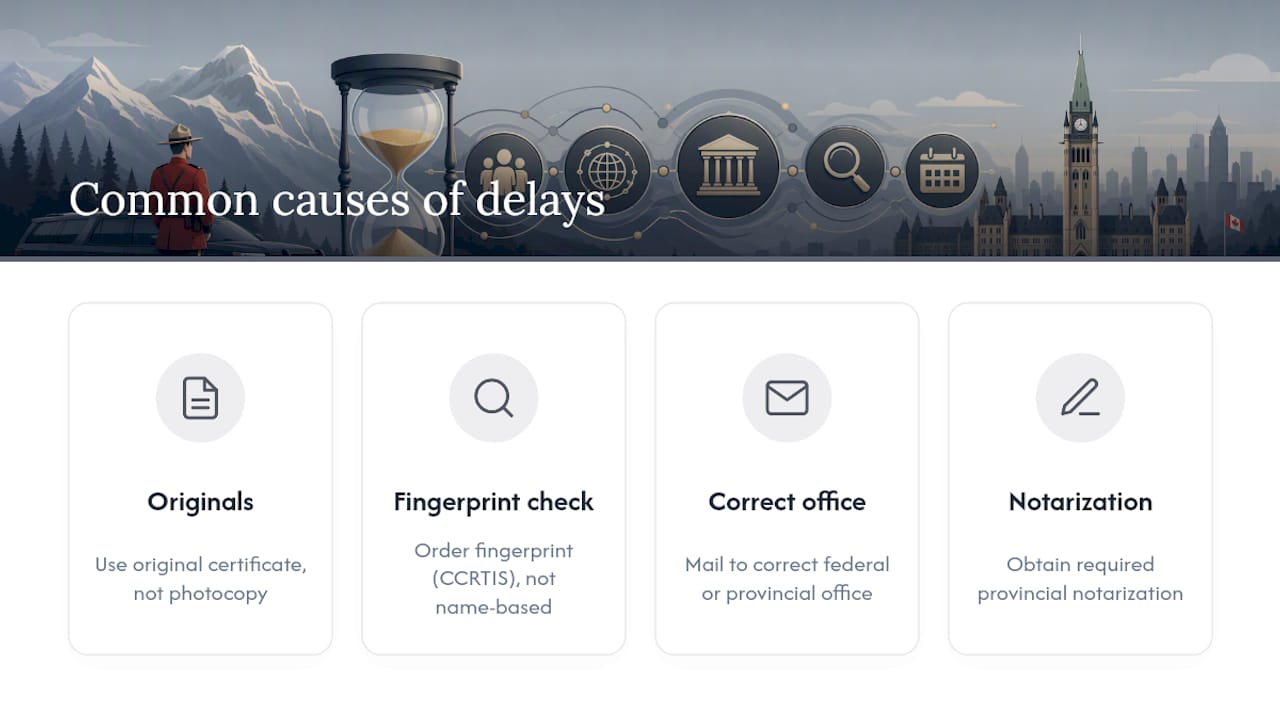
Other frequent issues include mailing your document to the wrong apostille office (federal instead of provincial, or vice versa), skipping a notarization step your province actually requires, and forgetting return postage or payment with your submission package.
Before you submit anything, check whether your destination country is a Hague signatory. If it isn't, an apostille won't work at all. You'll need the older authentication plus embassy legalization route instead, which involves an extra step at the destination country's consulate.
If your apostille office returns your document or asks for more information, contact them directly using the phone number listed on their official page rather than guessing. Most issues get resolved once you clarify the specific requirement they flagged.
Pro Tip: Always use tracked courier service for both directions of an apostille submission, write a clear cover letter listing exactly what's enclosed, and keep every receipt and tracking number until your apostilled document is back in hand.
When Does a Professional Apostille Service Make Sense?
Handling this yourself works fine when you have flexibility on timing and only one document to process. It gets harder when you're facing a visa deadline, coordinating notarization across provinces, or trying to figure out whether your specific RCMP check needs federal or provincial routing.
That's the gap a service like Speedy Apostille Services is built to close. The company specializes in expediting apostilles for Canadian documents recognized across over 120 Hague Convention countries, and it prices jobs with government fees built in upfront, so there are no surprise charges partway through. Clients typically see a turnaround of two to three days through a document review and secure handling process, backed by more than 1,000 client reviews and a 5.0 rating.
If you're weighing whether to pay for help, ask what documents you'll need to start. Most services want your original RCMP certificate, confirmation of your destination country, and basic contact information before they can quote a firm timeline and price.
What the Post-2026 Process Actually Rewards
The biggest misconception about RCMP apostilles isn't about fees or paperwork. It's the assumption that the process is uniform across Canada. It isn't. Ontario and Alberta run their own shops. Other provinces don't, and default to Global Affairs Canada. That single fact determines almost everything downstream, including whether you need a notary and which office you're mailing to.
Conventional advice tends to treat "get an apostille" as a single, generic action. It's not. It's a routing decision first, and a paperwork task second. Get the routing wrong and you'll lose weeks waiting for a rejection notice, not because your document was flawed, but because it went to the wrong desk.
If there's one thing worth prioritizing above cost or speed, it's confirming your province's competent authority status before you order fingerprinting, notarization, or anything else. Everything else in this process is reversible if you catch a mistake early. A document mailed to the wrong office and sent back three weeks later is the one delay you can't undo.
— Ken
Start Your RCMP Apostille Request
Speedy Apostille Services turns a process that usually takes three to six weeks of self-managed mailing, notary appointments, and provincial guesswork into a two to three day turnaround, with all government fees built into one upfront price.

If you're facing a visa deadline, an employer's document window, or you're simply unsure whether your RCMP check needs provincial or federal routing, this is exactly the situation the service is built for. To get started, you'll need your original fingerprint-based RCMP certified criminal record check and confirmation of your destination country. From there, the team reviews your document, handles any required notarization coordination, and manages secure courier handling both ways. Start your apostille request today, or reach out with urgent questions before you mail anything on your own.
Where to Verify Current Rules and Fees
Confirm processing addresses, fees, and notarization rules directly on official pages before submitting anything:
- Global Affairs Canada authentication services for federal processing details and current fees.
- Your provincial competent authority page (Alberta, Ontario ODS, or others) for provincial fees and mailing addresses.
- The RCMP criminal record check page for fingerprinting and CCRTIS requirements.
- Canada's Hague Convention announcement for background on the current apostille system.
Sources
- Canada joins apostille convention to facilitate use of public documents abroad
- Authentication of documents - Global Affairs Canada
- Authenticate your documents - Before you start (Step 1)
- Criminal record check - RCMP
FAQ
How do I apostille an RCMP criminal record check?
Order a fingerprint-based certified criminal record check through CCRTIS, keep the original document, and submit it to your province's competent authority if one exists, or to Global Affairs Canada if it doesn't.
How do I get a document apostilled in Canada?
Confirm which authority has jurisdiction over your document type and province, complete any required notarization, and submit the original along with the correct form and payment to that office.
Can I walk in to get an apostille?
Most provincial and federal apostille offices process submissions by mail or courier rather than in-person walk-ins, though a few provincial offices offer limited in-person drop-off; check your specific office's current policy before visiting. Services like Speedy Apostille Services handle the submission logistics so you don't need to visit any office at all.
How can I obtain an apostille from the government of Alberta?
Complete Alberta's Apostille Request Form, pay the $25 per document fee online, and mail your original document to Alberta's authentication office, allowing seven to ten business days for processing.
Does an RCMP apostille need notarization?
It depends on your route. Provincial competent authorities often require a local notary to notarize the original RCMP certificate first, while some federal submissions through Global Affairs Canada may not, so confirm before booking a notary appointment.