
Power of Attorney to India from Canada: Step-by-Step Guide
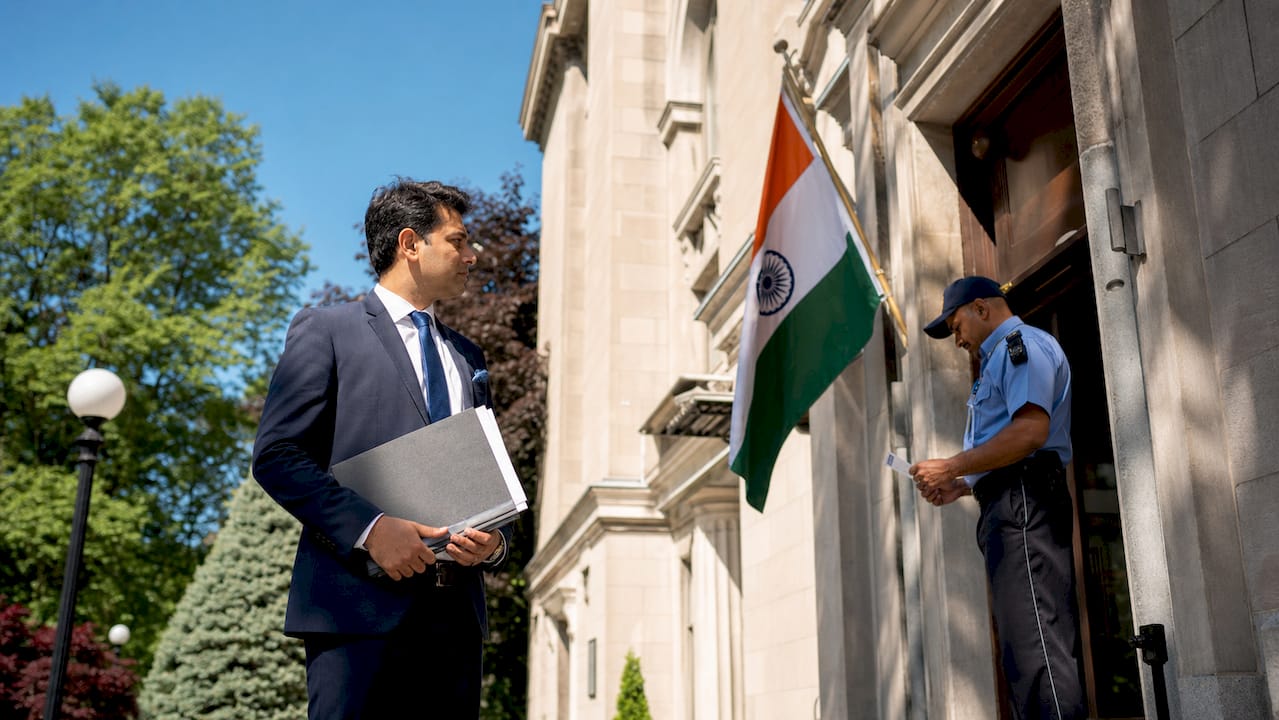
Power of Attorney to India from Canada: Step-by-Step Guide ! Professional submitting POA at Indian High Commission Granting a power of attorney to India from Canada requires four distinct steps: drafting a legally compliant document, notarizing it with a Canadian Notary Public, having it attested
Power of Attorney to India from Canada: Step-by-Step Guide
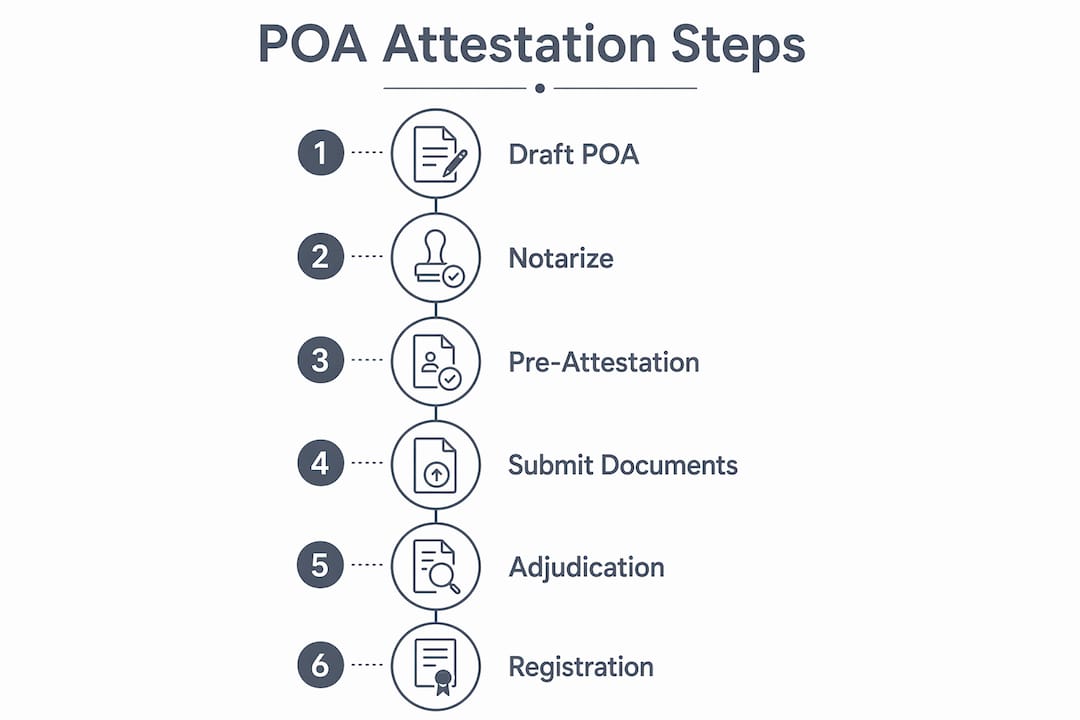
Granting a power of attorney to India from Canada requires four distinct steps: drafting a legally compliant document, notarizing it with a Canadian Notary Public, having it attested by the relevant Indian diplomatic mission in Canada, and completing adjudication and registration in India. Each step is mandatory. Skipping or rushing any one of them can render the document unenforceable under Indian law.
- Draft the POA with specific language aligned to Indian legal standards, naming the attorney and the exact powers granted.
- Notarize in Canada before any consular submission. Notarization authenticates the signature and identity but does not establish legal effect in India on its own.
- Attest at the Indian Consulate or High Commission in Canada. Canadian passport holders must first obtain attestation from Global Affairs Canada. Non-Canadian, non-Indian nationals must get attestation from their own country's embassy before approaching the Indian mission.
- Adjudicate and register in India. Registration under the Registration Act, 1908 is mandatory for property-related POAs. Adjudication at the local Sub-Registrar's Office must occur within approximately 3 months of the document's receipt in India.
- Choose the correct POA type. A General Power of Attorney grants broad authority; a Special Power of Attorney limits the attorney to specific, named transactions.
- Fees and timelines vary by consulate and document type. Processing at Indian missions in Canada typically takes several business days, while registration in India adds additional time depending on the state and Sub-Registrar's office.
Table of Contents
- Which Indian diplomatic offices in Canada handle POA attestation?
- How the attestation process works step by step
- What legal factors affect POA validity in India?
- What happens after the POA arrives in India?
- How Speedyapostilleservices helps with Canada-to-India document authentication
- Key Takeaways
- FAQ
Which Indian diplomatic offices in Canada handle POA attestation?
Three Indian diplomatic missions in Canada handle POA attestation: the High Commission of India in Ottawa, the Consulate General of India in Toronto, and the Consulate General of India in Vancouver. The office you approach depends on your province of residence.
- High Commission of India, Ottawa serves applicants from Ontario (excluding Toronto's jurisdiction), Quebec, Manitoba, Saskatchewan, New Brunswick, Nova Scotia, Prince Edward Island, and Newfoundland. POA applications are submitted directly at the High Commission, located at 10 Springfield Rd, Ottawa, Ontario, K1M 1C9. Unlike the consulates, Ottawa does not route submissions through BLS centers for POA attestation.
- Consulate General of India, Toronto covers applicants residing in Ontario within its jurisdiction. All in-person submissions go through BLS India Canada centers. Physical presence at BLS is mandatory for document verification.
- Consulate General of India, Vancouver serves British Columbia, Alberta, and other western provinces. Submission procedures mirror Toronto's BLS-based model.
| Office | Location | Jurisdiction | Submission Method |
|---|---|---|---|
| High Commission of India | Ottawa, ON | Eastern and central Canada (excluding Toronto) | Direct to High Commission |
| Consulate General of India | Toronto, ON | Ontario (Toronto jurisdiction) | Via BLS India Canada centers |
| Consulate General of India | Vancouver, BC | Western Canada (BC, Alberta, etc.) | Via BLS India Canada centers |
Canada's Hague Convention membership: Canada became a member of the Hague Apostille Convention on January 11, 2024. As a result, any Apostille Certificate issued by a competent Canadian authority requires no further attestation by the Consulate General of India, Toronto. Indian passport holders who obtain an apostille from a recognized Canadian authority do not need to submit their document at BLS for consular attestation.
How the attestation process works step by step
The attestation process follows a specific sequence. Deviating from it causes rejection.
Step 1: Prepare the notarized POA
Have the POA drafted and signed before a Canadian Notary Public. Bring the original notarized document and one copy. The notarization confirms your identity and signature but does not make the document enforceable in India.

Step 2: Gather supporting documents
Required documents for attestation at Indian missions in Canada include:
- Notarized POA, original and copy
- Passport (first and last page), original and self-attested photocopy
- Valid PR card, work permit, study permit, or visitor permit, original and copy
- Government-issued Canadian address proof, original and copy. Accepted documents include a driving license, provincial ID, or utility bills (gas, electricity, water, or landline telephone). Phone bills and bank statements are not accepted.
- Duly filled Miscellaneous Application Form with a photograph. Joint applicants must use the Joint Miscellaneous Form.
Step 3: Pre-attestation for non-Indian nationals
Canadian passport holders must have the POA attested by Global Affairs Canada (Sussex Drive, Ottawa) before submitting to the Indian mission. Citizens of countries other than Canada and India must first obtain attestation from their own country's embassy or high commission in Canada. Indian nationals are not required to obtain pre-attestation from any provincial or Canadian federal authority.
Step 4: Submit at BLS or High Commission
For Toronto and Vancouver jurisdictions, submit in person at the designated BLS India Canada center. For Ottawa, submit directly at the High Commission. All originals must be presented for verification at the time of submission.

| Stage | Who Does It | Estimated Time |
|---|---|---|
| Notarization in Canada | Canadian Notary Public | Same day to 2 business days |
| Pre-attestation (non-Indian nationals) | Global Affairs Canada or relevant embassy | Several business days |
| Indian Consulate/High Commission attestation | Indian diplomatic mission | Several business days |
| Adjudication in India | Sub-Registrar's Office | Typically completed within a few months of receipt |
| Registration in India (property POA) | Sub-Registrar's Office | Varies by state |
Pro Tip: Confirm current fee schedules directly with the BLS India Canada website or the relevant consulate before submitting. Fees are subject to change and are not published in a single consolidated location.
What legal factors affect POA validity in India?
Drafting is where most Canada-to-India POAs fail. The document must satisfy Indian legal standards, not just Canadian notarization requirements.
General vs. Special Power of Attorney
A General Power of Attorney (GPA) grants the attorney broad authority to act on the principal's behalf across multiple matters. A Special Power of Attorney (SPA) restricts the attorney to specific, named transactions, such as selling a particular property or managing a specific bank account. For property transactions in India, an SPA is generally preferred because it limits the scope of authority and reduces the risk of misuse.
Indian courts, including the Supreme Court of India, have placed restrictions on the use of GPA for property transfers. Transactions conducted through a GPA without proper registration and stamp duty compliance have been held unenforceable. An SPA tied to a specific property and transaction is far less likely to face legal challenge.
Drafting precision matters
Indian Sub-Registrar offices apply a literal interpretation of POA language. The document must include the exact property address, survey number, or plot number. Generic descriptions like "my property in Delhi" are routinely rejected. Legal experts advise having the intended attorney in India obtain a draft pre-approved by the local Sub-Registrar before the principal in Canada finalizes and signs the document.
Pro Tip: Ask your attorney in India to confirm the exact wording and property details the local Sub-Registrar requires before you notarize the document in Canada. Revising a notarized POA after the fact means restarting the entire process.
Notarization alone is not enough
Notarization in Canada authenticates the signature and identity of the principal. It does not make the POA enforceable in India. Full legal effect requires consular attestation in Canada followed by adjudication and, for property matters, registration in India. A document that is only notarized carries no legal weight before an Indian court or registrar.
Relevant Indian statutes governing POA validity include the Indian Contract Act, 1872, the Powers of Attorney Act, 1882, the Registration Act, 1908, and the Indian Stamp Act, 1899. Compliance with all four is necessary for a POA used in property transactions.
What happens after the POA arrives in India?
Once the attested POA reaches India, two further steps apply before it can be used for property transactions.
Adjudication (stamping)
Adjudication means the document is presented to the local Sub-Registrar's Office for stamp duty assessment and payment. This step must occur within approximately 3 months of the document's receipt in India. Missing this window voids the POA's legal effect for transactions. The attorney named in the POA typically handles this step in India.
Registration
For POAs relating to immovable property, registration at the Sub-Registrar's Office is mandatory under the Registration Act, 1908. The attorney must attend in person, along with two witnesses, and present the original attested POA, identity documents, and proof of the principal's identity. Stamp duty and registration fees vary by state and property value.
Failure to register a property-related POA means the document cannot be used to transfer, sell, or mortgage the property. Courts in India have consistently held that an unregistered POA for immovable property has no legal standing for the purpose of executing a sale deed.
Ongoing validity and revocation
A POA remains valid until revoked by the principal or until the principal's death. If the principal wishes to revoke the POA, the revocation must be communicated to the attorney and, where the POA was registered, a revocation deed should be registered at the same Sub-Registrar's Office. Attorneys in India should verify the POA's current validity before acting on it, particularly if significant time has passed since execution.
How Speedyapostilleservices helps with Canada-to-India document authentication
Speedyapostilleservices, based in Toronto, handles the apostille and authentication process for Canadian documents used internationally, including Powers of Attorney destined for India. The service covers document review, required notarization referral, secure handling, and government-issued apostille for use in countries that accept Canadian apostilles under the Hague Convention.
The all-inclusive pricing model bundles government fees into a single quoted price. There are no separate line items for government charges added at the end. Typical document handling takes 2–3 business days, with standard, expedited, and rush tiers available depending on urgency.
Speedyapostilleservices has accumulated over 1,000 positive reviews with a 5.0 rating. Clients preparing a Canada to India power of attorney benefit from having documents reviewed before submission, which reduces the risk of rejection at Indian consulates due to missing or incorrect paperwork. The service does not replace the consular attestation step but prepares documents so that step proceeds without avoidable errors.
For Canadians who became eligible for the apostille route after Canada joined the Hague Convention on January 11, 2024, Speedyapostilleservices provides the apostille certificate that eliminates the need for separate consular legalization, where applicable. Contact Speedyapostilleservices directly at speedyapostilleservices.com to confirm which authentication path applies to your specific document and destination.
Key Takeaways
A power of attorney from Canada to India requires notarization, consular attestation, and mandatory adjudication and registration in India to be legally enforceable, especially for property transactions.
| Point | Details |
|---|---|
| Four mandatory steps | Draft, notarize in Canada, attest at Indian mission, then adjudicate and register in India. |
| Pre-attestation required | Canadian passport holders must obtain Global Affairs Canada attestation before Indian consular attestation. |
| Adjudication deadline | The POA must be adjudicated at the Sub-Registrar's Office within approximately 3 months of arriving in India. |
| Drafting specificity | Include exact property addresses and survey numbers; generic language causes rejection at Indian Sub-Registrar offices. |
| Apostille option | Since Canada joined the Hague Convention on January 11, 2024, a Canadian apostille may replace consular legalization for eligible documents. |
FAQ
Can you give a power of attorney to someone in India from Canada?
Yes. A principal in Canada can grant a power of attorney to an attorney in India by drafting the document in Canada, notarizing it locally, and having it attested by the relevant Indian diplomatic mission before sending it to India for adjudication and registration.
What documents are required for POA attestation at Indian missions in Canada?
Required documents include the notarized POA original and copy, a self-attested passport photocopy, a valid PR card or permit, and a government-issued Canadian address proof such as a driving license or utility bill. Phone bills and bank statements are not accepted.
Can a power of attorney for India be completed entirely online?
No. Physical presence is required at BLS centers in Canada for document verification and submission, and registration at the Indian Sub-Registrar's Office also requires in-person attendance by the attorney.
How long does the full POA process take from Canada to India?
The timeline spans several stages: notarization in Canada takes 1–2 business days, consular attestation takes several business days, and adjudication and registration in India must be completed within approximately 3 months of the document's receipt. Total elapsed time depends on each office's current workload.
Does a Canadian apostille replace Indian consular attestation?
For eligible documents, yes. Since Canada joined the Hague Apostille Convention on January 11, 2024, a Canadian apostille issued by a recognized authority requires no further attestation by Indian consulates. Indian passport holders with an apostilled document do not need to submit it at BLS for consular attestation.