
Police Clearance Certificate from Canada: 2026 Guide
Police Clearance Certificate from Canada: 2026 Guide ! Woman completing fingerprint form for police clearance What is a police clearance certificate from Canada?

Police Clearance Certificate from Canada: 2026 Guide
What is a police clearance certificate from Canada?
Canada does not issue a document formally titled "police clearance certificate." The official equivalent is the certified criminal record check, issued by the Royal Canadian Mounted Police (RCMP) through fingerprint verification. Immigration, Refugees and Citizenship Canada (IRCC) accepts this document for immigration applications, employment screening, and legal verification purposes.
The RCMP relies on the Canadian Criminal Real Time Identification Services (CCRTIS) database to process these checks. Fingerprints are the core requirement. They confirm identity with a level of accuracy that name-based checks cannot match, protecting applicants from being linked to someone else's record due to a shared name.
Key facts about the Canadian police clearance process:
- The certificate may also be called a police clearance certificate, good conduct certificate, or judicial record extract depending on the requesting country
- Fingerprint verification ensures individuals cannot evade their criminal history and protects against false attribution
- Immigration applications must include the original certificate plus a certified translation into English or French if the document is in another language
- The RCMP and CCRTIS are the primary agencies involved in processing certified checks
- Government-issued photo ID is required at the time of fingerprinting
Types of criminal record checks available in Canada
Three main types of checks exist, and choosing the wrong one can delay or invalidate an application.
- Certified criminal record check (fingerprint-based): Issued by RCMP through CCRTIS. This is the check required for immigration, citizenship, and most government employment. It uses biometric fingerprints for definitive identity confirmation.
- Police Information Check (PIC): A name-based check provided by local police services. Suitable for employment or volunteer roles that do not involve children or vulnerable adults. Applicants outside Canada can apply by verifying identity with a local police force or consulate.
- Vulnerable Sector (VS) check: A detailed check that includes non-conviction information relevant to positions working with children or vulnerable adults. Only available inside Canada. Individuals outside Canada cannot apply for this check.
The scope of information disclosed varies by check type. A standard certified check for immigration shows conviction information, outstanding charges, and discharge records. A VS check adds suspended pardons and non-conviction findings. A PIC is the least comprehensive and does not meet IRCC immigration requirements.
How to apply for a police clearance certificate within Canada
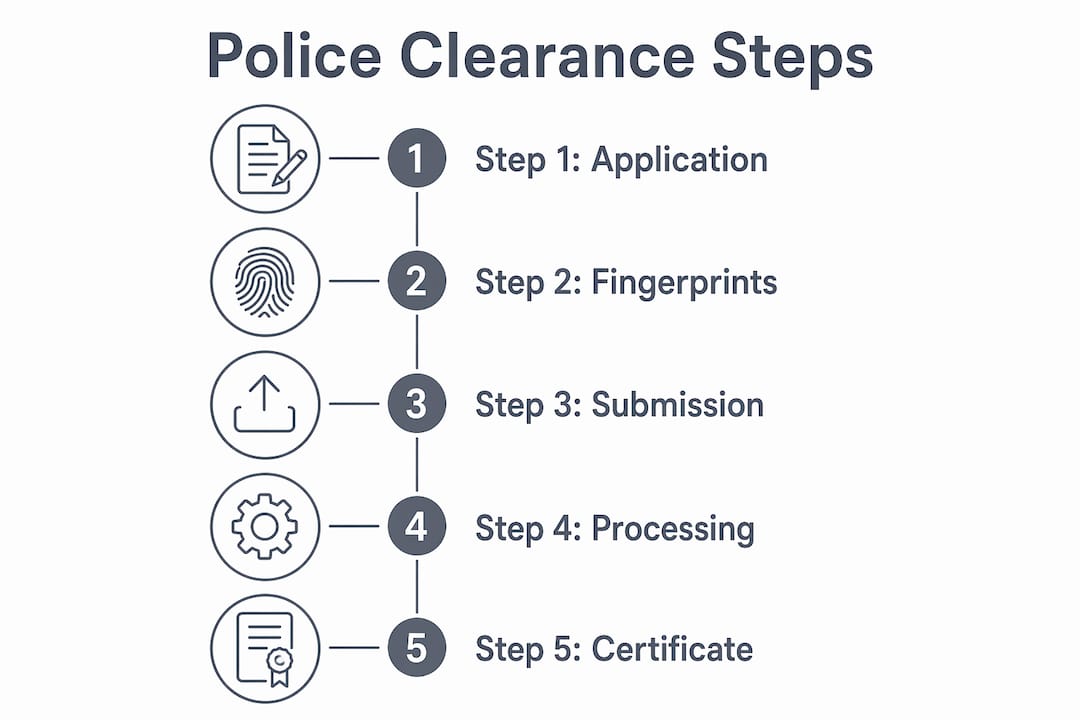
Applicants physically present in Canada follow a straightforward process through local police or an RCMP-accredited fingerprinting company.
Step-by-step process:
- Visit a local police service or an RCMP-accredited fingerprinting company to have fingerprints taken.
- Complete the required application form, including personal information and the purpose of the check.
- Pay the applicable fee at the time of application.
- The accredited company submits the fingerprints electronically to CCRTIS.
- Receive the certified criminal record check by mail or through a third-party consent arrangement.
Documents required:
- Two pieces of government-issued ID, one with a photo (for police certificate applications)
- One piece of photo ID showing name and date of birth (for fingerprinting only)
- Completed consent form authorizing CCRTIS to search the National Repository of Criminal Records
Pro Tip: Paper fingerprints cannot be mailed directly to the RCMP's CCRTIS. Submissions must go through an accredited company electronically. Sending fingerprints directly will result in rejection.
If errors appear on a received certificate, applicants should contact CCRTIS directly at CCRTIS-SCICTR@rcmp-grc.gc.ca to dispute or correct the record. Consent to the check can also be withdrawn by contacting CCRTIS, though withdrawal may not be possible once processing has begun.

How to obtain a Canadian police clearance from outside Canada
Applicants living abroad can still apply for an RCMP criminal record check outside Canada, but the process involves an additional step.
Step-by-step process for applicants abroad:
- Contact an authorized agency in your current country to obtain a paper copy of your fingerprints.
- Send the paper fingerprint form to an RCMP-accredited company in Canada.
- The accredited company converts the paper fingerprints to digital format and submits the application to CCRTIS electronically.
- Receive the certified criminal record check by mail or through authorized third-party delivery.
Authorized agencies that can take fingerprints abroad include:
- Foreign police services
- Embassies or consulates of foreign governments (not Canadian government offices)
- Notaries public
- Foreign private fingerprinting companies with a memorandum of understanding with an accredited Canadian company
Do not mail fingerprints or the application directly to RCMP's CCRTIS. That submission will not be accepted. Vulnerable Sector checks are not available to applicants outside Canada under any circumstances. For citizenship applications specifically, fingerprints must be collected inside Canada.
Processing times, fees, and common questions
Processing times for RCMP certified criminal record checks vary. Demand is currently high, and delays are common. If a delay affects an immigration application deadline, IRCC automatically extends the deadline by 30 days. Applicants do not need to contact IRCC or the RCMP to trigger this extension.
Common factors that cause delays:
- High volume of applications at CCRTIS
- Incomplete or incorrect application forms
- Illegible fingerprints requiring re-submission
- Missing consent forms or ID documentation
Fees: Fee amounts for certified criminal record checks and fingerprinting are set by CCRTIS and the accredited company used. Fees are not publicly listed as a single fixed rate since accredited companies set their own service charges in addition to government processing fees. Contact the accredited company directly for current pricing.
Verifying authenticity: A certified criminal record check from RCMP carries official RCMP markings. Recipients can verify the document by confirming the CCRTIS seal and checking that the document matches the applicant's personal details exactly.
Validity period: Canada does not set a universal expiry date on police clearance certificates. Requesting organizations, such as immigration authorities or employers, set their own validity windows. Many require a certificate issued within the past six months.
Fastest way to get a certificate: Apply through an RCMP-accredited fingerprinting company rather than waiting for a local police service appointment. Accredited private companies often process applications faster and can handle digital submission directly.
Authentication services for international use
Receiving a certified criminal record check is often only the first step. Many countries require the document to be apostilled or legalized before it is accepted by foreign authorities. This applies to immigration applications, international employment, and legal proceedings abroad.
Canada is a signatory to the Hague Apostille Convention. An apostille certifies the authenticity of the document for use in over 120 member countries. For countries not part of the Convention, full legalization through the destination country's embassy may be required.

Speedyapostilleservices, based in Toronto, handles apostille and authentication for Canadian documents including police clearance certificates, birth certificates, diplomas, and marriage licenses. Their pricing includes government fees upfront, with no hidden costs. Turnaround is typically 1–7 days, and the service includes document review and secure handling. Speedyapostilleservices holds over 1,000 reviews with a 5.0 rating.
Pro Tip: If you are applying for residency abroad, check whether your destination country requires an apostille on your Canadian police certificate before submitting your application. Some countries, such as those covered in Paraguay residency guides, list this as a mandatory document.
Key authentication considerations:
- Submit the apostille application after receiving the certified criminal record check from RCMP
- Confirm whether the destination country requires apostille or full legalization
- Certified translations into the destination country's language may also be required alongside the apostilled certificate
FAQ
How do you get a police clearance certificate from Canada?
Apply through an RCMP-accredited fingerprinting company, which submits your fingerprints electronically to CCRTIS. You will need government-issued photo ID and a completed consent form.
How long does it take to get a Canadian police clearance certificate?
Processing times vary and delays are common due to high demand. If an immigration deadline is affected, IRCC automatically extends it by 30 days without any action required from the applicant.
What is the fastest way to get a police clearance certificate?
Use an RCMP-accredited private fingerprinting company rather than a local police service. These companies often have shorter wait times and submit applications to CCRTIS electronically.
Can you apply for a Canadian police clearance online?
Electronic submission to CCRTIS is handled by accredited companies, not by individual applicants directly. You must attend an in-person fingerprinting appointment, after which the accredited company completes the electronic submission on your behalf.
Key Takeaways
The certified criminal record check issued by the RCMP through CCRTIS is Canada's official police clearance certificate, required for immigration, employment, and legal verification, and must be submitted electronically through an accredited fingerprinting company.
| Point | Details |
|---|---|
| Fingerprints are mandatory | RCMP certified checks require biometric fingerprints; name-based checks do not meet immigration requirements. |
| Outside Canada applicants | Get paper fingerprints from an authorized local agency, then contact an accredited Canadian company for digital submission. |
| Deadline extensions | IRCC automatically extends immigration deadlines by 30 days if RCMP processing delays occur. |
| Vulnerable Sector checks | Only available inside Canada; applicants abroad cannot apply for this check type under any circumstances. |
| Apostille for international use | A certified criminal record check often requires apostille or legalization before foreign authorities will accept it. |