
Notary vs Commissioner: Which One Canadian Documents Need
Notary vs Commissioner: Which One Canadian Documents Need ! Hand stamping Canadian document as a notary For Canadian documents that will stay in Canada, a commissioner of oaths is usually sufficient.

Notary vs Commissioner: Which One Canadian Documents Need
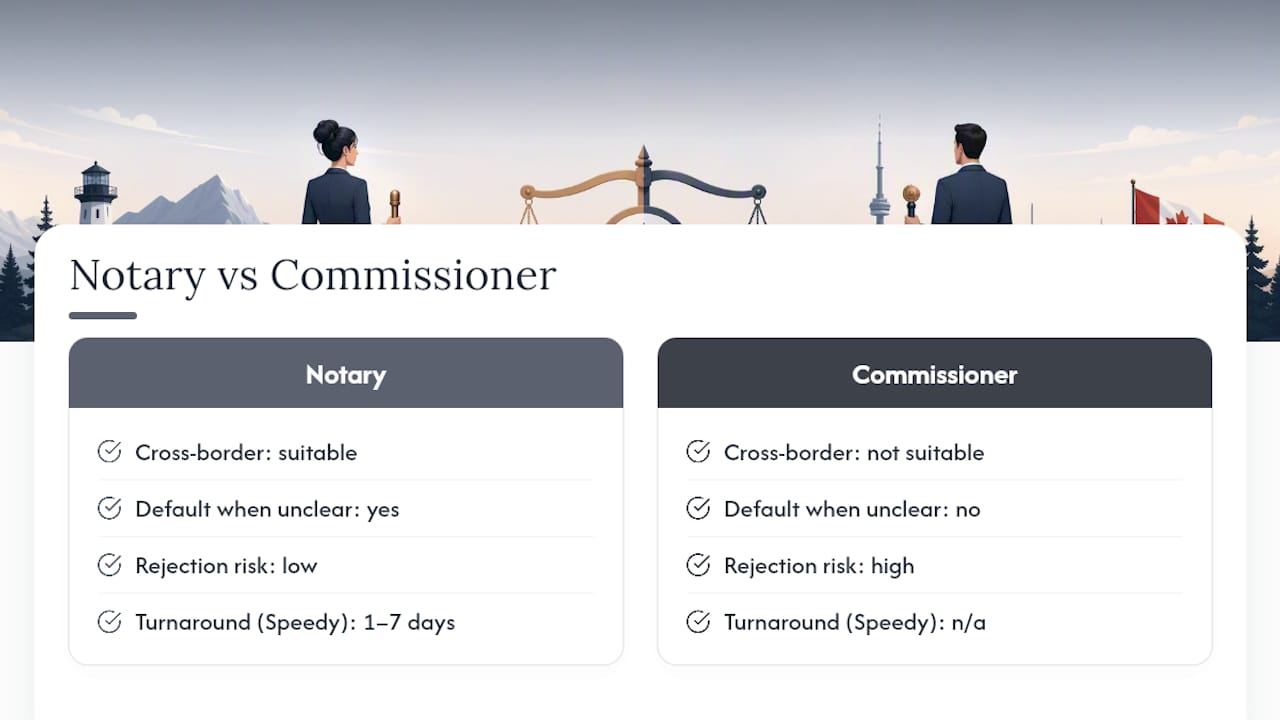
For Canadian documents that will stay in Canada, a commissioner of oaths is usually sufficient. For certified copies or anything headed abroad, you need a notary public. The scope gap explains everything else: a commissioner administers oaths, affidavits, and statutory declarations inside their province; a notary public does that plus certifies true copies, attests signatures, and performs the notarial acts that foreign institutions and authentication offices actually require.
- Domestic affidavit, statutory declaration, or in-province paperwork: commissioner works.
- Certified copy, international application, or anything going through authentication or an apostille: notary public.
When you're not sure which category your document falls into, Global Affairs Canada's Official Documents Services confirms that documents commissioned only by a commissioner are typically not accepted for authentication. Call the receiving institution first. If they don't answer clearly, default to a notary public.
Key Takeaways
A notary public holds every power a commissioner has plus the authority to certify copies and notarize documents for international acceptance, which makes the notary the safer default whenever a document leaves Canada.
| Point | Details |
|---|---|
| Match the official to the destination | Domestic affidavits need only a commissioner; anything certified, copied, or sent abroad needs a notary public. |
| Notaries outrank commissioners in scope | A notary can do everything a commissioner does plus certify copies and attest signatures for foreign use. |
| Confirm appointment before signing | Ask to see the certificate or seal, and check that the appointment hasn't expired, especially on older documents. |
| Avoid the most common rejection cause | Using a commissioner where a notarized certified copy was required is the top reason documents bounce back. |
| Consider full-service handling | Speedy Apostille Services bundles notarization checks with authentication and apostille processing, usually within a few days. |
Table of Contents
- Notary vs Commissioner: A Quick Comparison
- What a Commissioner for Taking Affidavits Can (and Cannot) Do
- What a Notary Public Can (and Cannot) Do
- How to Verify a Commissioner or Notary's Appointment
- Choosing Between a Notary and a Commissioner: A Decision Flow
- Common Mistakes That Get Documents Rejected
- A Practitioner's Take on Playing It Safe
- A Full-Service Option When You Need Notarization Plus Authentication
- Where to Verify These Rules Yourself
- Sources
- FAQ
Notary vs Commissioner: A Quick Comparison
A commissioner for taking affidavits witnesses oaths, affirmations, and statutory declarations. A notary public does all of that and adds certified true copies, signature attestation, and notarial certificates that satisfy foreign governments and institutions.
- Witnessing an affidavit for a local court filing: commissioner, low cost, widely available at law offices, banks, and some municipal offices.
- Certifying a copy of a diploma for a foreign university: notary public, required because commissioners can't certify copies.
- Signing a power of attorney used only in your home province: commissioner is often accepted.
- Any document needing an apostille or authentication: notary public, full stop. According to the Law Society of Ontario, a notary has all the powers of a commissioner plus the authority to notarize, while a commissioner's authority never extends to notarization.
If your document is going abroad, pick a notary. That one rule prevents most of the rejected submissions we see.
What a Commissioner for Taking Affidavits Can (and Cannot) Do
A commissioner's job is narrow by design. They administer oaths and affirmations, take affidavits, and witness statutory declarations, usually for use within their own province. Some professionals become commissioners automatically because of their job, including lawyers, judges, and certain municipal officers. The Law Society of Ontario notes that this appointment does not include the power to certify true copies or attest signatures for international use.
Provincial rules add texture here. In Ontario, a commissioner's authority generally stops at the provincial border unless a specific statute extends it. Manitoba and Newfoundland and Labrador appoint commissioners through similar affidavit legislation, but each maintains its own list of who qualifies by office. Alberta's framework, outlined by Alberta, separates commissioner status conferred by occupation from notary appointments that require a formal application.
Before you rely on a commissioner, confirm three things:
- Their appointment is current and covers the province where you're signing.
- The document you're submitting doesn't require a certified copy or international acceptance.
- The commissioner will print the date and, where the province requires it, note their appointment details next to the signature.
Pro Tip: Ask the commissioner outright whether they can also notarize documents. Many lawyers hold commissioner status by office but never applied for a separate notary appointment, so the answer is often no.
What a Notary Public Can (and Cannot) Do
A notary public carries every power a commissioner has, plus the authority to certify true copies, attest the execution of documents, verify signatures, and issue notarial certificates that receiving institutions recognize internationally. This broader mandate is exactly why foreign governments, embassies, and universities ask for a notary by name rather than accepting a commissioned affidavit.

The Law Society of Ontario is direct about the gap: a notary public has all the same powers as a commissioner and can also notarize documents, while a commissioner's authority does not extend to notarizing anything. That single sentence resolves most notary vs commissioner confusion on the spot.
Authentication offices care about formalities almost as much as authority. Global Affairs Canada's guidance lists the elements a valid notarial act needs: a handwritten signature, an embossed or stamped seal showing the notary's full name and jurisdiction, a statement of the act performed, and the date it happened. Skip any of those and authentication can stall.
Notary formalities vary somewhat by province, but expect these in most cases:
- A physical or digital seal on file with the province, not just a signature.
- An in-person appointment, though a growing number of provinces now permit remote online notarization for specific document types.
- A specimen signature the notary keeps on record for verification requests.
Before you sign anything, ask the notary three questions: do they hold a current seal and appointment, have they notarized documents for foreign use before, and will their certificate meet the receiving country's authentication requirements? Our guide to online notarization in Canada breaks down which document types qualify for remote notarization and which still require an in-person signing.
How to Verify a Commissioner or Notary's Appointment
Never take someone's word for it. Provincial registries and law society directories exist specifically so you can confirm an official's authority before you sign anything, and that check takes a few minutes.
Start with the source. In Ontario, Ontario explains the application process and eligibility, and it's the same office that maintains appointment records. Lawyers and paralegals are commissioners automatically by virtue of their license, but as the Law Society notes, they must apply separately for notary status. Never assume one implies the other.
Appointment terms also matter more than most people realize. Ontario recently extended non-lawyer, non-paralegal commissioner and notary appointments to longer terms, so an expired appointment is a real risk with older documents.
Follow this sequence before you rely on anyone's seal:
- Ask to see their certificate of appointment or a specimen of their seal.
- Confirm the appointment hasn't lapsed, especially with older commissions.
- Record the official's full name and appointment number for your own file.
- Photograph the seal and signature if the official permits it.
- Call the receiving institution to confirm they'll accept this specific type of official act before you pay for anything.
Choosing Between a Notary and a Commissioner: A Decision Flow
Two questions settle almost every notary vs commissioner decision. First, where will the document be used? Second, has the receiving party specifically asked for a certified copy or notarization?
If the answer to either question points outside Canada, or if the recipient uses the word "notarize" anywhere in their instructions, stop looking for a commissioner. Go straight to a notary public.
Watch for these red flags, all of which mean a commissioner won't cut it:
- An embassy or consulate is requesting the document.
- A foreign university, employer, or licensing body needs a certified transcript or diploma copy.
- An international bank or financial institution wants a verified signature.
- Immigration authorities in another country require authenticated Canadian records.
- The document is part of an apostille or authentication package headed to any of the 120-plus Hague Convention countries.
When in doubt, ask the receiving authority two direct questions: "Do you require notarization, or is a commissioned affidavit acceptable?" and "Do you require authentication or an apostille on top of notarization?" Then ask the official you're hiring whether they've handled documents for that exact purpose before.
Pro Tip: Commissioners are often free or cheap through banks and municipal offices, which makes them tempting. That savings disappears fast if the document bounces back from an embassy three weeks later and you're starting over.
Common Mistakes That Get Documents Rejected
Rejections tend to follow the same handful of patterns, and each one is avoidable with a five-minute check beforehand.
- Using a commissioner for a document that needed a notarized certified copy, the single most common error according to Mayo Law's guidance on notarization in Ontario.
- Submitting a notarized document missing the seal, statement of act, or date, any of which authentication offices flag immediately.
- Assuming a notary from another country, particularly a U.S. notary public, satisfies a Canadian document's requirements. They generally don't.
- Relying on an appointment that's expired, especially on documents signed years ago.
If a document gets rejected, don't panic. Re-notarize with a current, properly sealed notary public, request a fresh certified copy if the original submission used a commissioner, and confirm the correct authentication and apostille sequence before resubmitting. Rushing that second attempt without checking requirements again just repeats the mistake.
A Practitioner's Take on Playing It Safe
Every rejected file I've reviewed traces back to the same shortcut: someone chose the cheaper, closer official instead of confirming what the receiving institution actually wanted. Commissioners aren't a lesser option, they're just the wrong tool for anything crossing a border. When a client can't get a straight answer from the embassy or university on the phone, the safer default is always a notary public, not a commissioner.
Speedy Apostille Services, based in Toronto, handles the notarization and authentication side of this problem end to end, with all-in pricing and a typical turnaround of one to seven days, backed by more than 1,000 client reviews. That kind of volume gives a clear read on which documents get rejected and why.
— Ken
A Full-Service Option When You Need Notarization Plus Authentication
If you've read this far and realized your document needs both a notary and an apostille, you don't have to coordinate two separate appointments yourself. Speedy Apostille Services bundles document review, the required notarization check, and the full authentication or apostille process into one order.

The pricing includes government fees upfront, so there's no surprise invoice halfway through, and most orders move in one to seven days depending on the document and destination country. Documents like birth certificates, marriage licenses, diplomas, and corporate records are handled with the same secure process, whether the destination is a foreign university, an embassy, or an international employer. If your document is one of the 120-plus Hague Convention countries' recipients and you'd rather not guess which official to hire first, start your order with Speedy Apostille Services and let the review process confirm what's actually needed.
Where to Verify These Rules Yourself
Confirm details directly through the Law Society of Ontario, Global Affairs Canada's authentication guidance, and Ontario's appointment page. For international legalization context, see Harris & Charms' legalization process guide.
Sources
- Commissioner for taking affidavits and Notary public - Lawyer | Law Society of Ontario
- Who Can Notarize a Document in Ontario? (2026) | Mayo Law
- Authentication and legalization guidance | Global Affairs Canada (Official Documents Services)
- Ontario
FAQ
What's the Difference Between a Notary and a Commissioner?
A notary public has all the powers of a commissioner plus the ability to certify true copies, attest signatures, and notarize documents for international use, while a commissioner's authority is limited to administering oaths and affidavits.
Who Can Act as a Commissioner of Oaths in Canada?
Commissioners are appointed under provincial legislation, and certain roles, including lawyers, judges, and some municipal officers, hold commissioner status automatically by virtue of their office.
Who Can Legally Notarize a Document in Canada?
Only someone specifically appointed as a notary public can notarize a document; in Ontario, lawyers and paralegals must apply separately for notary status even though they're already commissioners by office.
What Is the Difference Between a Commissioner of Oaths and a Notary Public in Ontario?
In Ontario, a commissioner witnesses oaths and affidavits for domestic use, while a notary public can additionally certify copies and notarize documents needed for authentication or use outside Canada.
Can Speedy Apostille Services Handle Notarization and Authentication Together?
Yes. Speedy Apostille Services reviews the document, checks whether notarization is required, and manages the authentication or apostille process in one order, typically within one to seven days.
Recommended
- Online Notarization Apostille Canada: What Actually Works | Speedy Apostille Services
- Court Documents Apostille Canada: Where to Send Yours | Speedy Apostille Services
- Apostille vs Legalization Canada: Which One Do You Need? | Speedy Apostille Services
- Good Standing Apostille Canada: A Provincial and Federal Guide | Speedy Apostille Services