
Getting a Marriage Certificate Apostille in Canada
Getting a Marriage Certificate Apostille in Canada ! Canadian marriage certificate being stamped for apostille You can get an apostille for a Canadian marriage certificate if it is an original, government-issued long-form document carrying the registrar's signature and seal.

Getting a Marriage Certificate Apostille in Canada
You can get an apostille for a Canadian marriage certificate if it is an original, government-issued long-form document carrying the registrar's signature and seal. Canada joined the Hague Apostille Convention on January 11, 2024, so eligible documents now receive a single apostille certificate instead of the older multi-step legalization chain, at least for use in other member countries.
Your first move is simple:
- Check whether your destination country is a Hague member. If yes, you need an apostille.
- If it is not a member, expect consular legalization instead, which involves an extra step at that country's embassy or consulate.
- Identify the right competent authority: either Global Affairs Canada or the provincial authentication office where your certificate was issued.
One figure to remember: Canada's Convention membership took effect January 11, 2024, and it covers eligible public documents including marriage certificates issued by the provinces and territories.
Key Takeaways
A Canadian marriage certificate qualifies for an apostille only when it is an original long-form document with a verifiable registrar signature and seal, submitted to the correct provincial or federal authority based on the destination country.
| Point | Details |
|---|---|
| Confirm destination first | Check if the destination country is a Hague member before choosing between apostille and legalization. |
| Use the right document | Submit an original long-form civil marriage certificate, not a photocopy or laminated copy. |
| Match the correct authority | Send provincial documents to that province's authentication office; use Global Affairs Canada as the federal fallback. |
| Avoid the common rejections | Skip laminated certificates and religious-only records, and verify the signature and seal are legible. |
| Consider professional help for deadlines | Speedyapostilleservices reviews documents, submits to the correct office, and offers expedited turnaround for tight timelines. |
Table of Contents
- Marriage Certificate Apostille: When You Need One
- How Do You Apostille a Marriage Certificate?
- Which Province Handles Your Apostille?
- Why Marriage Certificate Apostilles Get Rejected
- When Hiring an Apostille Service Makes Sense
- Editorial Take: What Actually Slows People Down
- Get Your Marriage Certificate Apostilled Without the Guesswork
- Sources
- FAQ
Marriage Certificate Apostille: When You Need One
An apostille is a single certificate that verifies a signature and seal are genuine, issued when your destination country is also a Hague Convention member. Consular legalization is the older, multi-step process still required when the destination has not joined the Convention. The difference comes down entirely to where the document is going, not what it says.
For a marriage certificate to qualify, it generally must be:
- The original government-issued long-form civil marriage certificate.
- Signed by the actual registrar with an official seal, not a scan or reprint.
- Free of lamination, staples through the seal, or alterations.
Religious marriage certificates issued by a place of worship typically do not qualify on their own. Neither do plain photocopies. Provincial authentication offices verify the signature and seal against their own records before issuing anything, and an apostille only confirms who signed the document, not whether the marriage itself is valid or recognized abroad.
Pro Tip: Call or check the receiving foreign authority's website before you submit anything. Some countries still ask for extra steps beyond an apostille, like a local translation or registration with a civil registry, even after Canada joined the Convention.
How Do You Apostille a Marriage Certificate?
Six steps cover almost every case, whether you are applying for a spousal visa, registering a marriage abroad, or updating a name on foreign records.
- Confirm the destination country's status. Hague members generally accept an apostille; non-members require legalization through their embassy or consulate in Canada.
- Get the correct document. You need the original long-form civil marriage certificate with the registrar's signature and raised or embossed seal. If you only have a wallet-sized version or a photocopy, order a certified copy from the vital statistics office in the province where the marriage was registered.
- Handle notarization if required. Some receiving countries or document types call for notarization before authentication. Confirm this with the issuing province, since requirements vary.
- Pick the right competent authority. Ontario, British Columbia, and Alberta each issue apostilles for their own provincial documents, while Global Affairs Canada handles federal documents and acts as the fallback authority when a provincial office does not apply. Check that office's current application form before mailing anything.
- Submit with payment, tracking, and a clear cover letter. State the destination country explicitly on your form; this single detail determines whether you receive an apostille or a plain certificate of authentication. Use a courier with tracking and include prepaid return postage.
- Verify and retain. Once you receive the apostille, some issuing offices let you verify its authenticity using the apostille number and issue date. Record both numbers, then keep the original and at least one certified copy for the foreign authority.
Processing note: Standard government turnaround runs from a few business days to a few weeks depending on the office and season, with expedited options available through some providers.
Which Province Handles Your Apostille?
Where you send your marriage certificate depends entirely on which province issued it.
- Ontario — Official Documents Services (ODS) processes mail-in applications, verifies the registrar's signature and seal, and issues either an apostille or a certificate of authentication depending on your stated destination. Typical processing takes a couple of weeks once received, depending on workload and season.
- British Columbia — the OIC Administration Office attaches the apostille directly to your authenticated document. B.C. requires you to clearly name the destination country on your application so the office issues the correct certificate.
- Alberta — Alberta Vital Statistics confirms that marriage certificates qualify alongside birth and death certificates, but older certificates may need to be reissued if they predate current formatting standards.
When you are unsure which office applies, or your document combines provincial and federal elements, Global Affairs Canada serves as the federal fallback.
Why Marriage Certificate Apostilles Get Rejected
Most rejections trace back to the same handful of preventable mistakes:
- Submitting a plain photocopy instead of an original or certified copy.
- Sending a laminated certificate, which authentication offices cannot verify properly.
- Including a religious-only marriage certificate with no government registration behind it.
- A signature or seal the authenticating office cannot match against its own records.
Before you mail anything, order a fresh certified copy if your original is missing, laminated, or damaged. Confirm the issuing clerk's signature is legible and the seal is intact.
Pro Tip: Use a tracked courier, include a prepaid return envelope, and write the destination country clearly on every form. That one line prevents the office from issuing the wrong type of certificate.

When Hiring an Apostille Service Makes Sense
Doing this yourself works fine when you have time to spare and a straightforward document. It gets harder when you are on a visa deadline, unsure whether your certificate qualifies, or trying to coordinate provincial and federal offices from outside the country.
Speedyapostilleservices reviews your marriage certificate before submission, confirms it meets provincial and federal requirements, and submits it to the correct authority on your behalf. Pricing bundles government fees upfront, so there are no surprise charges once processing starts, and expedited tiers typically turn around in a few business days rather than weeks.
- Document review before anything gets mailed, catching disqualifiers like lamination or missing seals early.
- Submission to the correct provincial or federal office based on where your certificate was issued.
- Transparent, all-in pricing that includes government fees.
- Expedited processing for time-sensitive visa or immigration deadlines.
If you are still confirming whether your destination even requires an apostille, the Hague Apostille Convention Country Checker settles that question in a few clicks, and the guide on apostille versus legalization in Canada walks through the distinction in more depth.
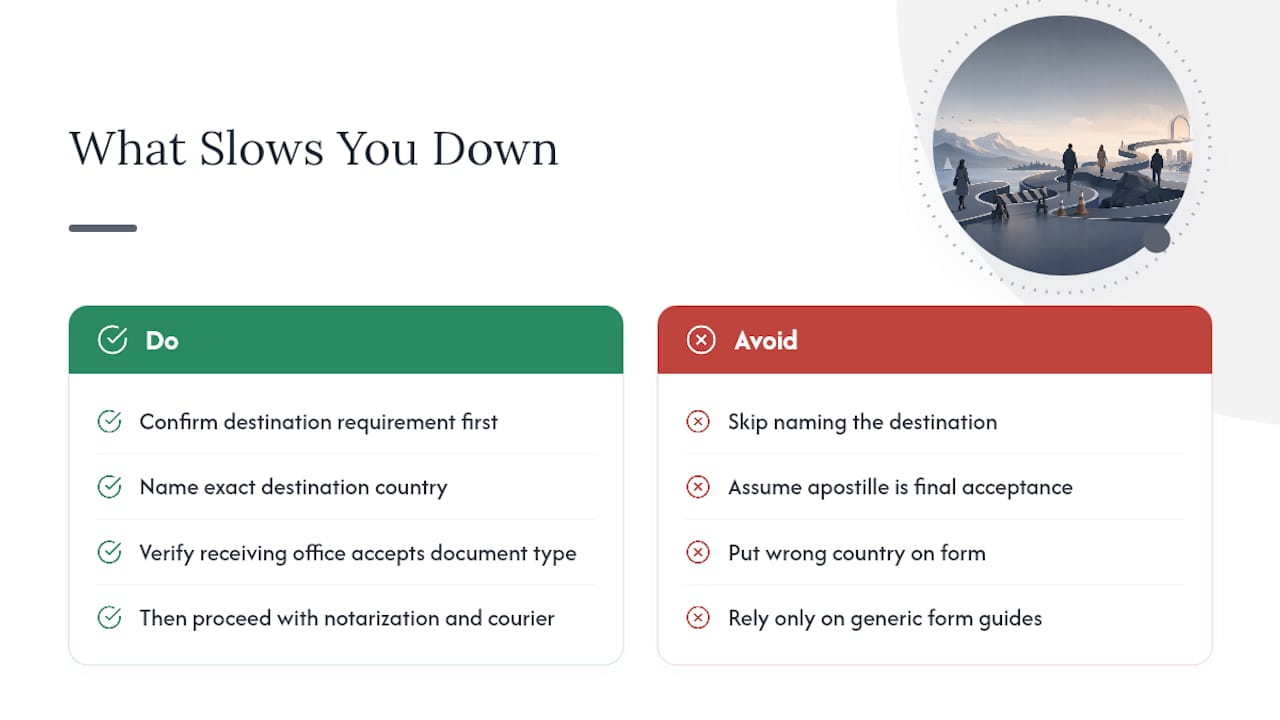
Editorial Take: What Actually Slows People Down
Most guides on this topic treat the apostille process as a form-filling exercise. It is not. The real bottleneck almost never shows up in the paperwork itself. It shows up in the gap between what a Canadian office issues and what a foreign registry, embassy, or immigration office actually expects.
Provinces ask you to name the destination country for a reason: that single field decides whether you get an apostille or the older-style authentication. Skip it, get it wrong, or assume your case is obvious, and you can lose weeks waiting for a reissue. That is the part conventional advice glosses over. Everyone talks about "get your document apostilled," as if the apostille itself is the finish line. It is not. The finish line is whatever the receiving country's civil registry, consulate, or immigration office decides to accept.
If you take one thing from this, prioritize confirming the destination requirement before you touch a mailing form. Everything else, the notarization, the courier, the provincial office, follows from that answer.
Get Your Marriage Certificate Apostilled Without the Guesswork
Speedyapostilleservices exists for exactly the moment you are in right now: staring at a marriage certificate, unsure whether it qualifies, and unsure which office to send it to. Instead of researching provincial authentication rules yourself and risking a rejection over lamination or a missing seal, Speedyapostilleservices reviews your document first, confirms the right competent authority, and handles submission with government fees built into one transparent price.

This matters most when a spousal visa deadline, an overseas wedding registration, or a name-change filing is on the clock. Expedited processing typically returns a completed apostille in a few business days instead of weeks, and secure handling means your original certificate does not vanish into an unclear tracking chain. If you are ready to move forward, visit Speedy Apostille Services to start your document review and get a clear price before you commit to anything.
Sources
- Authenticate your documents - Before you start (Step 1)
- Authentication of documents
- Authenticate a document for use outside Canada
- Documents for other jurisdictions or countries
FAQ
How do I get an apostille for a marriage certificate in Canada?
Submit the original long-form marriage certificate to the provincial authentication office where it was issued, or to Global Affairs Canada if it's a federal document, and state your destination country on the application.
Can I apostille my marriage certificate in Ontario?
Yes. Ontario's Official Documents Services verifies the registrar's signature and seal, then issues an apostille for use in Hague member countries.
Can I get an apostille on my BC marriage certificate?
Yes, through the OIC Administration Office, which attaches an apostille once you clearly identify your destination country on the submission.
Where can I get an apostille certificate in Canada?
Provincial authentication offices in Ontario, British Columbia, and Alberta handle their own documents, while Global Affairs Canada serves as the federal authority; Speedyapostilleservices can also manage submission for you.
What's the difference between an apostille and legalization for a marriage certificate?
An apostille is a single certificate accepted by other Hague Convention members, while legalization is a multi-step process still required for countries outside the Convention.
Recommended
- How to Get a Certificate of Status Apostille in Canada | Speedy Apostille Services
- Apostille for a Death Certificate: Get It Accepted Abroad | Speedy Apostille Services
- Getting an Apostille in Canada: A Sample-Based Guide | Speedy Apostille Services
- Can You Get a Medical Certificate Apostilled in Canada? | Speedy Apostille Services