
How to Get an Apostille Criminal Background Check
How to Get an Apostille Criminal Background Check ! Woman reviewing apostille criminal background check papers An apostille criminal background check is a federal criminal record authenticated by a government authority so foreign institutions can legally recognize it.

How to Get an Apostille Criminal Background Check
An apostille criminal background check is a federal criminal record authenticated by a government authority so foreign institutions can legally recognize it. In Canada, this means obtaining a fingerprint-based RCMP criminal record check, then submitting it for apostille or authentication before it crosses a border. Whether you need it for immigration, a work visa, or study abroad, the process has specific steps that must be followed in order. Skipping one step causes rejection. This guide covers every stage, from gathering prerequisites to avoiding the most common mistakes applicants make in 2026.
How to get an apostille criminal background check: what you need first
The foundation of the process is the right type of background check. Only fingerprint-based criminal record checks issued by federal authorities comply with international Hague Convention standards for apostille authentication. A local police check or a name-based search will not qualify.

For Canadians, the correct document is the RCMP fingerprint criminal record check, issued by the RCMP's Canadian Criminal Real Time Identification Services (CCRTIS). For Americans or dual citizens, the equivalent is the FBI Identity History Summary. Both are federal documents, and that distinction matters because state-level criminal records are apostilled by state Secretaries of State, while federal checks require federal authentication. Mixing these up is the single largest cause of rejection.
Before you start, confirm these prerequisites:
- Destination country membership: Check whether your destination country is a member of the Hague Apostille Convention. If it is not, you will need consular legalization instead of, or in addition to, an apostille.
- Document freshness: Most countries reject apostilled background checks older than 3–6 months at the time of submission. Plan your fingerprinting appointment accordingly.
- Physical signed document: The apostille certifies the issuing official's signature, not the contents of the report. A document without a verifiable official signature will be rejected outright.
- Certified translations: Most destination countries require certified translations of both the criminal background report and the apostille certificate itself.
- Required forms and fees: For U.S. applicants submitting to the U.S. Department of State, form DS-4194 is required. The federal apostille fee is $20 per document as of april 2026.
Pro Tip: Contact the destination country's embassy or consulate before you begin. Requirements change, and getting confirmation in writing protects you if a document is later questioned.
Step-by-step process for submitting your background check for apostille
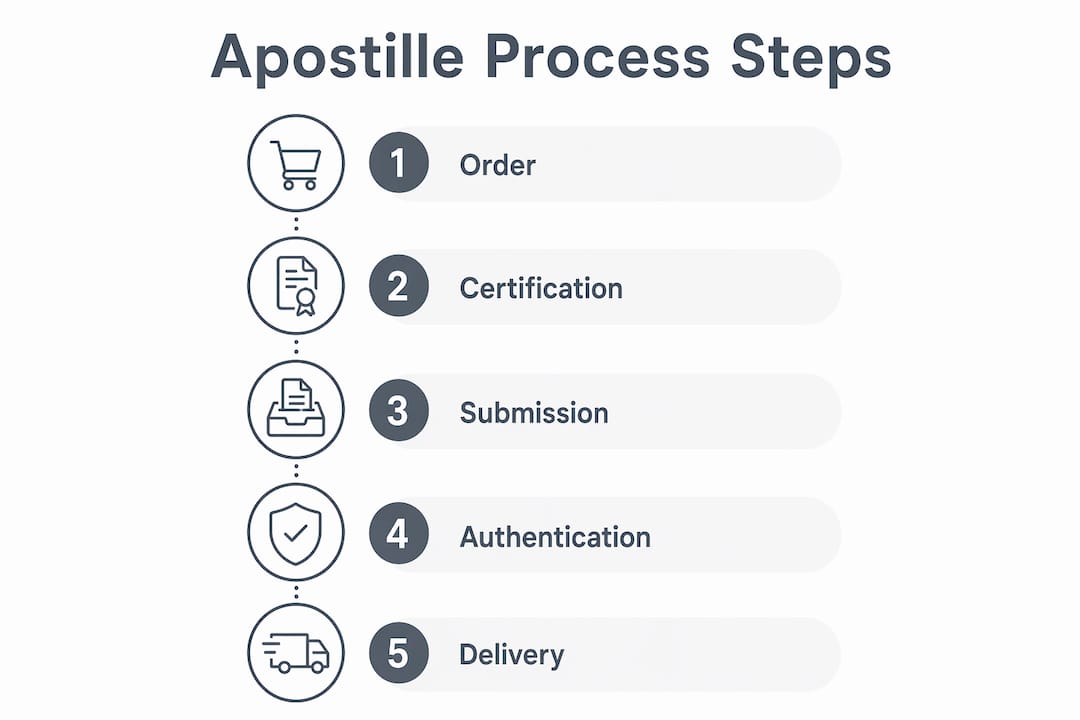
Once you have the right document in hand, the submission process follows a clear sequence.
-
Get fingerprinted. Book an appointment at an RCMP-accredited fingerprinting location or an FBI-approved channeler. Ink-rolled or digital fingerprints are both accepted, but confirm which format your destination requires.
-
Submit your fingerprints to the federal authority. For Canada, submit to RCMP CCRTIS. For the U.S., submit to the FBI. Fingerprint-based checks typically process in 3 business days if no manual review is needed. Manual review can extend the timeline up to 120 business days, so apply early.
-
Receive the physical document. Digital-only PDFs are often not accepted by authentication authorities. Request a hard copy original with an official signature. If you receive a digital version, check whether it can be printed on tamper-resistant paper or requires an affidavit before submission.
-
Prepare your submission packet. Include the original signed background check, the correct application form, your payment, and a cover letter specifying the destination country. For U.S. applicants, this goes to the U.S. Department of State. For Canadian documents, authentication is handled through Global Affairs Canada.
-
Choose your submission method. Mail-in processing via the U.S. Department of State takes 8–12 weeks. Expedited courier services reduce this to about 10 business days. Professional apostille service providers can often reduce turnaround further by handling submission logistics on your behalf.
-
Track your submission. Keep your tracking number and submission confirmation. If a document is returned with errors, review the rejection notice carefully before resubmitting.
-
Receive and verify the apostilled document. Check that the apostille certificate is attached, that the issuing authority's name is correct, and that the destination country is listed accurately.
Pro Tip: Order two certified copies of your background check at the same time. If one is rejected or expires before use, you have a backup without restarting the fingerprinting process.
What to do if your destination country is not in the Hague Convention
Apostille authentication only works between countries that are members of the Hague Apostille Convention. If your destination country is not a member, apostille is not sufficient. You need consular legalization instead.
Non-Hague Convention countries require a two-step process: federal authentication of the document first, followed by legalization at the embassy or consulate of the destination country. Common non-Hague destinations include China, the UAE, Saudi Arabia, and Egypt. Each has its own requirements, and some require additional steps beyond standard embassy legalization.
Key points for non-Hague situations:
- Confirm the process before you start. The destination country's embassy website is the authoritative source. Some countries also require the document to be notarized before federal authentication.
- Allow extra time. Consular legalization adds weeks to the process on top of the background check and federal authentication timelines.
- Certified translations are mandatory. Foreign governments and consulates almost always require a certified translation of the background check and the authentication certificate. A standard translation is not accepted.
- Separate state and federal documents. If you need both a state and a federal background check for a non-Hague country, each document follows its own authentication path before going to the embassy.
For readers relocating to Paraguay, the required documents for Paraguay page outlines exactly what authenticated records are needed, including criminal background checks.
Common mistakes that delay or reject your apostille application
Most apostille rejections are preventable. The errors below account for the majority of returned applications.
"The apostille authenticates the issuing official's signature on the criminal record check, not the contents of the report itself. Documents missing the required official signature are rejected regardless of criminal record status."
This is the most misunderstood point in the entire process. Applicants assume the apostille validates their clean record. It does not. It validates the signature of the official who issued the document. If that signature is absent or unverifiable, the application fails.
Other frequent mistakes include:
- Submitting a state background check for federal apostille. State records go to the Secretary of State. Federal records go to the U.S. Department of State or Global Affairs Canada. These are different authorities with different processes.
- Using an expired document. Submitting an expired background check causes rejection and forces a full restart. Build in time so the document remains valid through the entire submission and review period.
- Incorrect destination country on the form. The apostille certificate is issued for a specific country. If you list the wrong country, the document will not be accepted at your destination.
- Poor fingerprint quality. Low-quality fingerprint scans trigger manual review, which can extend processing to 120 business days. Use an accredited provider and confirm the scan quality before submission.
- Skipping translation. Submitting an English-language apostilled document to a non-English-speaking country without a certified translation will result in rejection at the foreign institution, even if the apostille itself is valid.
Emergency same-day apostille processing exists but is available only for documented life-or-death emergencies. Do not count on it for standard immigration or employment deadlines.
Key Takeaways
Getting an apostille criminal background check requires a fingerprint-based federal document, a physical signed original, and submission to the correct authentication authority for your destination country.
| Point | Details |
|---|---|
| Use a federal background check | Only RCMP or FBI fingerprint-based checks qualify for apostille under Hague Convention standards. |
| Check document validity | Most countries reject background checks older than 3–6 months at the time of submission. |
| Physical originals are required | Digital-only PDFs are often rejected; request a hard copy with an official signature. |
| Non-Hague countries need more steps | Countries like China and the UAE require consular legalization after federal authentication. |
| Certified translations are mandatory | Most foreign governments require certified translations of both the report and the apostille certificate. |
What I've learned from watching apostille applications go wrong
The most consistent pattern I see is applicants treating the apostille as the finish line when it is actually the midpoint. You get the background check, you get the apostille, and then you arrive at a foreign institution only to learn that a certified translation was required, or that the document expired three weeks before your appointment.
The second pattern is underestimating the RCMP background check processing time. A standard RCMP fingerprint criminal record check takes 3 business days with no complications. But fingerprint quality issues, incomplete forms, or a manual review flag can push that to weeks or months. If you are working toward a visa deadline, that gap can derail an entire application.
My practical advice: start the fingerprinting process at least three months before your submission deadline. That buffer covers RCMP or FBI processing, authentication, translation, and any resubmission if something is returned. For readers planning a move abroad, the documents needed for Paraguayan residency page is a useful model for how destination countries specify their exact requirements. Every country has a version of that list, and checking it early saves significant time.
Professional apostille services are worth the cost when your timeline is tight. The fee is small compared to the cost of a missed visa deadline or a rejected job offer.
— Ken
How Speedyapostilleservices handles your apostille background check
Speedyapostilleservices, based in Toronto, processes apostille applications for Canadian documents with a typical turnaround of 2–3 days. The service covers document review, secure handling, and submission logistics so applicants do not have to manage the process themselves.

All-in pricing includes government fees upfront, so there are no surprise costs at the end. Speedyapostilleservices has processed applications for over 120 Hague Convention countries and holds a 5.0 rating across more than 1,000 reviews. For Canadians who need a police clearance certificate from Canada authenticated quickly for immigration, employment, or study abroad, the apostille services page outlines the full process and current pricing.
FAQ
What is an apostille criminal background check?
An apostille criminal background check is a federal criminal record, such as an RCMP or FBI report, that has been authenticated by a government authority so it is legally recognized in foreign countries that are members of the Hague Apostille Convention.
How long does RCMP background check processing take?
A fingerprint-based RCMP check typically processes in 3 business days with no complications. Manual review due to fingerprint quality or other flags can extend processing up to 120 business days.
Can I use a digital PDF for my apostille application?
Digital-only PDFs are often not accepted for apostille submission. Most authentication authorities require a physical hard copy with an official signature, or the digital document must be printed on tamper-resistant paper with an accompanying affidavit.
What if my destination country is not in the Hague Convention?
Non-Hague countries require consular legalization instead of, or in addition to, apostille authentication. This involves federal authentication of the document followed by legalization at the destination country's embassy or consulate.
How old can my background check be for apostille submission?
Most countries reject apostilled criminal background checks older than 3–6 months at the time of submission. Plan your fingerprinting and application timeline so the document remains valid through the entire review and submission period.