
How to Apostille a Document in Quebec: 2026 Guide
How to Apostille a Document in Quebec: 2026 Guide ! Woman organizing apostille documents at home An apostille is a certificate that verifies the origin and signature of an official Quebec document for use abroad.

How to Apostille a Document in Quebec: 2026 Guide
An apostille is a certificate that verifies the origin and signature of an official Quebec document for use abroad. The Ministère de la Justice du Québec is the competent authority to issue apostilles for provincial documents. Quebec apostilles are issued in French only and are recognized among the 127 countries that signed the Hague Convention of October 5, 1961.
Key facts about Quebec apostilles:
- The apostille certifies document origin and the issuing signature or seal. It does not certify the document's content.
- The Ministère de la Justice du Québec handles all provincial apostille requests.
- Private documents require notarization and certification from the Chambre des notaires du Québec or the Barreau du Québec before submission.
- Quebec does not issue apostilles for federal documents. Those go to Global Affairs Canada.
- Applications are submitted by mail only. No walk-in service is available.
How to apostille a document in Quebec: step by step
The process follows a fixed sequence. Each step must be completed before moving to the next.
- Confirm document eligibility. Check that your document was issued by a Quebec provincial body. Civil status certificates must be from 2015 or later; all other eligible documents must be from 2019 or later.
- Prepare the document. Obtain the original or a certified true copy from the issuing body. For private documents, have a lawyer or notary certify the document officially.
- Get the required certification. For notarial acts, first obtain a certified true copy from the notary who produced the original, then get an authenticity certificate from the Chambre des notaires du Québec.
- Complete the apostille request form. Fill out the official form available on the Quebec government website. Any application not received within 3 months of completion will be canceled.
- Select a payment method. Pay the $66.50 fee per document by credit card online, money order, or bank draft payable to the Register Fund of the Ministère de la Justice. Personal checks are not accepted.
- Assemble and mail the package. Do not staple the form to the document. Group documents for the same apostille together. Use an envelope large enough to avoid folding. Mail to: Délivrance des apostilles, 276, rue Saint-Jacques, bureau 301, Montréal (Québec) H2Y 1N3, Canada.
Pro Tip: Include a prepaid return envelope with a courier label (minimum 8.5 x 11 in.) if you want tracked return shipping. The Ministère de la Justice returns documents by regular mail without tracking by default.
What are the fees and processing times for Quebec apostilles?
The fee is $66.50 per document. Payment options are credit card, money order, or bank draft. Personal checks are not accepted under any circumstances.
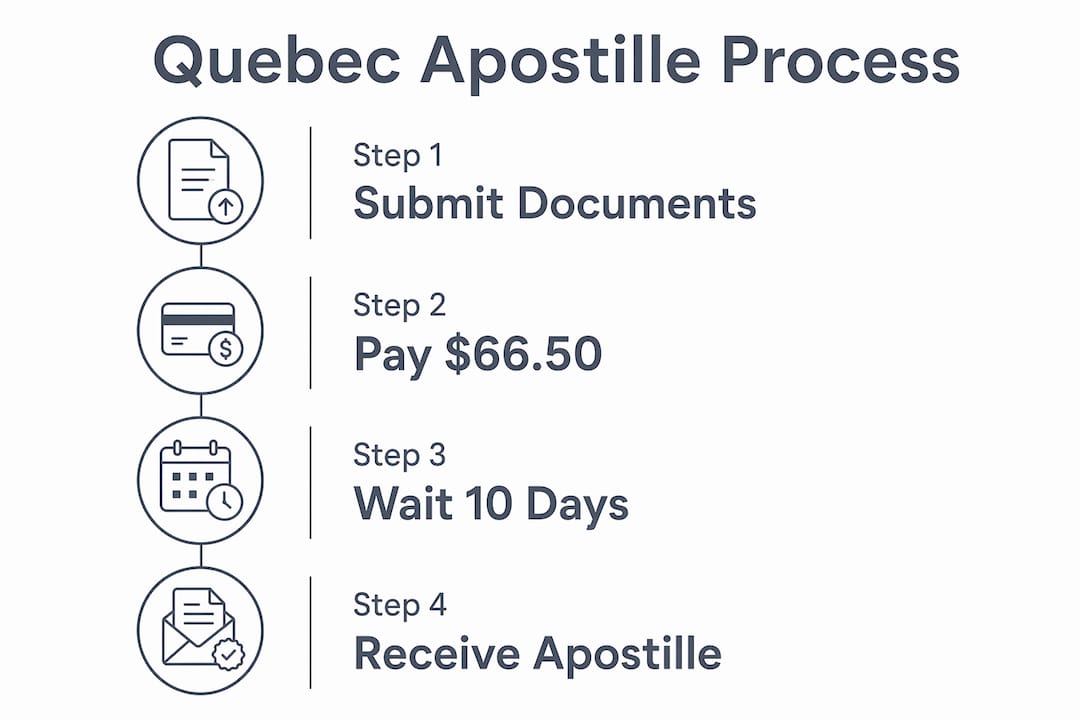
Processing takes approximately 10 business days, not counting mailing time in either direction. Delays typically occur when forms are incomplete, documents are ineligible, or the wrong payment method is used.
Common reasons for delays or refusals:
- Missing notarization or professional certification for private documents
- Documents issued before the required dates (2015 for civil acts, 2019 for others)
- Incorrect document format (driver's licenses, passports, and social insurance numbers cannot be apostilled)
- Insufficient postage on the return envelope
- Sending federal documents to the Quebec office instead of Global Affairs Canada
Which documents are eligible for apostille in Quebec?
The Ministère de la Justice du Québec issues apostilles for documents from Quebec provincial bodies. The Chambre des notaires du Québec handles certification for notarial documents before they reach the apostille stage.
Eligible document categories include:
- Civil status documents: birth certificates, marriage certificates, and name change certificates from the Directeur de l'état civil (issued 2015 or later)
- Court documents: Court of Québec, Superior Court, and Court of Appeal rulings, as well as divorce certificates (issued 2019 or later)
- Corporate documents: certified copies or attestation certificates from the Registraire des entreprises
- Educational documents: transcripts and diplomas from institutions recognized by the Ministère de l'Éducation or Ministère de l'Enseignement supérieur
- Notarial acts: certified true copy from the issuing notary plus an authenticity certificate from the Chambre des notaires du Québec
- Private documents: documents from non-public bodies in Quebec, certified by a lawyer or notary with a signature authentication from the relevant professional association
Federal documents such as RCMP background checks issued by the RCMP directly must go to Global Affairs Canada, not to Quebec's apostille office. Many applicants send these to the wrong office, which causes processing delays.
Court judgments may require two separate apostille applications: one for the judgment and one for the certificate of no appeal, each with its own $66.50 fee.
How are apostilled documents returned, and what about translations?
Apostilled documents are returned by regular mail without a tracking number. If you need tracked or expedited return, include a prepaid courier label and a large enough envelope (minimum 8.5 x 11 in.) with your application. The Ministère de la Justice does not cover any return shipping costs.
Quebec apostilles are issued in French only. If the recipient country requires the document in another language, a certified translation may be necessary.
Pro Tip: Confirm the recipient country's exact requirements before submitting. Some countries require only the original document to be apostilled; others require both the document and its translation to carry separate apostilles.
Translation requirements:
- Documents in a language other than French or English must include an official certificate from a lawyer or notary confirming they understand the content, or a translation by a member of the Ordre des traducteurs, terminologues et interprètes agréés du Québec (OTTIAQ).
- If the recipient country requires both the original and the translation to be apostilled, two separate apostille applications and fees apply.
- If only the original needs an apostille, one application covers it.
For documents destined for international use, confirming specific apostille requirements for the destination country avoids rejection after the fact.
What is the difference between apostille and authentication for Quebec documents?
An apostille and authentication both serve to make a document acceptable abroad, but they are not the same process and do not apply in the same situations.
An apostille is a standardized certificate issued under the Hague Convention. It is accepted by all 127 member countries without any further steps. Quebec's Ministère de la Justice issues apostilles directly for eligible provincial documents.
Authentication is a multi-step process used for countries that have not signed the Hague Convention. It typically involves notarization, provincial certification, and then federal authentication through Global Affairs Canada, sometimes followed by legalization at the destination country's embassy or consulate. The document legalization process for non-Hague countries is more involved and takes longer.
The practical rule: if the destination country is a Hague Convention member, request an apostille. If it is not, contact Global Affairs Canada about the full authentication and legalization chain.
Common mistakes to avoid when applying for an apostille in Quebec
Most rejected or delayed applications share the same errors. Avoiding them saves time and money.
- Sending federal documents to Quebec. The Ministère de la Justice only handles provincial documents. RCMP certificates, passports, and federal court documents go to Global Affairs Canada.
- Skipping notarization for private documents. Private documents without a lawyer or notary's official certificate and a signature authentication from the Chambre des notaires du Québec or Barreau du Québec will be refused.
- Using outdated documents. Civil status certificates must be from 2015 or later; other documents from 2019 or later.
- Sending ineligible formats. Driver's licenses, passports, and social insurance cards cannot be apostilled and will be returned without processing.
- Paying by personal check. Only credit card, money order, and bank draft are accepted.
- Not including a return envelope. Without a prepaid return envelope, documents come back by untracked regular mail.
How to verify the authenticity of an apostille received
The Gouvernement du Québec maintains an apostille register. Anyone who receives an apostilled document can check its validity through the official Quebec apostille register on the government's website. The register records the apostille number, issuing date, and related document details for each apostille issued.
To verify, locate the apostille number printed on the certificate and enter it in the register search tool. A valid result confirms the apostille was issued by the Ministère de la Justice du Québec and has not been altered.
How to prepare documents properly before submission
Document preparation is where most applications succeed or fail. The document itself must come from the authorized issuing body, not a photocopy made by the applicant.

For notarial acts, the two-step process is fixed: first, get a certified true copy from the notary who produced the original act; second, obtain an authenticity certificate from the Chambre des notaires du Québec confirming the notary's membership and signature. Both documents must accompany the apostille application.
For educational documents, request the transcript or diploma directly from the school, college, or university. Documents from private non-subsidized colleges must include a lawyer or notary's official certificate. For court documents, contact the clerk's office in the district where the ruling was issued.
Do not staple the form to the document. Attach documents belonging to the same apostille request together so they stay organized during processing. Use an envelope large enough to prevent folding.
Speedyapostilleservices handles the full process for Canadian documents, including document review, required notarization coordination, and submission to the relevant authority, with transparent all-inclusive pricing and a typical turnaround of 2–3 days.
Key Takeaways
Quebec apostilles are issued by the Ministère de la Justice du Québec, cost $66.50 per document, take approximately 10 business days to process, and must be submitted by mail with no walk-in option available.
| Point | Details |
|---|---|
| Issuing authority | The Ministère de la Justice du Québec issues apostilles for Quebec provincial documents only. |
| Fee per document | Each apostille application costs $66.50, payable by credit card, money order, or bank draft. |
| Processing time | Approximately 10 business days, not counting mailing time in either direction. |
| Document currency | Civil status certificates must be from 2015 or later; all other eligible documents from 2019 or later. |
| No walk-in service | All applications must be mailed to the Montreal office; no in-person submissions are accepted. |
FAQ
Who can apostille a document in Quebec?
The Ministère de la Justice du Québec is the only authority that issues apostilles for Quebec provincial documents. Private documents must first be certified by a lawyer or notary and accompanied by a signature authentication from the Chambre des notaires du Québec or the Barreau du Québec.
How long does it take to apostille a document in Quebec?
Processing takes approximately 10 business days, excluding mailing time. Using a prepaid courier return label can reduce the total wait, but the processing window itself does not change.
How much does it cost to get an apostille in Quebec?
The fee is $66.50 per document. Payment is accepted by credit card, money order, or bank draft payable to the Register Fund of the Ministère de la Justice. Personal checks are not accepted.
Can I walk in to get an apostille in Quebec?
No. Quebec apostille applications must be submitted by mail to the Montreal office. There is no in-person or walk-in service available.