
How to Apostille a Document in Alberta: 2026 Guide
How to Apostille a Document in Alberta: 2026 Guide ! Woman reviewing apostille documents at kitchen table Apostilling a document in Alberta means obtaining official certification from the provincial competent authority to verify its authenticity for use abroad.

How to Apostille a Document in Alberta: 2026 Guide
Apostilling a document in Alberta means obtaining official certification from the provincial competent authority to verify its authenticity for use abroad. Since january 2024, Alberta issues apostilles directly through its own provincial office, separate from the federal process managed by Global Affairs Canada. This change, tied to Canada's accession to the Hague Apostille Convention, applies to documents like birth certificates, marriage certificates, notarized affidavits, and powers of attorney. Knowing how to apostille a document in Alberta correctly saves you time, money, and the frustration of a rejected submission.
How to apostille a document in Alberta: the basics
An apostille is a standardized certificate attached to a public document to confirm its authenticity for use in another country. The Hague Apostille Convention, which Canada joined in 2024, governs this process. Alberta's Deputy Provincial Secretary serves as the competent authority for documents originating in Alberta. This is a distinct role from Global Affairs Canada, which handles federal documents and documents from other provinces.
The apostille does not change the content of your document. It certifies that the signature, seal, or stamp on the document is genuine. Foreign authorities in Hague Convention member states accept this certificate as proof of authenticity without requiring further legalization. That covers more than 125 countries, including major destinations for Canadian emigrants and students.
Which documents qualify for an Alberta apostille?
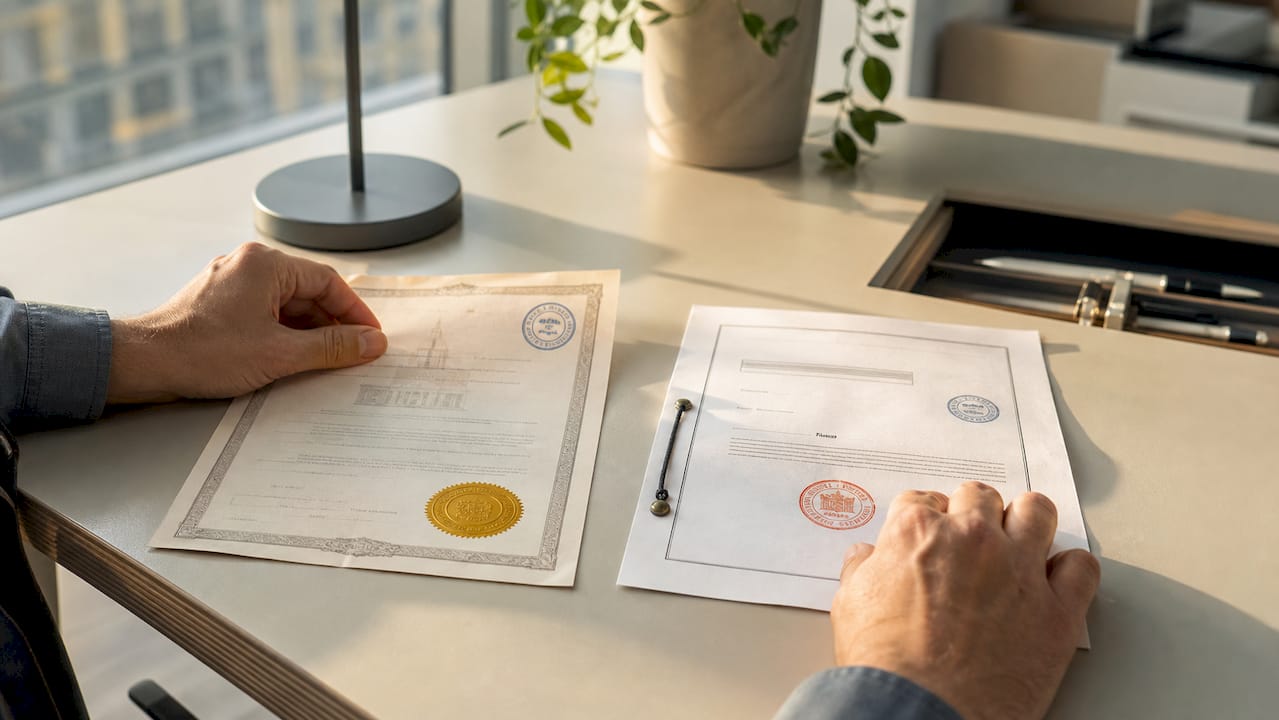
Not every document qualifies. Alberta can only apostille documents that originate within the province. The document must carry an official Alberta signature, seal, or stamp.
Public Alberta documents eligible for apostille include:
- Vital statistics records: birth certificates, marriage certificates, death certificates
- Court documents issued by Alberta courts
- Educational documents from Alberta institutions, such as diplomas and transcripts
- Documents issued by Alberta government ministries or agencies
Private documents eligible for apostille include:
- Powers of attorney notarized by an Alberta notary public
- Affidavits sworn before an Alberta commissioner of oaths
- Statutory declarations prepared and signed in Alberta
Private documents carry one firm requirement. The notary's signature and seal must be current and valid at the time of submission. An expired notary registration invalidates the document for apostille purposes. Always confirm your notary's standing before submitting.
Documents issued by the federal government, such as Canadian passports or citizenship certificates, do not qualify for Alberta's provincial apostille. Those go to Global Affairs Canada. Documents from other provinces, such as a birth certificate issued in Ontario, also go to that province's own competent authority, not Alberta's office.
Does your destination country require an apostille?
Confirming your destination country's requirements is the most critical step before you do anything else. Sending an apostilled document to a country that does not accept apostilles, or skipping the apostille for a country that requires one, causes delays and added costs.
The Hague Apostille Convention covers more than 125 member countries. If your destination country is a member, an apostille is the correct form of authentication. If it is not a member, you need traditional authentication and legalization, which is a different and longer process handled through Global Affairs Canada and the destination country's embassy.
Pro Tip: Check the destination country's embassy or consulate website directly. Requirements can vary by document type, even within the same country. A birth certificate for immigration purposes may have different requirements than a diploma for a work permit.
Do not assume that because one country accepts apostilles, a neighboring country does the same. Countries like China and Saudi Arabia are not Hague Convention members and require traditional legalization. Countries like France, Germany, Spain, and the United States are members and accept apostilles. Verifying this upfront prevents the most common and costly mistake in the entire process.
Some foreign authorities also require that your document be translated into their official language before they will accept it. The apostille itself does not address translation. That is a separate step covered later in this guide.
Step-by-step process to get your Alberta document apostilled
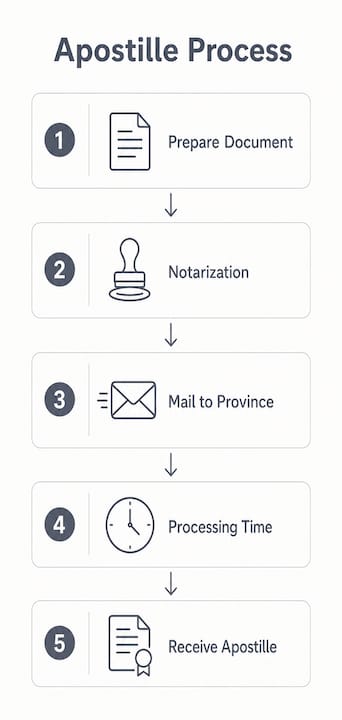
Follow these steps in order. Skipping or reordering them is the most common reason applications get rejected.
-
Confirm your document's origin. Verify that your document was issued or notarized in Alberta. If it was issued by the federal government or another province, Alberta's office cannot process it.
-
Obtain an official copy. For vital statistics documents like an apostille birth certificate Alberta residents need, request a certified copy directly from Alberta Vital Statistics. For court documents, request a certified copy from the issuing court. Photocopies are not accepted.
-
Notarize private documents if required. Powers of attorney, affidavits, and similar private documents must be notarized by an Alberta notary public before submission. Confirm the notary's seal and signature are current.
-
Complete the application form. Alberta's Deputy Provincial Secretary's Office provides the required application form. Fill it out completely. Incomplete forms are returned without processing.
-
Prepare payment. The fee is $25.00 per document. Payment receipts are emailed after processing. Confirm accepted payment methods with the office before submitting, as these can change.
-
Mail your documents. Applications must be mailed to the Deputy Provincial Secretary's Office. In-person submissions are not accepted. Include your return address and a copy of your payment receipt with the package.
-
Wait for processing. Processing typically takes 7–10 business days from receipt. Plan around this timeline, especially if you have visa deadlines or enrollment dates.
The table below summarizes the key details for quick reference.
| Step | Detail |
|---|---|
| Document origin | Must be issued or notarized in Alberta |
| Copies required | Official certified copies only, no photocopies |
| Notarization | Required for private documents; notary seal must be valid |
| Fee | $25.00 per document |
| Submission method | Mail only; in-person not accepted |
| Processing time | 7–10 business days |
Pro Tip: Use a tracked mailing service when sending your documents. The Deputy Provincial Secretary's Office does not accept responsibility for documents lost in transit. Keep copies of everything you send.
Sending documents to the wrong authority is the single most common error. Alberta documents go to Alberta's provincial office. Federal documents and documents from other provinces go to their respective authorities. Getting this wrong means your documents are returned and you restart the process from scratch.
What to do when your documents need certified translation
The apostille certifies the authenticity of a document. It does not certify any translation of that document. These are two separate processes, and confusing them causes rework.
Here is when a certified translation is required:
- The destination country's official language differs from the language of your document
- The foreign authority explicitly requests a translation alongside the apostille
- Immigration or educational institutions in the destination country require translated supporting documents
The correct sequence matters:
- Apostille the original document first
- Then have a certified translator translate the apostilled document
- If the destination country requires it, have the translation notarized separately
Certified translations may need notarization depending on the destination country's rules. Germany, for example, often requires that translations be certified by a sworn translator recognized by a German court. France has its own list of certified translators. Always check the specific requirements of the receiving authority, not just the country in general.
Hiring a translator familiar with legal translation standards for your destination country reduces the risk of rejection. A general translation service may produce an accurate translation that still fails to meet the formatting or certification requirements of a foreign court or government office.
For families relocating abroad or students applying to foreign universities, getting the apostille and translation sequence right from the start avoids weeks of delays. Verify requirements with the destination country's embassy or consulate before commissioning any translation work. Some countries also require that the apostille itself be translated, which adds another step.
Key Takeaways
Apostilling an Alberta document requires submitting the correct document type to the provincial competent authority by mail, with a $25.00 fee and a processing time of 7–10 business days.
| Point | Details |
|---|---|
| Provincial authority since 2024 | Alberta handles its own apostilles; federal documents go to Global Affairs Canada. |
| Document eligibility | Only documents issued or notarized in Alberta qualify for the provincial apostille. |
| Notarization is mandatory | Private documents need a valid Alberta notary seal before submission. |
| Mail-only submission | In-person drop-off is not accepted; use tracked mail and keep copies. |
| Translation is separate | The apostille does not cover translations; sequence apostille first, then translate. |
What I have learned from watching Alberta apostille applications go wrong
The apostille process in Alberta is straightforward on paper. The problems almost always come from assumptions, not from the process itself.
The most consistent mistake I see is people sending Alberta documents to Global Affairs Canada. Before 2024, that was the correct route for all Canadian documents. The provincialization of apostille services changed that entirely. Many people, and even some legal professionals, have not updated their understanding. If you send an Alberta birth certificate to the federal office, it comes back to you unprocessed, and you lose the time you spent waiting.
The second most common issue is submitting private documents without valid notarization. A notary's commission expires. If the notary who signed your power of attorney is no longer registered, the signature cannot be verified, and the apostille will be refused. Always call the notary's office and confirm their current standing before you mail anything.
Planning for translation is where families relocating internationally tend to underestimate the timeline. The apostille takes 7–10 business days. A certified legal translation can take another week or more, depending on the language pair and the translator's workload. If the translation also needs notarization, add more time. Starting this process two months before your deadline is not excessive. Starting three weeks before is a risk.
One thing that genuinely helps is using online verification tools to confirm that an issued apostille is valid before you send your documents abroad. This is especially useful if you are working with copies or if there was any delay in processing. Catching a problem before the document reaches a foreign authority is far better than dealing with a rejection overseas.
— Ken
Speedyapostilleservices can handle your Alberta apostille
Speedyapostilleservices, based in Toronto, processes Canadian apostille documents including birth certificates, marriage certificates, and diplomas for recognition in over 120 Hague Convention countries. The service includes document review, verification, and secure handling, with a typical turnaround of 2–3 days.
All pricing includes government fees upfront, so there are no surprise costs at the end. Speedyapostilleservices has over 1,000 verified reviews and a 5.0 rating. Families and individuals who need documents processed quickly and correctly use this service to avoid the errors that cause rejections and delays. To get started, submit your documents directly through the Speedyapostilleservices platform.
FAQ
What is the fee to apostille a document in Alberta?
The fee is $25.00 per document. Payment receipts are emailed after processing.
How long does the Alberta apostille process take?
Processing typically takes 7–10 business days from the date the Deputy Provincial Secretary's Office receives your documents.
Can I submit my documents in person?
No. The Deputy Provincial Secretary's Office only accepts mailed applications. In-person submissions are not accepted.
What documents can Alberta apostille?
Alberta can apostille documents issued by the provincial government, such as birth and marriage certificates, and private documents notarized by an Alberta notary public, such as affidavits and powers of attorney.
Does the apostille cover translations of my document?
No. The apostille certifies the authenticity of the original document only. Certified translations are a separate step and may require their own notarization depending on the destination country's rules.