
The Hague Convention: What It Means for Your Canadian Documents
The Hague Convention: What It Means for Your Canadian Documents ! Hands preparing Canadian documents for apostille An apostille authenticates a public document's signature and seal so it gets recognized in any of the 130 countries that belong to the Hague Apostille Convention.

The Hague Convention: What It Means for Your Canadian Documents
An apostille authenticates a public document's signature and seal so it gets recognized in any of the 130 countries that belong to the Hague Apostille Convention. Canada joined the Convention on January 11, 2024, which means Canadian birth certificates, diplomas, and corporate records no longer go through the older multi-step legalization chain when they're headed to a member country.
Before you submit anything, confirm two things:
- Check the destination country against the HCCH status table to confirm it's a Convention member.
- Review Global Affairs Canada's authentication guidance for the specific rules that apply to your document type.
Key Takeaways
An apostille authenticates a public official's signature on a Canadian document, letting it be recognized in any of the 130 Hague Convention member countries without further embassy legalization.
| Point | Details |
|---|---|
| Confirm membership first | Check the destination country against the HCCH status table before starting any paperwork. |
| Know what qualifies | Birth certificates, diplomas, corporate records, court documents, and RCMP checks are typical eligible documents. |
| Watch the allonge | A valid apostille is a securely affixed certificate showing a seal, signature, issuing authority, and date. |
| Non-signatory countries need more | Documents headed to non-member countries still require embassy or consular legalization after authentication. |
| Speedyapostilleservices as an option | Offers all-in pricing and 2 to 3 day expedited turnaround for Canadian documents needing apostilles. |
Table of Contents
- How Does the Hague Convention Work for Canadian Documents?
- Who Issues an Apostille in Canada?
- Step-by-Step: Getting a Document Ready for Submission
- How Long Does an Apostille Take and What Does It Cost?
- What If the Destination Country Isn't a Hague Member?
- How Do You Verify an Apostille Is Real?
- What the Convention Actually Solves, and Where People Get It Wrong
- A Faster Path for Time-Sensitive Apostille Needs
- Sources
- FAQ
How Does the Hague Convention Work for Canadian Documents?
Not every document you own qualifies. The Convention covers "public documents," a category that includes government-issued records, notarized papers, and official academic credentials. It does not cover private contracts between individuals that haven't been notarized or certified by a public official.
For Canadians, the documents that typically qualify include:
- Birth and marriage certificates issued by a provincial or territorial vital statistics office.
- Diplomas and academic transcripts from accredited institutions.
- Corporate records, including articles of incorporation and good standing certificates.
- Court documents, such as judgments or divorce decrees.
- Powers of attorney that have been properly notarized.
- RCMP criminal record checks.
An apostille doesn't verify that the content of your document is true. It confirms that the signature, seal, or stamp on the document belongs to a legitimate public official or notary. That distinction trips people up constantly. A university transcript still needs to say what it says. The apostille just confirms the registrar's signature on it is real.
Document condition matters too. Most competent authorities want an original or a certified true copy, not a photocopy you made at home. Some documents, like powers of attorney, need notarization first before they're eligible for authentication at all.
Pro Tip: Order an extra certified copy of your document before starting the apostille process. If a competent authority rejects your original for a formatting issue, you won't lose weeks waiting for a replacement.
Who Issues an Apostille in Canada?
Apostilles in Canada come from designated competent authorities, not from the Hague Conference itself. The HCCH sets the rules and maintains the treaty framework, but it doesn't issue or verify individual apostilles for any country, including Canada.
Here's what actually happens once a document is submitted:
- The competent authority reviews the document and confirms the underlying signature or seal is genuine.
- It issues an apostille as a separate certificate, called an allonge, that gets securely affixed to the document.
- The allonge includes the issuing country, the signer's name and capacity, the seal or stamp of the authority, and the date and place of issuance.
Roughly 130 countries now participate in the Convention framework, and a growing number issue apostilles electronically through the e-APP, or electronic Apostille Programme, launched in 2006. Canada currently issues apostilles as physical certificates. The allonge has to be firmly attached, not loosely stapled, because a document with a detachable or tampered allonge can be rejected outright by the receiving institution abroad.
Step-by-Step: Getting a Document Ready for Submission
Getting rejected on your first attempt usually comes down to preparation, not paperwork complexity. Build your submission around this checklist:
- Confirm you have an original document or a certified true copy, not a plain photocopy.
- Complete any required notarization before submission, especially for powers of attorney or affidavits.
- Arrange certified translations if the destination country requires the document in a language other than English or French.
- Gather supporting identification and any request forms the competent authority specifies.
- Double-check that names, dates, and spellings match across every page and every supporting document.
From there, you have three practical paths. You can submit directly to the competent authority yourself, work through a provincial authentication process if your document originates provincially, or use a qualified expedited service that handles submission on your behalf. Our document checklist tool walks through exactly what each document type needs before it goes in.
The errors that cause the most delays are mundane: mismatched names between a marriage certificate and a passport, loose or unstapled attachments, and documents submitted without the notarization the destination country actually requires. Catching these before submission saves weeks, not days.
How Long Does an Apostille Take and What Does It Cost?
Standard government processing timelines vary depending on the province and the current volume of requests, and they can stretch out during peak seasons like the summer immigration and study-permit rush. Expedited services exist specifically because standard timelines often don't match real deadlines like visa interviews or closing dates.
Fees typically break down into a few components:
- A government authentication fee charged by the competent authority.
- Notarization costs, if your document needs it first.
- Courier fees for sending and returning physical documents.
- A service fee if you use an expedited provider instead of self-submitting.
Speedyapostilleservices bundles all of these into a single all-in price upfront, with a typical turnaround of 2 to 3 days on expedited orders. That transparency matters because government fees alone can be confusing to estimate ahead of time, and hidden add-on costs are a common complaint with self-submission.
Pro Tip: If your deadline is firm, like a visa appointment or a foreign job start date, ask about expedited processing before you submit anything. Rush options exist, but they need to be requested up front, not after a document is already in the queue.
What If the Destination Country Isn't a Hague Member?
An apostille only works for countries that belong to the Convention. If your document is headed somewhere that hasn't joined, the older legalization process still applies, and it involves more steps than an apostille alone.
- Confirm the destination country's status using the HCCH status table before you do anything else.
- If it's not a member, contact that country's embassy or consulate in Canada to get their exact legalization requirements. Resources like Fast Passport Center's forms guidance walk through typical embassy documentation steps.
- Authenticate the document in Canada first, then submit it for embassy or consular legalization, either here or once you arrive in the destination country.
This two-step path takes longer than a standard apostille, so build in extra time if you're dealing with a non-signatory country.
How Do You Verify an Apostille Is Real?
Fraudulent or improperly issued apostilles do circulate, usually from unofficial "expediting" services cutting corners. Verification is straightforward if you know where to look.
- Cross-check the destination country against the HCCH status table to confirm it recognizes apostilles at all.
- Confirm the issuing authority is a recognized competent authority for the province or territory where the document originated.
- Inspect the allonge itself: it should show a clear seal, the issuing authority's name, an authorized signature, and a date, all firmly affixed to the document rather than loosely attached.
The Convention now covers 130 contracting parties, and that scale is exactly why fraud attempts happen: more countries accepting apostilles means more opportunity for bad actors to fake one. If you suspect a document has been tampered with or issued by an unauthorized party, contact the competent authority directly rather than the business that processed it.
What the Convention Actually Solves, and Where People Get It Wrong
The most common mistake I see in how people approach this topic is treating the apostille process like a formality to rush through instead of a verification chain that has to hold up under scrutiny abroad. The Convention's real value isn't speed. It's standardization. A single certificate, recognized the same way across 130 countries, replaces what used to be an unpredictable embassy-by-embassy legalization slog.
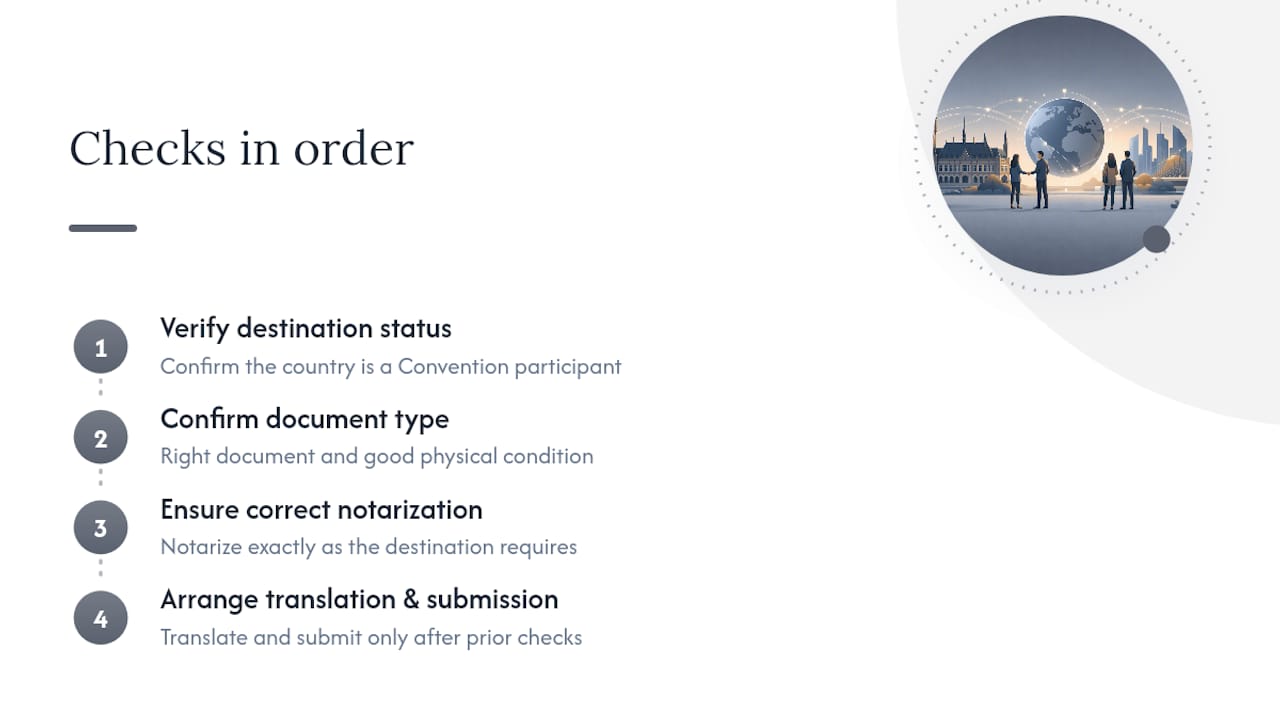
Where conventional advice falls short is in treating "get an apostille" as the whole task. It isn't. The document has to be the right type, in the right condition, notarized correctly if required, and matched to a destination country that actually participates in the Convention. Skip any of those checks and the apostille itself becomes worthless paper.
If you're prioritizing one thing before anything else, make it verification of the destination country's status. Everything else, notarization, translation, submission method, only matters once you know an apostille is even the right tool for where your document is going.
A Faster Path for Time-Sensitive Apostille Needs
Speedyapostilleservices handles the full range of documents covered in this guide: birth and marriage certificates, diplomas and transcripts, corporate records, court documents, and RCMP background checks, prepared for use in any of the 120-plus Hague Convention member countries.

The all-in pricing model rolls government fees, notarization when needed, courier costs, and service charges into a single quoted price before you commit, so there's no surprise invoice after your documents are already in process. Typical turnaround runs 2 to 3 days on expedited orders, backed by more than 1,000 client reviews and a 5.0 rating. An order starts with a document review, so gather your originals or certified copies and any notarization you already have on hand. Get a quote through the pricing and instant quote calculator to see exact costs for your specific document before you submit anything.
Sources
FAQ
What Does an Apostille Actually Certify?
An apostille confirms that a signature, seal, or stamp on a public document is genuine and was issued by a recognized authority. It does not verify the truth of the document's contents.
When Did Canada Join the Hague Apostille Convention?
Canada's accession took effect on January 11, 2024, allowing Canadian public documents to be apostilled instead of going through traditional embassy legalization for member countries.
How Many Countries Belong to the Hague Convention?
The Convention currently has 130 contracting parties, and that number is checked against the HCCH status table since membership changes periodically.
What Happens If My Destination Country Isn't a Member?
You'll need traditional legalization instead: authenticate the document in Canada, then have it legalized by that country's embassy or consulate here or in the destination country.
How Fast Can I Get an Apostille in Canada?
Standard government processing varies by province, but expedited services like Speedyapostilleservices offer typical turnaround of 2 to 3 days with all-in pricing that includes government fees upfront.