
Which Countries Accept the Hague Apostille?
Which Countries Accept the Hague Apostille? !
Which Countries Accept the Hague Apostille?
The Hague Conference on Private International Law (HCCH) maintains the only authoritative list of Hague apostille countries through its status table, which currently shows 130 contracting parties. If your destination country is on that list, you need an apostille. If it is not, you need embassy or consulate legalization instead.
- Check the HCCH status table before assuming any country accepts an apostille.
- A destination's membership status can change, so a date matters as much as a name on the list.
The HCCH status table currently lists numerous contracting parties in the 1961 Apostille Convention, along with each country's entry-into-force date.
Key Takeaways
An apostille is valid only between two Hague Convention member countries, and HCCH's status table is the single source that determines eligibility on any given date.
| Point | Details |
|---|---|
| Verify with HCCH first | Check the status table for membership and entry-into-force date before relying on any list. |
| Match issuing and destination status | Both countries must be contracting parties or the document needs legalization instead of an apostille. |
| Get it from the source country | Request the apostille from the competent authority where the document was issued, not the destination country. |
| Watch accession dates closely | Recently reported accessions, like Algeria and Vietnam, need entry-into-force confirmation before you rely on them. |
| Consider a managed option | Speedyapostilleservices handles Canadian document apostilles with all-in pricing and typical 2 to 7 day turnaround for readers who want to skip the direct-submission wait. |
A Note on Trusting Third-Party Lists
Plenty of blog posts publish country lists that look current but quietly lag behind the actual HCCH record. I've seen readers assume a country accepts an apostille because a roundup article said so, only to have their document bounced back. Check the entry-into-force date directly, and confirm the competent authority before you submit anything.
— Ken
A Faster Path for Canadian Documents
There are other routes to get a Canadian document apostilled: contacting the issuing province directly, or submitting through Global Affairs Canada yourself. Both work, but both also mean navigating government office hours, unclear processing queues, and the risk of a formatting rejection sending you back to square one.

Speedyapostilleservices handles the entire process for Canadian-issued birth certificates, marriage licenses, diplomas, transcripts, and corporate records, with all-inclusive pricing that folds in government fees upfront so there are no surprise costs after submission. Typical turnaround runs 2 to 7 days depending on the service tier and document type. If your document is headed to one of the Hague apostille countries, start by confirming eligibility with the country checker, then review the apostille and notary services page to see which turnaround option fits your timeline.
Table of Contents
- Hague Apostille Convention Countries by Region
- When Do You Need an Apostille Instead of Legalization?
- How to Verify a Country's Status and Find Its Competent Authority
- What Happens When a Non-Hague Country Is Involved?
- Do Bilateral Agreements Change the Apostille Process?
- Sources
- FAQ
Hague Apostille Convention Countries by Region
Scanning a full alphabetical list is tedious when you only care about one destination. Grouping by region gets you to your answer faster, and it mirrors how HCCH itself organizes accession activity.
Europe accounts for the largest bloc of contracting parties, and nearly every country on the continent participates, including Albania, Andorra, Austria, Belgium, Bosnia and Herzegovina, Bulgaria, Croatia, Cyprus, Czechia, Denmark, Estonia, Finland, France, Georgia, Germany, Greece, Hungary, Iceland, Ireland, Italy, Kosovo, Latvia, Liechtenstein, Lithuania, Luxembourg, Malta, Moldova, Monaco, Montenegro, Netherlands, North Macedonia, Norway, Poland, Portugal, Romania, Russia, San Marino, Serbia, Slovakia, Slovenia, Spain, Sweden, Switzerland, Turkey, Ukraine, and the United Kingdom.
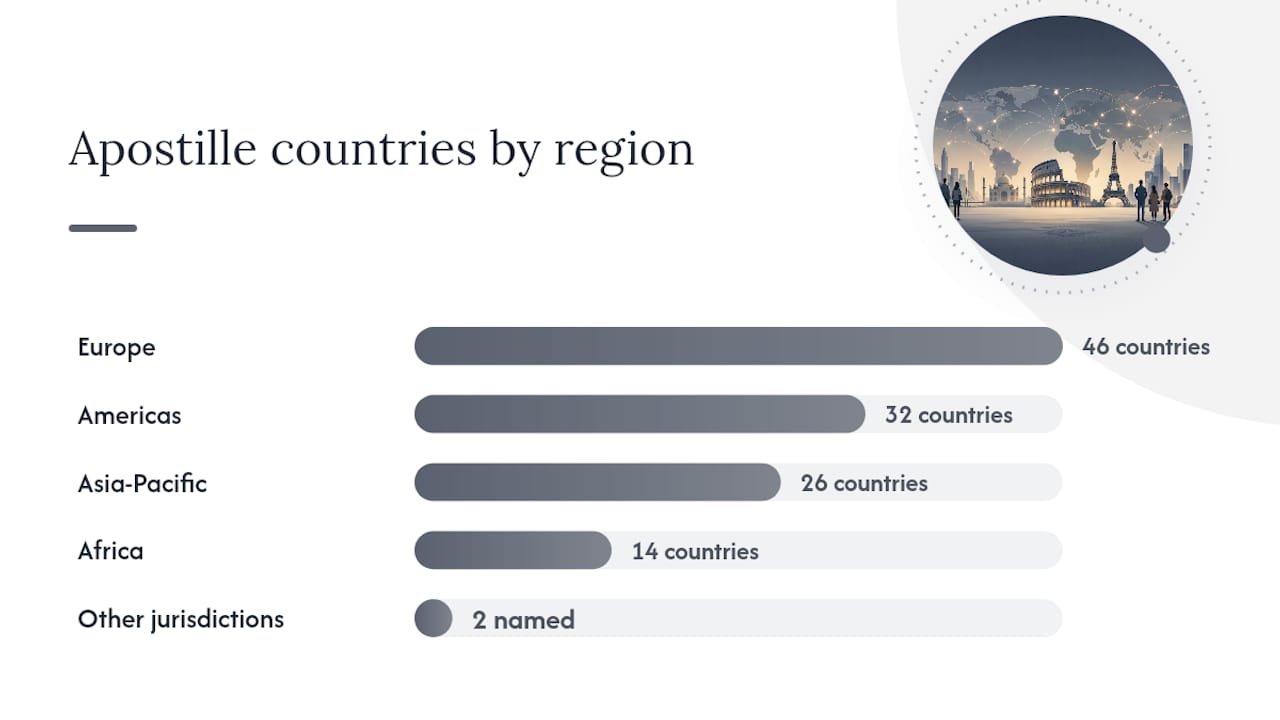
Americas membership covers most of North, Central, and South America, including Antigua and Barbuda, Argentina, Bahamas, Barbados, Belize, Bolivia, Brazil, Chile, Colombia, Costa Rica, Dominica, Dominican Republic, Ecuador, El Salvador, Grenada, Guatemala, Guyana, Honduras, Jamaica, Mexico, Nicaragua, Panama, Paraguay, Peru, Saint Kitts and Nevis, Saint Lucia, Saint Vincent and the Grenadines, Suriname, Trinidad and Tobago, the United States, Uruguay, and Venezuela. Canada is notably absent from this list, a point worth flagging since it affects how Canadian-issued documents get authenticated for use abroad.
Asia and Pacific participation has grown steadily, and now includes Australia, Azerbaijan, Brunei, China (with Hong Kong and Macao participating under separate arrangements), Cook Islands, Fiji, India, Israel, Japan, Kazakhstan, Marshall Islands, Mongolia, New Zealand, Niue, Oman, Palau, Philippines, Samoa, Singapore, South Korea, Tajikistan, Tonga, Uzbekistan, and Vanuatu. Vietnam has shown recent accession activity, but its entry-into-force date needs direct confirmation on the HCCH status table before you rely on it.
Africa has fewer contracting parties than other regions, but the list includes Botswana, Burundi, Cabo Verde, Eswatini, Lesotho, Liberia, Malawi, Morocco, Namibia, Rwanda, São Tomé and Príncipe, Senegal, South Africa, and Tunisia. Algeria has also seen recent accession news, and again the effective date is the detail that matters before you treat it as usable.
Other jurisdictions with contracting-party status include Kuwait, Saudi Arabia, and several small island nations not captured above. Several aggregator sites, including a 2026 country list roundup, reflect similar membership counts and are useful for a quick scan, but HCCH remains the source you confirm against before submitting any document.
When Do You Need an Apostille Instead of Legalization?
An apostille is a single-page certificate that authenticates a public document for use in any other contracting party, replacing what used to be a multi-step embassy chain. The Apostille Convention works only when both the issuing country and the destination country are members. If your destination is not on the HCCH list, you need legalization, a longer process that typically involves your country's foreign affairs department and then the destination's embassy or consulate.
You get the apostille from the competent authority in the place where the document was issued, never from the destination country. A Canadian-issued birth certificate gets its apostille from a Canadian authority, regardless of where in the world it is headed.
To figure out which route you need:
- Identify the destination country for your document.
- Check that country's status on the HCCH status table.
- If it is a contracting party, request an apostille from the issuing jurisdiction's competent authority.
- If it is not, contact the destination's embassy or consulate to begin legalization.
Pro Tip: Screenshot the HCCH status table entry for your destination country before you submit documents anywhere. Requirements and effective dates get misquoted often enough that having the primary source on hand saves you a rejected submission.
How to Verify a Country's Status and Find Its Competent Authority
Two lookups settle nearly every question about apostille eligibility. First, check the HCCH status table for your destination country's membership and entry-into-force date. Second, use the HCCH Apostille Section to identify the designated competent authority, since only that specific office can legally issue or verify an apostille for a given jurisdiction.
- Confirm membership and entry-into-force date on the HCCH status table.
- Identify the competent authority through HCCH's Apostille Section listings.
- Check whether the country participates in the e-APP, the electronic apostille program that allows issuance and online verification without a paper certificate.
- Never rely solely on a third-party blog's accession claim without cross-checking HCCH directly.
Recent Accessions and How to Read HCCH Dates
HCCH's status table tracks three separate dates: signature (a country agrees in principle), deposit (formal ratification is filed), and entry into force, the date the convention actually becomes binding. Algeria and Vietnam both saw accession activity noted by third-party trackers, but neither date should be treated as final until it appears as an entry-into-force date on HCCH's own page. Check the table's "last update" timestamp to know how current the information is.
What Canadian Document-Holders Typically Do
Canadians requesting an apostille generally go one of two ways: dealing directly with the relevant provincial or federal issuing authority, or using a paid expediter that handles submission and pickup. Direct submission can take weeks depending on the office's backlog. Professional providers typically report turnaround in the 2 to 7 day range, though fees and processing times vary by document type and issuing authority.
- Provincial documents (birth certificates, marriage licenses) generally route through the issuing province's authentication office.
- Federal documents and corporate records may route through Global Affairs Canada.
- A Hague country checker and a document checklist help you confirm eligibility and prepare paperwork before you submit.
Pro Tip: Order an extra certified copy of any document you plan to apostille. If a competent authority flags a formatting issue, you avoid a second trip to the records office.
What Happens When a Non-Hague Country Is Involved?
An apostille only works when both the issuing country and the destination are contracting parties. If either side sits outside the convention, the apostille loses its authority entirely, and the document needs full legalization instead.
This creates a common point of confusion for people moving documents between a Hague country and a non-member destination. Say a Canadian document travels to a country that has not joined the convention. Since Canada is not itself a member either, the document requires legalization through Global Affairs Canada's authentication process, followed by the destination country's embassy or consulate, regardless of whether the destination has any Hague ties elsewhere. The reverse case matters too: a document issued in a non-Hague country and destined for a Hague member cannot simply receive an apostille from the issuing country, because that country has no competent authority authorized to produce one. Legalization is the only path.
Businesses handling contracts, incorporation papers, or powers of attorney across mixed jurisdictions run into this constantly. A single multinational deal might require an apostille for one signatory's documents and full legalization for another's, depending on each country's convention status. Checking both sides of the transaction against the HCCH list, not just your own country's status, prevents a document from being rejected months into a deal.
Do Bilateral Agreements Change the Apostille Process?
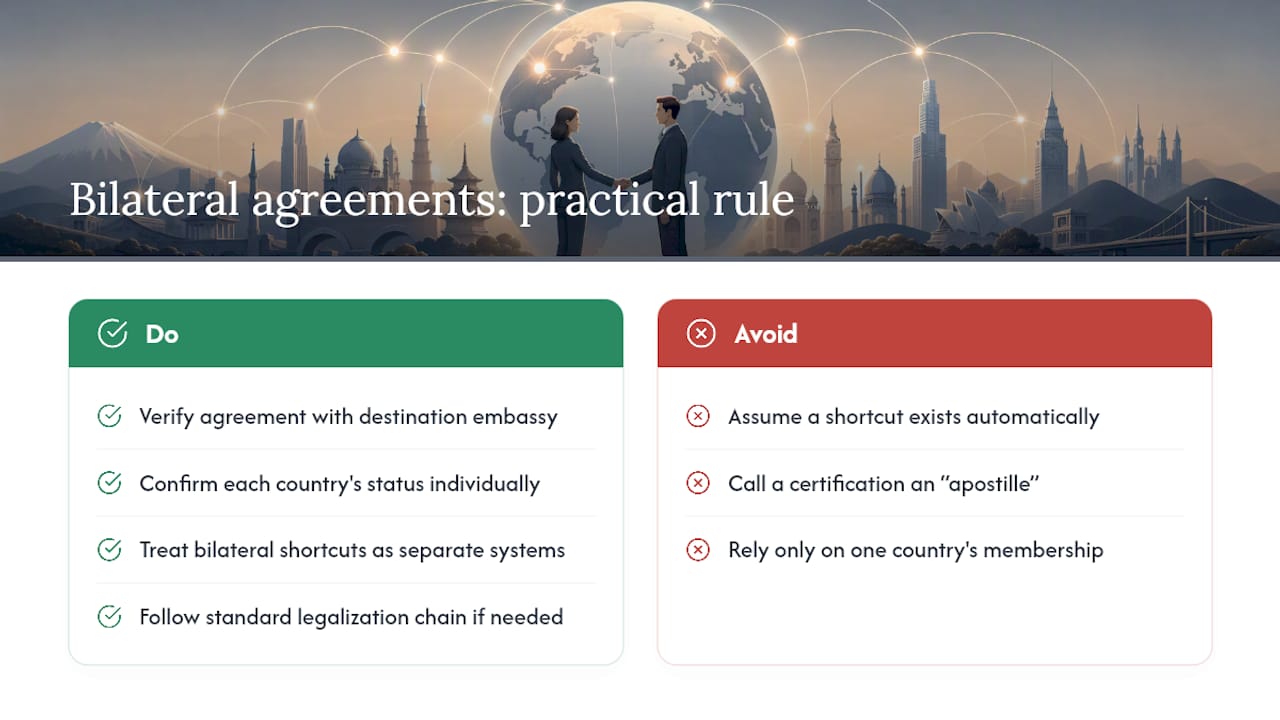
Bilateral treaties between two non-Hague countries, or between a Hague member and a non-member, can create separate authentication shortcuts that operate outside the apostille system entirely. These agreements are narrower than the Hague Convention. They typically apply to a specific document category, or exist only between two named countries rather than the roughly 130 that recognize each other's apostilles.
A country that has such an agreement with your issuing jurisdiction might accept a simplified certification process even though it is not an HCCH contracting party. That process is not an apostille, and calling it one on your paperwork can cause confusion or outright rejection at the receiving end. The safest approach is to treat bilateral shortcuts as separate systems: verify them directly with the destination country's foreign ministry or embassy rather than assuming any overlap with Hague procedures.
For readers dealing with a non-Hague destination, understanding the standard legalization chain still matters, since most bilateral arrangements are modifications of that baseline process rather than replacements for it; a guide to legalization procedures outlines how these embassy-based steps typically work for readers who need the longer route. A guide to legalization procedures outlines how these embassy-based steps typically work for readers who need the longer route. The practical rule holds regardless of any bilateral wrinkle: confirm both countries' status individually, and never assume a shortcut exists just because one side of the transaction is a Hague member.
Sources
Three references settle nearly every question in this guide: the HCCH status table for membership and dates, the HCCH Apostille Section for competent authority details, and the Convention Countries page from the U.S. Department of State for a government-issued explanation of how the rule applies in practice.
- 12 - Status table
FAQ
What Countries Are in the Hague Convention?
The HCCH status table lists 130 contracting parties across Europe, the Americas, Asia and the Pacific, Africa, and several other jurisdictions, covering most major destinations for international document use.
Is Canada Part of the Hague Apostille Convention?
No. Canada is not a contracting party to the 1961 Apostille Convention, which means Canadian-issued documents typically require legalization rather than an apostille when destined for another non-member country, though many Hague member countries do accept apostilles on Canadian documents under separate accession arrangements.
What Is the Difference Between Hague and Non-Hague Countries?
Hague countries accept a single apostille certificate from the issuing country's competent authority, while non-Hague countries require full legalization involving the issuing country's foreign affairs department and the destination's embassy or consulate.
Which Countries Require an Apostille?
Any contracting party to the Hague Convention requires an apostille rather than legalization for foreign public documents, provided the issuing country is also a member; check the status table to confirm both sides of the transaction.
Can Speedyapostilleservices Help With Documents for Any Hague Country?
Speedyapostilleservices processes Canadian-issued documents for use in any of the current contracting parties, using its Hague country checker to confirm eligibility before submission.