
GAC vs Provinces: Where to Send Canadian Documents for a Hague Apostille
GAC vs Provinces: Where to Send Canadian Documents for a Hague Apostille ! Apostille allonge attachment under review Yes, Canada issues apostilles.
GAC vs Provinces: Where to Send Canadian Documents for a Hague Apostille
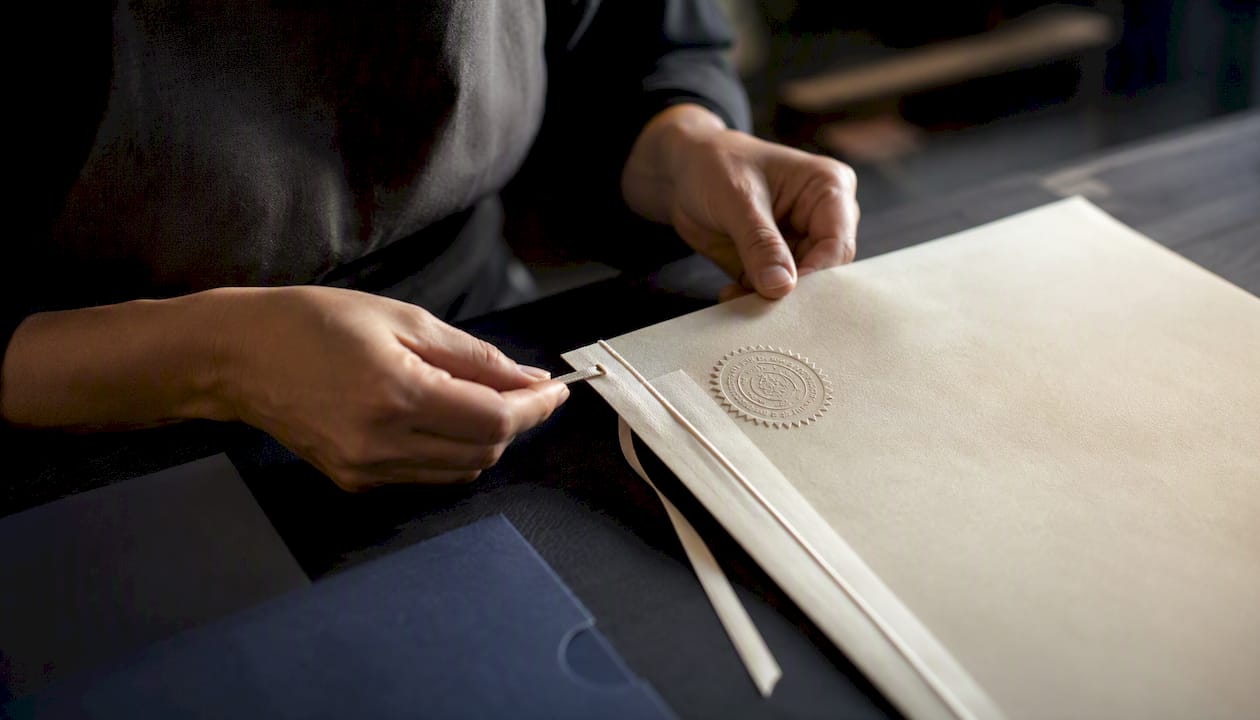
Yes, Canada issues apostilles. Canada joined the Hague Apostille Convention effective January 11, 2024, so eligible Canadian public documents headed to Hague signatory countries now receive an apostille (an allonge) instead of multi-step consular legalization. Where you send the document depends on whether it was issued or notarized federally or provincially.
TL;DR:
- Apostilles are now issued directly for Canadian documents headed to Hague signatory countries, eliminating the need for separate legalization steps unless the destination is non-member.
- Canada’s apostille process requires carefully identifying the correct authority among federal and provincial offices based on where the document was issued, notarized, or signed.
- Most Canadian public documents qualify for an apostille, but foreign-issued documents, photocopies, and improperly altered or laminated papers are excluded.
- The typical processing time ranges from 15 to 25 business days, with fees varying by province, and mail delays should be factored into planning.
- Verifying the apostille’s validity with the issuing authority’s registry is essential, and non-signatory countries require traditional authentication and consular legalization.
Table of Contents
- What Is a Hague Apostille and What Changed for Canada?
- Who Issues Apostilles in Canada?
- Which Documents Qualify for an Apostille?
- How to Get an Apostille on a Canadian Document, Step by Step
- How Long Does an Apostille Take, and What Does It Cost?
- How to Verify an Apostille and Avoid Common Mistakes
- What If the Destination Country Hasn't Joined the Hague Convention?
- What Ken Has Learned Handling Canadian Apostille Requests
- Skip the Guesswork: Let Speedy Apostille Services Handle the Routing
- Sources
- FAQ
What Is a Hague Apostille and What Changed for Canada?
An apostille is a certificate attached to a public document, called an allonge, that confirms a signature is genuine and that the signer acted in an official capacity. It does not verify or vouch for the content inside the document itself.
Before January 11, 2024, a Canadian document headed abroad needed authentication by Global Affairs Canada, then legalization by the destination country's embassy or consulate. That two-step process is gone for any document going to a fellow member of the Hague Apostille Convention. One apostille now does the job legalization used to do.
Before you rely on that shortcut, confirm your destination is actually a signatory:
- Check the HCCH signatory list directly, since membership has grown steadily since 2024.
- Use a country checker tool to cross-reference quickly.
- Ask the receiving institution abroad, because some still request extra steps regardless of treaty status.
Who Issues Apostilles in Canada?
Canada doesn't have one national apostille office. Jurisdiction splits between the federal government and several provinces, and sending a document to the wrong one is the single fastest way to lose a week.
The named competent authorities are:
- Global Affairs Canada (GAC) — handles federal documents and anything from provinces without their own designated authority.
- Ontario Official Documents Services (ODS) — documents issued or notarized in Ontario.
- Ministry of the Attorney General of British Columbia — BC-issued or BC-notarized documents.
- Ministry of Justice of Alberta — Alberta-issued or Alberta-notarized documents.
- Ministry of Justice and Attorney General of Saskatchewan — Saskatchewan-issued documents.
- Minister de la Justice du Québec — Quebec-issued documents.
The rule of thumb: figure out where the document was signed, notarized, or issued, not where you happen to live. A diploma from a Toronto university goes to Ontario ODS. A federal RCMP background check goes to Global Affairs Canada, no matter what province you're mailing it from.
Which Documents Qualify for an Apostille?
Most Canadian-issued public documents qualify, but the exclusion list catches a lot of people off guard.
Typically eligible:
- Vital statistics records (birth, marriage, death certificates)
- Court orders and judgments
- Educational diplomas and transcripts
- Corporate records and articles of incorporation
- Powers of attorney and other notarized instruments
- RCMP criminal record checks, provided they were issued in Canada
Common exclusions that trigger rejection:
- Documents originally issued in another country, even if they're now in your possession in Canada
- Photocopies instead of certified originals
- Laminated, glued, or stapled-together papers
- Religious documents with no government issuing authority behind them
Notarization requirements aren't uniform. A university transcript might need a commissioner's signature before it's apostille-ready; a government-issued birth certificate usually doesn't. Check with the specific competent authority before you submit anything.
How to Get an Apostille on a Canadian Document, Step by Step
Getting this right the first time saves days, sometimes weeks. Here's the sequence that actually works.
- Confirm the apostille is even required. Ask the recipient, school, or foreign government office directly. Some institutions still ask for notarization only.
- Identify the correct competent authority. Trace the document back to where it was issued or notarized: federal falls to GAC, provincial falls to that province's designated office.
- Get notarization done first, if it's needed. Skipping this step is one of the most common reasons documents bounce back unprocessed.
- Submit the original with the required application form. You can mail it, drop it off in person where that's offered, or in some provinces use an online portal. Pay the published fee by the accepted method, usually debit, credit, or a certified payment.
- Track your submission and wait for the allonge. The apostille certificate gets physically attached to your document and mailed back or made available for pickup.
Pro Tip: Never laminate, staple through, or otherwise alter a document you plan to apostille. A sealed or damaged original is one of the fastest ways to get a submission rejected outright.
How Long Does an Apostille Take, and What Does It Cost?
Timing varies more than most people expect, and the gap between federal and provincial processing can be significant.
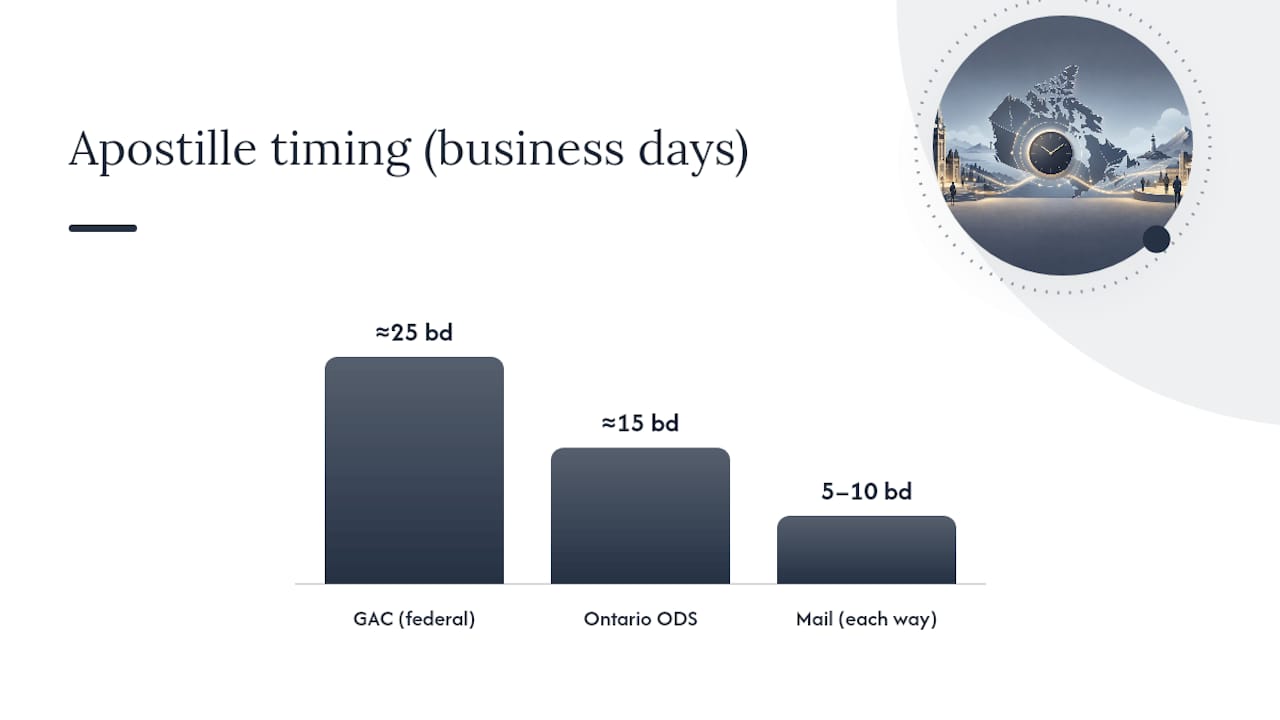
As of Global Affairs Canada's published guidance, federal authentication requests were running around 25 business days for documents received roughly a month prior. Ontario's ODS, by contrast, targets closer to 15 business days for provincial submissions, per Ontario's authentication guidance.
Fees differ by province and by document type, and most offices accept debit or credit alongside certified payment. On top of processing time, factor in:
- 5 to 10 business days for standard mail delivery each direction
- Expedited courier options if your deadline is tight
- Separate consular fees if your destination ultimately requires additional legalization
Rush deadlines and mail delays are exactly where a processing times resource or an expediting service earns its cost back.
How to Verify an Apostille and Avoid Common Mistakes
Once your document comes back with an allonge attached, don't assume it's automatically accepted abroad. Verify it.
- Use the issuing authority's e-register, where available, or the HCCH's resources to confirm the apostille number and issue date match what's printed.
- Never remove, alter, or laminate the allonge once it's attached; doing so can void the authentication entirely.
- Keep the original document intact from start to finish, since a torn or restapled page raises questions at the receiving end.
Most rejections trace back to three things: sending the document to the wrong competent authority, skipping required notarization, or physically altering the document after the fact.
Pro Tip: If a foreign institution asks you to confirm your apostille is valid, point them to the issuing authority's own verification tool rather than trying to explain it yourself. It settles the question faster.
What If the Destination Country Hasn't Joined the Hague Convention?
An apostille only works for fellow Hague members. If your destination country hasn't signed on, the old process still applies.
- Check the HCCH signatory list before you submit anything, since assuming coverage is a common and costly mistake.
- Non-signatory destinations require traditional authentication by Global Affairs Canada, followed by consular legalization through that country's embassy or consulate in Canada.
- Always confirm exact requirements with the receiving authority abroad before you submit, since competent authorities in Canada won't advise on foreign rules.
What Ken Has Learned Handling Canadian Apostille Requests
The mistake we see most often isn't complicated: someone sends a provincially notarized document straight to Global Affairs Canada, or the reverse, and loses a week or two waiting for a rejection letter to arrive. Jurisdiction misrouting causes more delays than any fee or backlog does.
Where a professional expeditor earns its keep is on the harder cases: corporate documents needing multiple signatures, deadlines measured in days rather than weeks, or files that touch more than one province's rules at once. For a single birth certificate with no time pressure, doing it yourself is entirely reasonable. For anything urgent or layered, the routing decisions get expensive to get wrong twice.
— Ken
Skip the Guesswork: Let Speedy Apostille Services Handle the Routing
Figuring out whether your document goes to Global Affairs Canada or a provincial office, then chasing notarization requirements on top of it, is where most delays actually happen. Speedy Apostille Services, based in Toronto, builds government fees into one upfront price from the start, so there's no surprise invoice showing up after your document is already in the mail.

The service covers document review, submission to the correct competent authority, secure handling, and the apostille itself, for documents like birth certificates, marriage licenses, diplomas, transcripts, corporate records, and RCMP background checks. Typical turnaround runs 2 to 3 days once your file is submitted correctly, backed by more than 1,000 client reviews and a 5.0 rating. If you're not sure which office your document belongs with, that's the exact problem this exists to solve. Start your apostille request and find out what's needed for your specific document.
Sources
- Canada
- Authentication of documents - Global Affairs Canada
- Ontario
- Apostille Convention enters into force for Canada - HCCH
FAQ
How Do I Get an Apostille From Canada?
Identify whether your document was issued or notarized federally or provincially, submit the original to the matching competent authority (Global Affairs Canada or the relevant provincial ministry), and pay the published fee.
How Long Does It Take to Get an Apostille in Canada?
Federal requests through Global Affairs Canada were running around 25 business days, while Ontario's ODS targets roughly 15 business days; add 5 to 10 business days for standard mail in each direction.
How Much Does an Apostille Cost in Canada?
Fees vary by province and document type, with most offices accepting debit or credit payment; check the specific competent authority's fee schedule before submitting, since Speedy Apostille Services builds these government fees into one all-in price.
Does Service Ontario Do Apostilles?
No. Apostilles for Ontario documents are issued through Ontario's Official Documents Services (ODS), not Service Ontario, and applicants should confirm eligibility directly on Ontario's authentication page.