
Good Standing Apostille Canada: A Provincial and Federal Guide
Good Standing Apostille Canada: A Provincial and Federal Guide ! Hand placing certificate envelope for apostille Yes, a Canadian Certificate of Good Standing can be apostilled.

Good Standing Apostille Canada: A Provincial and Federal Guide
Yes, a Canadian Certificate of Good Standing can be apostilled. The document goes through a Canadian competent authority, either Global Affairs Canada or a provincial Official Documents Services office, depending on where the underlying certificate was issued.
Three things to do first: confirm which jurisdiction issued or notarized your certificate (federal or a specific province), check whether the destination country belongs to the Hague Apostille Convention, and pull together the original document plus any required notarization before you submit anything.
The right office depends entirely on where your paperwork originated:
- Global Affairs Canada handles federal documents and covers provinces without their own apostille program.
- Ontario Official Documents Services (ODS) authenticates Ontario-issued and Ontario-notarized documents.
- British Columbia's Ministry of Attorney General processes BC public and notarized documents.
- Alberta and Saskatchewan run their own provincial authentication services for documents issued there.
Key Takeaways
A Canadian Certificate of Good Standing can be apostilled through Global Affairs Canada or a provincial competent authority, and sending it to the wrong office is the leading cause of delay.
| Point | Details |
|---|---|
| Confirm the issuing jurisdiction | Match your certificate's federal or provincial origin to the correct authenticating office before mailing anything. |
| Check Hague membership first | Apostilles only replace consular legalization for destination countries in the Hague Convention. |
| Prepare originals and notarization | Certified copies, correct notarization province, and no lamination prevent the most common refusals. |
| Budget realistic time and fees | Ontario ODS charges fees per document, for example, $16 for a notarized legal document and $32 for certain official documents; other authorities publish their own schedules. |
| Consider expedited review | Speedyapostilleservices offers document review and 2 to 3 day turnaround with all-inclusive pricing for time-sensitive filings. |
This article is general information, not a substitute for advice from a qualified lawyer. Consult a qualified legal professional about your own circumstances before acting on anything here.
Table of Contents
- When Does a Good Standing Apostille Canada Requirement Actually Apply?
- How Do You Get a Certificate of Good Standing in Canada?
- Preparing Your Certificate of Good Standing for Authentication
- Where Do You Send Documents for Authentication or an Apostille?
- How Long Does Apostille Processing Take, and What Does It Cost?
- Why Do Apostille Requests Get Refused, and How Do You Verify One?
- What Happens If the Destination Country Isn't a Hague Member?
- How Speedy Apostille Services Handles This for You
- Sources
- FAQ
When Does a Good Standing Apostille Canada Requirement Actually Apply?
Not every Certificate of Good Standing needs an apostille. It depends entirely on where the document is going and what it's used for.
Canada joined the Hague Apostille Convention on January 11, 2024. If the destination country is a member, a single apostille replaces the older, slower consular legalization chain. If it isn't a member, you'll need consular legalization instead, which adds a step at the destination country's embassy.
An apostille confirms the signature and seal of the official who signed your Certificate of Good Standing are genuine. It does not verify or endorse anything the certificate actually says about your corporation's standing.
Who typically needs one:
- Foreign business partners or investors requiring proof your corporation is active
- Overseas banks opening a corporate account
- Foreign courts or regulators reviewing a Canadian entity
- Government registries abroad processing a branch or subsidiary filing
Pro Tip: Ask the receiving party abroad exactly what they require before you order anything. Some foreign banks want an apostille dated within 90 days of use, which changes your timing.
How Do You Get a Certificate of Good Standing in Canada?
The certificate itself has to come before any authentication step, and where you order it from depends on how your corporation is incorporated.
For federally incorporated businesses, Corporations Canada issues a Certificate of Compliance. You'll need your corporation's legal name, corporation number or business number, and current contact details to place the request. Fees and processing windows apply and are published on their site.
Provincially incorporated businesses order from their home province's registry instead. Ontario uses its Business Registry, British Columbia uses Corporate Online, and Alberta has its own corporate registry portal. The document name itself shifts by jurisdiction: Certificate of Compliance, Certificate of Existence, or Certificate of Status, since Canada has multiple separate corporate jurisdictions, each with its own naming convention.
- Confirm which jurisdiction incorporated your business, federal or a specific province.
- Order the certificate from that exact registry, not a neighboring one.
- Request a date-specific certificate if the receiving party abroad needs current-as-of confirmation.
- Decide between an original paper certificate or a certified copy, since some authorities only accept one format.
Preparing Your Certificate of Good Standing for Authentication
A certificate that's perfectly valid can still get rejected at the authentication stage if it isn't formatted the way the competent authority expects.
What you typically need on hand:
- An original signature and official seal from the issuing registry
- Notarization, if the document type or destination country requires it
- A certified true copy where originals aren't accepted for mailing
- A certified translation if the destination country doesn't accept English or French documents
Pro Tip: Call the authenticating office before you notarize anything. Some authorities only accept notarization performed by a notary commissioned in that same province, so a Toronto notary's stamp won't work for a British Columbia submission.
Common mistakes that cause delays:
- Laminating a document, which authorities generally refuse outright
- Sending a plain photocopy instead of a certified copy
- Missing the corporate seal on a certificate that requires one
- Submitting a signature format that doesn't match the office's records
Where Do You Send Documents for Authentication or an Apostille?
This is where most delays actually happen. Canada splits authentication authority between the federal government and select provinces, and sending your certificate to the wrong office is the single most common cause of multi-week hold-ups.
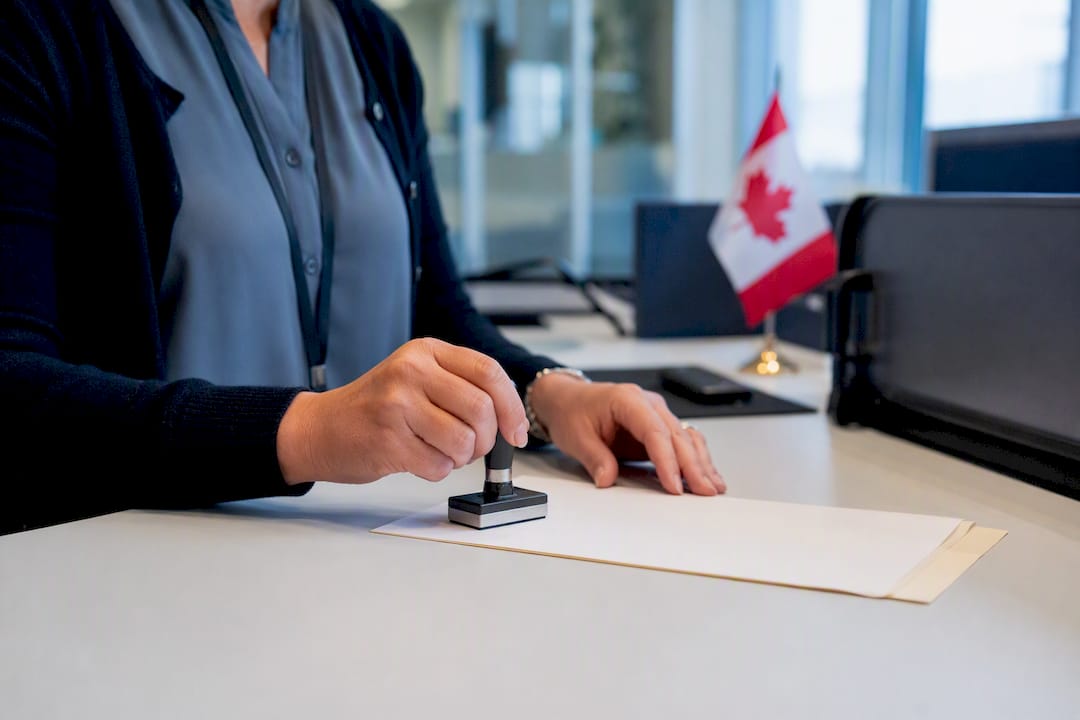
Global Affairs Canada authenticates federal documents and anything from a province that doesn't run its own program. Ontario ODS, British Columbia's Ministry of Attorney General, Alberta, and Saskatchewan each authenticate documents issued or notarized within their own borders. Quebec has its own procedural rules worth confirming directly with the province before submitting.
The decision tree is simple: wherever your certificate was issued or notarized is the office you submit to. A federally issued Certificate of Compliance goes to Global Affairs Canada. An Ontario-notarized document goes to Ontario ODS.
Submission options generally include:
- Mail, with a prepaid, trackable return envelope included
- Courier, for faster and more traceable delivery
- In-person drop-off, where the office offers it
British Columbia's guidance specifically requires that you identify the destination country on your submission, since different countries can affect the process.
How Long Does Apostille Processing Take, and What Does It Cost?
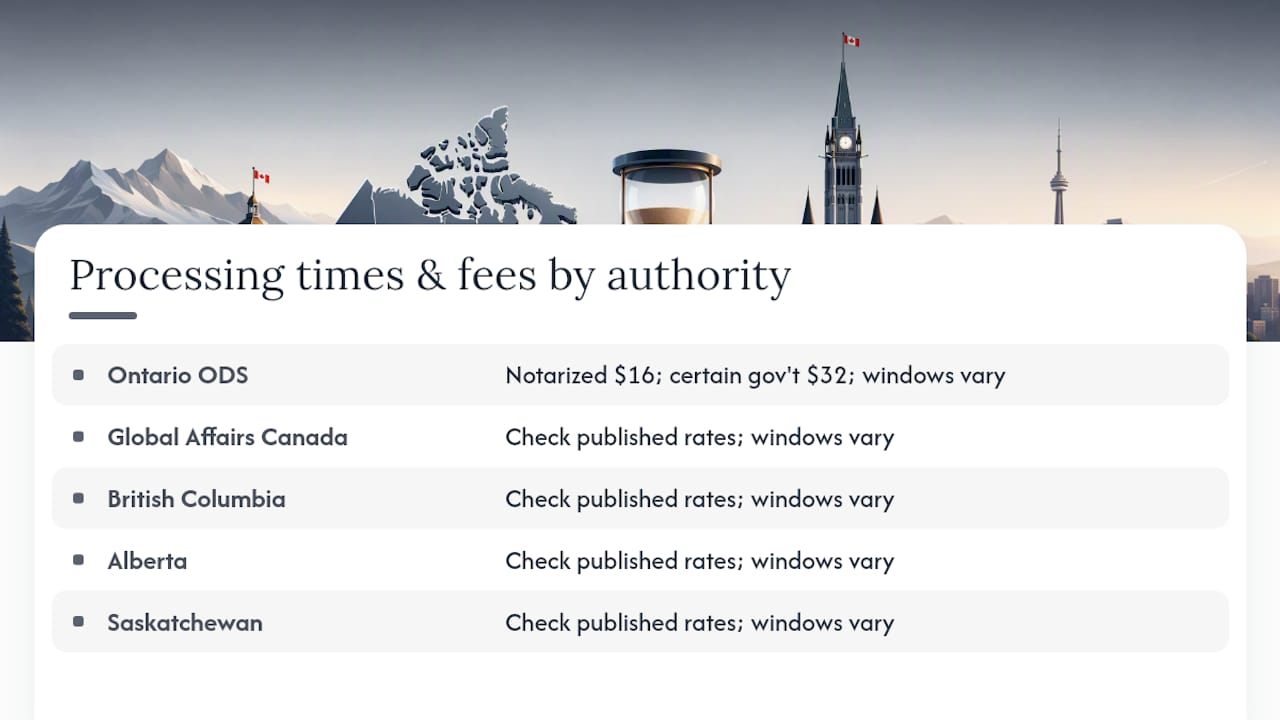
Processing times vary by authority, document volume, and whether you've submitted a complete package. Misdirected documents, incomplete notarization, or missing contact information all add weeks to an otherwise routine request.
Fees also vary by jurisdiction. Ontario ODS publishes per-document fees, with a notarized legal document running $16 and certain Ontario government official documents running $32. Other provinces and Global Affairs Canada set their own fee schedules, so check the issuing office's current published rates before you submit rather than relying on a figure from a previous year.
Pro Tip: If your deal or filing has a hard deadline, ask about expedited review and prepaid return shipping upfront. A bundled expedited service that handles submission and tracking on your behalf often shaves days off the total timeline compared to standard mail-in processing.
Standard processing windows are published by each authority and can shift with volume, particularly around year-end corporate filing periods when demand for Certificates of Good Standing spikes.
Why Do Apostille Requests Get Refused, and How Do You Verify One?
Refusals almost always trace back to a handful of predictable issues.
- The signature or seal doesn't match what the authority has on file
- The document appears altered, laminated, or otherwise tampered with
- Required notarization is missing or was done in the wrong province
- A foreign-issued document was mistakenly sent to a Canadian authority instead of the country that issued it
Once you have an apostille in hand, verifying it takes a few steps:
- Check the apostille number, issuance date, and issuing authority printed on the certificate.
- Use Global Affairs Canada's verification service, which confirms apostilles issued federally and by Alberta, British Columbia, and Saskatchewan.
- Cross-check the details against the original document to confirm nothing was substituted during processing.
If your request gets refused, contact the issuing office immediately and ask for the reason in writing. Correcting the specific defect and resubmitting quickly avoids sitting in a second processing queue from scratch.
What Happens If the Destination Country Isn't a Hague Member?
An apostille alone won't satisfy a non-Hague country. You'll need consular legalization on top of Canadian authentication.
- Complete Canadian authentication through Global Affairs Canada or the relevant provincial authority first.
- Contact the destination country's embassy or consulate in Canada to confirm their specific legalization requirements.
- Submit the authenticated document to that embassy for legalization and pay their fee, which is separate from Canadian government fees.
- Arrange return shipping once the embassy completes legalization.
Before you submit anything, confirm with the embassy whether they accept a Canadian apostille as-is, require additional certification, or demand a specific document format. Some embassies also require certified translations or extra affidavits that aren't obvious until you ask directly.
Pro Tip: Call the embassy before you pay for Canadian authentication, not after. Their formatting or affidavit requirements can affect how you prepare the document from the start.
Publisher Perspective: Why Document Review Saves Corporate Deadlines
Most rejected authentication requests share the same root cause: a small formatting or notarization detail nobody caught before mailing. Reviewing a Certificate of Good Standing before submission catches those defects while there's still time to fix them.
Businesses closing a loan, contract, or acquisition rarely have room for a second processing cycle. A quick pre-submission review and expedited handling often shortens the entire timeline more than any single step in the process. Still, confirm the destination country's exact requirements before paying for authentication.
How Speedy Apostille Services Handles This for You
Speedyapostilleservices is the alternative to piecing this process together yourself across multiple government offices. Instead of figuring out whether your certificate needs Global Affairs Canada or a provincial office, then tracking a mailed envelope for weeks, Speedyapostilleservices reviews your document, coordinates any required notarization, and submits it to the correct competent authority on your behalf.

The service covers document review, in-house notarization coordination, submission tracking, and secure return shipping, with all-inclusive pricing that bundles government fees upfront so there's no surprise invoice later. Standard turnaround runs 2 to 3 days for urgent corporate filings, and the service supports both individuals and businesses. If you're based in the Toronto area, same-day apostille service is also available for the tightest deadlines.
Get an instant quote for your Certificate of Good Standing and find out exactly what your document needs before you submit it anywhere.
Sources
- Authenticate your documents - Before you start (Step 1) — Global Affairs Canada
- Apostille Convention — Province of British Columbia
- Get a certificate of compliance or certificate of existence — Corporations Canada
- Open Government — corporate jurisdictions dataset
FAQ
Can You Get an Apostille on Canadian Documents?
Yes, since Canada joined the Hague Apostille Convention in January 2024, Canadian public documents including Certificates of Good Standing can receive an apostille from Global Affairs Canada or a provincial competent authority.
How Long Does It Take to Get Documents Apostilled in Canada?
Processing time varies by authority and completeness of your submission. Misdirected or incomplete requests take considerably longer, while expedited services can shorten the timeline to a few days.
Can You Walk In for an Apostille?
Some provincial offices, including certain Ontario ODS locations, accept in-person drop-off, but availability varies by office and it's worth confirming before showing up.
Does Service Ontario Do Apostilles?
No, apostilles for Ontario documents are issued by Ontario's Official Documents Services (ODS), not Service Ontario locations, which handle separate provincial services.
What Does an Apostille Actually Certify?
An apostille confirms the signature and seal on your document are genuine. It does not verify or endorse the content stated in the Certificate of Good Standing itself.