
Expedited Apostille in Canada: How to Get One Fast
Expedited Apostille in Canada: How to Get One Fast ! Hands affixing courier shipping label to envelope You cannot buy a formal "expedited" apostille from the Canadian government, but you can still get one much faster than the standard timeline by fixing your paperwork and routing before you submit

Expedited Apostille in Canada: How to Get One Fast
You cannot buy a formal "expedited" apostille from the Canadian government, but you can still get one much faster than the standard timeline by fixing your paperwork and routing before you submit, and by using a private expediter to handle the parts of the process the government does not control. Global Affairs Canada states plainly that it does not offer expedited processing for standard requests, and provincial offices such as Ontario's Official Documents Services (ODS) work the same way: applications get processed in the order they arrive.
That baseline sounds slow. The federal office reports a baseline processing time of about 25 business days, with additional mailing time. Ontario's ODS lists a typical mail-in processing time. Neither office promises to move faster for a fee.
The fastest realistic path combines three things: confirming the correct competent authority, having notarization and copies ready before you send anything, and using a vetted private expediter or prepaid courier to remove dead time from mailing and forwarding.
What to do right now:
- Call or check the website of the correct competent authority for your document type.
- Get any required notarization or certified copies done today, not after you submit.
- Contact a private expediter, such as Speedy Apostille Services, if your deadline is inside two to three weeks.
Key Takeaways
Getting a document authenticated quickly in Canada depends less on paying for speed and more on eliminating every avoidable delay before submission.
| Point | Details |
|---|---|
| No formal government expedite | Global Affairs Canada and provincial offices process applications in order received, with no paid fast lane. |
| Routing errors cause most delays | Confirm the correct competent authority (federal versus provincial) before sending anything. |
| Prepaid couriers save real time | Enclosing a prepaid label lets offices forward processed documents by courier instead of standard mail. |
| Hague status changes the path | Hague-member destinations generally need only the apostille; non-Hague countries require added consular legalization. |
| Private expediters control the controllable | Speedy Apostille Services reviews documents, routes correctly, and uses tracked couriers for a typical 1 to 7 day turnaround. |
Table of Contents
- Five Steps to Take in the Next 24 to 72 Hours
- Who Issues Apostilles in Canada and How Long Does It Take?
- How Does a Private Expedited Service Actually Speed Things Up?
- What Documents Do You Need Prepared Before Submitting?
- What Does Expedited Apostille Processing Cost in Canada?
- What Should Make You Suspicious of a "Fast" Apostille Offer?
- What Fast Turnaround Actually Looks Like
- How Speedy Apostille Services Handles Urgent Requests
- Sources
- FAQ
Five Steps to Take in the Next 24 to 72 Hours
- Confirm the destination's requirement. Check whether the country receiving your document is a Hague signatory. Canada joined the Hague Apostille Convention on January 11, 2024, so Hague-member countries generally accept an apostille alone. Non-Hague destinations still need consular legalization afterward.
- Identify the competent authority. Federal documents go through Global Affairs Canada; provincial ones (like an Ontario-issued birth certificate) go through that province's office. Wrong office is the top cause of avoidable delay.
- Check whether your document is public or private. Public records sometimes skip notarization; private documents almost always need it first.
- Secure notarization same-day if needed. Most notaries and lawyers can turn around a signature within hours, not days.
- Pick your fastest shipping route. Overnight courier pickup beats standard mail by days, and it matters more than people expect.
Pro Tip: If you're asking anyone to escalate your file, whether it's a government office or a private expediter, have your deadline proof ready: a flight itinerary, a visa appointment letter, or an embassy confirmation. Concrete deadlines get taken seriously; vague urgency does not.
Who Issues Apostilles in Canada and How Long Does It Take?
Canada has no single national apostille office. The right authority depends entirely on where the document was issued, and getting this wrong is the single biggest reason applications stall for weeks.
Federal documents, RCMP background checks, and documents notarized by a federally commissioned notary go through Global Affairs Canada. Provincial vital records, like Ontario birth and marriage certificates, go through that province's own authentication office: Ontario's ODS, Alberta's Authentication Office, offices in British Columbia and Saskatchewan, or Quebec's notarial system. None of these offices offers a paid expedited tier for standard applications.
Global Affairs Canada's baseline is about 25 business days for processing, not counting mail.
| Authority | Typical processing time |
|---|---|
| Global Affairs Canada (federal) | About 25 business days for processing, plus mailing time |
| Ontario ODS | Typical mail-in processing time |
| Alberta / Saskatchewan | Historically faster provincial ranges |
| British Columbia | Slower than Alberta/Saskatchewan on average |
Where offices do help is forwarding. Global Affairs Canada will courier your processed documents directly to an embassy or high commission if you enclose a prepaid expedited mail or courier label with your submission. That does not change your place in the queue, but it does cut out days of transit time on the back end.
How Does a Private Expedited Service Actually Speed Things Up?
Private expediters do not change government policy, and they cannot make an office skip your file ahead of someone else's. What they control is everything happening around the government's queue, and that is where most of the wasted time actually lives.
A private service typically handles:
- Reviewing your documents for errors before submission, so nothing bounces back.
- Routing to the correct competent authority the first time.
- Submitting daily rather than batching requests, which keeps your file moving.
- Using prepaid, tracked couriers instead of standard mail for both directions.
- Referring you to notarization or translation help if your documents need it first.
In practice, that combination is why a client using an in-market expedited service like Speedy Apostille Services might deliver documents in a range of days for straightforward cases, significantly faster than the processing and mailing time when proceeding alone by mail. The gap isn't magic. It's the elimination of every avoidable delay stacked on top of a government process that moves at its own pace regardless of who is asking.
Pro Tip: Ask any expediter for proof of submission (a government receipt) and a tracking number for the courier leg. A legitimate service will hand these over without hesitation.
- Document review catches errors before they cost you a week.
- Correct routing avoids rejection at the competent authority.
- Prepaid tracked couriers remove the slowest part of the mail-in process.
What Documents Do You Need Prepared Before Submitting?
Most delays are self-inflicted, and nearly all of them are preventable with a checklist run before anything goes in the mail.
- Confirm whether your destination country wants an original or a certified true copy.
- Complete notarization for private documents before requesting authentication; public documents often go direct.
- Verify translations, if required, and check whether the translation itself needs its own authentication.
- Double-check the issuing office matches the document's origin (federal versus provincial) to avoid a wrong-jurisdiction rejection.
- Gather originals and confirm copy requirements.
- Complete notarization or certified-copy steps first.
- Include a prepaid courier label and return envelope if mailing.
- Add clear forwarding instructions if the document needs to reach an embassy afterward.
Pro Tip: Confirming the correct competent authority before you send anything is the single most effective move you can make. Everything else on this list matters less if the document lands on the wrong desk.
What Does Expedited Apostille Processing Cost in Canada?
Your total bill has several separate pieces, and skipping one usually means an unpleasant surprise later.
- Government authentication fee (varies by authority and document type).
- Private expediter facilitation fee, if you use one.
- Local courier to get your document to the expediter or office.
- Return courier, domestic or international depending on destination.
- Notarization or translation fees, when required.
A government-only mail-in path for a Hague-member destination might run 3 to 5 weeks end to end once processing and mailing are combined.
Timelines shift depending on destination. A Hague-member country typically needs only the apostille itself, while a non-Hague country adds embassy legalization on top, which can extend the schedule by another one to three weeks depending on the consulate's own backlog. Courier transit time, often overlooked, can add several days on either end of the process regardless of how fast the authority itself works.
What Should Make You Suspicious of a "Fast" Apostille Offer?
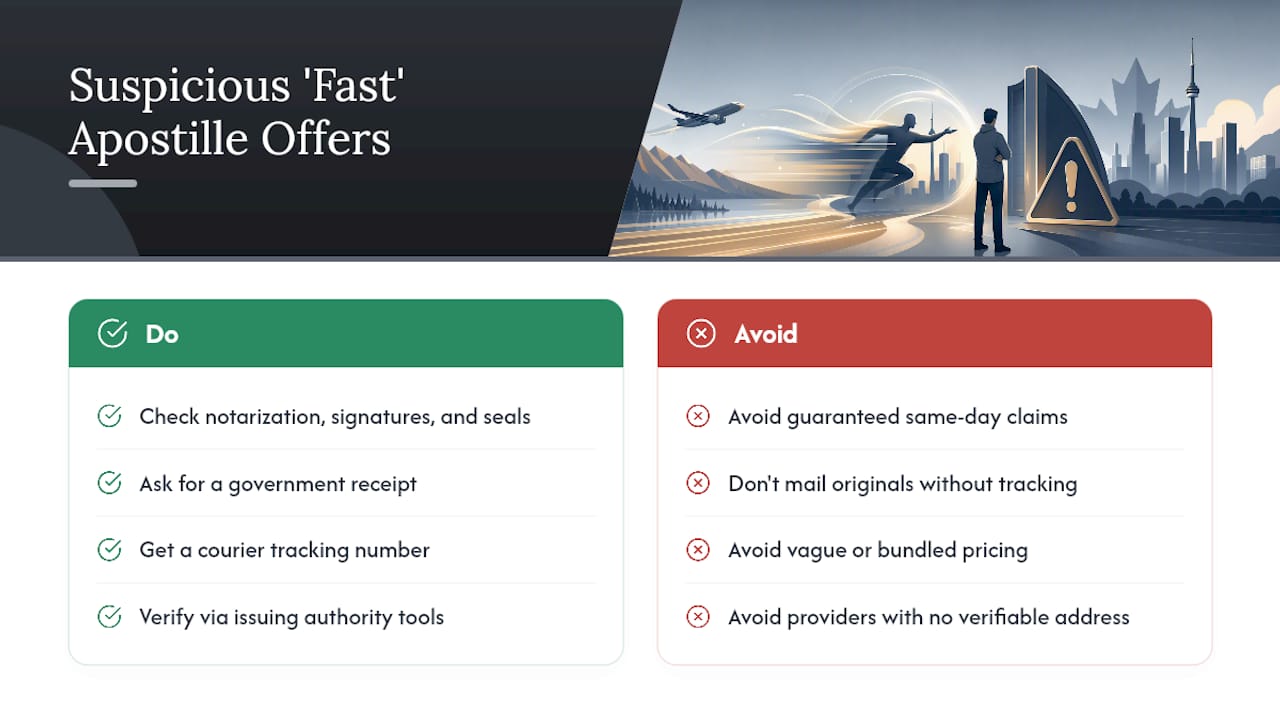
Delays cluster around a handful of predictable mistakes: wrong competent authority, missing notarization, an unsigned page, a sealed document that got opened before submission, or a courier that simply runs late. Each one can add a week or more to a file that should have moved quickly.
Watch for red flags too. Any company promising a guaranteed same-day government apostille for every document type is overselling something no authority actually offers. So is a service that asks you to mail original documents with no tracking, gives vague or bundled pricing with no breakdown, or has no verifiable physical address.
Ask for a government receipt, a courier tracking number, and instructions for how to verify the finished apostille yourself. A legitimate expediter hands these over without being asked twice.
Documents issued by Global Affairs Canada or several provinces can be verified directly through the issuing authority's own tools, which is worth doing before you assume a document is finished.
What Fast Turnaround Actually Looks Like
I've seen enough of these files pass through to say this plainly: the biggest time savings almost never come from anything exotic. They come from someone catching a missing notarization before it becomes a rejection, and from a courier label that's already prepaid instead of an afterthought.
Where a private expediter earns its fee is document review, controlling the courier legs, and offering local drop-off instead of trusting the mail both ways. What it cannot do is skip the government's own queue. Anyone promising otherwise is selling something that doesn't exist.
How Speedy Apostille Services Handles Urgent Requests
Speedy Apostille Services exists for exactly the situation this article describes: a deadline that the standard government timeline won't meet. Based in Toronto, the service reviews your documents, routes them to the correct competent authority, and uses prepaid tracked couriers instead of standard mail to remove the slowest part of the process.

Turnaround typically runs 1 to 7 days depending on the document and routing, with many straightforward cases landing in the 2 to 3 day range the service is known for. That range depends on steps the government itself controls, so no expediter can promise a fixed date regardless of document type. All-in pricing includes government fees upfront, so there's no surprise add-on once your file is already moving.
If your deadline is close, start by requesting a document review through the Speedy Apostille Services landing page. Have your document type, destination country, and deadline ready. That initial review confirms the real timeline and total cost before you commit to anything, and if you're in the Toronto or GTA area, same-day drop-off options can shave additional days off the schedule.
Sources
- Authentication of documents
- Canada joins the Apostille Convention to facilitate use of public documents abroad
Verify a finished apostille through the issuing authority's own confirmation tools rather than taking a private service's word for it.
FAQ
How long does it take to get an apostille in Canada?
Global Affairs Canada reports about 25 business days for processing, plus 5 to 10 business days for mailing. Ontario's ODS lists roughly 15 business days for mail-in requests.
How can I speed up my apostille?
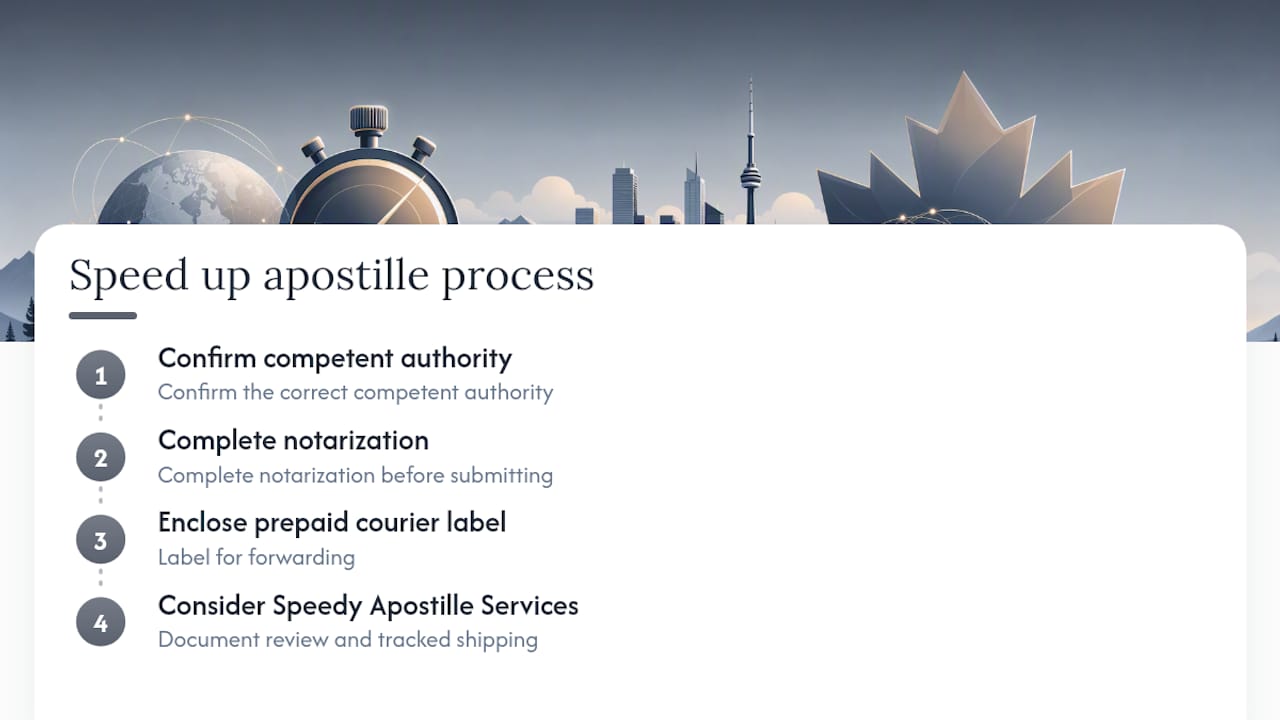
Confirm the correct competent authority, complete notarization before submitting, enclose a prepaid courier label for forwarding, and consider a private expediter like Speedy Apostille Services for document review and tracked shipping.
How quickly can I get an apostille through a private service?
Speedy Apostille Services reports typical turnaround of 1 to 7 days, often 2 to 3 days for straightforward documents, though the exact timing still depends on the competent authority's own processing.
How do I get an apostille in Canada?
Identify whether your document is federal or provincial, get any required notarization done first, submit to the correct competent authority, and include a prepaid courier label if you want faster forwarding once it's processed.
Does Canada offer expedited apostille processing directly through the government?
No. Global Affairs Canada and provincial offices explicitly state they do not offer expedited services for standard requests; applications are processed in the order received.