
Find the Right Apostille Office for Your Canadian Education Credential
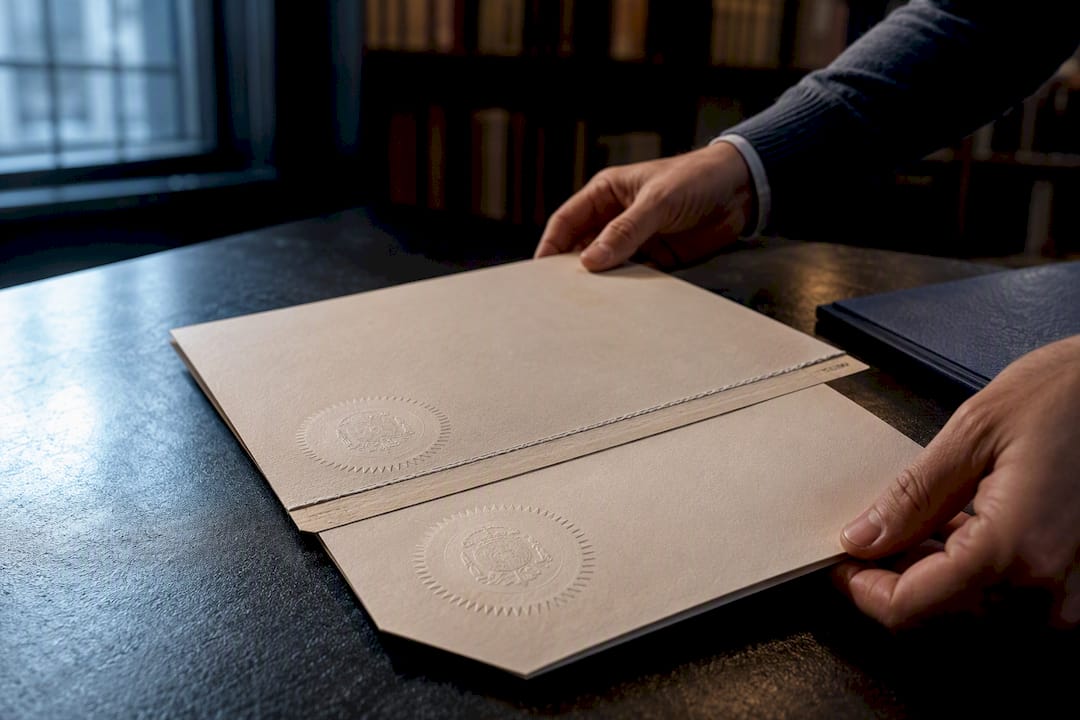
Find the Right Apostille Office for Your Canadian Education Credential ! Education credential with attached apostille allonge Yes, Canadian education credentials can be apostilled.
Find the Right Apostille Office for Your Canadian Education Credential
Yes, Canadian education credentials can be apostilled. Diplomas, transcripts, and enrollment letters all qualify when they meet the eligibility rules. The office that handles the request depends on where the document was issued or notarized, provincially or federally. Before doing anything else, confirm your destination country's status under the Hague Apostille Convention and identify which authority issued your document.
TL;DR:
- Education credentials from Canada qualify for apostille if they meet the Hague member country requirement and are not laminated or photocopied, which are explicitly rejected.
- The issuing jurisdiction determines which Canadian authority—provincial or federal—issues the apostille, with common errors including sending provincial documents to Global Affairs Canada and vice versa.
- Most rejections stem from submitting ineligible documents, such as laminated diplomas or copies lacking original signatures or seals, making it crucial to verify document condition before applying.
- Processing times vary from a few days for in-person filings at provincial offices to weeks for mail submissions to Global Affairs Canada, with costs including fees for notarization, government authentication, and courier services.
- Using a professional apostille service like Speedy Apostille Services streamlines the process, offering in-person handling, certified copies, and transparent upfront pricing for faster and error-free documentation.
Table of Contents
- What Is an Education Credential Apostille and When Do You Need One?
- Does My Diploma Need an Apostille or Legalization?
- Who Issues Apostilles in Canada: Province or Federal?
- Step-by-Step: Preparing an Education Credential for Apostille
- How Long Does It Take and What Does It Cost?
- Common Rejection Reasons for Education Apostilles
- Getting Notarization or a Certified True Copy Before Apostille
- Authentication vs. Apostille: What's the Difference in Canada?
- Common Mistakes When Preparing Education Documents for Apostille
- Cost Breakdown for the Full Apostille Process
- When a Paid Apostille Service Makes Sense
- How Speedy Apostille Services Handles Education Credentials
- Sources
- FAQ
What Is an Education Credential Apostille and When Do You Need One?
An apostille is a certificate that authenticates the signature and seal of the public official who signed your document. It doesn't verify the content of your diploma. It confirms that the signature on it is genuine. In Canada, this certificate takes the form of an "allonge," a separate page attached to the authenticated document.
You only need an apostille when your destination is a member of the Hague Apostille Convention. If the country you're sending documents to hasn't joined the convention, you'll likely need embassy or consular legalization instead, a different and usually slower process.
Education documents that typically qualify for an apostille include:
- Diplomas and degree certificates
- Official transcripts issued directly by the institution
- Enrollment confirmation letters
- Degree verification letters from the registrar's office
Does My Diploma Need an Apostille or Legalization?
Global Affairs Canada is direct on this point: the destination decides the requirement, not Canadian law. That means the answer to "apostille or legalization" lives with whoever is receiving your document abroad, not with any Canadian office.
Before submitting anything, work through these checks:
- Contact the receiving party directly. Ask the admissions office, employer, or licensing board whether they require an apostille, consular legalization, or something else entirely.
- Confirm Hague membership. Cross-check the destination country against an official Hague country list or a country checker resource before you pay for anything.
- Ask about copies versus originals. Some institutions accept certified true copies; others insist on the original diploma or transcript.
- Ask about translations. If your destination doesn't use English or French, ask whether a certified translation needs to accompany the apostilled document.
Skipping this step is the single most common way people waste money on apostilles they didn't need, or worse, get the wrong process entirely.
Who Issues Apostilles in Canada: Province or Federal?
Canada doesn't have one national apostille office. The rule is jurisdictional: the competent authority that handles your request is the one where the document was issued or notarized. Provincial authorities handle provincial documents. Global Affairs Canada (GAC) handles federal ones.
For education credentials, this usually plays out simply:
- A diploma from a provincial university, such as one in Ontario or Alberta, goes to that province's competent authority.
- A document notarized in Ontario by an Ontario notary gets routed through Ontario's apostille process, even if the underlying credential itself came from elsewhere.
- Federally issued documents, or documents notarized by a federal official, go to GAC.
The most common mistake applicants make is sending a provincially issued diploma to Global Affairs Canada by default, assuming it's the "main" office. It isn't for provincial documents, and misrouted submissions get delayed or bounced back, sometimes weeks after mailing. Check the issuing jurisdiction first, every time, before you address an envelope.
Step-by-Step: Preparing an Education Credential for Apostille
Getting a diploma or transcript apostilled follows a fairly fixed sequence. Skipping steps or doing them out of order is what causes most delays.
- Confirm destination and competent authority. Verify the destination country's Hague status and identify whether your document routes to a provincial office or Global Affairs Canada.
- Obtain notarization or a certified true copy. Many competent authorities won't apostille an original diploma directly. They require a notarized copy or a certified true copy from the issuing institution first.
- Inspect the physical document. Check for an original signature and an original seal or stamp. Laminated pages are automatically rejected, and Global Affairs guidance is explicit that laminated or photocopied documents are ineligible.
- Complete forms and pay fees. Fill out whatever application form the competent authority requires, pay the government authentication fee, and include a prepaid return envelope or courier waybill if you're mailing in.
- Submit and track. File in person where that's an option, or mail your package to the correct office. Once it's returned, check the allonge itself: confirm it's properly attached and the details match your document exactly.
Universities sometimes add a layer here that surprises people. McGill's guidance on student records notes that the competent authority may contact the issuing institution directly to verify signatory details before issuing the apostille. That verification step can add processing days that have nothing to do with the office's stated turnaround time.
Pro Tip: Order an extra certified true copy of your transcript when you first request it from the registrar. If your apostille application gets rejected for a document condition issue, you won't have to wait for the university to reissue one from scratch.
How Long Does It Take and What Does It Cost?
Processing time varies by office and by how you submit. In-person filing at a provincial office is typically faster than mailing documents to Global Affairs Canada, where mail volume and return shipping both add days on top of processing itself.
Expect these cost categories, though exact amounts vary by province and office:
- A government authentication or apostille fee, set by the issuing authority
- A notarization fee if your document requires certification first, commonly $35 for a notarized certified true copy through a private notary service
- Courier or return postage costs if you're not filing in person
One detail people underestimate: the university verification step mentioned earlier can push total turnaround past whatever the office's posted processing window states. Build in buffer days, especially if you're mailing rather than filing in person, and look into expedited options early if your deadline is firm rather than waiting until the last week.
Common Rejection Reasons for Education Apostilles
Most rejections trace back to a handful of repeat problems, and nearly all of them are avoidable with a quick check before you submit.
- Ineligible document types. Photocopies, laminated pages, and documents from unrecognized institutions are all explicitly excluded from authentication.
- Foreign-issued credentials. A diploma issued outside Canada can't be apostilled through a Canadian competent authority, even if you currently live in Canada.
- Signature or seal problems. If the signatory's authority can't be verified, the competent authority may contact the institution directly, adding delay rather than an outright rejection.
- Wrong competent authority. Sending a provincial document to GAC, or vice versa, is a paperwork error that costs you the mailing time round trip.
- Missing forms or fees. Incomplete applications get returned rather than processed, so double-check the office's checklist before mailing.
Pro Tip: Call the competent authority's office before submitting if you're unsure about signatory eligibility. A five-minute phone call is cheaper than a rejected mail-in application.
Getting Notarization or a Certified True Copy Before Apostille
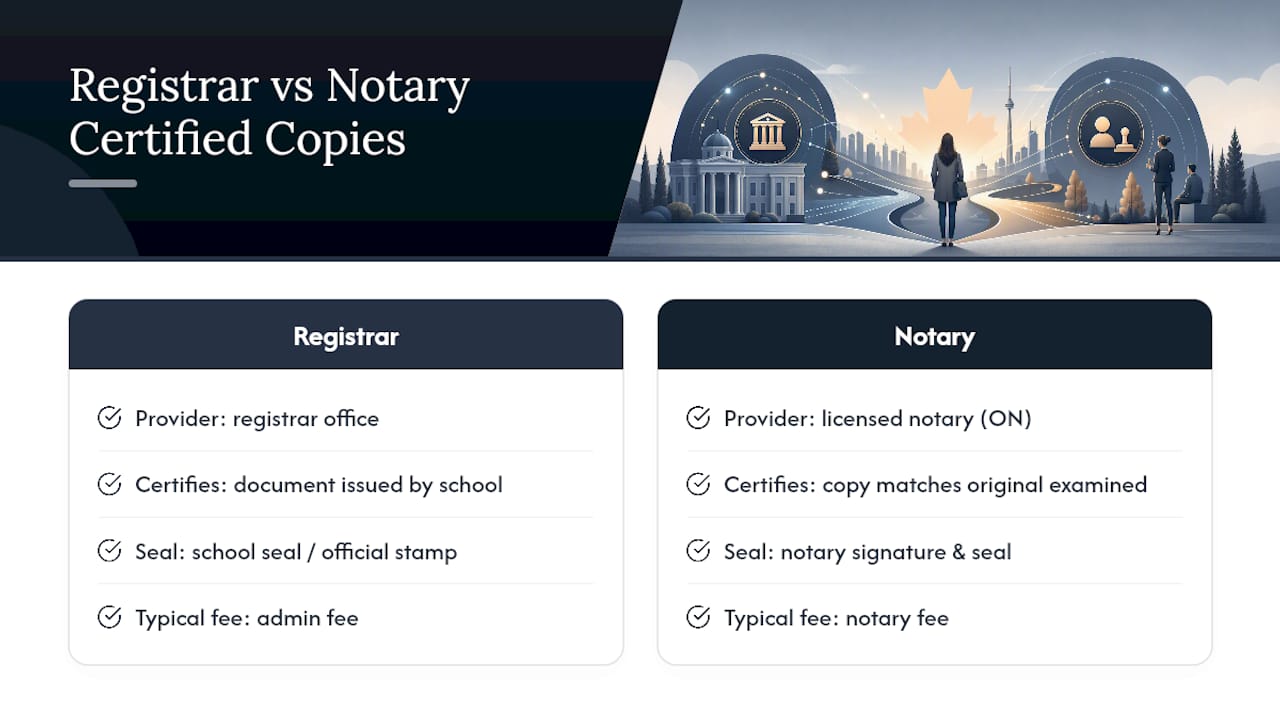
Most competent authorities won't stamp a raw diploma. They need a notarized copy, a certified true copy from the registrar, or both, depending on the office and the destination's requirements. Start by contacting your institution's registrar and asking for an official transcript sealed directly by the school. Many registrars will produce a certified true copy on request, sometimes for a small administrative fee separate from any notary cost.
If your competent authority instead requires notarization, you'll need a licensed notary public, or in Ontario, specifically a commissioned Ontario Notary, to review the original document and certify a true copy of it. The notary compares the copy against the original, signs, and applies a seal. This is different from having the registrar certify a copy: a notary certifies that the copy matches an original they personally examined, while a registrar certifies that the document came from their institution's own records.
Timing matters here. Order your certified documents well before you plan to submit for apostille, since registrar turnaround alone can take days, and a rushed notarization appointment booked at the last minute limits your options. Keep at least one extra certified copy on hand. If a competent authority rejects your first submission for a condition issue, unrelated to the certification itself, you'll need a fresh certified copy rather than the original rejected one, since documents that have already been submitted and returned sometimes carry markings that disqualify them for reuse.
Authentication vs. Apostille: What's the Difference in Canada?
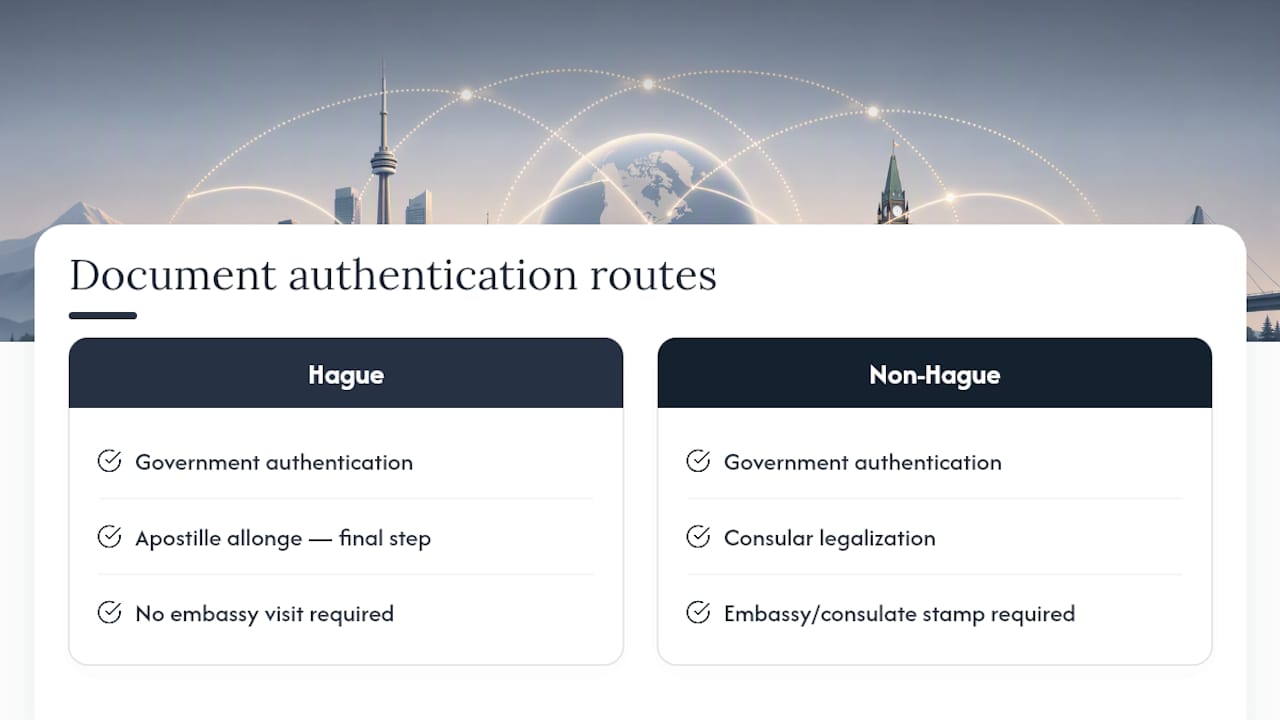
These two terms get used interchangeably, which causes real confusion. Authentication is the broader government process of verifying a public document's signature and seal for use abroad. An apostille is the specific certificate that Canada now issues as the output of that authentication process for Hague Convention countries, since Canada's accession to the convention took effect in January 2026.
Before Canada joined the convention, authenticated documents required an additional legalization stamp from the destination country's embassy or consulate in Canada, a two-step process. Now, for Hague member countries, the apostille allonge itself is the final step. No embassy visit required. For non-Hague destinations, authentication still exists as a process, but it's followed by consular legalization instead of an apostille.
This distinction matters for a very practical reason: apostille vs. notarization for degrees is a separate question entirely. Notarization is a preliminary step performed by a notary public to certify a copy is genuine. It has no international legal standing on its own. An apostille, or authentication more broadly, is the government-level step that actually makes a document usable abroad. Confusing the two, thinking a notarized copy alone will satisfy a foreign institution, is one of the most frequent and costly mistakes applicants make.
Common Mistakes When Preparing Education Documents for Apostille
Applicants lose the most time on preparation errors that have nothing to do with the apostille office itself. The document arrives at the counter already disqualified.
Sending a laminated diploma is the single most repeated mistake. Many Canadian institutions laminate diplomas as a matter of course for durability, but lamination is explicitly listed as grounds for rejection. If your original diploma is laminated, you'll need a certified true copy instead, not the laminated original.
Another frequent error is assuming a scanned or photocopied transcript will work. It won't. Authentication requires an original signature and seal, physically present on the page, not a reproduction of one.
Applicants also routinely misjudge which jurisdiction issued their document. A degree earned at a university in one province but notarized by a lawyer in another creates ambiguity about which competent authority actually applies. When in doubt, the safest approach is to ask the competent authority directly rather than guess.
Finally, people underestimate paper condition. Torn corners, water damage, or missing seal impressions can all trigger a rejection, since the authenticating office needs to visually confirm the seal and signature are intact and legible.
Cost Breakdown for the Full Apostille Process
The total cost of apostilling an education credential in Canada breaks into three separate categories, and understanding each one prevents budget surprises.
Certification or notarization fees. If your competent authority requires a notarized certified true copy rather than the original diploma, expect a notarization cost. Through Speedyapostilleservices, a notarized certified true copy runs $35 CAD per document.
Government authentication fees. This is the fee charged by the provincial competent authority or Global Affairs Canada itself to process and issue the apostille. Amounts are set by each office and vary depending on where the document was issued.
Handling costs. Courier fees for return shipping, or additional per-document charges when you're apostilling more than one credential at once, add to the total. If you're bundling multiple documents in a single order, additional documents are commonly billed at a lower per-document rate than the first, since providers apply volume-based pricing to reduce handling costs across a batch.
Add these together and budget for the notarization step, the government fee itself, and shipping, rather than assuming the government fee alone represents your total cost. Deadlines also factor into price. Rush or same-day options generally cost more than standard processing, so weigh how firm your deadline actually is before choosing a tier.
When a Paid Apostille Service Makes Sense
Doing this yourself works fine if you have one document, a clear destination, and no deadline pressure. It gets harder fast when you're juggling multiple jurisdictions, a notarization requirement, and a school or employer deadline measured in days, not weeks. That's the gap professional services fill: someone who already knows which office a document routes to and can file it in person instead of mailing it.
Some apostille services file Ontario documents in person at the counter, include notarization through an Ontario Notary, and provide all-in pricing that includes government fees. Typical turnaround times can be 2 to 3 days.
— Ken
How Speedy Apostille Services Handles Education Credentials
Speedyapostilleservices is the alternative to mailing documents yourself and hoping you picked the right office. It bundles Ontario Apostille filing, notarization and certified true copies, and courier handling into one order, with government fees included in the upfront quote so there's no surprise invoice after the fact.

For diplomas and transcripts issued or notarized in Ontario, the Ontario Apostille service covers document review, in-house notarization through a commissioned Ontario Notary, and in-person filing at the counter for faster turnaround than a mail-in submission. If your deadline is tight, Next-Day Priority or Same-Day Rush options are available for an additional cost. Some services correct filing errors without extra charge and may have positive client reviews.
If you're apostilling a diploma or transcript for a study abroad application, an employer, or a licensing board, check current pricing and get a quote through the pricing page before your deadline gets closer than it already is.
Sources
Start with Global Affairs Canada's authentication requirements for federal rules, and Alberta's document authentication page for a provincial example. McGill's student records apostille guidance shows how one university handles transcript requests directly.
- Authentication of documents: Requirements — Global Affairs Canada
- Authenticate your documents - Before you start — Global Affairs Canada
- How to Request an Apostille | Student Records - McGill University
FAQ
How do I get educational documents apostilled in Canada?
Confirm your destination is a Hague Convention member, obtain a certified true copy or notarization if your competent authority requires one, then submit to the provincial authority or Global Affairs Canada based on where the document was issued.
How can I get my documents apostilled in Canada?
Identify the issuing jurisdiction first: provincial documents go to that province's competent authority, while federally issued documents go to Global Affairs Canada. Services like Speedyapostilleservices handle Ontario filings in person for faster turnaround.
How do I apostille a degree certificate?
Check whether your original diploma is laminated or requires a certified true copy, since laminated originals are not eligible for authentication. Submit the eligible document to the competent authority matching where your university is located.
How can I apostille my diploma?
Obtain a certified true copy from your registrar or a notarized copy if required, verify the destination country accepts apostilles rather than consular legalization, and submit to the correct provincial or federal office for processing.
What does it cost to apostille a diploma through Speedyapostilleservices?
Notarization and certified true copies can involve a fee per document, and government authentication fees may be included upfront in some quotes. Current rates for expedited filing options are listed on the pricing page.