
Document Attestation for Canadians: A 2026 Guide
Document Attestation for Canadians: A 2026 Guide ! Canadian professional reviewing attestation documents Document attestation is the official process that confirms a document's authenticity for legal recognition in a foreign country.

Document Attestation for Canadians: A 2026 Guide
Document attestation is the official process that confirms a document's authenticity for legal recognition in a foreign country. It is not a content check. Consular officers verify signatures and seals, not the facts written inside the document. For Canadians preparing to study, immigrate, or work abroad, understanding this distinction saves time and prevents costly rejections. The two main paths are Apostille, used in Hague Convention member countries, and embassy legalization, used everywhere else.
What is document attestation and how does it differ from Apostille?
Document attestation is formal authentication that makes a Canadian document legally usable in another country. The term covers two distinct processes, and mixing them up is the most common reason applications fail.
Apostille applies only to countries that have joined the Hague Apostille Convention. Over 120 countries are parties to this treaty. For those destinations, a single Apostille certificate attached to your document is all the foreign authority needs. Canada is a member, so Canadian documents can receive an Apostille for use in countries like France, Germany, Mexico, and Australia.

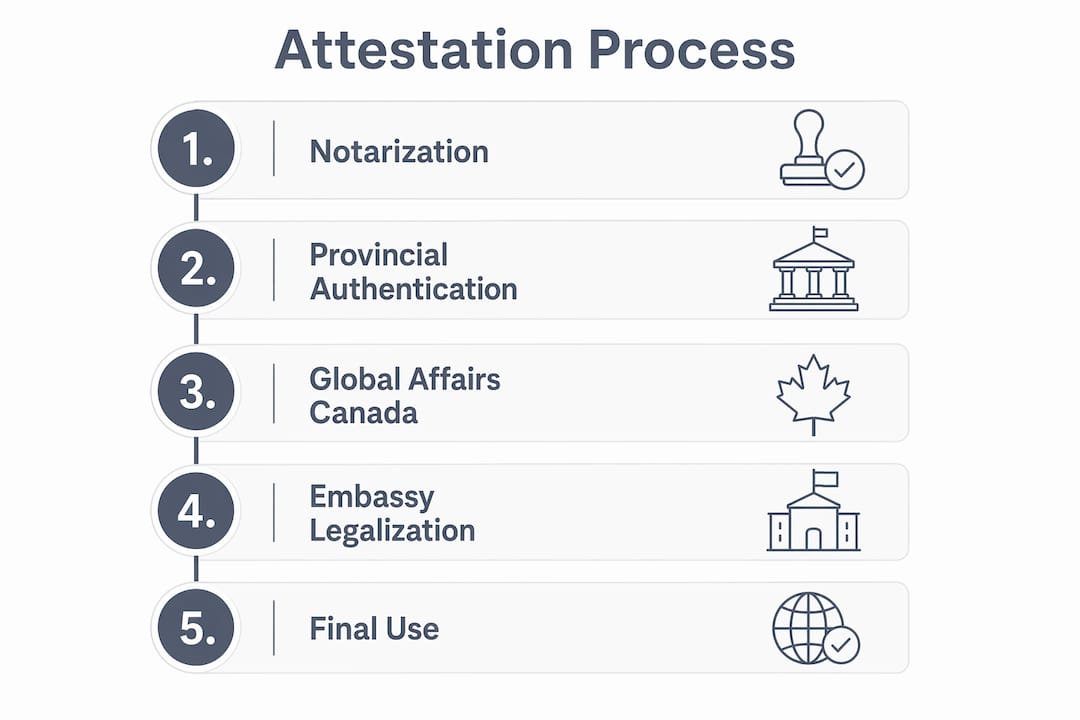
For countries outside the Hague Convention, the process is longer. It is called legalization or full attestation. The document moves through a chain of authorities: a local notary, a provincial authority, Global Affairs Canada (Canada's Ministry of Foreign Affairs), and finally the destination country's embassy in Canada. Skipping any link in that chain invalidates the attestation entirely.
| Feature | Apostille | Embassy legalization |
|---|---|---|
| Countries covered | 120+ Hague Convention members | Non-Hague countries |
| Steps required | Single certificate | Notary, province, Global Affairs, embassy |
| Typical speed | Faster | Slower, multi-agency |
| Cost | Lower | Higher, multiple fees |
Pro Tip: Before you do anything else, confirm whether your destination country is a Hague Convention member. That single check determines your entire process.
Which documents commonly need attestation for international use?
Most documents that carry legal weight in Canada can require attestation when used abroad. The category depends on why you need the document recognized.
Personal documents are the most common. These include:
- Birth certificates (for immigration, citizenship applications, or marriage abroad)
- Marriage certificates and divorce decrees
- Death certificates
- Adoption papers
- Criminal record checks
Educational documents are frequently requested by foreign universities and employers. Diplomas, transcripts, and professional certificates all fall into this group. A Canadian nursing graduate applying to work in the UAE, for example, must have her diploma attested before her credentials are recognized.
Commercial documents cover a different need. Power of attorney, articles of incorporation, and commercial contracts often require attestation when a Canadian business operates or signs agreements in another country.
Digital attestation is a newer option for eligible electronically issued documents. If a document carries a QR code or barcode, some authorities can verify and attest it remotely and faster than paper-based processes. This is still limited by country and document type, but the trend is growing.
How does the attestation process work step by step?
The steps vary depending on your destination country, but the general sequence is consistent for most Canadians.
- Notarization. A licensed notary public certifies the document or a copy. Notarization starts the process but does not complete it. Many people stop here, which leads to rejection abroad.
- Provincial authentication. The notary's signature is verified by the relevant provincial authority. In Ontario, this is ServiceOntario. In British Columbia, it is the BC Vital Statistics Agency.
- Federal authentication or Apostille. Global Affairs Canada authenticates the provincial authority's seal. For Hague countries, this step produces the Apostille certificate. The process ends here for those destinations.
- Embassy legalization (non-Hague countries only). The document goes to the destination country's embassy or consulate in Canada. Consulates typically require original documents, photocopies, and a signed application form.
- In-person signing. Many consulates require the applicant to sign documents in the physical presence of a consular officer. A pre-signed document is often rejected outright.
Pro Tip: Call the destination country's embassy in Canada before you start. Requirements change without notice, and a five-minute call can prevent a six-week delay.
Timelines at each step add up. Provincial authentication can take a few business days. Global Affairs Canada processing varies by volume. Embassy appointments may be weeks away. Starting early is not optional if you have a deadline.
What are the costs and typical timelines for attesting documents?
Fees and timelines vary widely. There is no single price list because each authority sets its own schedule.
Costs and turnaround times depend on the embassy, the number of documents, and the type of service selected. Government processing fees are generally modest at the provincial and federal levels. Embassy fees are where costs climb, particularly for countries with high demand or limited consular staff in Canada.
| Stage | Typical cost range | Typical timeline |
|---|---|---|
| Notarization | $50–$150 per document | Same day to 2 days |
| Provincial authentication | $25–$75 per document | 2–5 business days |
| Global Affairs Canada (Apostille) | $35 per document | 10–15 business days |
| Embassy legalization | $100–$400+ per document | 1–6 weeks |
Expedited options exist at most stages but carry higher fees. Some embassies offer urgent processing for an additional charge. Professional attestation services, like Speedyapostilleservices, bundle multiple steps and often reduce total turnaround time significantly. Speedyapostilleservices reports a typical turnaround of 2–3 days for Apostille processing, with all-in pricing that includes government fees upfront.
What practical tips help avoid delays and rejections?
Starting the process 2–3 months early is the single most effective way to avoid missed deadlines. Bureaucratic backlogs are real and unpredictable. A student visa application or a work permit with a fixed deadline does not wait for a slow embassy queue.
Common mistakes to avoid:
- Assuming notarization is the final step. It is only the first.
- Submitting photocopies when originals are required.
- Signing documents before appearing before the consular officer. Documents signed in advance are frequently rejected.
- Failing to confirm whether the destination country is a Hague member before choosing a process path.
- Ignoring translation requirements. Some countries require a certified translation alongside the attested document.
- Using outdated fee schedules. Embassy fees change, and paying the wrong amount causes delays.
Pro Tip: Keep certified copies of every document at each stage. If a step fails, you will not have to restart from scratch.
One detail many people miss: attestation confirms that the official who signed the document is who they claim to be. It does not confirm that the information inside the document is accurate. A birth certificate with an error will still receive an Apostille. The error remains the applicant's problem to resolve separately.
Key Takeaways
Document attestation is a multi-step authentication process, and choosing the wrong path between Apostille and embassy legalization is the leading cause of failure for Canadians preparing documents for international use.
| Point | Details |
|---|---|
| Apostille vs. legalization | Apostille covers 120+ Hague countries; non-Hague countries require full embassy legalization. |
| What attestation verifies | Officers confirm signatures and seals only, not the accuracy of document content. |
| Notarization is not enough | Notarization starts the chain but additional government steps are always required. |
| Start early | Begin the process 2–3 months before your deadline to absorb bureaucratic delays. |
| In-person signing matters | Many consulates reject pre-signed documents; sign only before the consular officer. |
What I've learned after watching people get this wrong repeatedly
The confusion between Apostille and legalization is not a small misunderstanding. It costs people weeks of time and real money. I have seen students miss enrollment deadlines because they assumed notarization was sufficient. I have seen professionals lose job offers because they submitted documents to the wrong authority.
The part that surprises most people is how mechanical the process is. Attestation has nothing to do with whether your document is truthful. A consular officer is not reading your diploma to see if you actually earned it. They are checking that the registrar's signature matches what is on file. That is the entire job. Once you understand that, the process becomes less intimidating and more manageable.
My strongest advice is to verify the destination country's Hague Convention status before touching a single document. That one step determines everything else. If you are unsure, a professional attestation service is worth the cost. The fee is almost always less than the cost of restarting a failed application.
Digital attestation is worth watching. For countries and document types that support it, the process is faster and less prone to physical handling errors. It is not universal yet, but it is expanding. Canadians dealing with UAE, for example, can already access digital attestation for eligible documents.
— Ken
Speedyapostilleservices: attestation support for Canadians
Speedyapostilleservices, based in Toronto, handles Apostille processing for Canadian documents including birth certificates, marriage licenses, and diplomas. The service covers recognition in over 120 Hague Convention countries and is built for individuals and families who need documents authenticated without delays or hidden fees.

All-in pricing includes government fees upfront, so the cost you see is the cost you pay. The typical turnaround is 2–3 days. The service has earned over 1,000 reviews with a 5.0 rating. If you are ready to move forward, submit your documents directly through the Speedyapostilleservices platform and get the process started today.
FAQ
What is document attestation?
Document attestation is the formal process of verifying a document's authenticity for legal use in a foreign country. It confirms the validity of official signatures and seals, not the accuracy of the document's content.
Do I need an Apostille or embassy legalization?
The answer depends on your destination country. Apostille applies to the 120+ countries in the Hague Apostille Convention. All other countries require full embassy legalization, which involves multiple government steps.
Is notarization enough for international use?
No. Notarization initiates the authentication chain but is not sufficient on its own. Additional steps, including provincial authentication and either Apostille or embassy legalization, are always required.
How long does the attestation process take in Canada?
Timelines vary by stage and destination. Apostille processing through Global Affairs Canada typically takes 10–15 business days. Embassy legalization can add 1–6 weeks. Professional services like Speedyapostilleservices can reduce Apostille turnaround to 2–3 days.
Can I attest documents digitally?
Digital attestation is available for eligible electronically issued documents that carry a QR code or barcode. Availability depends on the destination country and document type. It is not yet universally accepted but is expanding.