
Getting a Divorce Certificate Apostille in Canada
Getting a Divorce Certificate Apostille in Canada ! Hand stamping official seal on divorce certificate Yes, Canada issues apostilles for eligible divorce certificates, provided the correct competent authority authenticates the document first.

Getting a Divorce Certificate Apostille in Canada
Yes, Canada issues apostilles for eligible divorce certificates, provided the correct competent authority authenticates the document first. The first move is to confirm with the destination country's embassy or requesting authority whether it wants an apostille or full consular legalization. From there, identify who issued your certificate: a province handles provincial court records, while Global Affairs Canada handles what falls outside provincial jurisdiction.
TL;DR:
- Most Canadian provinces require original or certified copies, along with a proper identification document, for the apostille application of divorce certificates.
- An apostille only certifies the signature and authority of the official, not the validity of the divorce certificate's content, making original documents essential.
- Processing times and fees depend on the provincial or federal authority handling the document, with some provinces offering expedited options and others requiring notarization or reissuance first.
- Countries outside the Hague Convention need separate legalization procedures at their embassy or consulate, which are usually longer and more complex than apostille requests.
- Using a professional service can simplify the process, especially for urgent needs, complicated signatures, or when living outside Canada.
Table of Contents
- What Does a Divorce Certificate Apostille Actually Certify?
- Who Issues an Apostille for a Divorce Certificate in Canada?
- What Documents Do You Need to Submit?
- How Do You Get an Apostille on Your Divorce Certificate?
- How Long Does It Take, and What Does It Cost?
- What If Your Destination Country Isn't in the Hague Convention?
- How Do You Verify an Apostille and Avoid Rejection?
- When Hiring a Professional Apostille Service Makes Sense
- Speedy Apostille Services Handles the Paperwork So You Don't Have To
- Official Pages to Check Before You Submit
- Sources
- FAQ
What Does a Divorce Certificate Apostille Actually Certify?
An apostille does not confirm that the contents of your divorce certificate are true. It confirms that the signature and seal on the document belong to a real public official who had the authority to sign it, according to Global Affairs Canada. That distinction matters because it explains why originals or certified copies are required. A photocopy has no verifiable signature to check.
The apostille itself is a separate certificate, called an allonge, physically attached to your document. A few points to keep straight:
- The allonge must stay attached; removing or restapling it can void the whole thing.
- If the destination country belongs to the Hague Apostille Convention, the apostille is normally the only authentication step needed.
- If it does not belong to the Convention, you will need consular legalization instead, which is a longer, separate process.
Who Issues an Apostille for a Divorce Certificate in Canada?
Canada does not have one single apostille office. Global Affairs Canada issues apostilles for documents that fall under federal authority, but many divorce certificates are provincial court or vital-statistics records, which means a provincial competent authority handles them instead.
Provincial rules differ in ways that catch people off guard:
- Ontario: certificates of divorce issued before July 10, 2023 may need notarization first unless the certificate is reissued by the court; a freshly reissued certificate skips that notarization step entirely.
- Alberta: the province accepts Certificates of Divorce directly for apostille submission through its own authentication office.
- British Columbia: runs its own Apostille Convention page and process, separate from the federal system.
- Saskatchewan: follows its own provincial authentication channel rather than routing through Ottawa.
Before you send anything, check our checklist by province to confirm you're mailing the certificate to the right office the first time.
What Documents Do You Need to Submit?
Most rejections trace back to paperwork, not policy. Authorities generally want an original or a certified true copy, never a plain photocopy, and they want it clean.
- Original or certified copy of the divorce certificate, unaltered and unlaminated.
- Reissued certificate from the court if the original's signature can't be verified against current records.
- Certified translation, if the destination country requires the document in a language other than English or French.
- Valid government ID matching the name on the certificate, or supporting documents if your name has changed.
- Cover letter stating the destination country and the purpose (remarriage, visa, custody, and so on), plus a prepaid return envelope.
Avoid gluing, laminating, or otherwise altering the certificate before submission. Any of those can be read as tampering and lead to an outright rejection.
Pro Tip: If your divorce is old and the certificate looks worn or the signature style has changed since it was issued, request a reissued certificate before you apply. It's often faster than fighting a rejection later.
How Do You Get an Apostille on Your Divorce Certificate?
The process is straightforward once you know the order of operations.
- Confirm destination requirements. Contact the embassy or the specific authority requesting the document to find out if it wants an apostille or legalization.
- Identify the right issuing authority. Provincial office, court, or Global Affairs Canada, depending on where and how the certificate was issued.
- Assemble your package. Original or certified copy, translation if needed, ID, applicable fees, and a return envelope.
- Submit the package by mail or the method that office specifies, with a cover letter stating your name, the destination country, and the document's purpose.
- Verify on receipt. Check the allonge is intact and matches your document, then keep photocopies of everything before it leaves your hands again.
If a submission comes back rejected, call the issuing office directly and ask for the specific reason rather than resubmitting blind.
How Long Does It Take, and What Does It Cost?
Processing times vary depending on which office handles your certificate, and provincial pages along with Global Affairs Canada publish their own current timelines rather than a single national number. Fees also differ by authority and typically cover the authentication and apostille issuance separately from courier or return postage.
A few ways to reduce delays:
- Have the certificate notarized in advance if your province requires it, so you're not waiting on a second round trip.
- Ask about provincial rush processing where it's offered.
- Use a professional service to handle expedited submission and error checking.
Even paid expedited handling can't outrun everything. If a court or vital-statistics office needs to confirm or reissue a certificate before authentication, that verification step happens on the third party's timeline, not yours.
What If Your Destination Country Isn't in the Hague Convention?
An apostille only works for countries that signed the Hague Apostille Convention. If your destination country isn't a member, you need consular legalization instead, and it's a different process entirely.
- Your certificate is first authenticated by the appropriate Canadian competent authority, the same starting point as an apostille.
- From there, it goes to the destination country's embassy or consulate in Canada for legalization, which is a separate stamp and separate fee.
- Legalization usually takes longer than an apostille and can carry its own translation requirements.
- Confirm the embassy's exact rules before you start. Paying for authentication only to learn the embassy wants something different wastes both time and money.
How Do You Verify an Apostille and Avoid Rejection?
Global Affairs Canada and some provinces offer online verification tools tied to their authentication pages so a foreign authority can confirm your apostille is genuine. Rejections tend to come from a small set of repeat problems.
- An unverifiable signature, often because the signing official's record is outdated in the system.
- A tampered or detached allonge, even if the tampering was accidental.
- A document that originated outside Canada being submitted to a Canadian authority by mistake.
To lower your odds of rejection, request a reissued certificate rather than relying on an old original with a questionable signature, use certified translations where required, and never separate the allonge from the certificate once it's attached.
Pro Tip: Photograph both sides of the apostilled certificate and the allonge together before mailing it anywhere. If a foreign office claims something arrived damaged or incomplete, you'll have proof of what you actually sent.
When Hiring a Professional Apostille Service Makes Sense
Most people can walk through this process alone if they have time and a straightforward document. But three situations change that calculation fast: a hard visa or remarriage deadline abroad, a court-issued certificate with signature or reissue complications, or an applicant currently living outside Canada who can't easily mail things back and forth.
A reputable service should review your document before submission, not after a rejection. It should bundle government fees into one upfront price instead of surprising you later, handle the physical document securely, and know the provincial quirks, like Ontario's reissue rule, before you ask about them.
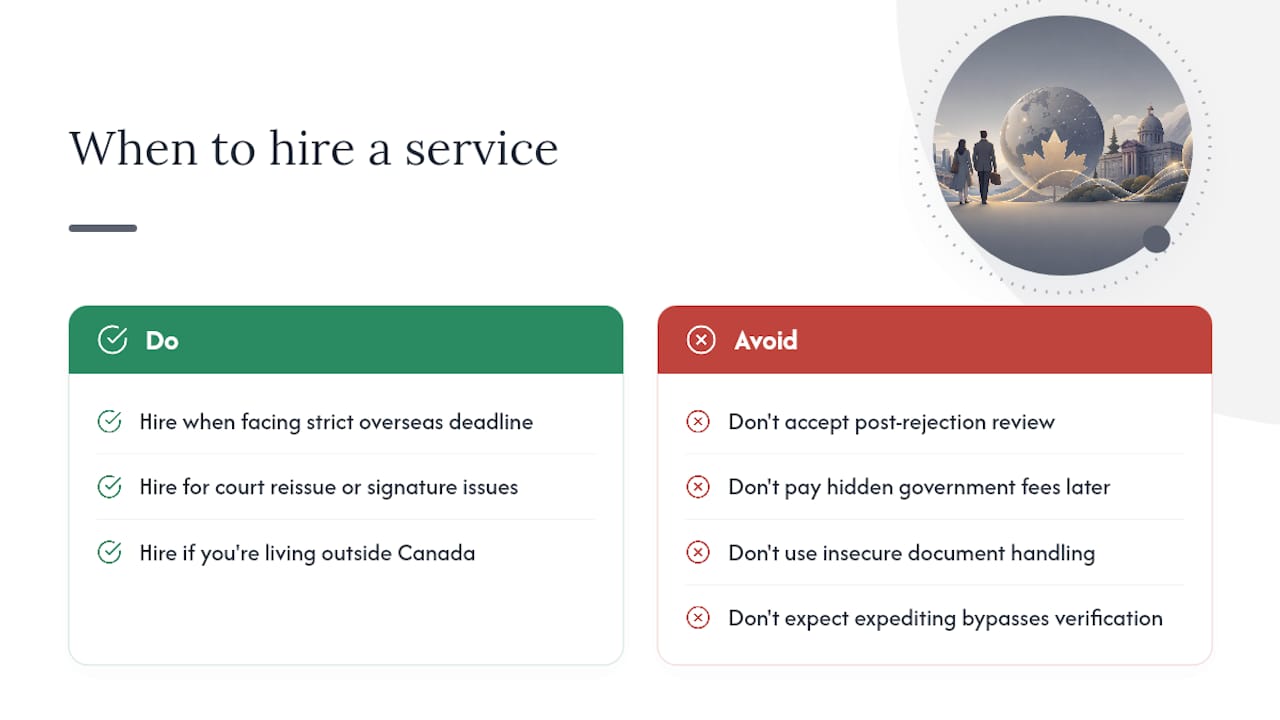
Paying for expediting doesn't skip verification steps a court or registry controls. It just removes the guesswork on your end.
— Ken
Speedy Apostille Services Handles the Paperwork So You Don't Have To
Speedyapostilleservices is the alternative to guessing your way through provincial rules and mailing documents to the wrong office. Its all-in pricing bundles government fees upfront, so there's no second invoice after you've already waited weeks.

Every divorce certificate gets reviewed before submission, which catches the notarization and reissue issues that cause most rejections, including Ontario's pre-July 2023 certificate rule. Documents are handled securely from intake to return, and most orders turn around in 2 to 3 days rather than the multi-week wait common with provincial mail-in processing. If your certificate was issued outside Ontario, our guide on court documents apostille requirements covers where yours likely needs to go.
Start by requesting a quote for your divorce certificate and get a clear answer on documents, cost, and timeline before you commit to anything.
Official Pages to Check Before You Submit
Confirm your specific case against Global Affairs Canada's authentication guidance and your province's competent authority page. Always double-check requirements directly with the destination country's embassy first.
Sources
- Authenticate your documents - Before you start (Step 1)
- Authentication of documents
- Authenticate a document for use outside Canada
- Documents for other jurisdictions or countries
FAQ
How do I get an apostille certificate in Canada?
Confirm the destination country requires an apostille, identify whether your divorce certificate falls under provincial or federal authority, then submit the original or certified copy to that office along with any required fees and a cover letter.
How can I get an apostille on a document in Ontario?
Ontario's Official Documents Services handles the authentication and apostille process for Ontario-issued documents, though divorce certificates issued before July 10, 2023 may need notarization first unless the court reissues the certificate.
Does Global Affairs Canada provide apostille services for Canadian documents?
Yes, Global Affairs Canada issues apostilles for documents that fall under federal jurisdiction, but many divorce certificates are provincial records and go through that province's competent authority instead.
How much does it cost to get an apostille on a document in Canada?
Fees vary by issuing authority and typically cover authentication plus apostille issuance separately from courier or return postage costs; check the specific provincial or federal page handling your document for current rates.
What's the difference between an apostille and legalization for a divorce certificate?
An apostille works for countries in the Hague Apostille Convention, while legalization is required for non-member countries and involves an added step at that country's embassy or consulate after Canadian authentication.
Recommended
- How to Get a Certificate of Status Apostille in Canada | Speedy Apostille Services
- Apostille for a Death Certificate: Get It Accepted Abroad | Speedy Apostille Services
- Court Documents Apostille Canada: Where to Send Yours | Speedy Apostille Services
- Getting an Apostille in Canada: A Sample-Based Guide | Speedy Apostille Services