
Since Jan 11, 2026, Digital Documents Can't Be Apostilled in Canada
Since Jan 11, 2026, Digital Documents Can't Be Apostilled in Canada ! Digital certificate on secure review workspace No.

Since Jan 11, 2026, Digital Documents Can't Be Apostilled in Canada
No. In most Canadian jurisdictions, you cannot get an apostille on a purely digital document. Competent authorities including Global Affairs Canada and provincial offices require an original signature on paper, or a certified true copy with a wet-ink signature and seal. Your next move: identify the correct competent authority for your document type, then arrange notarization on paper.
TL;DR:
- Most Canadian jurisdictions do not accept digital documents for apostille certification, requiring original or certified true paper copies with wet signatures.
- Canada’s 2024 joining of the Hague Apostille Convention simplifies the process for documents headed to member countries, eliminating embassy legalization.
- Apostille issuance is split between federal and provincial authorities, so submitting through the wrong office is a common cause of rejection.
- Digital files with e-signatures or scans typically cannot be apostilled unless printed, notarized as a true copy, and sealed with a wet signature.
- Verification through Canada's e-register is essential to confirm the authenticity of an apostille before international use.
Table of Contents
- What Is an Apostille, and What Changed in 2026?
- Who Actually Issues Apostilles in Canada?
- Can Digital or Electronically Signed Documents Get Apostilled?
- Step-by-Step: Preparing and Submitting Your Document
- Processing Times, Fees, and How to Verify Your Apostille
- Common Mistakes That Get Applications Rejected
- When a Specialist Service Actually Helps
- Get Your Documents Apostilled Without the Guesswork
- Ken's Closing Perspective
- Sources
- FAQ
What Is an Apostille, and What Changed in 2026?
An apostille is a single certificate that confirms a signature, seal, or stamp on a public document is genuine, so it can be recognized abroad without further embassy involvement. Before January 11, 2024, Canadian documents needed a longer chain of authentication and consular legalization to be accepted in most foreign countries. That changed when Canada joined the Hague Apostille Convention, cutting out the embassy step for the member countries of the Hague Apostille Convention.
The practical differences:
- Old process: authentication by Global Affairs Canada, then separate legalization at the destination country's embassy or consulate.
- New process: one apostille certificate, accepted directly by any Hague member country.
- Exception: if your destination country hasn't joined the convention, you still need full consular legalization, not an apostille.
Always confirm your destination's status before you start; assuming every country accepts an apostille is one of the fastest ways to waste a submission fee. For example, understanding specific international requirements like those for Italy can be crucial, see International Power of Attorney in Italy - MG Law.
Who Actually Issues Apostilles in Canada?
There's no single national apostille office. Canada splits authority between the federal government and the provinces, and sending your document to the wrong one is the single most common reason applications stall.
Global Affairs Canada handles federal documents and, in provinces without their own program, provincial documents too. Examples include:
- RCMP criminal record checks and federal court documents
- Documents from provinces or territories that haven't set up their own authentication office
- Some corporate and immigration paperwork tied to federal departments
Several provinces run their own competent authority instead. Ontario's Official Documents Services (ODS) handles Ontario-issued birth certificates, marriage licenses, and education records. British Columbia, Alberta, Saskatchewan, and Quebec each operate similar provincial programs, and Quebec's process runs primarily in French, which catches out a lot of applicants who assume English forms will work everywhere.
Before you submit anything, check where your specific document was issued and confirm which office handles it. The HCCH's list of competent authorities is the most reliable way to double-check.
Can Digital or Electronically Signed Documents Get Apostilled?
Generally, no. Government guidance is consistent across jurisdictions: to be authenticated, a document must have an original, recognized signature and be in paper format. A PDF with an e-signature, a DocuSign field, or a scanned image of a signature doesn't meet that bar in most provinces.
Remote Online Notarization (RON) complicates this further. Some provinces permit RON for certain legal purposes, but that doesn't automatically translate to apostille eligibility. Ontario's ODS still generally requires hard-copy originals or certified true copies notarized in person, which means a RON session alone usually won't satisfy the apostille requirement even where RON itself is legal for other uses.
If your document exists only as a PDF, the practical workaround is straightforward: print it, then have a licensed notary compare it against the digital source and certify it as a "Certified True Copy" with a wet-ink signature and an embossed seal. That paper copy, not the original PDF, is what goes to the competent authority.
Pro Tip: Before paying a notary, ask whether they're registered with the province and whether their signature is already on file with the competent authority you're using. Unregistered notarizations are a leading cause of rejected apostille requests.
Step-by-Step: Preparing and Submitting Your Document
Getting this right the first time saves weeks. Follow this order:
- Confirm what the receiving party actually needs. Some employers, universities, or foreign registries want an apostille specifically; others want additional certified translations or consular stamps on top. Email them before you spend money.
- Identify your competent authority. Federal documents and provinces without their own program go through Global Affairs Canada. Ontario, BC, Alberta, and Quebec documents go through their respective provincial offices. Getting this wrong means starting over.
- Get your document notarized as a certified true copy. This step matters most for anything that started as a digital file. Confirm your notary's registration status before the appointment, not after.
- Complete the application forms and pay the correct fee. Choose your submission method, mail-in or an online portal where one exists, and double-check the return shipping option so your original document doesn't get lost in transit.
- Verify the issued apostille once you receive it. Canada's e-register verification tool lets you confirm an apostille is genuine before you send it internationally.
Government sources are explicit on one point that trips up a lot of applicants: processing times stay the same whether you apply directly or through a professional service. A third party can't push your file ahead of the government's internal queue, though it can prevent the errors that put you back at the end of it.
Processing Times, Fees, and How to Verify Your Apostille
Government processing windows vary by authority and by how busy that office is that month, and no service, including a professional one, can shortcut the official queue. What a good service can do is prevent the paperwork errors that add weeks to your timeline.
Fees also vary by province and document type:
- Provincial competent authorities (Ontario, BC, Alberta) each publish their own fee schedules for authentication and apostille issuance.
- Third-party services and courier costs sit on top of government fees, not instead of them.
- Rush or expedited handling, where offered, typically carries an additional charge.
Once you have your certificate in hand, verify it through the government's e-register before relying on it internationally. Fraudulent or altered apostilles do circulate, and a quick verification check protects you from a rejected submission overseas, and from becoming an unwitting party to fraud. Our guide on spotting apostille scams covers the warning signs in more detail.
Common Mistakes That Get Applications Rejected
Most rejections trace back to a small handful of avoidable errors.
- Sending the document to the wrong authority. Confirming the correct competent authority for your document's issuing jurisdiction prevents the majority of rejections.
- Missing an original signature or seal. A photocopy of a signed document isn't the same as a document bearing a live signature.
- Using a notarization that isn't on file. If the competent authority can't verify your notary's signature against its own records, the application stalls.
- Submitting a digital-only file with an e-signature. This remains the most common mistake for applicants unfamiliar with the paper requirement.
- Applying for a document type outside the authority's eligibility list. Some documents, including certain post-secondary records, have narrow eligibility windows.
Pro Tip: Photocopy everything before you mail it. If your original gets delayed in transit, you'll need proof of exactly what you submitted and when.
When a Specialist Service Actually Helps
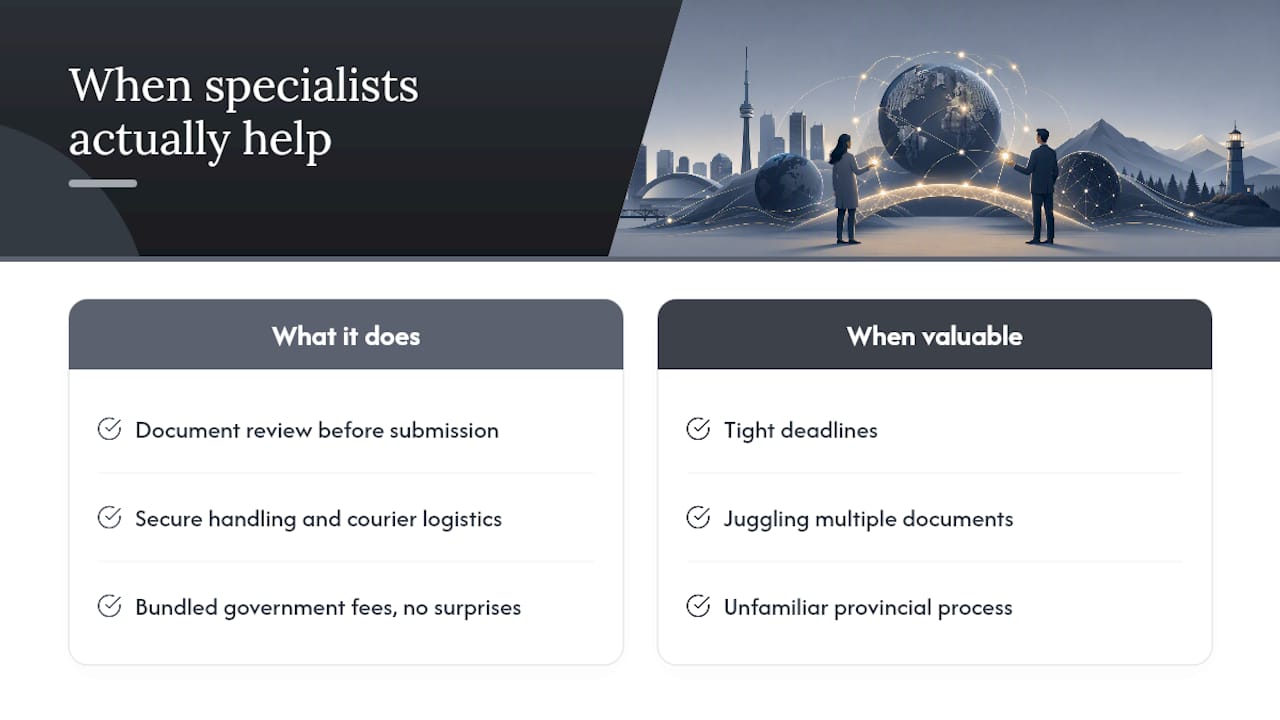
A specialist service can't speed up the government's internal processing queue, no legitimate provider can. What it does offer is document review before submission, secure handling and courier logistics, and bundled government fees so there are no surprise costs. That's most valuable when you're facing a tight deadline, juggling multiple documents, or working with a provincial process you've never navigated before.
Get Your Documents Apostilled Without the Guesswork
If you've read this far, you already know the paperwork itself isn't complicated. What eats up time is figuring out which office to use, whether your notarization qualifies, and how to avoid a rejected submission that sends you back to square one. Speedyapostilleservices was built around solving exactly that problem for Canadian individuals and businesses.
Speedyapostilleservices, based in Toronto, reviews your documents before submission, handles the required notarization and secure handling, and bundles government fees into one all-inclusive price with no hidden costs. Typical turnaround runs several days depending on document type and service tier, covering birth certificates, marriage licenses, diplomas, transcripts, corporate records, and RCMP background checks for use in over 120 Hague Convention countries. If you need a document apostilled correctly and quickly, start your apostille request with Speedyapostilleservices and get a document review before anything goes to a government office.
Ken's Closing Perspective
The safest path is almost always the boring one: confirm your destination country's requirements, find the correct competent authority for your document's origin, and get a proper paper notarization before you submit anything. Skipping that sequence to save a few days almost always costs more time later. If you're dealing with a corner case, our posts on online notarization limits and apostille requirements for work abroad cover the situations this article can't fully resolve on its own.
— Ken
Sources
- Authentication of documents - Global Affairs Canada
- Ontario
- Canada joins Apostille Convention to facilitate use of public documents abroad
FAQ
Can I Get a Digital Apostille in Canada?
No. Most Canadian competent authorities require a paper original or a certified true copy with a wet-ink signature and seal; purely digital files with e-signatures are typically rejected.
Does Canada Use the Hague Apostille Convention?
Yes. Canada joined the Hague Apostille Convention effective January 11, 2024, replacing the older embassy legalization process for member countries.
Who Do I Contact to Apostille an Ontario Document?
Ontario documents go through Official Documents Services (ODS), which verifies signatures against its own records and generally requires hard-copy originals.
Can a Third-Party Service Speed Up My Apostille?
No provider can change government processing times. A service like Speedyapostilleservices can, however, prevent the document errors that add delays and can bundle notarization, review, and fees into one process.
How Do I Verify an Apostille Is Real?
Canada's e-register, referenced through the HCCH's competent authority listing, lets you confirm an issued apostille's authenticity before relying on it abroad.