
Avoid Routing Delays: Apostille a Court Judgment in Canada in 1–7 Days
Avoid Routing Delays: Apostille a Court Judgment in Canada in 1–7 Days ! Court file routed through courthouse records archive Yes, a Canadian court judgment can receive a court judgment apostille once you obtain a certified copy from the issuing court and route it to the correct authority.

Avoid Routing Delays: Apostille a Court Judgment in Canada in 1–7 Days
Yes, a Canadian court judgment can receive a court judgment apostille once you obtain a certified copy from the issuing court and route it to the correct authority. Whether that authority is federal or provincial depends on which court issued the judgment, and getting this wrong is the most common reason for delay. The next step is simple: call the court clerk, request a certified true copy, and confirm which office handles that document type before you mail anything.
TL;DR:
- Most delays occur when mistakenly routing federal judgments through provincial offices or vice versa, so confirming the court's jurisdiction beforehand is essential.
- Certified copies must be signed directly by the court clerk and bear the official embossed seal; notarized or photocopied seals will lead to rejection.
- Countries outside the Hague Apostille Convention require traditional consular legalization, not an apostille, so destination country status must be verified early.
- Processing times and costs vary significantly between federal and provincial offices, with expedited services available for urgent international filings.
- Family and criminal judgments often require additional documentation or stricter certification standards, making it critical to confirm specific requirements with the foreign authority.
Table of Contents
- What Does an Apostille Certify, and Why Does Canada's Accession Matter?
- Who Issues Apostilles for Court Judgments: Federal or Provincial?
- How Do You Apostille a Court Judgment in Canada?
- What Documents and Certifications Are Required?
- What Should You Expect for Timing and Cost?
- Common Pitfalls When Apostilling a Court Judgment
- Do Requirements Differ by Type of Judgment?
- Why Getting the Routing Right Matters More Than People Think
- Get Your Court Judgment Apostilled Without the Routing Guesswork
- Sources
- FAQ
What Does an Apostille Certify, and Why Does Canada's Accession Matter?
An apostille certifies the signature, seal, and authority of the official who signed the underlying document. It says nothing about whether the judgment itself is correct or enforceable. That distinction matters because a foreign court or agency receiving an apostilled Canadian judgment is trusting the paper trail, not endorsing the ruling.
Canada joined the Hague Apostille Convention in early 2024. Before that date, Canadian documents headed abroad needed consular legalization, a multistep chain involving the foreign embassy or consulate. Apostille court documents now skip that chain entirely for use in any of the more than 120 member countries recognized under the Convention.
If your destination country has not joined the Convention, the apostille route does not apply. You will still need consular legalization through that country's embassy or consulate in Canada. Check the destination's status before you start, not after.
Who Issues Apostilles for Court Judgments: Federal or Provincial?
This is where most delays happen. Canada does not have one national office that stamps every apostille. Instead, the correct competent authority depends on where the judgment originated.
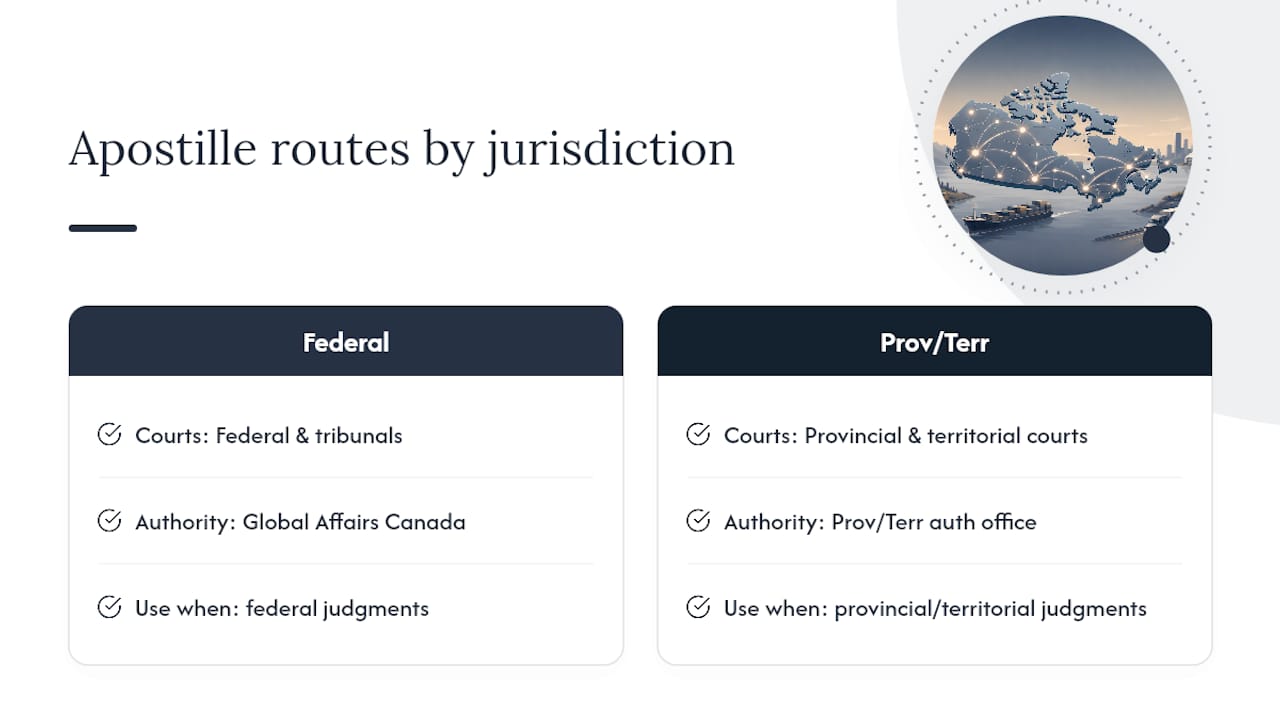
Federal Court and Federal Court of Appeal judgments, along with documents from certain federal tribunals, typically route through Global Affairs Canada. Provincial and territorial court judgments, including those from provincial superior courts, small claims courts, and family courts, go through that province's own authentication office instead.
British Columbia illustrates this well. The province administers its own apostille program for documents issued within BC, separate from the federal process. Ontario, Alberta, Quebec, and every other province run comparable programs for their own courts. A judgment issued by the Ontario Superior Court of Justice needs Ontario's authentication office, not Global Affairs Canada, and vice versa for federal matters.
The fastest way to identify the right jurisdiction is to look at the court heading on your judgment itself. It names the court, and the clerk's office can confirm exactly which authentication authority accepts documents from that court. When in doubt, call before you submit. Sending a provincial judgment to a federal office, or the reverse, is a documented and avoidable source of processing delay.
How Do You Apostille a Court Judgment in Canada?
The process for court document apostille requests follows a consistent order, regardless of which province issued the judgment.
- Confirm the destination country's Hague status. Check the HCCH member list before doing anything else. If the country is not a member, you need consular legalization instead of an apostille.
- Request a certified true copy from the court clerk. Ask specifically for a copy bearing the clerk's original signature and the court's official seal. A photocopy of your existing judgment will not qualify.
- Identify the correct competent authority. Federal matters go to Global Affairs Canada; provincial and territorial matters go to that province's authentication office. Call ahead if the court heading leaves any doubt.
- Submit the certified copy with the required cover form and payment. Most offices accept mail submissions, and some allow in-person drop-off. Follow the specific submission instructions for that office exactly.
- Inspect the returned document. Check for a certificate number, a properly attached apostille certificate, and an intact clerk certification before moving forward with translation or delivery to the foreign recipient.
Pro Tip: Order two certified copies from the clerk at the same time, even if you only plan to apostille one. If the first submission gets rejected for a technicality, you avoid a second trip back to the courthouse and a second round of clerk fees.
What Documents and Certifications Are Required?
A court judgment apostille request lives or dies on the quality of the underlying certified copy. Authentication offices are strict about this, and for good reason. They are certifying the clerk's signature, so that signature has to be genuine and current.
- The copy must be issued and signed directly by the court clerk, not by a lawyer, notary, or law firm administrator.
- It must carry the court's official raised or embossed seal, not a scanned or photocopied seal image.
- Look for certifying language such as "certified true copy," "according to the original," or "original retained by court archive," depending on the court's standard wording.
- Notarized photocopies do not substitute for a clerk-certified copy. Apostille authorities reject them routinely.
- If your certified copy is more than a few months old, some foreign authorities will ask for a freshly re-certified version. Check the destination's requirements before submitting an older copy.
What Should You Expect for Timing and Cost?
Processing times for apostille requirements for court orders vary by office and by how you submit. Mail-in requests generally take longer than in-person submissions, and provincial offices don't all run on the same clock. Global Affairs Canada and each provincial authentication office publish their own current fee schedules and estimated turnaround windows, and those numbers shift, so check the specific office handling your document before you plan around a date.
Expedited service through a private agent typically costs more than standard government processing but can meaningfully cut turnaround for time-sensitive matters like custody hearings or foreign litigation deadlines. Budget separately for translation and for any extra certified copies. Both come after the apostille is attached, not before, and both add their own time and cost on top of the base authentication fee.
Common Pitfalls When Apostilling a Court Judgment
Most rejections trace back to a handful of avoidable mistakes. Knowing them ahead of time saves a resubmission cycle that can add weeks.
- Don't translate the judgment before it's apostilled. Get the apostille attached first, then have the completed apostilled package translated if the destination country requires a non-English version.
- Confirm the exact certification wording your destination authority expects. Some foreign agencies are particular about phrases like "true copy" versus "certified copy," and a mismatch can trigger a rejection.
- Order multiple certified copies up front if the receiving country or multiple agencies each require a separate original.
- Call the issuing court clerk or Global Affairs Canada before mailing anything if you are unsure whether your judgment is a federal or provincial matter.
Pro Tip: If your judgment will be used for more than one purpose abroad, such as both a custody filing and a property matter, get separate certified copies apostilled for each. Foreign agencies frequently want to keep the original apostilled document on file and won't return it.
Do Requirements Differ by Type of Judgment?
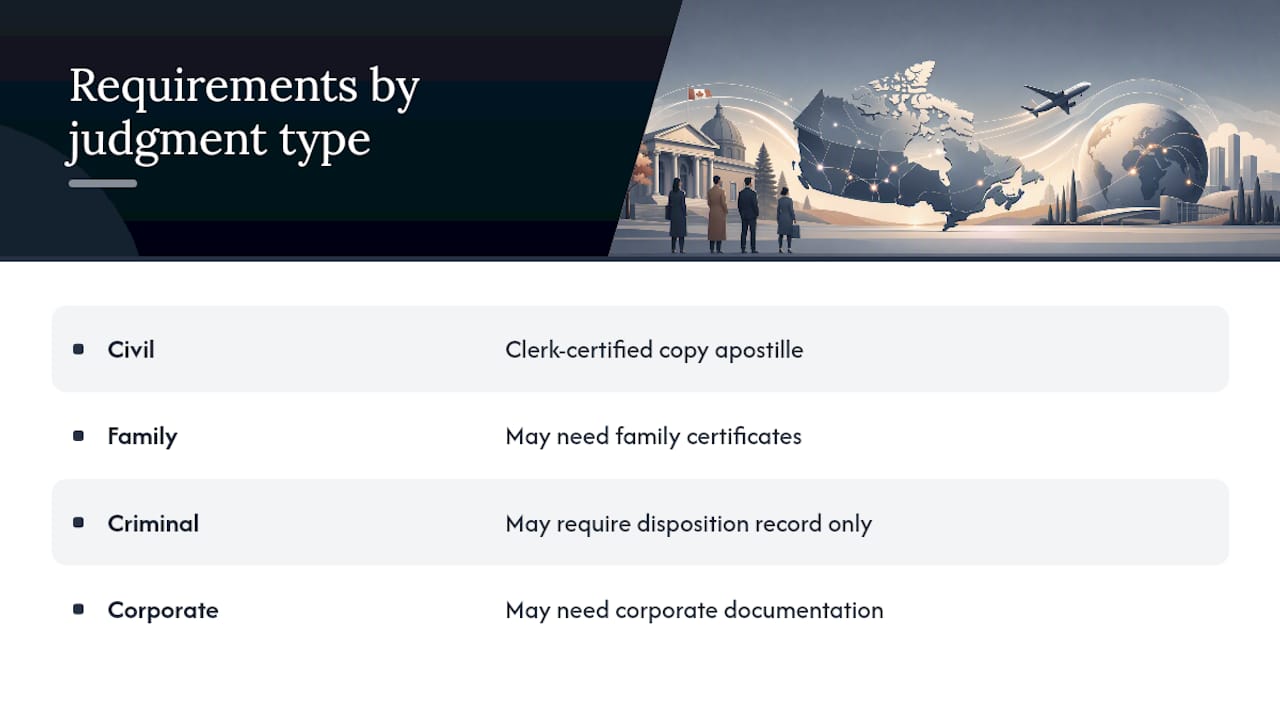
Civil judgments, the most common type sent abroad, generally follow the standard process described above without added complications. Foreign courts and agencies typically want proof of a monetary award, a property ruling, or a contract dispute resolution, and a clerk-certified copy with apostille satisfies that in most Hague member countries.
Family court judgments carry extra sensitivity. Divorce decrees, custody orders, and child support judgments often get scrutinized closely by the receiving country's family courts, immigration authorities, or vital records offices. Some destinations require the apostilled judgment alongside a certified marriage certificate or birth certificate for the children involved, so confirm the full document set the receiving agency wants before you submit just the judgment alone.
Criminal judgments and records raise the most jurisdictional caution. Many countries treat foreign criminal records as sensitive information tied to immigration eligibility, adoption approval, or professional licensing. Confirm with the receiving agency exactly what they need certified, since some accept only a record of disposition rather than a full judgment transcript.
Corporate and commercial judgments, such as arbitration awards or civil enforcement orders involving businesses, sometimes require additional corporate documentation alongside the judgment, particularly if the foreign proceeding needs to verify the legal standing of the company named in the ruling. In every case, the underlying rule stays constant: a properly certified copy from the correct court, routed to the correct authentication authority.
Why Getting the Routing Right Matters More Than People Think
The paperwork around a court judgment apostille looks simple on paper. Get a certified copy, send it to the right office, wait for the certificate. In practice, the jurisdictional split between Global Affairs Canada and the provinces trips up more people than any other step in the process, including experienced legal assistants who assume Canada works like a single-window system similar to what other Hague countries use.
That assumption is understandable and wrong. Canada's federal structure means the provinces retained control over authenticating their own court documents even after accession to the Convention. Specialist agents that handle document routing can catch this before submission rather than after a rejection letter arrives. That distinction shows up in three practical places: confirming certified-copy wording matches what the destination actually accepts, routing federal versus provincial judgments to the correct office on the first attempt, and handling the physical document securely through return shipping.
— Ken
Get Your Court Judgment Apostilled Without the Routing Guesswork
Speedy Apostille Services handles the exact friction points covered above: reviewing your certified copy for correct wording, determining whether your judgment needs Global Affairs Canada or a provincial office, and managing secure return shipping once your apostille is issued.

The service runs on standard, expedited, and rush options, with government fees bundled into one all-in price from the start, so there's no separate invoice showing up later. Turnaround runs 1 to 7 days depending on the option you choose and which authority handles your judgment. If you're working against a foreign filing deadline, the expedited apostille process is built for exactly that pressure. Start by reviewing where your court document needs to go, then submit your certified copy for review.
This article is general information, not a substitute for advice from a qualified lawyer. Consult a qualified legal professional about your own circumstances before acting on anything here.
Sources
- Authentication of documents - Global Affairs Canada
- Canada joins the Apostille Convention: What you need to know
- Apostille Convention - Province of British Columbia
FAQ
Who can apostille documents in Canada?
Global Affairs Canada handles federal documents, while each province and territory runs its own authentication office for documents issued within that jurisdiction, including most court judgments.
How long does it take to get an apostille in Canada?
Processing times vary by office and by whether you submit by mail or in person, with expedited private services available for time-sensitive matters; check the specific authority handling your document for current estimates.
Does Canada require an apostille for documents used abroad?
Canada itself doesn't require an apostille for domestic use, but any Canadian public document, including a court judgment, needs one if it's headed to a Hague member country for official use there.
How much does an apostille cost in Canada?
Costs include a government fee set by whichever office processes your request, plus optional expedited service fees if you use a private agent; fee schedules differ between Global Affairs Canada and the provincial offices.
What is a court judgment apostille?
It's a certificate attached to a certified copy of a Canadian court judgment that verifies the clerk's signature and the court's seal are genuine, allowing the judgment to be recognized in Hague member countries without further consular legalization.