
Court Documents Apostille Canada: Where to Send Yours
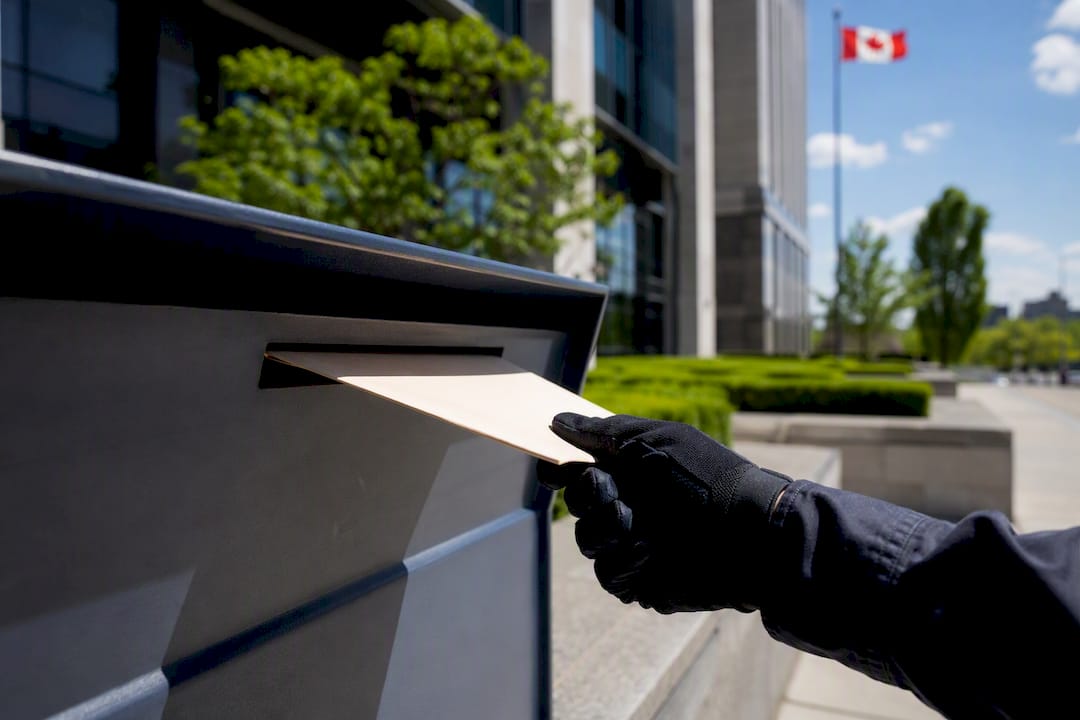
Court Documents Apostille Canada: Where to Send Yours ! Hand submitting court document envelope at postal drop-box Canadian court documents can be apostilled, and the right office depends on where the document was issued or notarized.
Court Documents Apostille Canada: Where to Send Yours
Canadian court documents can be apostilled, and the right office depends on where the document was issued or notarized. If a provincial competent authority covers that province, send it there; otherwise, Global Affairs Canada handles it. Start now with these steps:
- Identify the province where the court document was issued or notarized.
- Confirm the destination country is a member of the Hague Apostille Convention.
- Prepare an original or a certified true copy, plus any required notarization.
- Contact the receiving embassy or authority to verify their specific requirements before submitting.
Ontario Official Documents Services (ODS) handles Ontario court records; other provinces run their own equivalent offices.
Key Takeaways
Getting a Canadian court document apostilled requires matching it to the correct competent authority, since sending it to the wrong office is the single biggest cause of delay.
| Point | Details |
|---|---|
| Confirm jurisdiction first | Match your document's issuing province to Global Affairs Canada or the relevant provincial office before doing anything else. |
| Verify destination requirements | Contact the receiving embassy or authority to confirm age, format, or translation rules ahead of submission. |
| Know what an apostille proves | It verifies a signature or seal is genuine; it never certifies the document's content is true. |
| Avoid common rejection triggers | Wrong authority, plain photocopies, and lapsed notary registration cause most delays. |
| Consider a managed service for tight deadlines | Speedyapostilleservices bundles jurisdiction review, notarization referral, and government fees into one turnaround of 1 to 7 days. |
This article is general information, not a substitute for advice from a qualified lawyer. Consult a qualified legal professional about your own circumstances before acting on anything here.
Table of Contents
- Do I Need an Apostille for My Court Document?
- Which Canadian Authority Issues Apostilles for Court Documents?
- How Do I Get a Court Document Ready for an Apostille?
- How Long Does an Apostille Take and What Does It Cost?
- Where Do I Send Court Documents for Authentication?
- What Does an Apostille Actually Prove, and How Do I Verify One?
- What Mistakes Delay a Court Document Apostille?
- How Can Speedy Apostille Services Help With Court Documents?
- Editorial Perspective: What Most Guides Get Wrong About This Process
- Get Your Court Documents Apostilled Without the Guesswork
- Sources
- FAQ
Do I Need an Apostille for My Court Document?
Check with the receiving authority or embassy first. If the destination country belongs to the Hague Apostille Convention, you'll typically need an apostille rather than the older consular legalization route. Canada joined the convention on January 11, 2024, which replaced most embassy legalization steps for member countries.
The three terms get mixed up constantly:
- Apostille: a single certificate issued by a competent authority, accepted in all Hague member countries.
- Certificate of authentication: the older, pre-2024 equivalent, still used for non-Hague countries.
- Consular legalization: an added step required only when the destination country has not joined the convention.
Pro Tip: Call or email the receiving embassy or institution before you pay for any authentication. Some countries impose document age limits or require a translation stamped by a specific type of translator, and no apostille fixes that after the fact.
Which Canadian Authority Issues Apostilles for Court Documents?
Send the document to whichever authority issued or notarized it: Global Affairs Canada for federal paperwork and for provinces without their own program, or the relevant provincial office if one exists. Global Affairs Canada authenticates documents issued or notarized in provinces and territories that haven't set up a competent authority of their own.
Four provinces run their own programs:
- Ontario Official Documents Services (ODS): handles Ontario court records, notarized legal documents, and provincial government paperwork.
- Alberta: Ministry of Justice authenticates Alberta-issued court and legal documents.
- British Columbia: the Ministry of Attorney General authenticates provincial public documents, and requests must name the destination country up front.
- Saskatchewan: Ministry of Justice handles authentication for documents issued in that province.
If your court document came from Manitoba, the Maritimes, or a territory, Global Affairs Canada is almost always the right destination. When in doubt, check the issuing court's province against the list above before mailing anything.
How Do I Get a Court Document Ready for an Apostille?
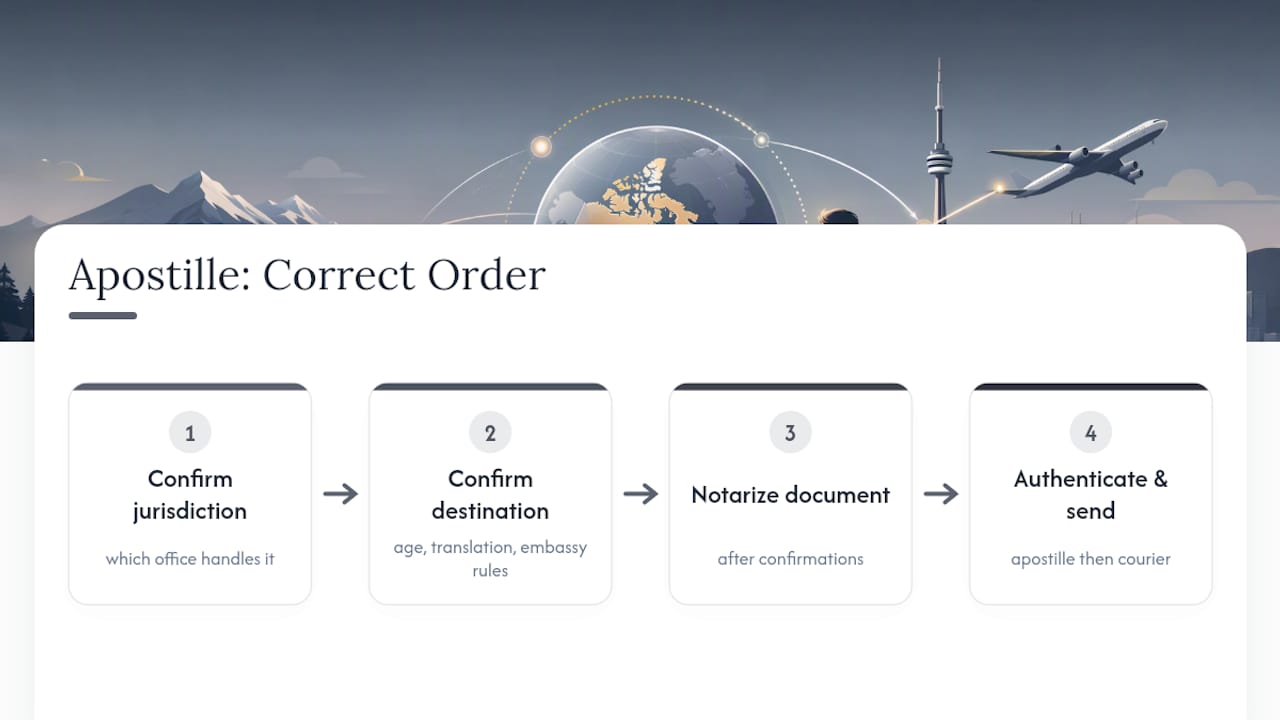
Getting an apostille means matching your document to the right office, then proving its signature or seal is genuine through notarization or certified copying. Work through these steps in order:
- Confirm the destination country and jurisdiction. Match the province where your document was issued to the authority list above.
- Check whether notarization is required. Public documents issued directly by a court often qualify without extra notarization; private legal documents usually need a notary's signature and seal first.
- Get an original or certified true copy. Photocopies without a certifying stamp will be rejected outright.
- Translate if the destination requires it. Some countries demand a certified translation attached before or after authentication.
- Submit to the correct authority. Use the provincial office's mail-in or in-person process, or the GAC portal for federal and non-designated-province documents.
- Track your submission and confirm receipt of the apostille. Most offices provide a reference number or tracking option.
Ontario made a notable change for court-issued documents effective July 10, 2023: many court records no longer require a separate notarization step before authentication, since the court seal itself already carries recognized signing authority. Other provinces still expect notarization on private legal documents like affidavits or powers of attorney. A document checklist helps confirm each requirement before you submit: original versus certified copy, notary registration status, and destination country listed correctly on the request form.
How Long Does an Apostille Take and What Does It Cost?
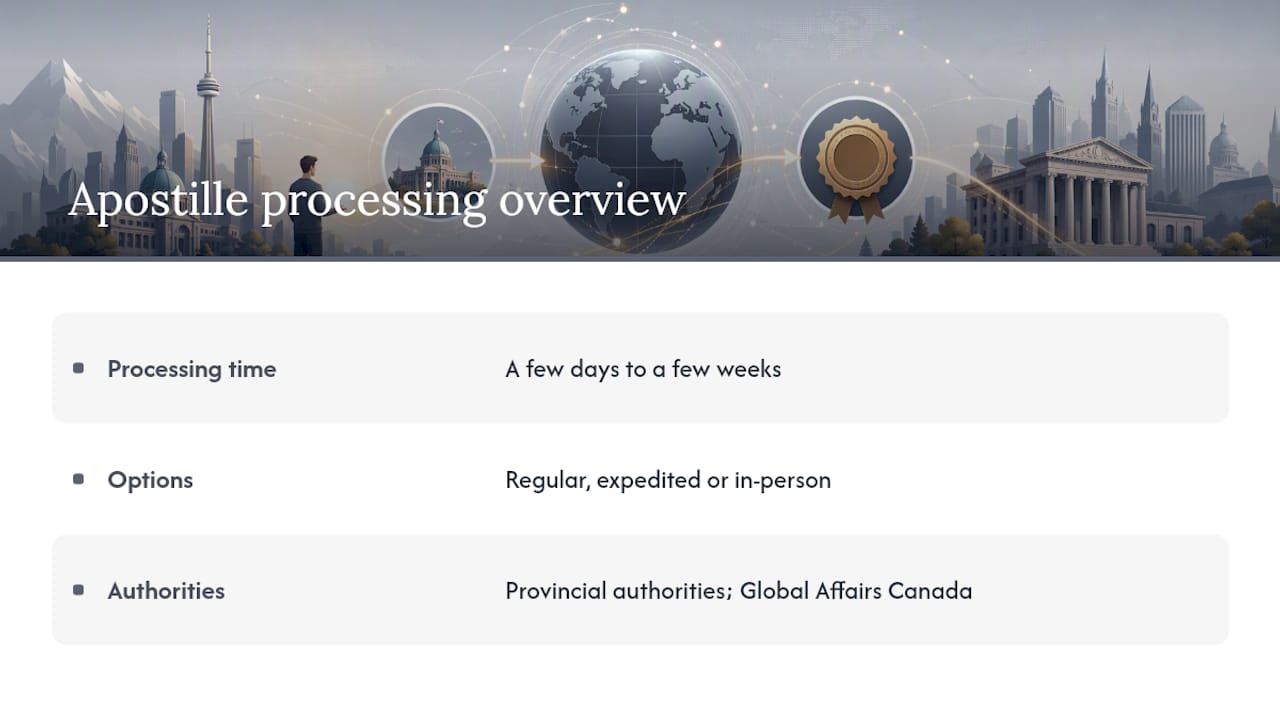
Standard processing runs anywhere from a few days to a few weeks depending on the office, with expedited or in-person options available at most provincial authorities and through GAC for urgent cases. Ontario ODS, for instance, publishes separate timelines for mail-in versus in-person requests.
Government fees vary by document type and province:
- Ontario charges $16 for a notarized legal document and $32 for court-issued or government documents.
- Third-party services typically add fees for document review, courier delivery, and rush processing.
Pro Tip: If your court document needs notarization first, book that appointment before you plan your authentication timeline. Notary availability, not the government office, is often the actual bottleneck. Readers facing tight deadlines can also look at urgent same-day apostille options available in the Toronto area.
Where Do I Send Court Documents for Authentication?
Send your document to whichever office issued or notarized it, using the submission method that authority accepts. GAC generally expects paper submissions bearing an original signature and seal, unless their site states otherwise for a specific request type.
Submission methods differ by office:
- In-person drop-off: requires the original document and valid photo ID; some offices offer same-day pickup.
- Mail-in submission: needs a prepaid return envelope, a cover letter stating the destination country, and contact information.
- Online triage or portal: GAC uses this to direct requests to the correct processing stream before paper documents are mailed in.
Keep photocopies of everything before it leaves your hands, and use tracked courier rather than regular mail for anything irreplaceable, like an original court order.
What Does an Apostille Actually Prove, and How Do I Verify One?
An apostille confirms that a signature, seal, or stamp on your document is genuine. It does not confirm that the contents of the document are true or accurate. That distinction matters because officials at Global Affairs Canada are explicit that apostilles verify authority, not accuracy.
To confirm an apostille is legitimate:
- Check the apostille number and issue date against the issuing authority's verification page.
- Contact the competent authority directly if the receiving country asks for confirmation.
- Verify the notary's registration status if your document required notarization first, since an expired or unregistered notary invalidates the whole chain.
What Mistakes Delay a Court Document Apostille?
Most delays trace back to one of four mistakes: sending the document to the wrong authority, submitting a photocopy instead of an original or certified copy, using a notary whose registration has lapsed, or attaching a scanned file when paper is required. Any one of these gets an application bounced back.
Run through this before you mail or drop off anything:
- Confirm the issuing province matches the authority you're sending to.
- Confirm you have an original or a properly certified true copy, not a plain photocopy.
- Confirm your notary's commission is active, if notarization applies.
- Confirm any required translation is attached and certified.
- Confirm the destination country is spelled correctly and matches Hague Convention membership.
Court-issued documents in Ontario carry their own in-person processing note, so check current wait times before planning a same-day trip.
How Can Speedy Apostille Services Help With Court Documents?
Speedyapostilleservices reviews your court document, arranges notarization when needed, submits it to the correct competent authority, and returns it by secure courier. This suits readers under time pressure, unsure which office applies to their document, or without easy access to a local notary.
- All-in pricing that bundles government fees upfront, with no hidden add-ons.
- Document review before submission, aimed at catching the mistakes covered above.
- Turnaround tiers from 1 to 7 days depending on urgency.
- Secure handling and tracked return delivery for original court records.
Pro Tip: If you're not certain whether your document needs GAC or a provincial office, that uncertainty alone is a good reason to have someone check jurisdiction for you before you mail anything. Start at the Speedy Apostille Services landing page.
Editorial Perspective: What Most Guides Get Wrong About This Process
Most guides to apostilling Canadian court documents treat the process as one uniform flow: notarize, authenticate, done. That's misleading. The real friction point isn't the apostille step itself, it's figuring out which office has jurisdiction over your specific document before you do anything else. Send a Manitoba court order to Ontario ODS by mistake, and you've lost a week for nothing.
The conventional advice also underplays how much power the receiving country holds here. An apostille satisfies Canada's side of the transaction. It says nothing about whether the destination country will accept a document that's six months old, or demands a translation certified by a specific body. Readers who skip that embassy phone call are the ones who end up redoing the entire process.
If you take one thing from this, prioritize confirming jurisdiction and destination requirements before you touch a notary or a courier. Everything downstream, cost, timing, and format, depends on getting that first decision right.
Get Your Court Documents Apostilled Without the Guesswork
Figuring out whether your court document belongs with Global Affairs Canada or a provincial office is exactly the kind of decision that stalls people for days. Speedyapostilleservices handles that jurisdiction check for you, then manages notarization referrals, submission, and secure return delivery, with government fees built into one upfront price instead of surprise add-ons later.

This fits best if you're facing a deadline abroad, you're not sure which provincial office applies to your document, or you simply don't have a notary nearby. The document checklist tool can help you confirm what you have before you start, and readers in the Toronto area can check same-day options directly. Get a quote for your court document at the Speedy Apostille Services landing page and find out your turnaround time before you commit.
Sources
- Authenticate your documents — Global Affairs Canada
- Ontario
- Apostille Convention — Province of British Columbia
FAQ
How Can I Get My Documents Apostilled in Canada?
Identify which authority issued or notarized your document, prepare an original or certified copy, and submit it to Global Affairs Canada or the matching provincial competent authority such as Ontario ODS.
How Long Does It Take to Get an Apostille in Canada?
Processing ranges from a few days to a few weeks depending on the office and whether you request an expedited or in-person option; provincial authorities and Global Affairs Canada both publish their own timelines.
How Much Does It Cost to Get an Apostille on a Document in Canada?
Government fees vary by document type. Ontario charges $16 for a notarized legal document and $32 for court-issued or government documents, with additional charges possible for courier or third-party review services.
Does Service Ontario Do Apostilles?
No. Ontario apostilles and certificates of authentication are issued by Ontario Official Documents Services (ODS), not ServiceOntario.
What Does an Apostille Actually Verify?
An apostille confirms that a signature, seal, or stamp on a document is genuine. It does not confirm the truth of the document's content.