
Avoid 3–8 Week Delays: Countries Without Apostille (2026 Status)
Avoid 3–8 Week Delays: Countries Without Apostille (2026 Status) ! Consular clerk handling document legalization folder Whether your destination accepts an apostille depends entirely on whether that country is a party to the Hague Apostille Convention.

Avoid 3–8 Week Delays: Countries Without Apostille (2026 Status)
Whether your destination accepts an apostille depends entirely on whether that country is a party to the Hague Apostille Convention. If it isn't, you cannot use an apostille at all and must go through consular or embassy legalization instead. The only reliable way to confirm current status is the HCCH Apostille Convention status table, since membership changes almost every year.
TL;DR:
- Countries that are not part of the Hague Apostille Convention cannot accept apostilles and must use consular legalization, which typically takes three to eight weeks.
- China and Canada recently joined the Convention in 2023 and 2024 respectively, shifting some documents from consular legalization to apostille acceptance.
- Some countries or territories, especially those with disputed status, may have different requirements and should be confirmed directly with the receiving institution.
- Always verify the current status on the HCCH Apostille Convention website or your government’s official authentication page before starting the legalization process.
- Using an apostille for a non-Hague country results in rejection, making it essential to confirm the destination's Hague membership and bilateral recognition status beforehand.
Table of Contents
- Which Countries Do Not Accept Apostilles
- Why Some Countries Skip the Apostille System Entirely
- How to Legalize a Document for a Non-Hague Country
- How to Check a Country's Current Status Before You Submit
- Common Mistakes and When to Bring in a Specialist
- How Speedy Apostille Services Helps With Both Paths
- Where to Verify Country Status Yourself
- Sources
- FAQ
Which Countries Do Not Accept Apostilles
A "non-Hague" country simply means it never signed or acceded to the 1961 Hague Apostille Convention. For these destinations, an apostille has no legal standing whatsoever. Government offices there won't recognize the stamp, won't know what to do with it, and will bounce your paperwork back for the older legalization process instead.
The list of non-Hague countries includes many Middle Eastern and African nations, as well as several other notable countries and territories such as the United Arab Emirates, Qatar, Kuwait, Cuba, Haiti, Turkmenistan, and Egypt in some contexts, among others.
These examples come from compiled lists of common non-Hague destinations that legalization providers track closely because they generate the most consular requests.
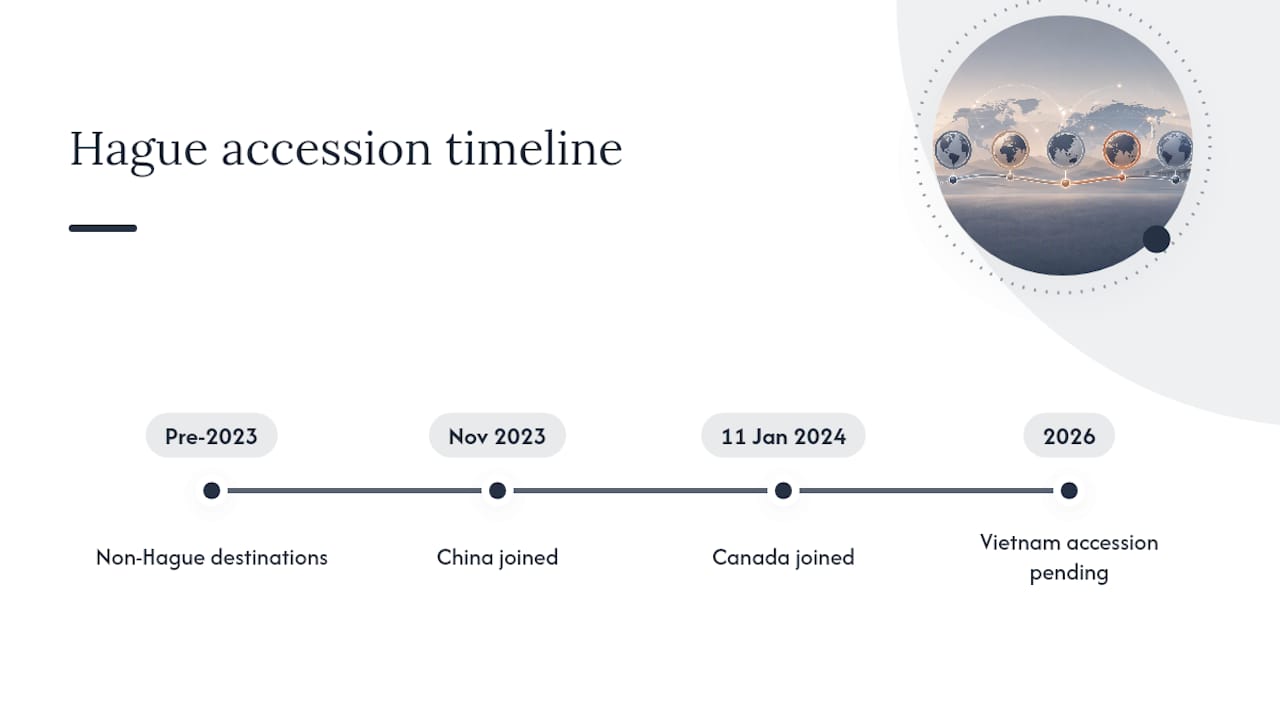
The list is not static. China joined the Convention in November 2023, instantly moving one of the world's largest document destinations from consular legalization to apostille. Canada joined effective January 11, 2024, which means Canadian documents headed to Hague countries now get an apostille rather than the older certificate of authentication. Vietnam has an accession date on the books for 2026, though it's worth checking whether it's actually in force before you rely on it.
One more wrinkle: some territories and unrecognized jurisdictions don't follow the same rules as their parent state. A document destined for a territory with disputed status may face requirements that don't match what you'd expect from checking the sovereign country's Hague membership. When in doubt, contact the receiving institution directly.
Why Some Countries Skip the Apostille System Entirely
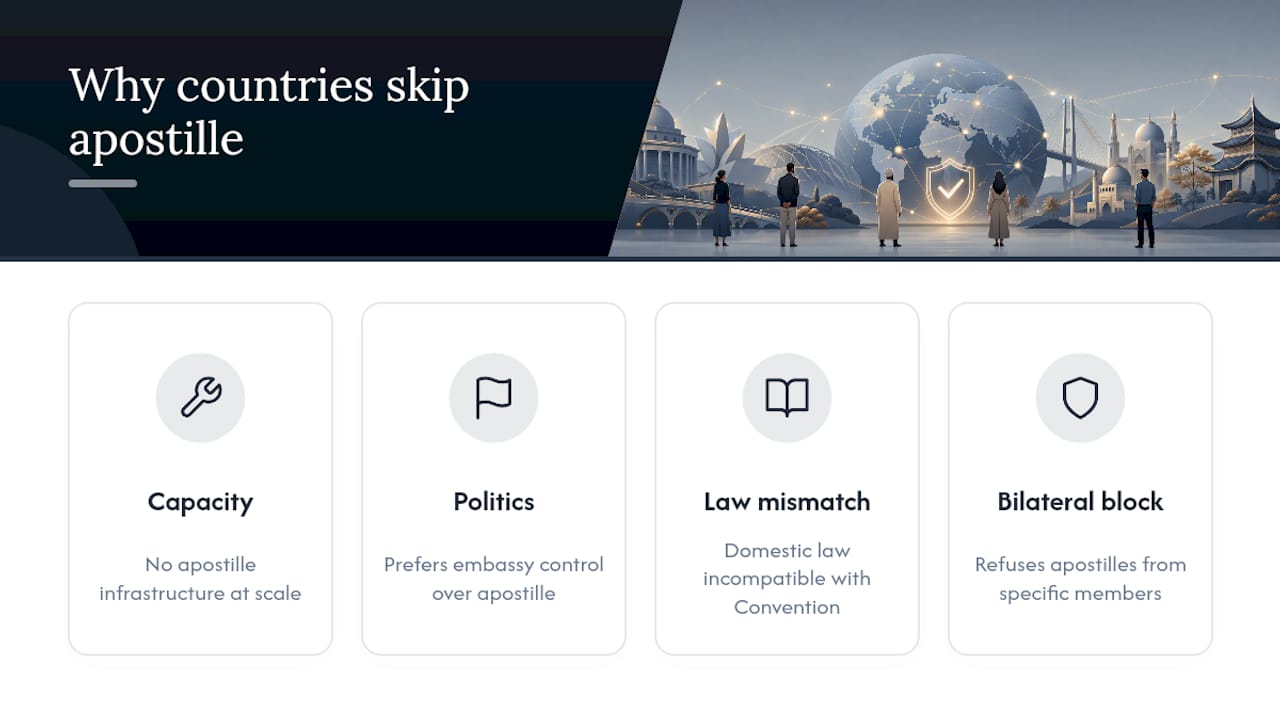
Non-membership usually comes down to one of three things: diplomatic hesitation, administrative capacity, or a legal system that doesn't mesh well with the Convention's framework. Some countries simply haven't built the government infrastructure to issue and verify apostilles at scale, so they stick with the traditional embassy chain, which they can control more directly.
Politics plays a role too. A government may decline to join because it prefers to maintain direct oversight over foreign document recognition rather than outsourcing trust to a single stamp.
There's also a subtler problem: bilateral objections. A country can be a full Convention member and still refuse to recognize apostilles from a specific other member state, usually through a formal declaration lodged with the Hague Conference. This means two members don't guarantee smooth recognition between each other. Always check the specific country pair, not just each country's individual status.
How to Legalize a Document for a Non-Hague Country
When your destination isn't a Convention member, you're looking at a multistep chain instead of a single stamp. Here's the typical order:
- Notarization, if the document isn't already a certified government-issued original.
- Home-country authentication, where the relevant government office confirms the notary's or issuer's signature is genuine.
- Foreign ministry authentication, adding a second layer of government confirmation.
- Consulate or embassy legalization, where the destination country's own diplomatic post reviews and stamps the document as final approval.
This route usually takes three to eight weeks or longer, depending on consulate backlogs and whether an in-person appointment is required. Compare that to the typical two to three business days for an apostille, and the cost gap becomes obvious too. Consular fees, courier charges, and sometimes mandatory in-person visits add up fast.
You'll also frequently need a certified translation into the destination country's official language, and some consulates require the applicant to appear in person rather than submitting by mail. Read the specific apostille versus legalization requirements for your case before assuming either path applies.
Pro Tip: Call or email the receiving institution or consulate before you start the process. Requirements shift by consulate and even by individual document type, and confirming upfront saves weeks of rework.
How to Check a Country's Current Status Before You Submit
The HCCH status table is the single source that matters most here. It lists every contracting party along with accession dates, entry-into-force dates, and any objections a member state has lodged against another.
Read the "entry into force" column carefully. A country can accede to the Convention on one date but the treaty won't actually apply between that country and yours until a later date, sometimes months out. "Pending accession" means it's not usable yet, no matter how confident a blog post sounds.
Beyond the HCCH table, check the destination country's embassy website and your home country's own authentication page, since some national ministries publish their own accepted-country lists that reflect real-world administrative practice. Because accessions happen year to year, re-check status shortly before you submit anything. A status that was accurate in January can change by summer.
Common Mistakes and When to Bring in a Specialist
Outdated country lists cause more failed submissions than any other single error. So does skipping notarization or certified translation because a document "looked official enough" without it. Starting the wrong legalization path, apostille when consular legalization was needed, wastes real weeks.
A paid service earns its cost when you're facing a tight deadline, a multi-step consular chain, or several documents at once, especially if you need guidance on foreign license validation processes. Realistic turnaround for consular legalization runs three to eight weeks; apostilles move in days when a country actually qualifies.
How Speedy Apostille Services Helps With Both Paths
Not every document you need authenticated is headed to a Hague country, and figuring out which path applies before you start saves real time. Speedyapostilleservices handles both sides: apostilles for the 120-plus Hague member countries, and guidance through consular or embassy legalization when your destination doesn't participate in the Convention at all.

The all-in pricing model means government fees are built into your quote from the start, so there's no surprise invoice halfway through a consular chain. Most apostille orders turn around in two to three business days, and the review step catches missing notarization or translation requirements before they cause a rejection at the consulate. If you're not sure which route your birth certificate, diploma, or corporate record actually needs, start your order with Speedyapostilleservices and get a clear answer before you spend weeks guessing.
Where to Verify Country Status Yourself
- HCCH Apostille Convention status table, the official record of members and pending accessions
- Your government's own authentication or document authentication page
- The destination country's foreign ministry or embassy website
Sources
- HCCH — Status Table: Apostille Convention
- Global Affairs Canada — Document authentication
- Ministry of Foreign Affairs Pakistan — List of countries accepting Apostille
- Apostille MA — Non Hague Countries List (2026)
FAQ
What Are the Non-Hague Countries in 2026?
Notable non-Hague destinations include the United Arab Emirates, Qatar, Kuwait, Cuba, Haiti, Turkmenistan, and many African nations, though the exact list shifts as countries accede. Always confirm against the HCCH status table rather than a static list, since Vietnam has a 2026 accession date that changes its status.
Which Countries Do Not Recognize the Hague Convention?
Any country that never signed or acceded to the 1961 Convention doesn't recognize apostilles at all, including most Gulf states and a large share of African nations. Some Convention members also formally object to recognizing apostilles from specific other members, which creates exceptions even within the membership.
What Happens if I Use an Apostille for a Non-Hague Country?
The receiving institution will reject it, since a non-Hague country has no legal framework for recognizing the stamp. You'll need to restart with consular or embassy legalization, which adds weeks to your timeline.
How Long Does Consular Legalization Take Compared to an Apostille?
Consular legalization typically takes three to eight weeks depending on the consulate, versus two to three business days for a standard apostille through a service like Speedyapostilleservices.
Can a Country Be a Hague Member and Still Reject My Apostille?
Yes. A member state can lodge a formal objection against recognizing apostilles from a specific other member, so checking the bilateral relationship matters as much as checking each country's individual membership status.