
Corporate Apostille Canada: A Business Guide for 2026
Corporate Apostille Canada: A Business Guide for 2026 ! Hands packaging corporate documents for apostille Most Canadian corporate documents get apostilled by one of two authorities: Global Affairs Canada's Authentication Services Section, or a designated provincial authority in Alberta, British Co

Corporate Apostille Canada: A Business Guide for 2026
Most Canadian corporate documents get apostilled by one of two authorities: Global Affairs Canada's Authentication Services Section, or a designated provincial authority in Alberta, British Columbia, Ontario, Quebec, or Saskatchewan. Which one applies depends on where the document was issued or notarized. Since Canada joined the Hague Apostille Convention on January 11, 2024, a single apostille now replaces the older two-step authentication and legalization process for documents heading to any of the more than 120 member countries.
Before you send anything, confirm you have:
- An original document or a certified true copy, not a photocopy
- A wet-ink notarization where the document type requires one
- A certified translation if the document isn't in English or French
- A completed service request form for the authority you're submitting to
- Return postage or a courier label with tracking
Pro Tip: Check the destination country against the Hague member list before you file anything. If it's not a member, you're looking at apostille plus consular legalization, not apostille alone.
Key Takeaways
The competent authority for a corporate apostille in Canada depends on where the document was issued or notarized, and getting that routing wrong is the single biggest cause of delay.
| Point | Details |
|---|---|
| Two competent authorities | Global Affairs Canada handles federal and non-designated provincial documents; five provinces (Alberta, BC, Ontario, Quebec, Saskatchewan) run their own authority. |
| Post-2024 process | Since January 11, 2024, a single apostille replaces the old two-step authentication process for Hague member countries. |
| Certified copies matter | Corporate certificates often need a registrar-issued copy, not a company photocopy, to avoid rejection. |
| Build in buffer time | Add two to three weeks for possible resubmission on top of published processing times like Ontario's 15 business days by mail. |
| Professional help available | Speedyapostilleservices offers document review, correct routing, notarization referral, and insured courier handling under one all-in price for corporate clients. |
Table of Contents
- Who Issues a Corporate Apostille in Canada?
- How Do You Submit a Corporate Apostille Request?
- What Are Processing Times and Fees for a Corporate Apostille?
- Why Do Apostille Applications Get Rejected?
- How Do You Verify an Apostille Once It's Issued?
- What Happens When a Country Isn't a Hague Member?
- When Should You Use a Professional Apostille Service?
- What Corporate Teams Consistently Get Wrong
- Get Your Corporate Documents Apostilled Without the Guesswork
- Sources
- FAQ
Who Issues a Corporate Apostille in Canada?
The rule is simpler than it looks once you know where your document came from. Documents issued by the federal government, along with documents from provinces or territories that don't have their own designated authority, go to Global Affairs Canada's Authentication Services Section in Ottawa. Documents issued or notarized in Alberta, British Columbia, Ontario, Quebec, or Saskatchewan generally go to that province's own competent authority instead.
For corporate documents specifically, the routing usually breaks down like this:
- Articles of incorporation and corporate certificates: sent to the provincial authority where the company is registered, unless it's a federal incorporation
- Corporate resolutions and powers of attorney: routed based on where they were notarized, not where the company operates
- Notarized contracts: follow the notary's province
- RCMP background checks tied to a corporate hire: go to Global Affairs Canada, even for applicants in provinces with a designated authority
If you're unsure, don't guess. Check the GAC triage tool or your province's Official Documents Services (ODS) page before you mail anything, since sending a document to the wrong office adds weeks to your timeline.
How Do You Submit a Corporate Apostille Request?
Start by confirming whether your destination country is a Hague member. If it is, you need only an apostille. If it isn't, plan for apostille plus consular legalization. Everything else follows from that first decision.
- Verify document type and format. Some corporate documents, like a corporate certificate, must come directly from the provincial registrar. A copy your in-house counsel prints off won't work.
- Secure notarization. If your document needs a wet-ink signature and seal, a licensed notary public has to complete that step before you submit anything for authentication.
- Arrange certified translation. Documents not in English or French need a certified translation attached, and it typically needs to accompany the original when submitted.
- Complete the request form and shipping. Fill out the correct service request form for GAC or your provincial authority, and include return postage or a courier label. Insured, trackable shipping protects you if a document goes missing in transit.
- Send to the correct office. Include a cover letter listing your contact information, the number of documents, and the destination country for each.
A few things trip up corporate applicants more than individuals. Multi-document batches (say, articles of incorporation plus three corporate resolutions) sometimes need to go to different offices if they were notarized in different provinces. And board resolutions authorizing the apostille request itself are sometimes required by receiving countries, so check the destination's requirements before you assume a plain corporate letterhead will do.
Pro Tip: Run a pre-submission review on every document before mailing. A quick internal check, or a review from a professional service, catches the missing signature or wrong copy type that would otherwise send your file back to square one.
What Are Processing Times and Fees for a Corporate Apostille?
Processing speed depends heavily on which authority you're dealing with, and mail time adds to whatever the office quotes you.
| Authority | Typical Processing Time | Fee Notes |
|---|---|---|
| Global Affairs Canada (Ottawa) | Several business days for mail-in requests | No fee for the apostille service in some cases |
| Ontario (ODS) | Up to 15 business days by mail | Provincial fees may apply |
| Alberta, BC, Quebec, Saskatchewan | Varies by office and volume | Check the provincial page for current fee schedules |
Add mailing and return courier time on top of whatever processing window you're quoted. If you're working against a closing date or a foreign registration deadline, expedited or courier handling cuts down transit time, though it doesn't necessarily speed up the government's own review queue.
- Build in a two to three week buffer for possible rejection and resubmission
- Track your package both ways with a courier that provides delivery confirmation
- Ask whether the receiving office accepts drop-off if your deadline is genuinely tight
Why Do Apostille Applications Get Rejected?
Most rejections come down to a handful of repeat offenders, and nearly all of them are preventable with a careful first pass.
- Missing wet-ink signature or an unrecognized notary stamp
- Submitting a photocopy where a certified true copy or original was required
- Documents that are glued, stapled improperly, or laminated (lamination in particular voids many document types for authentication purposes)
- Foreign-issued documents mistakenly sent to a Canadian authority
- Formatting that doesn't match the sample the competent authority publishes
Corporate applicants run into a few issues that individuals rarely see. A company-prepared photocopy of an incorporation certificate, instead of an official copy from the corporate registry, is a near-automatic rejection. So is a corporate resolution missing the specific language a receiving country requires, or a notarization that follows a different province's format than the one where the notary is licensed.
Pro Tip: Treat the apostille request like a small project with a checkpoint. A five-minute review against the competent authority's published sample format catches most errors before they cost you three weeks in the resubmission queue.
How Do You Verify an Apostille Once It's Issued?
Once you receive your apostille, confirm it's genuine before relying on it for a foreign filing. Global Affairs Canada and some provinces, including Alberta, British Columbia, and Saskatchewan, offer verification tools or a direct line to their authentication unit for this.
- Record the apostille number and issuance date printed on the allonge (the separate sheet attached to your document).
- Check that the issuing authority's name, seal, and signature on the allonge match what the issuing office actually uses.
- Use the relevant online verification portal where one exists, or contact the issuing office directly if it doesn't.
Pro Tip: Keep a scanned copy of both the apostille allonge and the underlying corporate document in your company's records. If a foreign registry or bank ever questions authenticity, you want that file ready in minutes, not days.
What Happens When a Country Isn't a Hague Member?
An apostille alone doesn't finish the job when your destination isn't on the Hague member list. In that case, the apostille (or, in some workflows, straight authentication) is typically the first step, followed by consular legalization at that country's embassy or consulate in Canada.
- Confirm the specific requirements of the destination consulate before you submit anything, since they vary by country
- Prepare certified translations early, since consulates often want them alongside the authenticated original
- Book a consular legalization appointment or use a third-party consular service if the embassy doesn't accept walk-ins
- Skip the apostille only if the destination authority explicitly tells you a different process applies. Otherwise, the two-step route is the safe default.
Even for Hague member countries, some receiving institutions perform their own independent checks on document contents, so an apostille doesn't always eliminate every downstream review once your document lands abroad.
When Should You Use a Professional Apostille Service?
A professional service earns its cost when the stakes of a rejection outweigh the cost of the service itself. For corporate clients, that's most of the time, given how many documents move through multiple jurisdictions at once.
- Pre-submission document review to catch the wrong copy type or missing signature before it costs you a resubmission cycle
- Referral to a notary when your team doesn't have one on hand or your existing notary isn't licensed for the required format
- Correct routing to GAC or the right provincial authority, which matters more with multi-document corporate batches
- Insured, trackable courier handling for both outbound submission and the return of your authenticated documents
Hire one when you're working against a closing deadline, moving several corporate documents across different provincial jurisdictions at once, or simply don't have in-house notary access. Pro Tip: Look for a provider offering transparent, all-in pricing and clear proof of delivery. A hidden government fee tacked on after the fact is the last thing you want to discover mid-transaction.
What Corporate Teams Consistently Get Wrong
The pattern shows up again and again: a company sends a photocopy where the receiving authority wanted a registrar-issued certificate, or a resolution lands without the wet-ink signature a province requires. These aren't exotic mistakes. They're the same three or four errors, repeated across different companies and different document types.
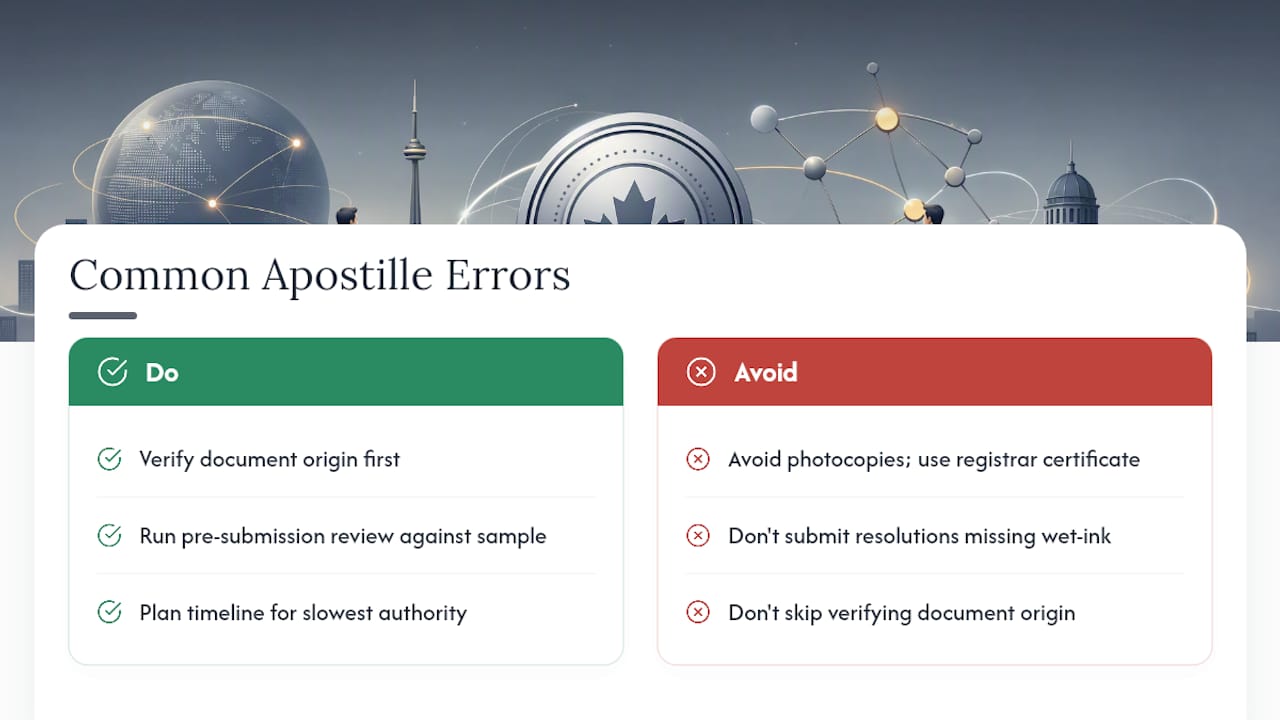
The fix isn't complicated. Verify the document's origin before you touch anything else, run a pre-submission review against the competent authority's own sample format, and build your project timeline around whichever authority in the chain is slowest, not the fastest.
Get Your Corporate Documents Apostilled Without the Guesswork
Speedyapostilleservices exists for exactly the scenario this article just walked through: a corporate deadline, multiple documents, and zero appetite for a rejection loop that eats three weeks.
Rather than figuring out on your own whether your articles of incorporation go to Ontario's ODS or Global Affairs Canada, Speedyapostilleservices handles the document review, routing, notarization referrals, and secure courier handling in one bundled, all-in price with no hidden government fees added later. That single point of contact matters most when you're managing several corporate documents across provinces at once, since one missed format detail can stall an entire deal. Turnaround runs across standard, expedited, and rush tiers depending on how tight your closing date is. Start your corporate apostille request today and get a clear timeline before you commit.
Sources
- Authenticate your documents - Before you start (Step 1)
- Five Tips for Authenticating Canadian Documents to Use Abroad
- Ontario
- Alberta
FAQ
Who Can Apostille Documents in Canada?
Only Global Affairs Canada or a designated provincial authority (Alberta, British Columbia, Ontario, Quebec, or Saskatchewan) can issue a Canadian apostille. Which one applies depends on where your document was issued or notarized.
How Do I Get an Apostille from Canada?
Confirm the correct competent authority for your document type, prepare an original or certified copy with any required notarization, and submit it along with a completed request form and return postage. A service like Speedyapostilleservices can handle this routing and preparation on your behalf.
How Much Does an Apostille Cost in Canada?
Global Affairs Canada does not charge a fee for its apostille service in some cases, while provincial authorities may apply their own fee schedules. Check the specific authority's current published rates before submitting.
How Long Does It Take to Get an Apostille in Canada?
Timelines vary by authority. Ontario's mail-in Official Documents Services process can take up to 15 business days, and you should add courier or mail transit time on top of that on either end.