
Can You Apostille a Commercial Invoice in Canada?
Can You Apostille a Commercial Invoice in Canada? !
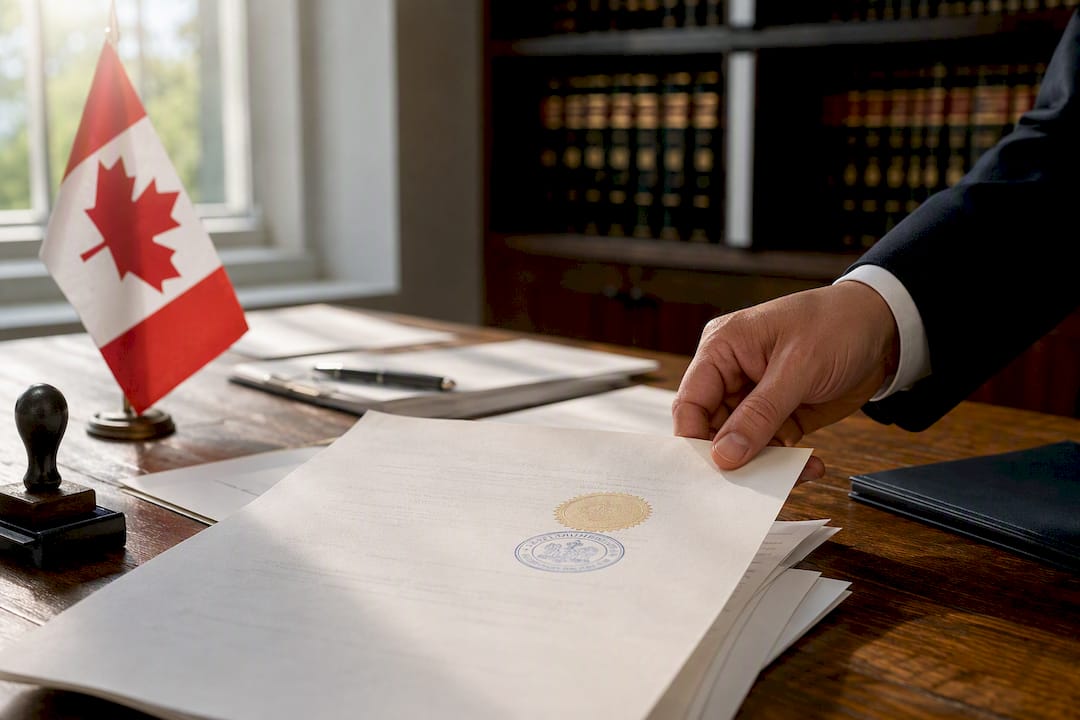
Can You Apostille a Commercial Invoice in Canada?
Yes. A Canadian commercial invoice can be apostilled once you confirm the destination country actually requires one, and once the invoice has been notarized if it's a private business document rather than a government-issued record. Canada joined the Hague Apostille Convention on January 11, 2024, which changed how documents get authenticated for use abroad. Two authorities matter here: Global Affairs Canada handles federal authentication, and Ontario's Official Documents Services (ODS) handles documents issued or notarized in that province. Speedy Apostille Services manages this process daily for Canadian exporters.
Before doing anything else:
- Confirm with the receiving country or customs broker whether an apostille is actually required.
- Check if the invoice needs notarization first, since most commercial invoices are private documents, not public ones.
Pro Tip: Call or email the buyer's customs broker before you pay for anything. A five-minute question can save you a week of resubmission.
Key Takeaways
A commercial invoice can be apostilled in Canada once notarized and matched to the correct federal or provincial authority, with non-Hague destinations requiring an added embassy legalization step.
| Point | Details |
|---|---|
| Confirm before you start | Check with the destination country or customs broker whether an apostille is actually required. |
| Notarization usually comes first | Commercial invoices are private documents and typically need a notary's signature before authentication. |
| Jurisdiction follows notarization location | Ontario, Alberta, British Columbia, Saskatchewan, and Quebec each authenticate documents notarized in their own province. |
| Non-Hague destinations need extra steps | Apostille plus embassy legalization applies when the destination hasn't joined the Hague Convention. |
| Professional handling saves time on deadlines | Speedy Apostille Services offers 2 to 3 day turnaround with transparent, all-in pricing for time-sensitive shipments. |
Table of Contents
- What Is a Commercial Invoice Apostille and When Do You Need One?
- Who Issues Apostilles in Canada and What Qualifies?
- How Do You Apostille a Commercial Invoice in Canada?
- What if the Destination Isn't a Hague Convention Member?
- How Do You Verify an Apostille Issued in Canada?
- What Mistakes Delay a Commercial Invoice Apostille?
- When Does a Professional Apostille Service Make Sense?
- Get Your Commercial Invoice Apostilled Without the Guesswork
- Where to Check Official Apostille Information
- Sources
- FAQ
What Is a Commercial Invoice Apostille and When Do You Need One?
A commercial invoice apostille certifies that the signature, seal, or stamp on your invoice is genuine, so a foreign customs office or bank can trust it without further verification. Not every invoice needs one. The deciding factor is whether your invoice is treated as a public document or a private commercial one.
Government-issued documents (birth certificates, court records) qualify directly for authentication. A commercial invoice, since a private business writes and signs it, usually needs notarization first. Once notarized, it becomes eligible for the apostille process.
Common triggers for requiring one include:
- Customs officials in the destination country demand proof the invoice is authentic.
- A foreign bank requires authenticated trade documents to release payment.
- A certificate of origin or related trade document chain requires the invoice to carry an apostille.
If the destination is a Hague Convention member, an apostille typically replaces the older embassy legalization chain entirely. If it isn't, you'll need extra steps covered further down.
Pro Tip: Don't assume every export shipment needs authentication. Many buyers only ask for it when a letter of credit or government import license is involved.
Who Issues Apostilles in Canada and What Qualifies?
Jurisdiction depends on where the document was issued or notarized, not where you live or where your business operates. Two authority levels apply:
- Global Affairs Canada authenticates documents connected to the federal government and issues apostilles for those.
- Provincial competent authorities in Alberta, British Columbia, Ontario, Quebec, and Saskatchewan handle documents issued or notarized within their own province.
A commercial invoice notarized by an Ontario notary public gets processed through Ontario's ODS, not Global Affairs Canada. The same invoice notarized in Alberta goes through Alberta's authentication office instead.
Commonly eligible documents include notarized commercial invoices, certificates of origin, and business records signed in front of a Canadian notary. What's not eligible: any document issued outside Canada. Global Affairs Canada is explicit that foreign-issued paperwork must be authenticated in the country where it originated, not sent to a Canadian office.
Pro Tip: If your business operates in more than one province, notarize the invoice in whichever province you want to handle the apostille request. It keeps the paper trail simple.
How Do You Apostille a Commercial Invoice in Canada?
Start by checking whether the destination country is a Hague Convention member. That single fact determines whether you stop at the apostille stage or need to go further with embassy legalization.
- Check the destination. If it's a Hague member, an apostille is typically sufficient. If not, plan for consular legalization after the apostille.
- Prepare the invoice. It needs to be a physical, signed original, not a scanned printout, if the receiving authority requires wet-ink signatures.
- Notarize if required. Since most commercial invoices are private business documents, a Canadian notary public typically needs to notarize the signature before authentication can proceed.
- Identify the correct authority. Match the document to where it was signed or notarized: Global Affairs Canada for federal documents, or the relevant provincial office (Ontario, Alberta, British Columbia, Saskatchewan, Quebec) for provincially notarized ones.
- Submit the document. You can mail it directly, use a provincial in-person counter where available, or route it through a professional apostille service that handles submission and courier logistics for you.
- Wait for processing and return delivery. Ontario's ODS generally processes requests within 15 business days, and fees run around $16 for a notarized legal document and $32 for an official Ontario government document. Federal timelines through Global Affairs Canada vary by document volume and season.
Expedited options exist through several provincial offices and through private services, which is where most time-sensitive exporters end up saving days rather than weeks.
Pro Tip: Build in a buffer beyond the stated processing time. A missing notarization stamp or an unsigned page is the single fastest way to add another two weeks.
What if the Destination Isn't a Hague Convention Member?
An apostille only replaces embassy legalization for countries that belong to the Hague Convention. If your buyer is in a non-member country, the apostille becomes the middle step of a longer chain, not the final one.
The typical sequence looks like this:
- Notarize the invoice.
- Get the apostille or authentication certificate from the correct Canadian authority.
- Submit the authenticated document to that country's embassy or consulate in Canada for consular legalization.
When the destination country hasn't signed the Hague Convention, the traditional embassy legalization chain still applies even after the apostille is issued. Skipping that last step means the document may not be accepted at customs or by the foreign bank at all.
This extra layer adds time and cost, and embassy processing windows vary widely, some clear requests in days, others take weeks depending on consular staffing.
Pro Tip: Contact the destination country's embassy in Canada before you start. Some require original supporting documents alongside the invoice, and you don't want to discover that after the apostille is already done.
How Do You Verify an Apostille Issued in Canada?
Before shipping anything overseas, confirm the apostille itself is valid. You'll need the apostille number, the date it was issued, and the name of the issuing authority.
- Global Affairs Canada maintains a verification tool for apostilles it issues.
- Provincial authorities, including Ontario's ODS, maintain their own records for documents they authenticated.
- Save a screenshot or printed confirmation of the verification result before you send the original document abroad.
| Point | Details |
|---|---|
| Verification requires three details | Apostille number, issuance date, and issuing authority name. |
| Two verification systems exist | Global Affairs Canada and the relevant provincial office each verify their own apostilles separately. |
Pro Tip: Foreign banks sometimes ask for proof of verification alongside the apostilled invoice. Keep that saved confirmation on file, not just the physical document.
What Mistakes Delay a Commercial Invoice Apostille?
Most delays trace back to the same handful of errors, and nearly all of them are avoidable with a five-minute check beforehand.

The most common ones: skipping notarization on a private document that required it, sending a document that was actually issued outside Canada to a Canadian authority, never confirming what the destination actually requires, and submitting an invoice with incomplete fields like missing dates or unsigned pages.
Before you submit, run through this:
- Confirm notarization status and that the signature is current.
- Verify all invoice fields are complete and legible.
- Check translation needs if the destination doesn't operate in English or French.
- Confirm the correct competent authority based on where the document was notarized.
- Arrange payment for government fees and confirm your return shipping method.
Practitioners consistently point to one root cause behind most rejected submissions: nobody confirmed the exact requirement with the foreign recipient before starting the process.
Skipping that confirmation step is the most expensive mistake on this list, not because the fix is hard, but because the fallout (customs holds, resubmission fees, missed shipping windows) is entirely preventable.
When Does a Professional Apostille Service Make Sense?
Handling one invoice yourself is manageable if you have time to spare. Handling a dozen trade documents on a tight shipping deadline is a different problem entirely.
A dedicated service typically covers:
- Reviewing the invoice for errors before submission, so you're not discovering a missing signature after the fact.
- Arranging notarization in-house or referring you to a notary who understands cross-border requirements.
- Submitting directly to Global Affairs Canada or the correct provincial office on your behalf.
- Managing secure courier handling both ways.
- Verifying the completed apostille before it ships to your buyer.
Speedy Apostille Services offers expedited processing options that can significantly reduce turnaround times compared to standard government processing. For a single low-stakes document, doing it yourself works fine. For bulk shipments, tight customs windows, or multistep legalization chains involving foreign embassies, the math tends to favor a service that already knows which office to send what to.
Pro Tip: If you regularly export to the same country, keep a record of exactly which authentication chain worked last time. It saves you from re-researching the same requirements every quarter.
Practical notes from someone who handles apostilles in Canada
The most common surprise clients bring me isn't the apostille itself, it's discovering mid-process that the invoice was never notarized, or that an embassy wants an extra statement nobody mentioned. Package documents securely and submit early. Deadlines rarely move; paperwork problems always take longer to fix than expected.
Get Your Commercial Invoice Apostilled Without the Guesswork
Speedy Apostille Services handles the entire chain for you, document review, notarization referral, submission to the correct federal or provincial authority, and secure courier delivery, bundled into one transparent price with no hidden government fees added later.
Where a DIY submission means researching provincial jurisdiction rules and hoping you picked the right office, this service already knows which authority handles your invoice and gets it moving. Clients typically see their documents back in 2 to 3 days, with expedited tiers available when a shipping deadline can't slip. If you're preparing a commercial invoice for a Toronto-area business or need it routed through Ontario's ODS, get a quote and start your order at Speedy Apostille Services today.
Where to Check Official Apostille Information
Government pages remain the most reliable source for current fees, processing times, and eligibility rules, and they update faster than most third-party guides.
- Global Affairs Canada: Authenticate your documents covers federal authentication, where to send documents, and the official verification tool.
- Ontario ODS: Authenticate a document for use outside Canada lists Ontario's fee schedule and 15-business-day processing window.
- Improving authentication services in Canada explains the reforms tied to Canada joining the Apostille Convention.
Sources
- Authenticate your documents - Before you start (Step 1)
- Authenticate your documents
- Authenticate a document for use outside Canada
- Improving authentication services in Canada
FAQ
Who Can Apostille Documents in Canada?
Global Affairs Canada authenticates federal documents, while provincial competent authorities in Ontario, Alberta, British Columbia, Saskatchewan, and Quebec handle documents issued or notarized within their own province.
How Long Does It Take to Get an Apostille in Canada?
Ontario's ODS generally processes requests within 15 business days, though professional services like Speedy Apostille Services often complete the process in 2 to 3 days through expedited handling.
How Much Does It Cost to Apostille a Document in Canada?
Ontario charges around $16 for a notarized legal document and $32 for an official Ontario government document, though fees vary by province and document type.
Does Global Affairs Canada Provide Apostille Services for Canadian Documents?
Yes, Global Affairs Canada authenticates documents connected to the federal government and issues apostilles for them, alongside a verification tool to confirm authenticity.
Does a Commercial Invoice Always Need an Apostille?
No. Many commercial invoices only need an apostille when a foreign customs office, bank, or trade document chain specifically requires authenticated proof of the signature's validity.