
Baptism Certificate Apostille in Canada: How It Works
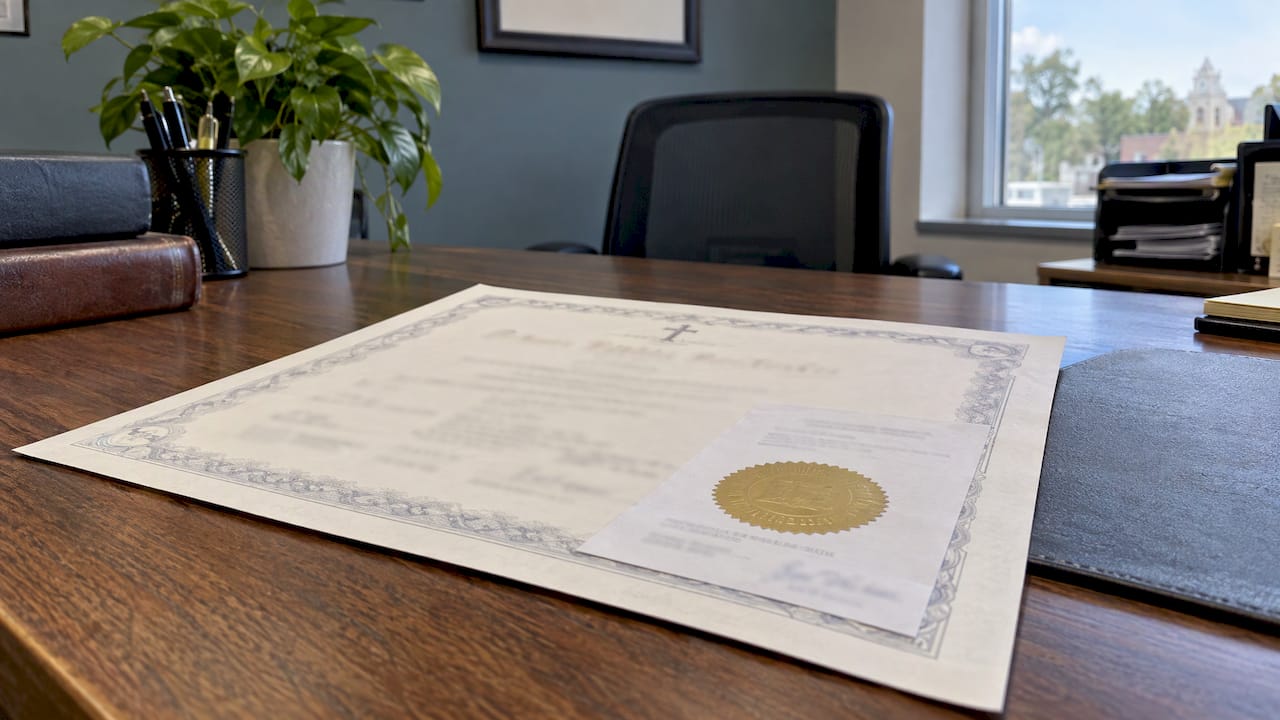
Baptism Certificate Apostille in Canada: How It Works ! Baptism certificate with an attached apostille A baptism certificate is issued by a church, not by a government.
Baptism Certificate Apostille in Canada: How It Works
A baptism certificate is issued by a church, not by a government. That changes how it is apostilled in Canada. Global Affairs Canada does not authenticate religious documents, so the certificate usually goes through a notary first. In Ontario, Speedy Apostille Services handles this step through a commissioned Ontario Notary, and the destination country decides whether the document is accepted.
TL;DR
- An apostille is a certificate that confirms a signature, seal or stamp on a document so that other Hague Convention countries accept it. Canada joined the convention on January 11, 2024.
- Global Affairs Canada cannot authenticate religious documents such as baptismal certificates.
- A church record normally needs a notary's certification before a province can authenticate the notary's signature. Rules differ by province.
- The destination country's law decides if an apostille is needed. Confirm this with the authority that asked for the document.
- Notarization with Speedy Apostille Services costs $35 CAD per document.
Table of Contents
- Why a baptism certificate is a special case
- Who needs a baptism certificate apostilled
- Step 1: Ask the receiving authority what it accepts
- Step 2: Get the right version of the certificate
- Step 3: Notarization and certified true copies
- Step 4: Send it to the right authority
- Step 5: Apostille, translation and delivery
- What the Ontario route costs
- Common reasons a baptism certificate is refused
- Our view
- Order an Ontario apostille for your certificate
- FAQ
- Sources
Why a baptism certificate is a special case
Birth, marriage and court documents come from government bodies. Their signatures are on file with a public authority. That authority can confirm them and attach an apostille.
A baptism certificate comes from a parish or a congregation. No public authority holds the signature of the priest or church official. This is why the usual route does not apply.
Global Affairs Canada states in its authentication requirements that it cannot authenticate religious documents such as baptismal certificates issued by a religious institution. The same page says the destination country's law determines whether authentication is needed at all.
The next step is a document a notary has certified. The notary is a public officer whose signature a province can verify.
Who needs a baptism certificate apostilled
Most people who ask about this are not asking for a religious reason. They need the record for a legal or administrative file abroad. Common cases include:
- Families relocating abroad, who need church records for a school, a parish or a civil registry.
- Immigrants and people applying for citizenship through a parent or grandparent, where a foreign authority asks for the whole chain of family records.
- Professionals and students whose file abroad includes a proof of identity or family status.
- Businesses are rarely involved. Their paperwork is usually corporate records, which follow a different route.
The request almost always comes from the foreign authority. That authority tells you which documents it wants and in what form. Start there.
Step 1: Ask the receiving authority what it accepts
The rule for apostilles is set by the country that receives the document, not by Canada. Global Affairs Canada says on its alternatives page that the requirement to authenticate a Canadian document is determined by the destination country's laws. The page also says some foreign missions can legalize Canadian documents directly, and that applicants must confirm this with the embassy, high commission or consulate.
Before you do anything, get these answers in writing from the authority that asked for the document:
- Does it want an apostille, or a different form of legalization?
- Does it accept a notarized copy of the church certificate, or a newly issued certificate?
- Does it need a translation, and does the translation also need to be certified?
- Does it set a limit on how old the certificate can be?
The country must be a member of the Hague Convention for an apostille to work. Our Hague Apostille Convention country checker lists the countries. If the country is not a member, the document may need consular legalization. We offer consular legalization as a service.
Step 2: Get the right version of the certificate
Global Affairs Canada's rules say a document must be on paper, carry an original recognized signature and a seal where one applies, and be sent to the correct authority. Photocopies, glued documents and laminated documents are refused.
For a baptism certificate, this means:
- Ask the parish for a recently issued certificate with an original signature, or
- Bring the original record to a notary who can certify a true copy.
A recent certificate is often the easiest choice. Some parishes charge a small fee or take days to reply, so ask early. Do not laminate the certificate. Do not staple extra pages to it.
If the certificate is a photocopy of a record, it cannot be apostilled as it is. It has to be certified by a notary first.
Step 3: Notarization and certified true copies
Notarization is the step that connects a church record to the apostille system. A notary examines the original, certifies that a copy is a true copy, and signs and stamps the certification. The province then authenticates the notary's signature.
Global Affairs Canada sets out what a valid notarization looks like on its requirements page. The notary must:
- hold a valid certificate of appointment,
- sign by hand in ink,
- apply a stamp or seal that shows their full name and province or territory,
- state the type of notarial act, and
- state the date.
The rules for notaries differ between provinces and territories. A notarization that fails one of these points is a common reason for a refusal.
Québec sets this out clearly. Its official apostille page lists a baptismal certificate as an example of a document from a non-public body that can be authenticated. It must be officially certified by a lawyer or notary. The notarized document and the notary's certificate then need a signature authentication from the Chambre des notaires du Québec or the Barreau du Québec. Québec issues apostilles in French only and does not certify the content of the document.
British Columbia notes on its authentication page that not every document needs notarization before authentication, and some should not be notarized. Instructions depend on the document type.
In Ontario, we notarize the certificate and certify true copies. Notarization and certified true copies cost $35 CAD per document. Our notarization guide explains what a notary checks.

Step 4: Send it to the right authority
Not one office handles all of Canada. Global Affairs Canada handles federal documents and documents issued or notarized in Manitoba, New Brunswick, Newfoundland and Labrador, the Northwest Territories, Nova Scotia, Nunavut, Prince Edward Island and Yukon. Alberta, British Columbia, Ontario, Québec and Saskatchewan handle documents issued or notarized in their own provinces.
The province or territory where the notary signed decides the route, not the place where the church stands.
Fees and times vary by province. These are the published figures:
| Authority | Fee per document | Time stated |
|---|---|---|
| Alberta | $25 | At least 7 to 10 business days |
| British Columbia | $20 | See the official page |
| Ontario, through Speedy Apostille Services | Included in the all-in quote | 1 to 7 days, depending on the tier |
Alberta processes documents in the order received. If a document cannot be apostilled, it is returned with a written explanation. Government fees and processing times can change, so check the official page before you submit.
Our guides explain the routing in detail: which provinces issue apostilles and GAC versus the provinces.
Step 5: Apostille, translation and delivery
The apostille is attached to the notarized document. It confirms the notary's signature and seal. It does not confirm that the baptism took place, and it does not confirm the content of the certificate.
The Convention is in force in Canada since January 11, 2024. B.C. says an apostille issued there does not need consular legalization for use in a Convention member country.
Translation is a separate question. A destination authority may want the certificate in its own language. Some want the translator to be certified. Ask the authority in Step 1. Where a translation is needed, we can refer you to a translator. Order of work matters: in many cases the translation is attached after the apostille, but the receiving authority has the final say.
Businesses that ship related goods also meet other export papers. A certificate of origin is a different document with its own rules, described in this certificate of origin requirements guide.
What the Ontario route costs
Our price includes government fees. You see the total before you commit. Published prices:
- Notarization and certified true copies: $35 CAD per document.
- Second document: $50 CAD.
- Documents 3 to 5: $45 CAD each.
- Documents 6 and over: $40 CAD each.
The Ontario apostille itself, Next-Day Priority and Same-Day Rush are quoted on our pricing page. The cost calculator gives a total for your set.
Families often have several documents: the baptism certificate, birth certificates and a marriage certificate. Ordering them together lowers the cost per document.
Common reasons a baptism certificate is refused
- The certificate is a photocopy and has not been certified by a notary.
- The notary's stamp is missing the province or the date.
- The document was sent to the wrong province.
- The document is laminated.
- The destination authority wanted a different form of legalization.
- The certificate is a digital file. Our guide on digital documents explains why paper is needed.
We correct filing errors at no extra cost.
Our view
Baptism certificates come to us from families who have already been told twice that the document cannot be done. The reason is usually the same. The certificate is a church record, and people send it to the wrong office.
We start with the notary. In Ontario, documents are handled only by a commissioned Ontario Notary. They are not outsourced and not passed to intermediaries. The notary checks the certificate, certifies the copy and prepares it for filing.
We file in person at the ODS counter. That allows same-day or next-day turnaround. The quote includes government fees, so the total is known before the order starts.
If an error occurs in filing, we correct it at no extra cost. A family sending several records abroad gets one clear price and one point of contact.
Ken
Order an Ontario apostille for your certificate
We notarize baptism certificates and file them in Ontario. Turnaround is 1 to 7 days, with standard, next-day and same-day options. Our typical time is 2 to 3 days. See the services page to place an order.
We also work in Toronto, Mississauga, Hamilton, Oakville, Burlington and Richmond Hill. The Toronto and GTA same-day page lists same-day details.
FAQ
Can a baptism certificate be apostilled in Canada?
Yes, in most cases after notarization. Global Affairs Canada does not authenticate religious documents. A notary certifies the document, and the province authenticates the notary's signature. The destination country decides if it accepts the result.
Who can apostille a baptism certificate?
The province or territory where the notary signed. Alberta, British Columbia, Ontario, Québec and Saskatchewan handle their own. Global Affairs Canada handles the rest. For Ontario, we handle the notarization and the filing.
Does the certificate need to be an original?
The document must be on paper with an original signature. Photocopies are refused. Québec accepts the original or a true copy certified by its producer. A notary can certify a true copy in Ontario for $35 CAD per document.
How long does it take?
It depends on the province. Alberta states at least 7 to 10 business days. In Ontario, our turnaround is 1 to 7 days, and typically 2 to 3 days.
Does it need a translation?
That depends on the receiving authority. Ask it before you order. We can refer you to a translator.
Sources
- Global Affairs Canada: Authentication of documents, requirements
- Global Affairs Canada: Authentication of documents, alternatives
- Gouvernement du Québec: About apostille
- Alberta.ca: Documents for other jurisdictions or countries
- Certificate of origin requirements guide