
6–7 Weeks to Apostille Bank Documents in Canada: Notary Checklist
6–7 Weeks to Apostille Bank Documents in Canada: Notary Checklist ! Notary witnessing bank document signature Yes, Canadian bank documents can be apostilled, but not straight off the bank's printer.

6–7 Weeks to Apostille Bank Documents in Canada: Notary Checklist
Yes, Canadian bank documents can be apostilled, but not straight off the bank's printer. A bank statement or bank letter must be notarized first, or issued as a bank-certified letter, before any authority will authenticate it. Global Affairs Canada handles many submissions, while some provincial offices manage documents notarized or issued within their jurisdiction. Your next move is simple: book a notary appointment or ask your bank for a certified letter on official letterhead.
TL;DR:
- Canadian bank documents must be notarized or issued as certified letters before they can receive an apostille, with bank letters on official letterhead being preferable.
- The process involves verifying destination country requirements, choosing the correct competent authority, and including tracking and prepaid return envelopes to avoid delays.
- Canadian authorities differ based on jurisdiction: Global Affairs Canada handles many documents, but some provinces have their own certification offices, requiring careful coordination.
- Australia, the UK, and other Hague countries treat Canadian authentication certificates as equivalent to an apostille, but non-Hague countries often demand additional consular legalization.
- Proper notarization, correct wording, and pre-approval from the destination bank or institution significantly reduce rejection risks and streamline the authentication process.
Table of Contents
- How to Get a Bank Documents Apostille: Step-by-Step
- Who Issues Apostilles in Canada: Federal or Provincial?
- Notarizing Bank Statements and Bank Letters the Right Way
- How Long It Takes and What It Costs
- Avoiding Rejection: Pitfalls and a Pre-Send Checklist
- Why an Experienced Service Helps With Complex Cases
- Why Canada Doesn't Issue a Traditional Apostille
- Alternative Authentication Options in Canada
- Getting Your Document Notarized the Right Way
- What Happens After Authentication: Final Legalization Steps
- Which Documents Typically Need This Kind of Authentication
- Confirming the Destination Country Accepts Canadian Authentication
- A Practical Take on Bank Document Apostilles
- Speedy Apostille Services: How We Help
- Sources
- FAQ
How to Get a Bank Documents Apostille: Step-by-Step
Getting a bank statement or bank letter ready for international use follows a fixed sequence. Skip a step and the whole package can bounce back weeks later.
- Confirm the destination country's requirement. Check whether the country accepts an apostille or requires consular legalization instead. This single check saves the most time of any step on this list.
- Pick the right document. A bank letter on official letterhead, stating account status or balance, is usually easier to authenticate than a raw statement. Statements often need to be recent, with recency requirements varying depending on the receiving institution.
- Notarize it correctly. A notary either witnesses a bank officer's signature on the letter or signs a sworn true-copy declaration for a statement copy. The wording matters here.
- Select the correct competent authority. Base this on where the notarization happened or where the document originated, not on where you happen to live.
- Submit the package. Include the notarized document, any required application form, payment for fees, and a return envelope with tracking.
A few things trip people up at each stage:
- Bank letters need a live signature and date, not a photocopy of an old one.
- Statements older than a few months often get rejected outright.
- Notary wording that says "certified copy" instead of "true copy" can cause delays depending on the authority.
- Missing a prepaid, tracked return envelope slows the whole process down.
Pro Tip: Call your bank's branch manager before your notary appointment and ask for a bank letter instead of a statement. Letters are typically cleaner to notarize and less likely to raise recency questions.
Who Issues Apostilles in Canada: Federal or Provincial?
Global Affairs Canada is the federal authority for many document types, but several provinces run their own competent-authority offices for documents issued or notarized within provincial borders. Sending a package to the wrong office is one of the most common reasons authentication gets delayed.
The rule of thumb: base your decision on where the notarization took place or where the bank document was originally issued.
- If a Toronto notary signed your bank letter, check whether Ontario has a provincial process or whether it routes through Global Affairs Canada.
- If you live in a province with a standalone competent authority, its website usually lists exactly which document types it handles.
- When in doubt, Global Affairs Canada's guidance page clarifies which submissions it accepts directly.
Calling the office directly before mailing anything costs a few minutes and prevents a returned package weeks later.
Notarizing Bank Statements and Bank Letters the Right Way
Bank documents count as private records. That means a notary has to step in before any apostille process can begin, since the authority is only authenticating a signature and seal, not the financial data itself, according to Global Affairs Canada.
Two paths exist here. A notary can witness a bank officer's live signature on an official letter, or a notary can sign a sworn declaration that a statement copy is a true copy of the original. Ask your notary to confirm, in writing, that they verified your identity, used true-copy wording rather than "certified copy," and dated the notarization clearly.
Many banks offer in-house notary services, which speeds things up and avoids wording mistakes that outside notaries sometimes make on financial documents. If your bank cannot notarize, any licensed notary public can handle the sworn declaration.
A few practical notes worth checking before you book anything:
- Remote or online notarization is accepted in some provinces but not others, and some authorities still demand a physical original with a wet-ink signature, so verify what's actually accepted before relying on it.
- If your destination country requires a translation, ask whether the translation itself needs separate notarization or apostille treatment, since requirements vary by country and by receiving institution.
Pro Tip: Request two notarized originals instead of one. If a foreign bank rejects the first copy over a formatting issue, you won't have to restart the entire notarization process.
How Long It Takes and What It Costs
Standard government processing runs around 25 business days, not counting mailing time. Add another 5 to 10 business days for mail to travel each direction, and the realistic total for a mailed submission often lands closer to six or seven weeks.
Choosing courier service over standard mail can shave several days off the round trip, which matters if you're working against a visa interview date or a foreign bank's onboarding deadline.
Government processing alone can take up to 25 business days, before mailing time is added on either end.
Costs typically break into three pieces: the notary's fee, any government processing fee tied to the authority handling your document, and courier charges for sending and returning the package. Bundled, all-in pricing that folds government fees into one upfront number tends to make budgeting far less of a guessing game than paying each piece separately.
Avoiding Rejection: Pitfalls and a Pre-Send Checklist
Most rejected bank document packages fail for the same handful of reasons: the wrong competent authority received the submission, the notarization wording was incomplete, the statement was too old, or the wrong document type was sent entirely, per Global Affairs Canada's own guidance.
Before you notarize anything, call the receiving bank or institution abroad and ask directly: Do you require an apostille or consular legalization? Is a bank letter acceptable, or do you need a full statement? How recent does the document need to be?
Run through this before sealing the envelope:
- Confirm the destination country accepts an apostille rather than requiring legalization.
- Verify you're sending to the correct competent authority for where the document was notarized or issued.
- Check the notary used true-copy or witnessed-signature wording, dated and signed properly.
- Keep a photocopy of everything you're sending.
- Include a prepaid return envelope with tracking enabled.
Why an Experienced Service Helps With Complex Cases
Jurisdiction mistakes and notarization wording errors are the two things that derail bank document submissions most often. An experienced reviewer catches these before anything ships. Some services back their process with positive reviews, transparent all-in pricing, and fast turnaround times. DIY works fine for a single, straightforward document with time to spare. Multi-document corporate packages or tight deadlines usually favor bringing in a specialist.
Why Canada Doesn't Issue a Traditional Apostille
Canada is not a member of the Hague Apostille Convention, the 1961 treaty that lets member countries authenticate documents with a single standardized certificate recognized across all other member states. Because Canada sits outside that treaty, Canadian authorities cannot issue the same one-page apostille certificate that a country like France or Mexico can stamp on a document in minutes.
Instead, Canada uses its own authentication and legalization system, run through Global Affairs Canada and, for some document types, provincial offices. The outcome for the document holder looks similar. A signature and seal get verified so a foreign institution can trust the document's origin. The mechanics behind it differ, and that difference explains why Canadian document authentication sometimes takes longer than the apostille process in Hague member states.
This distinction also explains why a "bank documents apostille" for a Canadian statement is, technically, an authentication and legalization certificate that functions like an apostille once your destination country recognizes it. For countries that are themselves Hague members, Canada's authentication certificate is generally treated as equivalent to an apostille for practical purposes. For non Hague countries, the document usually needs an extra round of consular sign off after Canadian authentication, since neither an apostille nor Canada's certificate alone satisfies their legal requirements.
Alternative Authentication Options in Canada
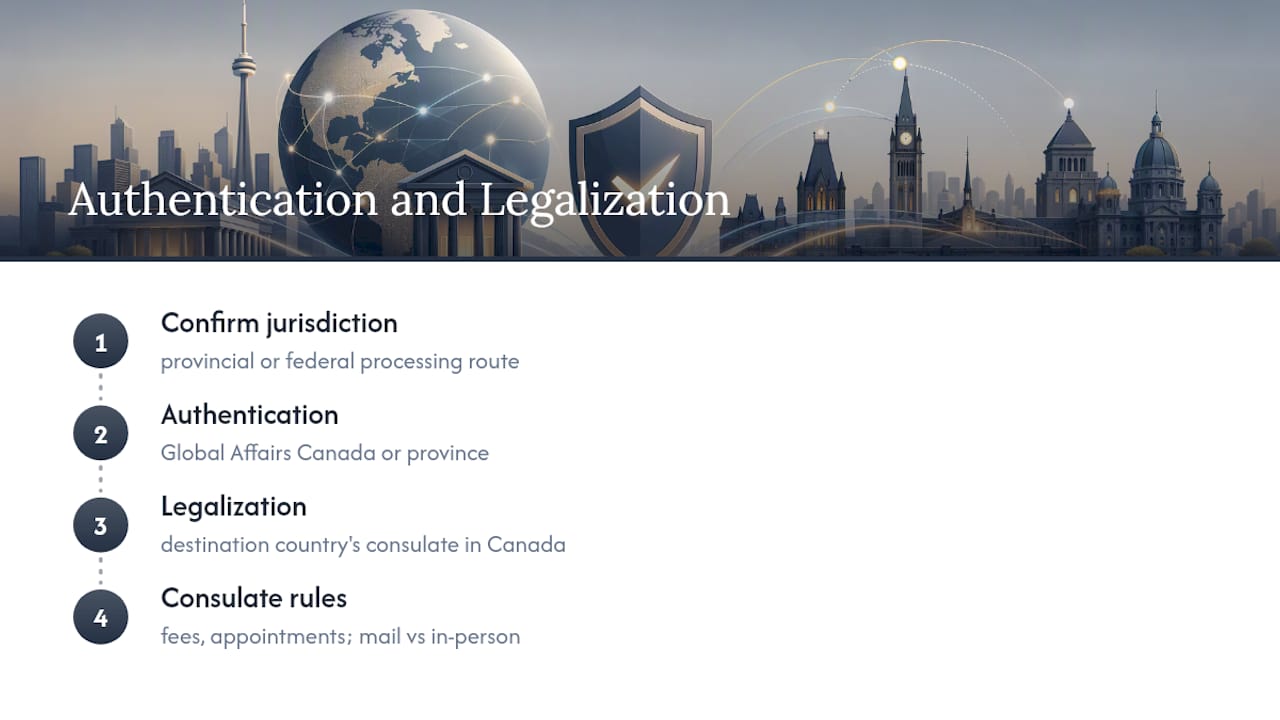
With apostilles off the table, Canada relies on a two-track authentication and legalization system. Global Affairs Canada authenticates the notary's or official's signature and seal on your document first. If your destination country is not a Hague Apostille Convention member, that authenticated document then needs a second stamp of approval from that country's embassy or consulate in Canada, a step known as legalization.
Provincial competent authorities fill a parallel role for documents issued or notarized within their own borders, which is why confirming jurisdiction before you submit anything saves real time. Some provinces process authentication requests faster than the federal office for documents that qualify, while others funnel everything back through Global Affairs Canada regardless.
Foreign consulates and embassies located in Canada each set their own legalization requirements, fees, and appointment systems, and these vary considerably by country. Some consulates accept mailed submissions with a return courier label. Others require an in-person appointment, particularly for financial documents where identity verification carries extra weight. Building in a buffer for consulate scheduling matters as much as budgeting for government processing time, since embassy appointment slots can book out for weeks during busy visa and immigration seasons.
Checking both the Global Affairs Canada authentication page and the relevant consulate's own website before starting is the safest way to avoid a bounced submission at the legalization stage.
Getting Your Document Notarized the Right Way
Every province and territory in Canada licenses its own notaries public, and requirements differ slightly depending on where you live. Ontario, British Columbia, and Alberta all license notaries who can witness signatures and certify true copies, but the specific wording they use, and how they're trained to phrase a notarial certificate for financial documents, can vary by province.
Lawyers in most provinces can also act as notaries, and many law offices offer notarization as a standalone service without requiring you to retain them for anything else. Some banks provide in-house notary services for their own account holders, which tends to be the fastest route for a bank letter since the same institution that issued the document can notarize it on the spot.
When booking an appointment, ask specifically for notarization suited to international authentication, not a general notarization for domestic use. The distinction matters because a notary unfamiliar with apostille or authentication requirements may use certification language that Global Affairs Canada or a provincial authority won't accept, sending you back to square one.
Bring government-issued photo identification to every notary appointment. For a bank letter, the bank officer signing the letter typically needs to sign it in the notary's physical presence, so a signed letter mailed to you in advance usually won't work. Confirm this detail when you book, since some notaries will not backdate or accept a pre-signed document under any circumstances.
What Happens After Authentication: Final Legalization Steps
Once Global Affairs Canada or the relevant provincial authority has authenticated your bank document, the process is finished for Hague Convention member countries. The authenticated document is ready to send or hand-deliver to its destination.
For countries that have not joined the Hague Apostille Convention, one more step remains: consular legalization. This means submitting your already-authenticated document to that country's embassy or consulate here in Canada, where consular staff verify the Canadian authentication and add their own stamp or certificate. Only after that second stamp is the document considered fully legalized for use in that country.
Each consulate sets its own fees, processing times, and submission methods, so check the specific embassy's website well before your deadline. Some consulates process legalization requests within a few business days. Others, particularly during peak travel or immigration seasons, can take several weeks. Building this into your overall timeline prevents an unpleasant surprise right when you thought the process was nearly done.
Keep certified copies of every document at each stage: the original notarized version, the authenticated version, and the consular-legalized version if that step applies. Foreign institutions occasionally ask to see the full chain of certification, not just the final legalized document, particularly for financial paperwork tied to account opening or large transactions abroad.
Which Documents Typically Need This Kind of Authentication
Bank statements and bank letters are far from the only financial documents that need authentication for international use. Corporate financial records, including audited financial statements, board resolutions authorizing international transactions, and letters of good standing from a bank, commonly require the same notarize-then-authenticate path.
Personal financial documents beyond basic statements also show up regularly in these requests: proof of funds letters for immigration applications, income verification letters for foreign mortgage applications, and reference letters confirming an account holder's banking history. Each follows the identical logic. Because it's a private record rather than a government-issued document, it needs notarization before any authority will authenticate it.
Beyond banking, the same authentication and legalization system applies to a wide range of Canadian-issued documents headed abroad, including birth certificates, marriage licenses, diplomas, and RCMP background checks. The common thread across all of them is that private or personal documents typically need a notary's involvement first, while government-issued vital records sometimes skip that step and go straight to the competent authority.
If you're preparing a package with multiple document types, financial records alongside a diploma or a background check, check each document's notarization requirement separately rather than assuming one rule covers everything in the envelope.
Confirming the Destination Country Accepts Canadian Authentication
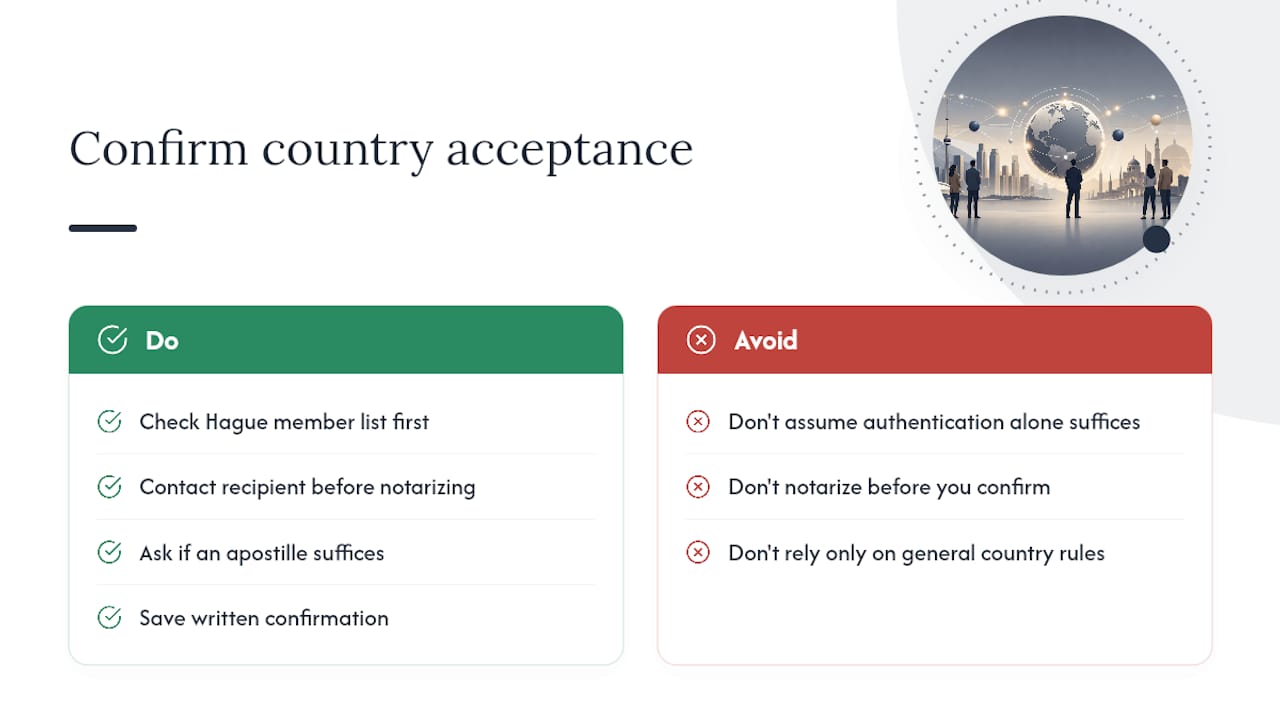
Not every country treats Canadian authentication the same way, so verifying acceptance before you spend weeks on the process matters more than most people realize. Start with the Hague Apostille Convention's own member list, since that single check tells you whether your document needs consular legalization on top of Canadian authentication or not.
Even among Hague member countries, some foreign banks and government offices maintain their own internal rules about how recent a bank statement must be or what specific wording they expect in a bank letter. A document that's technically authenticated correctly can still get rejected by an overly strict foreign bank compliance officer if the content itself doesn't match what they expect to see.
Contacting the receiving institution directly, before you notarize anything, remains the single most reliable way to confirm acceptance. Ask three specific questions: does an apostille equivalent satisfy their requirement or do they need full consular legalization, is a bank letter acceptable in place of a full statement, and how recent does the document need to be dated. Financial institutions dealing with cross-border transactions sometimes apply stricter document standards than the country's general legal requirements suggest, a nuance worth exploring further if your documents relate to international asset protection or complex cross-border legal matters.
Save the email or written confirmation from the receiving institution. If a dispute arises later over document validity, having their own stated requirements in writing protects you.
A Practical Take on Bank Document Apostilles
The most common mistake isn't skipping notarization. It's using the wrong notarization wording, then not catching it until the package comes back weeks later. The simplest prevention step is asking the notary to write "true copy" language explicitly and confirming the receiving institution's exact requirements before you start, not after. Use a tracked courier for both directions of the submission. The extra few dollars buys certainty that a lost envelope won't cost you another six weeks.
— Ken
Speedy Apostille Services: How We Help
Bank documents carry their own quirks: notarization wording, jurisdiction routing, recency rules that vary by country. Speedy Apostille Services reviews each document before submission, routes it to the correct authority, and handles the apostille or authentication process from start to finish.
The service covers notarization review, correct authority routing, government processing, and secure return shipping for bank statements, bank letters, and any accompanying corporate financial records. Turnaround times may be as short as a few days once documents are received, with pricing that includes government fees upfront and positive customer feedback reported. If you're facing a tight deadline or a multi-document package, get a quote at Speedy Apostille Services and find out exactly what your submission needs before you send anything.
Sources
FAQ
Who Can Apostille Documents in Canada?
Global Affairs Canada authenticates many document types federally, while some provinces run their own competent-authority offices for documents notarized or issued within their borders. Speedy Apostille Services can help identify and route to the correct office for your specific bank document.
How Long Does It Take to Get Documents Apostilled in Canada?
Standard government processing runs around 25 business days, plus 5 to 10 business days each way for mailing. Expedited handling services can significantly shorten the overall timeline compared to standard government processing.
What Documents Are Needed to Get an Apostille?
For bank documents, you need a notarized bank letter or statement, since private financial records require notarization before any authority will authenticate them, along with any application form the competent authority requires and payment for applicable fees.
Can I Get an Apostille in Manitoba?
Manitoba residents should confirm whether their document falls under a provincial competent authority or needs to go through Global Affairs Canada, based on where the notarization took place. Checking directly with the relevant office before mailing anything avoids a misdirected submission.