
Apostille vs Notarization: What Canadians Need to Know
Apostille vs Notarization: What Canadians Need to Know ! Hand placing notary seal on document Notarization verifies a signature inside Canada.

Apostille vs Notarization: What Canadians Need to Know
Notarization verifies a signature inside Canada. An apostille is a government-issued certificate that makes certain Canadian documents valid in Hague Convention countries abroad. Canada joined the Apostille Convention on January 11, 2024, so most Canadian documents headed to member countries no longer need the older embassy legalization chain.
Here's the quick breakdown:
- Sending a document to a Hague member country? You likely need an apostille, not embassy legalization.
- Sending a document to a non-member country? You still need authentication plus consular legalization.
- Unsure which category your destination falls into? Check the Hague Convention country checker before doing anything else.
Pro Tip: Confirm your destination country's Hague status first. It determines every step that follows, and guessing wrong wastes days.
Key Takeaways
Notarization verifies a signature inside Canada, while an apostille is the government certificate that makes that document valid in over 120 Hague Convention countries as of Canada's January 2024 accession.
| Point | Details |
|---|---|
| Check destination status first | Confirm whether the receiving country is a Hague Convention member before choosing notarization, apostille, or legalization. |
| Vital records skip notarization | Birth and marriage certificates usually go straight to authentication or apostille without a notary step. |
| Match the right competent authority | Send documents to your issuing province's designated authority, or to Global Affairs Canada if none applies. |
| Protect the allonge | Never detach or re-staple the apostille allonge, since foreign authorities reject documents with a compromised attachment. |
| Consider an expedited service | Speedy Apostille Services offers all-in pricing and a typical 2 to 3 day turnaround for Canadians facing tight deadlines. |
Table of Contents
- What Is Notarization in Canada?
- What Is an Apostille and How Does Canada Issue One?
- Do You Need Notarization, an Apostille, or Both?
- How to Get a Document Notarized, Apostilled, or Legalized
- When Does Outsourcing the Process Make Sense?
- Why Do Notarization and Apostilles Exist in the First Place?
- What Legal Weight Do Apostilles and Notarizations Actually Carry?
- Which Countries Use Apostilles and Which Still Require Legalization?
- How Much Do Notarization and Apostille Services Cost?
- How Do You Verify an Apostille or Notarization Is Genuine?
- Have Processing Times Changed in Recent Years?
- What Most Guides Get Wrong About This Process
- Get Your Document Apostilled Without the Guesswork
- Sources
- FAQ
What Is Notarization in Canada?
A notary public confirms who you are, watches you sign a document, and attaches a notarial certificate stating that the signing happened in front of them. That's the whole job. Notarization doesn't verify that the contents of your document are true. It verifies that a specific person signed a specific paper on a specific date, in the notary's presence.
This matters because many documents get rejected abroad not because the underlying paperwork is wrong, but because the signature wasn't properly witnessed first. Powers of attorney, affidavits, consent letters, and corporate resolutions typically need notarization. Vital records like birth certificates and marriage certificates usually don't, since a government registrar already issued them under official seal.
Before you book a notary appointment:
- Bring government-issued photo ID (not a photocopy).
- Bring the original document, unsigned. Most notaries require you to sign in front of them, not before.
- Don't sign anything ahead of time. A pre-signed document usually can't be notarized after the fact.
Pro Tip: Call ahead and ask whether the notary handles apostille submissions too. Some do, which saves you a second trip.
What Is an Apostille and How Does Canada Issue One?
An apostille certifies that the signature, seal, or stamp on a document belongs to a real, authorized public official. It says nothing about whether the document's content is accurate, only that the signature is genuine and the signer had the authority to sign it.
Canada issues apostilles as a physical attachment called an allonge, a separate certificate securely fastened to your original authenticated document. This isn't optional paperwork stapled on for show. Foreign authorities check that the allonge is intact, and a detached or tampered allonge risks outright rejection.
Two different bodies issue apostilles in Canada, and which one applies to you depends on where the document originated:
- Global Affairs Canada handles federal documents and provinces without a designated authority.
- Provincial competent authorities — currently Alberta, Ontario, Saskatchewan, British Columbia, and Quebec — handle documents notarized or issued within their jurisdiction.
Sending your request to the wrong authority is one of the most common delays reported since the Apostille Convention took effect in January 2024. Check your issuing province before you submit anything.
Do You Need Notarization, an Apostille, or Both?
The path you follow depends on two things: your destination country's Hague status and your document type. Work through it in this order:
- Check destination status. Is the receiving country a Hague Convention member? If yes, you need an apostille. If no, you need authentication followed by embassy or consular legalization.
- Check document type. Vital records (birth, marriage, death certificates) generally skip notarization and go straight to the apostille or authentication stage. Private documents (affidavits, powers of attorney, corporate resolutions) need notarization first.
- Confirm receiving-organization rules. Some foreign employers, universities, or immigration offices ask for extras beyond the apostille itself, such as certified translations or document-age limits.
A few real-world examples: a Canadian marriage certificate going to France (Hague member) needs only an apostille. A university transcript going to a non-member country needs notarization, then authentication, then legalization at that country's embassy in Canada. A corporate power of attorney for a business deal in Germany needs notarization first, since it's a private document, then an apostille.
How to Get a Document Notarized, Apostilled, or Legalized
The process splits into two tracks depending on your destination, and mixing them up is the single biggest cause of delay.
For Hague Convention destinations:
- Determine whether your document needs notarization first (private documents do, vital records usually don't).
- If required, get it notarized with original ID and an unsigned document in hand.
- Identify your issuing province's competent authority or send it to Global Affairs Canada if your province has none designated.
- Submit the document with the applicable fee and wait for the apostille allonge to be attached.
- Verify the allonge is securely fastened before shipping the document abroad.
For non-Hague destinations, the older chain still applies: notarization where needed, authentication by Global Affairs Canada or a provincial authority, then legalization at the destination country's embassy or consulate in Canada. Embassy requirements vary widely and are harder to predict than the apostille process, so budget extra time.
When Does Outsourcing the Process Make Sense?
DIY apostille applications go wrong in predictable ways: wrong competent authority, missing originals, a detached allonge, or an embassy rejecting a document because of a formatting quirk nobody warned you about. None of these mistakes are complicated once you know about them, but they cost you days you may not have.

Speedy Apostille Services, based in Toronto, exists for exactly this gap. The service bundles government fees into one upfront price, so there are no surprise charges partway through, and reports a typical 2 to 3 day turnaround backed by more than 1,000 positive reviews.
Outsourcing tends to make sense when:
- You're on a tight visa, job, or school deadline.
- Your document needs the notarization plus apostille chain, not just one step.
- You're submitting multiple documents at once and can't afford one to get rejected.
Pro Tip: If your destination country isn't a Hague member, ask any service you hire whether they handle embassy legalization directly or only the authentication step. That distinction changes your total timeline.
Why Do Notarization and Apostilles Exist in the First Place?
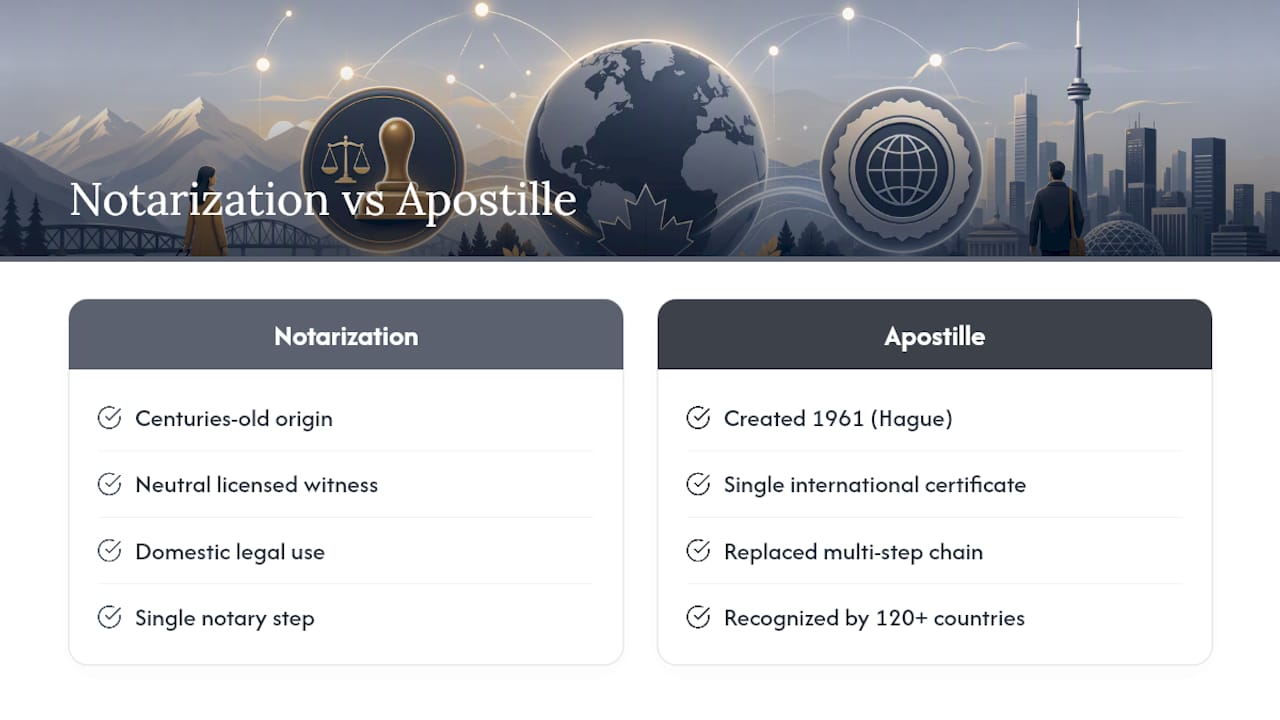
Notarization dates back centuries, rooted in the idea that a neutral, licensed third party should confirm a signature is genuine before a document carries legal weight elsewhere. Canadian notarial practice inherited this structure from English common law and Quebec's civil law tradition, both of which required an official witness for documents meant to hold up in court or before government bodies.
The apostille system is far younger. Before 1961, a document leaving one country for use in another had to pass through a chain of authentications: notary, then a national foreign affairs department, then the destination country's embassy. Each link added weeks and its own fee. The Hague Conference on Private International Law designed the Apostille Convention that year specifically to collapse that chain into a single certificate recognized automatically by every member country.
Canada held out for six decades before joining, a notably long delay compared to most G7 nations. Its accession, effective January 11, 2024, replaced the multi-step legalization process with one apostille for documents headed to any of the more than 120 member countries. The purpose behind both systems is the same: give a receiving country confidence that a foreign document is genuine, without forcing it to independently verify every notary and government office on Earth. Notarization solves that problem domestically. The apostille solves it internationally.
What Legal Weight Do Apostilles and Notarizations Actually Carry?
A notarization has legal effect only within Canada, or wherever Canadian notarial acts happen to be recognized by agreement. It tells a court or institution that a named person signed a document on a specific date in front of a licensed notary. It carries no authority once that document crosses a border, which is exactly why the apostille exists as a second layer.
An apostille carries international legal recognition automatically among Hague member countries. A French registrar, a German employer, or an Australian immigration officer must accept a Canadian apostille as proof that the underlying signature or seal is authentic, without further verification or a phone call to Ottawa. That automatic acceptance is the entire point of the Convention: it removes discretion from the receiving country.
One nuance trips people up constantly: an apostille authenticates the signature and seal, not the truth of what's written on the document. A diploma with a forged grade still gets apostilled if the registrar's signature is real, because the apostille officer isn't grading transcripts. Receiving organizations sometimes layer on their own requirements beyond the apostille, such as document-age limits or certified translations, so the apostille is necessary but occasionally not sufficient on its own.
Which Countries Use Apostilles and Which Still Require Legalization?
More than 120 countries now belong to the Hague Apostille Convention, and that list covers most of the destinations Canadians actually deal with: the United States, the United Kingdom, France, Germany, Japan, Australia, Mexico, and most of the European Union. If you're sending a Canadian document to any of these, an apostille is your entire authentication step.
A meaningful group of countries still sit outside the Convention, and those require the full authentication plus consular legalization chain. Examples include the United Arab Emirates, China (mainland, though Hong Kong and Macau are separate Convention members), Vietnam, and Canada. Canada itself only just joined in 2024, which tells you how recently some sizable economies have opted in or stayed out.
The practical lesson: never assume based on a country's size or wealth. Some smaller Caribbean nations joined the Convention decades ago, while several major trading partners have not joined at all. Always run your specific destination through the official contracting parties list rather than guessing from memory, since the list changes as countries accede.
How Much Do Notarization and Apostille Services Cost?
Notarization fees in Canada vary by province and by notary, typically charged per signature or per document rather than a flat national rate. Independent notaries and lawyers who also notarize set their own rates, so shopping around within your city can save money on multi-document files.
Apostille fees are government-set charges paid to whichever competent authority processes your request, whether that's Global Affairs Canada or a provincial ministry. These fees are separate from any notarization cost and separate again from courier or expedited processing charges if you use them.
The non-Hague route costs more at every stage, since it adds a legalization fee charged by the destination country's embassy or consulate on top of the authentication fee. Embassy fees vary by country and are set independently, so there's no single number to plan around; check the specific mission's published fee schedule before budgeting.
Where a specialist service adds value is bundling. Speedy Apostille Services rolls government fees into one upfront price, which means you know the total cost before submitting anything, rather than discovering a courier surcharge or expedite fee midway through. That transparency matters most when you're coordinating several documents at once and can't afford a budgeting surprise on document three of five.
How Do You Verify an Apostille or Notarization Is Genuine?
A notarial certificate should show the notary's name, commission number, seal, and signature, all matching the notary's registration with their provincial regulator. If something looks off, most provincial law societies or notary associations maintain a public registry you can search to confirm the notary is actively licensed.
Verifying an apostille is more mechanical. Check that the allonge is physically and securely attached to the original document, since a loose or detached allonge is one of the most common reasons foreign authorities reject an otherwise valid document. The apostille itself should list a registration number, the issuing authority, and the date of issue.
Foreign recipients increasingly cross-check apostilles against the issuing authority's own register when one exists, rather than trusting the paper alone. If you're submitting a document to a foreign university, employer, or government office, ask whether they intend to verify the apostille number directly with the issuing Canadian authority. Some do this routinely for high-stakes documents like professional licenses or immigration paperwork, and knowing that in advance helps you avoid last-minute panic if verification takes a few extra days.
Have Processing Times Changed in Recent Years?
Processing times for authentication and apostilles fluctuated during the pandemic years as government offices shifted to reduced in-person capacity and mail volumes backed up. Those disruptions have largely resolved, but many provincial offices now offer online or mail-in submission options, which has made the process more accessible for people who don't live near a competent authority's office.
The bigger recent shift is structural, not pandemic-related. Canada's accession to the Apostille Convention in January 2024 replaced a chain of separate steps with a single certificate for Hague destinations, which cuts real time off the process regardless of any pandemic-era backlog. Offices are still adjusting to the new volume of apostille requests versus the old authentication-only requests, and some provinces have seen temporary processing slowdowns simply from the switch itself.
Embassy legalization timelines for non-Hague countries remain the least predictable part of the entire system. Individual missions set their own hours, appointment systems, and staffing levels, and those have varied more than domestic government offices since 2020. If your document needs to go through embassy legalization, build in extra buffer time and check that specific embassy's current appointment availability rather than relying on a general estimate.
What Most Guides Get Wrong About This Process
Most explainers treat notarization and apostilles as two boxes on a checklist you tick in sequence. That framing misses the part that actually causes delays: figuring out which competent authority has jurisdiction over your document. A notarized power of attorney signed in Ontario has to go to Ontario's designated ministry, not Global Affairs Canada, and sending it to the wrong office doesn't just slow things down, it usually means starting over.
The other underrated detail is the allonge itself. People treat the apostille certificate like a sticker you can peel off and photocopy. You can't. It has to stay physically attached to the original, and a foreign registrar who sees a loose or re-stapled allonge has every reason to reject the whole submission. I'd argue this single detail causes more rejected apostilles than any confusion about the Hague Convention itself.
If there's one thing to prioritize, it's confirming your destination country's Convention status before touching a notary. Everything downstream, whether you notarize first, which office you submit to, and how long you should expect to wait, depends on that one fact. Get it wrong and you'll redo work that a five-minute check would have prevented.
— Ken
Get Your Document Apostilled Without the Guesswork
If everything above sounds like more steps than you want to manage alongside a visa deadline or a job offer, Speedy Apostille Services handles the entire chain for you, from notarization coordination through the final apostille or legalization submission.

The service is built around one clear advantage over doing this yourself: a single upfront price that already includes government fees, so there's no midway surprise charge once your document is already in process. Documents typically move through in 2 to 3 days, and every submission is handled securely from intake to return shipping. That combination has earned the company over 1,000 positive client reviews.
If your timeline is tight or your document needs both notarization and an apostille, start your order with Speedy Apostille Services and get a clear cost and timeline before you commit to anything.
Sources
- Authenticate your documents - Before you start (Step 1) — Global Affairs Canada
- Canada adopts the Apostille Convention to streamline document verification — Mondaq
FAQ
Can I Get an Apostille on Canadian Documents?
Yes. Canada has issued apostilles since joining the Hague Apostille Convention on January 11, 2024, and Canadian documents can now receive an apostille for use in any of the more than 120 member countries.
What Is the Difference Between Apostille and Notarization?
Notarization verifies a signature or identity within Canada through a notary's certificate. An apostille is a government-issued certificate that authenticates a Canadian official's signature or seal for use in another Hague Convention country.
How Long Does It Take to Get an Apostille in Canada?
Standard processing through Global Affairs Canada or a provincial competent authority can take longer during busy periods, while an expedited service like Speedy Apostille Services typically completes requests in 2 to 3 days.
Does Service Ontario Do Apostille?
No. Apostilles for Ontario-issued or Ontario-notarized documents go through the Ministry of Public and Business Service Delivery of Ontario, the province's designated competent authority, not ServiceOntario locations.
Do I Need Notarization Before Getting an Apostille?
It depends on the document. Private documents like powers of attorney and affidavits usually need notarization first, while vital records such as birth and marriage certificates typically go straight to the apostille or authentication stage.
Recommended
- Apostille vs Legalization Canada: Which One Do You Need? | Speedy Apostille Services
- Online Notarization Apostille Canada: What Actually Works | Speedy Apostille Services
- Apostille Scams in Canada: How to Spot and Avoid Them | Speedy Apostille Services
- Apostille Attachment Canada: Who Issues One and Where | Speedy Apostille Services