
Apostille Transcripts: How to Get Your Diploma Legalized
Apostille Transcripts: How to Get Your Diploma Legalized ! Sealed diploma envelope on office desk Yes, an academic transcript can be apostilled, as long as it is a Canadian-issued document and meets the receiving country's apostille requirements under the Hague Apostille Convention.

Apostille Transcripts: How to Get Your Diploma Legalized
Yes, an academic transcript can be apostilled, as long as it is a Canadian-issued document and meets the receiving country's apostille requirements under the Hague Apostille Convention. The apostille itself replaces the older embassy legalization chain for member countries but the exact timing of the change varies by region. Your first move is not paperwork. It's identifying who issued the transcript and which authority handles apostilles for that jurisdiction.
- Provincial documents (most college and university transcripts) usually go to a provincial competent authority, such as Ontario's Official Documents Services.
- Federal documents and transcripts from provinces without a designated authority go to Global Affairs Canada.
- Getting this wrong is the single most common reason apostille requests bounce back or stall for weeks.
Confirm the issuing jurisdiction before you order certified copies, book a notary, or pay any fee. Everything downstream depends on that one decision.
Key Takeaways
A Canadian academic transcript can be apostilled only when you send it to the correct competent authority, provincial or federal, based on where it was issued.
| Point | Details |
|---|---|
| Identify the right authority first | Match your transcript's issuing province to its competent authority, or default to Global Affairs Canada. |
| Preserve sealed transcripts | Ask your registrar for a notarized certification page that references the sealed envelope instead of opening it. |
| Budget for time and fees | Ontario charges a fee for public post-secondary transcripts; other authorities set their own fees and timelines. |
| Verify before you submit | Use the issuing authority's verification tool with the apostille number and issuance date before mailing. |
| Consider a professional service | Speedyapostilleservices offers document review, correct-authority routing, and 1 to 7 day turnaround with all-inclusive pricing. |
Where To Check Official Rules and Verification Tools
Confirm current rules directly with Global Affairs Canada or your provincial authority, and check the receiving institution's exact requirements before submitting.
- Global Affairs Canada: authentication and apostille guidance for federal and non-designated provinces.
- Ontario Official Documents Services: apostille rules, fees, and verification for Ontario transcripts.
This article is general information, not a substitute for advice from a qualified lawyer. Consult a qualified legal professional about your own circumstances before acting on anything here.
Table of Contents
- What Does an Apostille on a Transcript Actually Certify?
- Who Issues Apostilles for Canadian Transcripts?
- How Do You Apostille a Transcript Step by Step?
- Does a Transcript Need Notarization or a Certified Copy?
- How Long Does It Take and What Does It Cost?
- What Causes an Apostille Request to Get Rejected?
- How Do You Verify an Apostille Once You Have It?
- Is Hiring an Apostille Service Worth It for Transcripts?
- Get Your Transcript Apostilled Without the Guesswork
- Sources
- FAQ
What Does an Apostille on a Transcript Actually Certify?
An apostille is a certificate attached to a document, an allonge, confirming that a specific signature, seal, or stamp on it is genuine. Canada has issued apostilles this way since joining the Hague Apostille Convention in January 2024, replacing the multi-step legalization process that used to run through embassies and consulates for member countries.
Here's what an apostille does not do: it does not confirm that your grades are accurate, that you actually graduated, or that the course descriptions on the transcript are true. It only vouches for the signature or seal of the official who signed or stamped it.
- An apostille authenticates the registrar's or notary's signature, not the transcript's content.
- It does not replace a certified translation if the destination institution requires one in a different language.
- It attaches to the document as a physical page (the allonge), not a stamp printed on the transcript itself.
Pro Tip: If your transcript needs translation for the destination country, get the apostille on the original English or French document first, then have the translation certified separately. Apostilling a translation instead of the source document is a common, avoidable mistake.
Who Issues Apostilles for Canadian Transcripts?
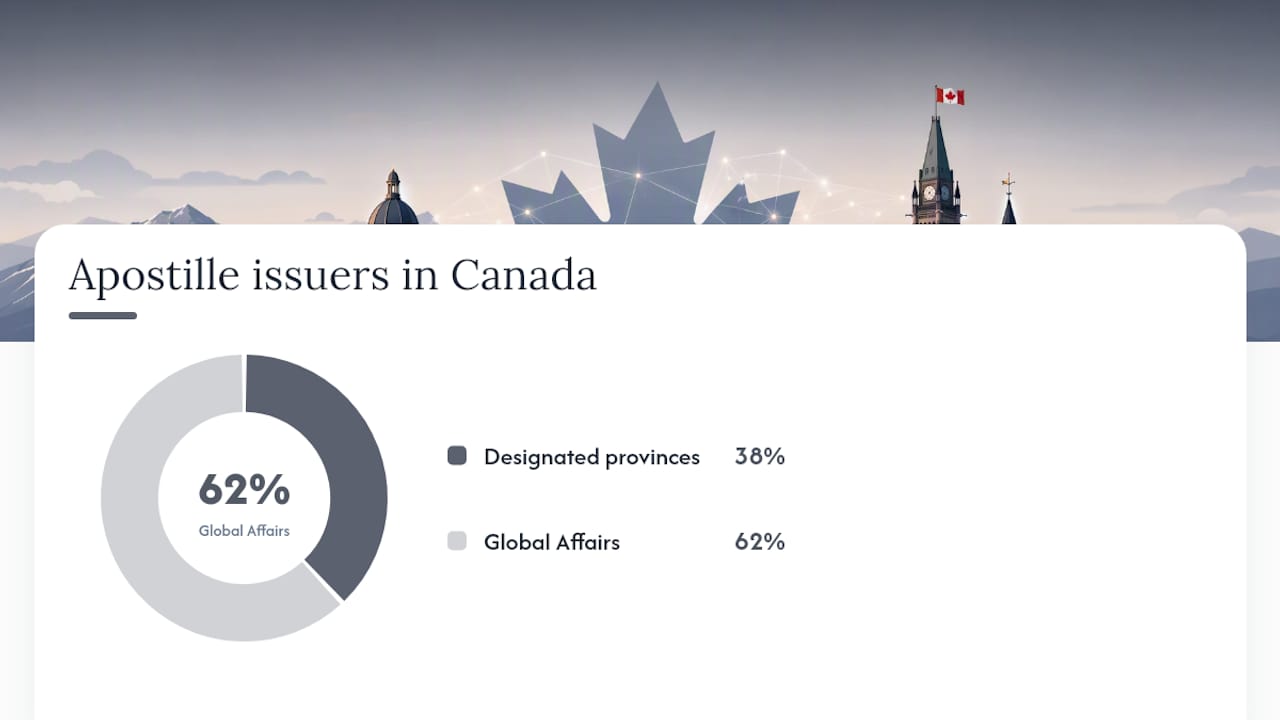
The office you send your transcript to depends entirely on where it was issued or notarized, not where you personally live. Ontario, Alberta, British Columbia, Quebec, and Saskatchewan each have a designated provincial competent authority. Every other province and territory routes through Global Affairs Canada instead.
Ontario's system is a useful reference point. The province's Official Documents Services issues apostilles specifically for Ontario public post-secondary degrees, diplomas, and transcripts. Send an Ontario college transcript to Global Affairs Canada by mistake, and it gets rejected or forwarded, adding real delay to a process that should take days.
- Provincial competent authorities handle documents issued or notarized within their own province.
- Global Affairs Canada handles federal documents and anything from provinces or territories without a designated authority.
- Archived federal protocol records show this regional split developed gradually as provinces took on authentication duties previously centralized at the federal level.
| Document Origin | Who To Contact | Example Fee |
|---|---|---|
| Ontario public post-secondary transcript | Ontario Official Documents Services | $32 per document |
| Alberta post-secondary transcript | Government of Alberta Document Authentication | Set by provincial fee schedule |
| Federal document or non-designated province | Global Affairs Canada | Set by federal fee schedule |
How Do You Apostille a Transcript Step by Step?
Follow these four steps in order. Skipping ahead, especially to notarization, before confirming destination requirements is where most delays start.
- Confirm the destination country's status. Check whether it belongs to the Hague Apostille Convention using a resource like the Hague country checker, then verify the receiving institution's exact wording requirement.
- Confirm how your institution issues transcripts. Ask the registrar whether transcripts come sealed, as a registrar-certified page, or electronically, since this determines your notarization path.
- Choose a notarization pathway the destination accepts. Options include a registrar-notarized certification or an affidavit from a document custodian; wording must be apostille-eligible, meaning it references an original signature and seal.
- Submit to the correct competent authority. Complete the required forms, include the fee, and send a trackable return envelope so you're not left guessing where your transcript sits.
- Order two or three certified sets upfront if more than one institution will request your transcript.
- Keep a photocopy of every document you submit before mailing originals anywhere.
Pro Tip: If your school issues sealed transcripts, don't open the envelope to "check" it. Opened seals are one of the fastest ways to get an apostille request bounced back.
Does a Transcript Need Notarization or a Certified Copy?
Whether you need notarization depends on how your institution issues transcripts and what the destination requires. Two pathways cover most cases.
Registrar-notarization means the registrar's office signs and seals a certification page attached to the transcript, and that signature gets notarized. Custodian-certified copy means a notary or authorized official attests to a copy's authenticity against an original they've personally reviewed. Destinations vary in which one they'll accept, so check before choosing.
Sealed transcripts create a specific wrinkle. Many registrars will not open a sealed envelope for notarization. Instead, they issue a notarized cover letter or certification page that references the sealed envelope, preserving the institutional seal while still giving the notary something to sign. This keeps the original document intact and apostille-ready.
- Ask your registrar directly for their "apostille-compatible" certification process rather than assuming standard notarization applies.
- Order extra certified sets in the same request if you expect to submit to more than one country or institution.
Pro Tip: When a registrar seems unfamiliar with apostille requirements, ask specifically for a certification page that references the sealed transcript rather than a generic notarized copy. That phrasing distinction matters to the authenticating office.
How Long Does It Take and What Does It Cost?
Processing time and cost both depend on which authority handles your transcript. Ontario's Official Documents Services lists a standard fee of $32 for public post-secondary degrees, diplomas, and transcripts, though fees vary by authority and by whether you request expedited handling.
Turnaround ranges widely based on submission volume, how your documents are routed, and whether you pay for expedited service. Mail-in requests to a provincial office or Global Affairs Canada typically take longer than in-person or courier-based expedited options.
Ontario's authentication office states that apostille requests are processed in a set order based on submission method, with expedited service available for an additional fee for those who can't wait out the standard queue.
- Standard mail-in processing tends to run longer than in-person drop-off at a provincial office.
- Expedited handling shortens turnaround but adds a service fee on top of the base authentication charge.
- Check current provincial processing estimates before you plan travel or admission deadlines around a specific date.
What Causes an Apostille Request to Get Rejected?
Rejections almost always trace back to a handful of preventable errors. The Ontario Official Documents Services and Global Affairs Canada both point to the same recurring issues.
- Missing an original signature or seal, or submitting a photocopy that lacks a verifiable mark.
- Sending the document to the wrong authority, such as a provincial transcript mailed to Global Affairs Canada.
- Opening a sealed transcript envelope before submission, which breaks the registrar's seal.
- Notary wording that doesn't reference an original document or signature clearly enough for the authenticating office.
- Missing a certified translation when the destination requires one in a language other than English or French.
If your destination country is not a Hague Convention member, the apostille alone won't finish the job. You'll need additional legalization at that country's embassy or consulate in Canada, completed only after the apostille or authentication is issued, never before. This two-step sequence matters for destinations like the UAE, which sit outside the Convention and often require translation affidavits alongside embassy legalization.
Pro Tip: If translation is required, ask the translator to prepare a signed affidavit of accuracy alongside the translated document. Some destination countries want that affidavit notarized too, so confirm before you submit.
How Do You Verify an Apostille Once You Have It?
Once your apostille arrives, verification is quick if you have the right details on hand. Ontario's Official Documents Services offers a verification tool that confirms an apostille's authenticity using its apostille number and issuance date, both printed on the allonge itself.
- Keep the apostille number and issuance date somewhere safe until the receiving institution confirms it accepted the document.
- When submitting, include the original apostille or allonge attached to the transcript, plus a certified translation if the destination requires one.
- Use a trackable courier or mail service for the final submission so you have proof of delivery.
If the receiving institution rejects an apostilled transcript, contact your registrar first to confirm the document was issued correctly, then reach out to the issuing authority to verify the apostille itself. A professional review service can help identify whether the issue is with notarization wording, translation, or jurisdiction.
Is Hiring an Apostille Service Worth It for Transcripts?
Handling this yourself works fine when you have time, a straightforward jurisdiction, and no translation requirement. Hiring a service makes more sense once any of those variables get complicated.
- Tight deadlines, especially for study-abroad admissions or visa applications tied to a specific date.
- Sealed transcripts that need careful handling to avoid breaking the registrar's seal.
- Translation requirements that add a second layer of certification.
- Uncertainty about which competent authority applies to your specific document.
The trade-off is straightforward: a service costs more than DIY submission, but it removes the risk of sending a transcript to the wrong office or using notary wording that gets rejected. That risk carries its own cost in lost weeks, not just dollars.
Pro Tip: Hiring a service pays off most when you need multiple original apostilled sets, your destination isn't a Hague member, or you're working against a hard admission deadline. For a single, simple submission with no time pressure, DIY is often enough.
A Publisher's Note on What Clients Actually Ask For
Most inquiries about transcripts center on three things: faster turnaround, help handling a sealed envelope without breaking the seal, and confirming notarization wording will hold up. Bundled pricing and clear turnaround ranges help set expectations upfront. Always confirm requirements with your registrar and the destination institution before submitting anything.
Get Your Transcript Apostilled Without the Guesswork
Speedyapostilleservices exists for exactly the situations covered above: a sealed transcript that needs careful handling, a tight admission deadline, or uncertainty about which authority to contact.

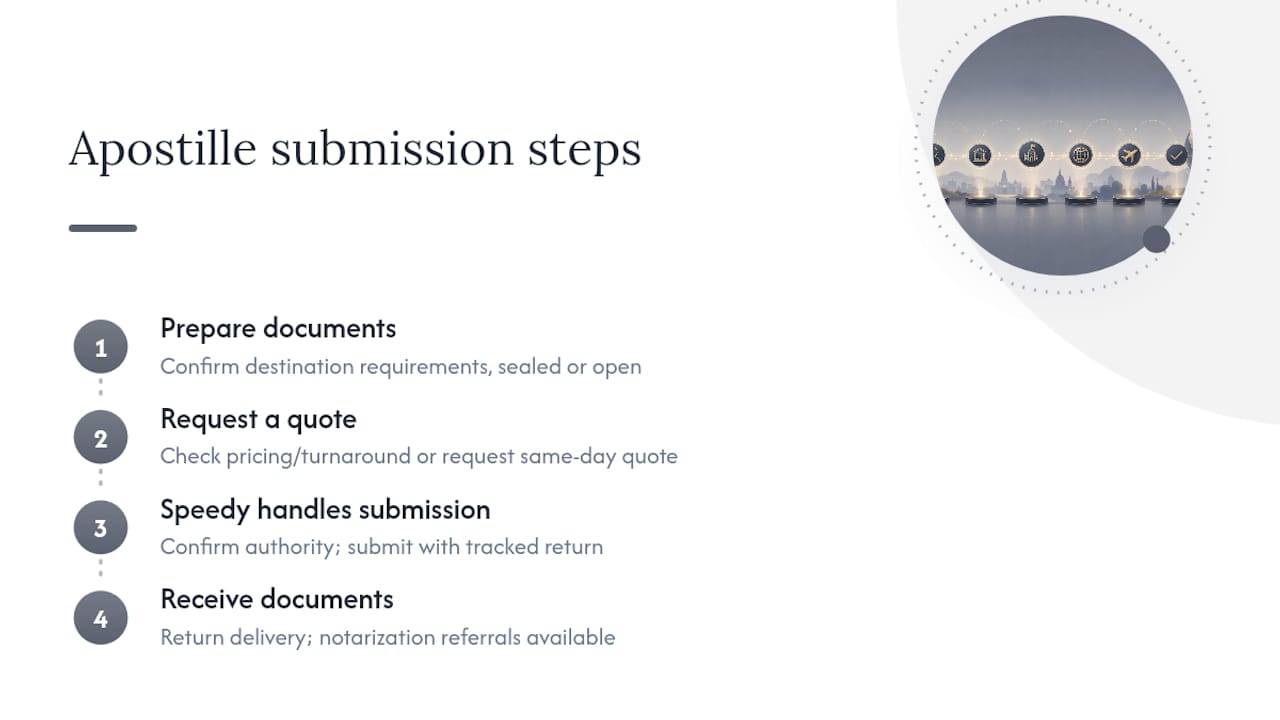
Speedyapostilleservices reviews your transcript, confirms the correct competent authority for your document's jurisdiction, and handles submission with tracked return delivery. Pricing is all-inclusive, meaning government fees are built in upfront rather than added as surprise charges later, and turnaround typically runs 1 to 7 days depending on the service tier you choose. In-house notarization referrals are available for transcripts that need a registrar certification before apostille submission.
Before reaching out, gather your destination country's exact requirements, confirm whether your transcript is sealed or open, and order extra certified sets if more than one institution will need copies. Check current pricing and turnaround options or get a same-day quote through the Speedy Apostille Services landing page to start your submission.
Pro Tip: Having your destination requirements and translation needs sorted out before you contact a service shaves real time off processing, since it skips a round of back-and-forth questions.
Sources
- Authenticate your documents - Before you start (Step 1)
- Authenticate a document for use outside Canada
- W05
FAQ
Can I Get an Apostille on Canadian Documents?
Yes. Canada has issued apostilles since joining the Hague Apostille Convention in January 2024, covering documents like transcripts, diplomas, and birth certificates.
How Can I Apostille My Transcript?
Confirm your destination country's requirements, determine whether your transcript needs notarization, then submit it to the correct provincial competent authority or Global Affairs Canada based on where it was issued.
How Do I Get an Apostille on a Document in Quebec?
Quebec has its own designated provincial competent authority for apostilles, separate from Global Affairs Canada, so Quebec-issued documents should go directly to that provincial office rather than the federal one.
How Long Does It Take to Get Documents Apostilled in Canada?
Processing time varies by authority, submission method, and whether you request expedited service; standard mail-in requests generally take longer than expedited or in-person options.
Do I Need to Notarize My Transcript Before Apostilling It?
It depends on how your institution issues transcripts. Sealed transcripts often use a registrar-notarized certification page instead of opening the envelope, while open transcripts may need a separate notarized copy.