
Apostille Scams in Canada: How to Spot and Avoid Them
Apostille Scams in Canada: How to Spot and Avoid Them ! Hand holding Canadian apostille certificate Apostille scams in Canada are a real risk, but they are easy to avoid if you verify before you pay.

Apostille Scams in Canada: How to Spot and Avoid Them
Apostille scams in Canada are a real risk, but they are easy to avoid if you verify before you pay. The single most important action is checking the issuing competent authority and confirming the apostille number and issue date on an official government portal before sending any money or documents.
Take these steps immediately if you are working with an unfamiliar provider:
- Confirm which competent authority should have issued your apostille based on where your document was issued or notarized.
- Ask the provider for the apostille number and issuance date, then verify both directly on the issuing authority's own portal.
- Do not release final payment until verification is complete.
Trusted authorities to check first:
- Global Affairs Canada
- Ontario, Alberta, British Columbia, Quebec, and Saskatchewan competent authorities
Pro Tip: If a provider resists giving you the apostille number before payment, treat that as a stop sign, not a negotiating point.
Key Takeaways
Verifying the apostille number and issue date on the issuing authority's official portal before paying is the single most reliable defense against apostille scams in Canada.
| Point | Details |
|---|---|
| Verify before paying | Confirm the apostille number and issue date on the issuing authority's official government portal. |
| Know your competent authority | Global Affairs Canada or your province (Ontario, Alberta, BC, Quebec, Saskatchewan) issues based on where the document originated. |
| Expect realistic timing | Government processing plus five to ten business days for mailing is standard; guaranteed same-day government turnaround is a red flag. |
| Watch for non-Hague confusion | Countries outside the Apostille Convention still require consular legalization, not an apostille. |
| Choose transparent providers | Speedyapostilleservices lists all-in pricing with government fees disclosed upfront and typical two to three day expedited turnaround. |
This article is general information, not a substitute for advice from a qualified lawyer. Consult a qualified legal professional about your own circumstances before acting on anything here.
Table of Contents
- Which Canadian Authorities Issue Apostilles?
- How Does the Official Apostille Process Work?
- How Do You Verify an Apostille Is Real?
- What Are the Most Common Apostille Scams in Canada?
- What Should You Do If You Suspect Fraud?
- What Do Trustworthy Apostille Services Actually Look Like?
- Apostilles vs. Other Legalization Methods in Canada
- Legitimate Notarization vs. Fake Notarization
- How Speedy Apostille Services Can Help
- Sources
- FAQ
Which Canadian Authorities Issue Apostilles?
Canada joined the Apostille Convention on January 11, 2024, and the country now designates specific competent authorities to issue apostilles instead of relying on the older embassy legalization chain. Global Affairs Canada handles documents issued federally or in provinces without their own competent authority, while five provinces run their own programs:
- Ontario — Official Documents Services
- Alberta — provincial competent authority
- British Columbia — provincial competent authority
- Quebec — provincial competent authority
- Saskatchewan — provincial competent authority
Which authority applies depends on where the document was issued or notarized, not where you happen to live now. A birth certificate issued in Alberta goes through Alberta's authority even if you currently reside in Ontario. A document notarized by an Ontario notary generally routes through Ontario's Official Documents Services, following the eligibility rules Ontario publishes.
The volume here matters: a large number of Canadian public documents get authenticated every year. That scale is exactly why scammers target this space. It's a high-traffic, deadline-driven service people need fast, often for immigration, school, or job requirements abroad.
How Does the Official Apostille Process Work?
The legitimate process follows a fixed sequence, whether you handle it yourself or use a service.
- Confirm the destination country actually accepts apostilles rather than requiring older-style consular legalization.
- Get the document notarized or certified if the competent authority requires it.
- Identify the correct competent authority based on where the document originated.
- Submit the document, either by mail or in person, depending on the authority's rules.
- Wait for processing, then receive the apostille attached to your original document.
Processing time is where expectations go wrong. Global Affairs Canada reports timelines based on 90th-percentile performance and tells applicants to add five to ten business days for mailing on top of that. Some provincial offices, including Ontario, publish service standards of up to 15 business days for certain requests. Anyone promising same-day turnaround from the government itself is describing something the government does not offer.
Fees split into two buckets: the government's own authentication fee, and whatever a third-party service charges on top for handling, courier, and expediting. A transparent provider breaks these out clearly instead of bundling them into a vague total. You can compare published government processing benchmarks against what any service promises you.
One more detail worth knowing: since 2024, Canada issues a single apostille certificate, sometimes called an "allonge," physically affixed to your document rather than a stack of legalization stamps. That's the streamlined format Global Affairs Canada rolled out alongside the Convention.
How Do You Verify an Apostille Is Real?
Every competent authority runs its own verification portal, and you need two specific pieces of information to use it: the apostille number and the issuance date. Without both, you cannot confirm anything.
Here's the checklist to run before you accept any apostille as legitimate:
- Confirm the web address is a genuine government domain, not a lookalike site.
- Enter the apostille number and issue date exactly as printed on the document.
- Cross-check that the issuing authority named in the portal matches the authority you expected based on where the document originated.
- Compare the document type and applicant details shown in the portal against your actual document.
Ontario's Check Apostille Validity tool is a working example: enter the number and date, and it confirms whether that apostille genuinely exists in Ontario's records. Global Affairs Canada runs a similar system for federally issued apostilles.
Pro Tip: Screenshot the verification result and note the confirmation number the moment you check it. If a dispute comes up later, that record is your evidence.
What Are the Most Common Apostille Scams in Canada?
Fraud in this space usually follows a small number of repeatable patterns rather than anything sophisticated.
- Selling an "apostille" for a destination country that isn't part of the Hague Convention, when what's actually required is consular legalization.
- Promising to beat official government processing times, which no third party controls.
- Sending doctored screenshots of a "successful" verification instead of directing you to check the portal yourself.
- Operating through a website with hidden domain ownership and no verifiable physical address.
- Pressuring you with countdown timers, "final notice" language, or demands for full payment before any work begins.
The confusion between "legalization" and "apostille" is where a lot of this starts. For countries outside the Convention, a traditional multistep legalization process is often still required, and scammers exploit that gap by charging for an "apostille" that the destination country will never accept.
Red flags worth memorizing: no listed office address, a domain registered within the last few months, and refusal to share the apostille number before payment clears. Third-party site checkers can flag things like hidden WHOIS records or unusually low traffic on a site claiming to be a major processor, though these signals point you toward further checking rather than proving fraud outright.
Pro Tip: If a company's marketing leans hard on urgency and light on specifics like office location or government fee breakdowns, slow down before you pay anything.
What Should You Do If You Suspect Fraud?
Act in this order if something feels off:
- Stop payment immediately if a transaction is still in progress; contact your bank or card issuer to flag it.
- Attempt verification on the relevant competent authority's official portal using the apostille number and date you were given.
- Gather records, including emails, receipts, screenshots, and any promotional material the provider sent you.
- Report the incident to local police, the Canadian Anti-Fraud Centre, and your provincial consumer protection office.
- Contact Global Affairs Canada directly if the concern involves a federally issued apostille or its legitimacy.
For larger financial losses or disputes over document integrity, a consumer protection lawyer can advise on recovery options specific to your province.
What Do Trustworthy Apostille Services Actually Look Like?
Legitimate providers share a handful of traits: a verifiable street address, government fees itemized rather than folded into one number, published turnaround expectations, and a documented process for handling your original documents.
What they won't do is promise to override posted government processing standards or push consular legalization for a country that already accepts apostilles under the Convention.
- Verifiable business address and contact information
- All-in pricing that separates government fees from service fees
- Clear, realistic turnaround windows
- Public reviews tied to a real business history
Speedyapostilleservices operates from a Toronto office, publishes all-in pricing that includes government fees, and typically delivers expedited apostille service in two to three business days.
Pro Tip: Ask any provider for their office address and a fee breakdown in writing before you send documents. A legitimate company answers both without hesitation.
Apostilles vs. Other Legalization Methods in Canada
Canada issues apostilles now, but that doesn't mean every document going abroad qualifies for one. The apostille only works for destination countries that are also party to the Hague Convention. If your document is headed to a country outside that group, you still need the older consular legalization route: authentication by the competent authority, followed by legalization at that country's embassy or consulate in Canada.
This distinction is exactly what scammers count on. Someone unfamiliar with the 2024 changes might assume "apostille" is now the universal term for any document authentication, and a fraudulent provider will happily sell you one for a non-Hague country, knowing it will be rejected on arrival. Checking whether your destination country is a Convention member takes two minutes and prevents that entirely.
There's also a practical difference in what each process produces. An apostille is a single certificate, the allonge described earlier, attached once by one authority. Consular legalization can involve multiple signatures and stamps across different offices, sometimes including a notary, then the provincial or federal authenticating office, then the embassy itself. More steps mean more opportunities for a scammer to insert a fake or unnecessary charge at any stage, claiming it's required when it isn't.
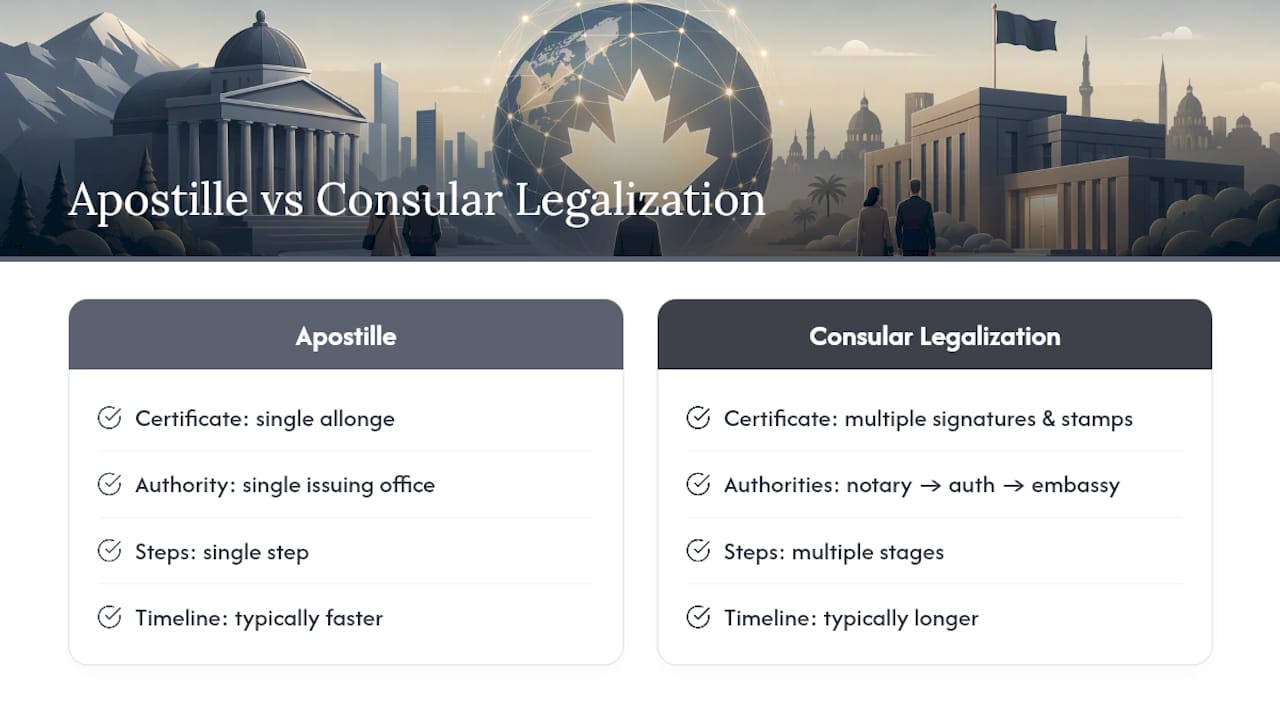
Before paying anyone for either service, confirm which path your specific destination actually requires. A provider who can't tell you whether your target country is Hague or non-Hague, and instead defaults to selling you whatever service they offer, is not giving you accurate guidance.
Legitimate Notarization vs. Fake Notarization
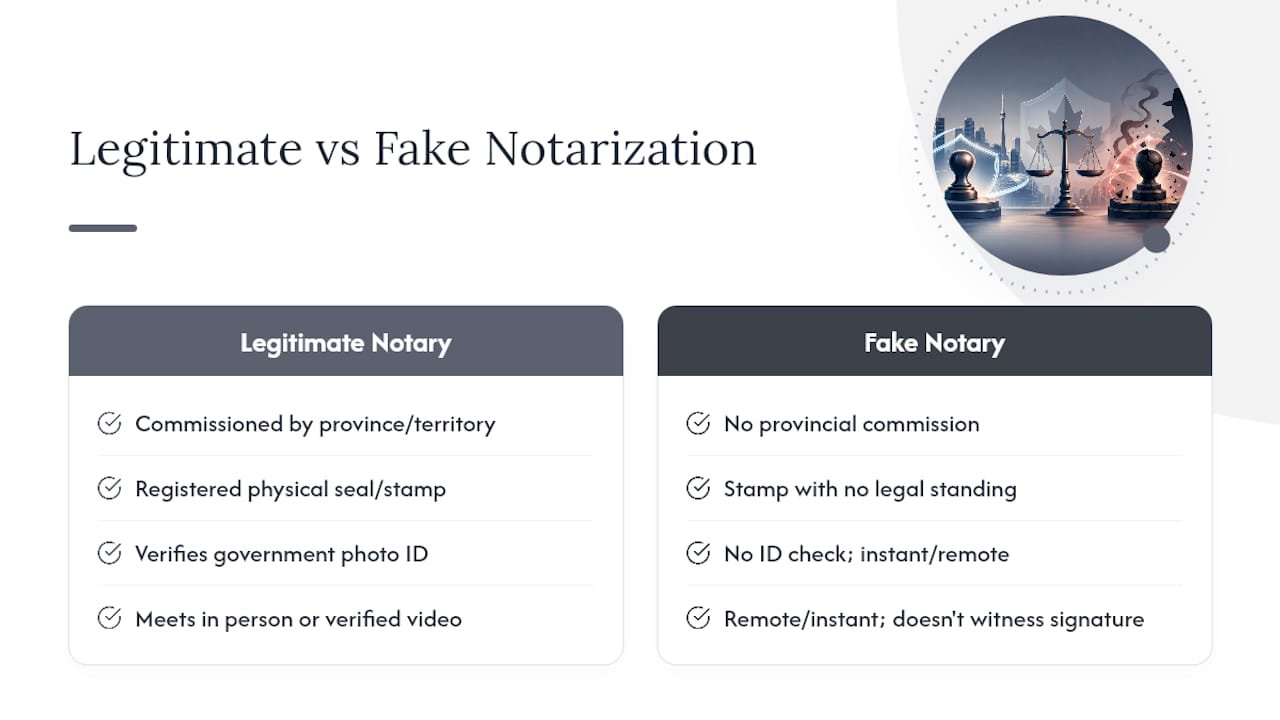
Notarization often comes before an apostille, and it is its own point of vulnerability. A legitimate Canadian notary public is commissioned by a provincial or territorial government, holds a physical seal or stamp registered to their name, and signs documents in person after verifying your identity, typically with government-issued photo ID.
Fake notarization schemes usually show up in one of two forms. The first is a "notary" operating without a real provincial commission, often found through informal referrals or unverified online listings, who applies a stamp with no legal standing. The second is remote or "instant" notarization offered by services that never actually confirm your identity or witness your signature, producing a document that looks notarized but won't survive scrutiny at the competent authority stage.
Checking legitimacy is straightforward. Every province maintains a registry or licensing body for notaries public, and you can confirm a notary's commission status before you use their services. A real notary will always meet you (in person or through a verified video process where provincial rules allow it), ask for ID, and apply a stamp that includes their name, commission number, and expiry date.
If a notarized document later gets rejected at the apostille stage because the notarization itself wasn't valid, you've lost time and money before you even reached the government authentication step. Confirming the notary's credentials upfront is a five-minute check that prevents that outcome entirely, and it pairs naturally with building out your document checklist before you submit anything.
A Note From the Publisher
We've spent years helping Canadians get documents apostilled correctly. Verify everything, expect transparent pricing, and treat secure handling of your originals as non-negotiable.
How Speedy Apostille Services Can Help
Speedyapostilleservices is the alternative to guessing which provider to trust: government fees are disclosed upfront, not buried, and every step from document review to secure handling happens in-house at a Toronto office you can actually verify.
The service covers Canadian documents including birth certificates, marriage licenses, diplomas, transcripts, court documents, corporate records, and RCMP background checks, with apostilles accepted across more than 120 Hague Convention countries. Pricing is all-in from the start: government fees, handling, and service charges are shown together, so there's no surprise invoice after the fact. Typical turnaround for expedited orders runs two to three days, well within the realistic government processing windows discussed earlier, and every order includes document review before submission to catch problems early. If you need a document apostilled and want a provider that shows its numbers before you commit, get a quote through Speedyapostilleservices and see the full cost before you decide.
Sources
- Authenticate your documents - Before you start (Step 1)
- Improving authentication services in Canada
- Check Apostille Validity
- Ontario
FAQ
Does Global Affairs Canada Provide Apostille Services?
Yes. Global Affairs Canada is a competent authority under the Apostille Convention and issues apostilles for documents that don't fall under one of the five provincial authorities.
How Long Does It Take to Get an Apostille in Canada?
Timing depends on the authority and current volume; Global Affairs Canada reports its own processing time and advises adding five to ten business days for mailing, while some provinces publish standards up to 15 business days for certain requests. Expedited providers like Speedyapostilleservices typically deliver in two to three business days.
How Much Does an Apostille Cost in Canada?
Cost breaks into the government's authentication fee plus any third-party service fee for handling and expediting; a transparent provider itemizes both instead of quoting one bundled number.
How Do I Get an Apostille From the Government of Alberta?
You submit your document to Alberta's competent authority if it was issued or notarized in Alberta, following that province's submission process and eligibility rules for the type of document involved.
Is It Safe to Use an Online Apostille Service?
It's safe when the provider discloses a verifiable address, itemizes government fees separately, and lets you confirm the final apostille number and date on the issuing authority's own portal before you consider the job complete.