
Skip Embassy Legalization for 120+ Countries: Canada Apostille Rules
Skip Embassy Legalization for 120+ Countries: Canada Apostille Rules ! Canadian document authentication certificates and seals Yes.

Skip Embassy Legalization for 120+ Countries: Canada Apostille Rules
Yes. Since January 11, 2024, Canada issues apostilles for eligible Canadian public documents. Confirm the destination country's requirement first, then send your paper document with an original signature to the correct competent authority, either Global Affairs Canada or your provincial office.
TL;DR:
- Canada's apostille service now covers federal and select provincial documents, but applicants must verify if their destination country requires an apostille or embassy legalization.
- Eligible documents require an original, non-laminated paper with a wet signature or seal; digital copies, laminated or bound papers, and non-Canadian-issued documents cannot be authenticated.
- Processing times vary by authority and exclude mailing, with fees differing across provinces; missteps like incorrect mailing or missing signatures significantly delay or reject applications.
- For non-Hague countries, authentication followed by embassy legalization is necessary, involving a longer, sequential process with additional forms and appointments.
- Confirming destination country membership in the Hague Convention is critical, as Canada only issues apostilles for member countries, while non-members require full authentication and legalization steps.
Table of Contents
- Apostille Requirements Canada: Who Issues Them and What They Mean
- Which Documents Qualify for an Apostille?
- How to Prepare, Package, and Submit Your Documents
- How Long Does an Apostille Take, and What Does It Cost?
- What If the Destination Country Isn't a Hague Member?
- Why Canada Doesn't Issue Apostilles for Every Case
- The Step-by-Step Path to Authentication and Legalization
- Apostille vs. Authentication and Legalization: What's Actually Different
- Canadian Authorities That Handle Authentication and Legalization
- Common Rejection Reasons and How to Avoid Them
- How Long Does an Apostille Stay Valid?
- What a Managed Service Can and Cannot Change
- Get Your Documents Apostilled Without the Back and Forth
- Where to Verify the Rules Yourself
- Sources
- FAQ
Apostille Requirements Canada: Who Issues Them and What They Mean
An apostille is a certificate, sometimes called an allonge, attached to a Canadian public document. It confirms the document's signature and seal are genuine. This single certificate replaces the older multi-step consular legalization process for any of the more than 120 Hague Convention member countries.
Two levels of authority can issue an apostille in Canada, depending on where the document was signed or notarized.
- Global Affairs Canada handles federal documents and covers provinces and territories without their own competent authority.
- Alberta, British Columbia, Ontario, Quebec, and Saskatchewan each operate their own provincial apostille office.
A birth certificate issued in Alberta goes to Alberta's authority. A federal RCMP background check goes to Global Affairs Canada. Sending a provincial document to the wrong office is one of the most common causes of delay, so check the issuing province before mailing anything.
Which Documents Qualify for an Apostille?
Eligibility comes down to three things: the signature, the format, and the source. Miss any one of them and the authority will reject the submission.
- The document needs an original, wet-ink signature or an original seal, not a photocopy or a printout of a scanned signature.
- It must be a physical paper document. Digital-only files cannot be apostilled unless printed with the original signature intact.
- Laminated, glued, or bound documents are usually refused, since the authority needs to physically attach the apostille certificate.
- Religious documents and documents issued outside Canada fall outside what Canadian authorities can authenticate.
- If the document contains anything other than English or French, it needs a certified translation, and some destination countries also require a translator's affidavit sealed by a Canadian notary.
If your original document has gone missing or you only have a copy, the fix is a certified true copy from the issuing institution or a notary public, not a request for an exception at the authentication counter.
Pro Tip: Call the issuing institution (school registrar, vital statistics office, court) before you notarize anything. Many will issue a fresh certified paper copy with a live signature in days, which saves you a rejected submission weeks later.
How to Prepare, Package, and Submit Your Documents
Getting the paperwork right matters as much as getting the right office. Work through this in order.
- Confirm with the destination country's embassy, consulate, or the receiving institution whether an apostille is required at all. Destination country law governs this, not Canadian law.
- Identify the correct competent authority based on where the document was issued or notarized: a provincial office (Alberta, British Columbia, Ontario, Quebec, Saskatchewan) or Global Affairs Canada.
- Have the document notarized if it is not already an original government-issued paper. The notary's signature must be in ink, with a visible stamp or seal and current commission information.
- Attach a certified translation if the document is not in English or French.
- Complete the service request form for the authority you are using, and note the service request number on your package.
Packaging trips up more applicants than people expect. Small handling mistakes are why some applications get bounced back without ever reaching a reviewer's desk.
- Use an envelope large enough that documents do not need to be folded.
- Include a prepaid return courier label or envelope so the office can send documents back.
- Mark the package clearly if you are requesting expedited or urgent processing.
- Keep a tracking number for both the outbound and return legs of the shipment.
Quebec, for example, cancels applications that do not arrive within a set submission window, so timing your mailing matters as much as filling out the form correctly. Our mailing checklist by province breaks down the specific packaging rules for each competent authority.
How Long Does an Apostille Take, and What Does It Cost?
Processing windows differ by authority, and none of the published estimates include the time your envelope spends in transit. Global Affairs Canada publishes its own processing estimates that explicitly exclude postal or courier transit, so a "10 business day" estimate can easily become three weeks once you add mailing both directions.
Fees are set individually by each authority, not by a single national rate.
- Quebec charges $66.50 per document as of this writing, payable through methods the province specifies on its application portal.
- Other provinces and Global Affairs Canada set their own fee schedules and accepted payment methods, so check the relevant office directly before submitting payment.
Statistic Callout: Quebec cancels apostille applications that sit unclaimed for more than three months, so a slow mail service or an address error can cost you the entire fee and force a resubmission.
A few habits cut down on avoidable delays: submit a complete package the first time, confirm the correct authority before you mail anything, and use a trackable courier rather than standard post for anything time-sensitive.
What If the Destination Country Isn't a Hague Member?
Not every country recognizes an apostille. For non-Hague destinations, authentication in Canada is only the first step. Consular legalization is the second, separate step that a Hague member country never requires.
The process runs in sequence, not in parallel.
- Get the document authenticated by the correct Canadian competent authority, exactly as you would for an apostille.
- Submit the authenticated document to the destination country's embassy or consulate in Canada for legalization.
- Some embassies require additional forms or a translator's affidavit on top of the authentication certificate.
Budget significantly more calendar time for this route. You are waiting on two separate offices with two separate queues, and embassy appointment availability can add weeks on its own. Book any required embassy appointment as soon as you send your documents for authentication, not after they come back. Our explainer on the Hague Convention's practical effects covers which countries fall into each category.
Why Canada Doesn't Issue Apostilles for Every Case
Canada joined the Hague Apostille Convention on January 11, 2024, which is a genuine shift from the system that came before it. Before that date, every Canadian document headed abroad needed full consular legalization: authentication in Canada, then a stamp from the destination country's embassy, with no shortcut available for any country.
That old two-step system hasn't disappeared. It still applies to any document headed to a country that is not a member of the Hague Convention. Canada's membership only changes the process for documents traveling to fellow member countries. Send a document to Germany, Japan, or Mexico, all Hague members, and a single apostille certificate is enough. Send the same document to a non-member country and you are back to authentication plus embassy legalization.
This is the detail that trips up a lot of applicants: they assume "Canada is in the Convention now" means every document gets an apostille automatically. It does not. The destination country's own membership status is what determines the path, and that status has nothing to do with where the document was issued in Canada. Confirming this one fact before you submit anything saves weeks of wasted processing time on the wrong track.
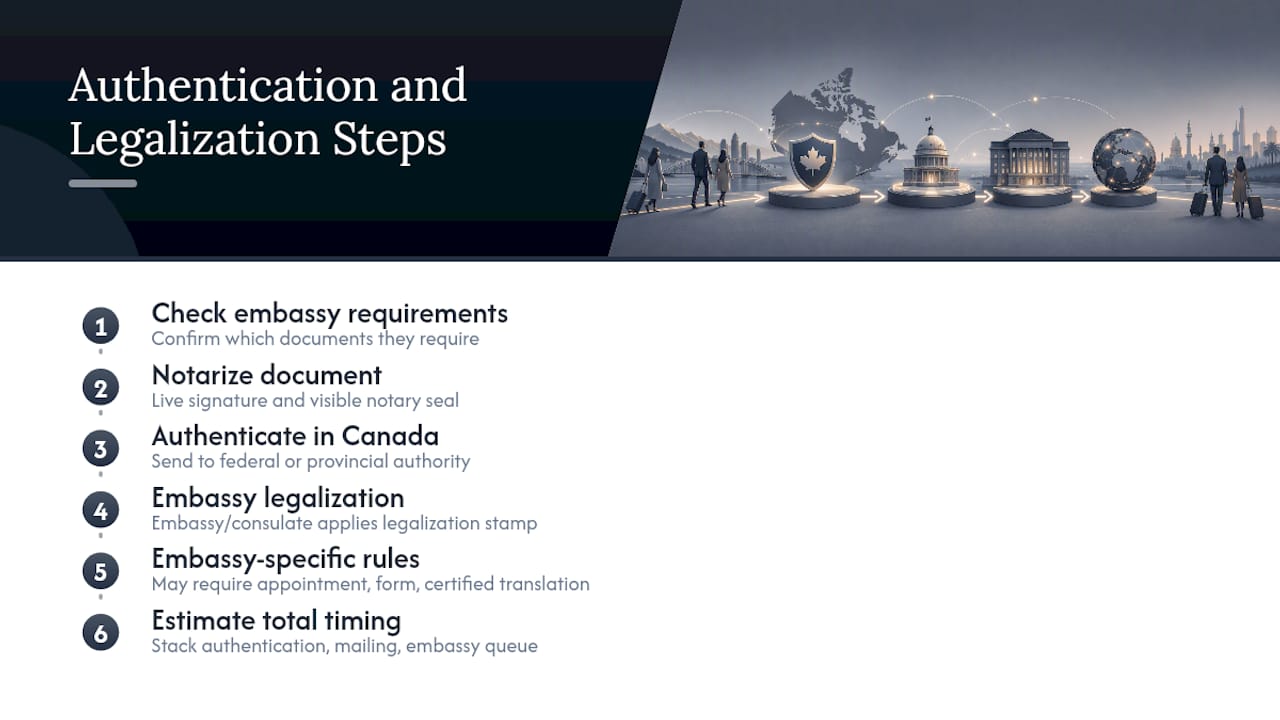
The Step-by-Step Path to Authentication and Legalization
For non-Hague destinations, the process has a fixed order, and skipping ahead rarely works.
Start by confirming with the destination country's embassy or consulate exactly which documents they require legalized, since requirements vary even among non-Hague countries. Next, get the underlying document properly notarized if it isn't already a government original, with a live signature and a visible notary seal. Send that document to the correct Canadian competent authority, federal or provincial depending on where it was issued, for authentication.
Once authentication comes back, the document goes to the destination country's embassy or consulate in Canada for the actual legalization stamp. Many embassies require an in-person appointment or a mail-in package with their own specific form, separate from anything Global Affairs Canada or a province requires. Some also want a certified translation with a notarized translator's affidavit attached before they will legalize the document.
Each stage has its own processing window, and they run sequentially rather than at the same time. A realistic estimate stacks the authentication turnaround, mailing time to and from the embassy, and the embassy's own legalization queue. That total is almost always longer than a straightforward apostille for a Hague member country, so build in extra weeks if your document is headed somewhere outside the Convention.
Apostille vs. Authentication and Legalization: What's Actually Different
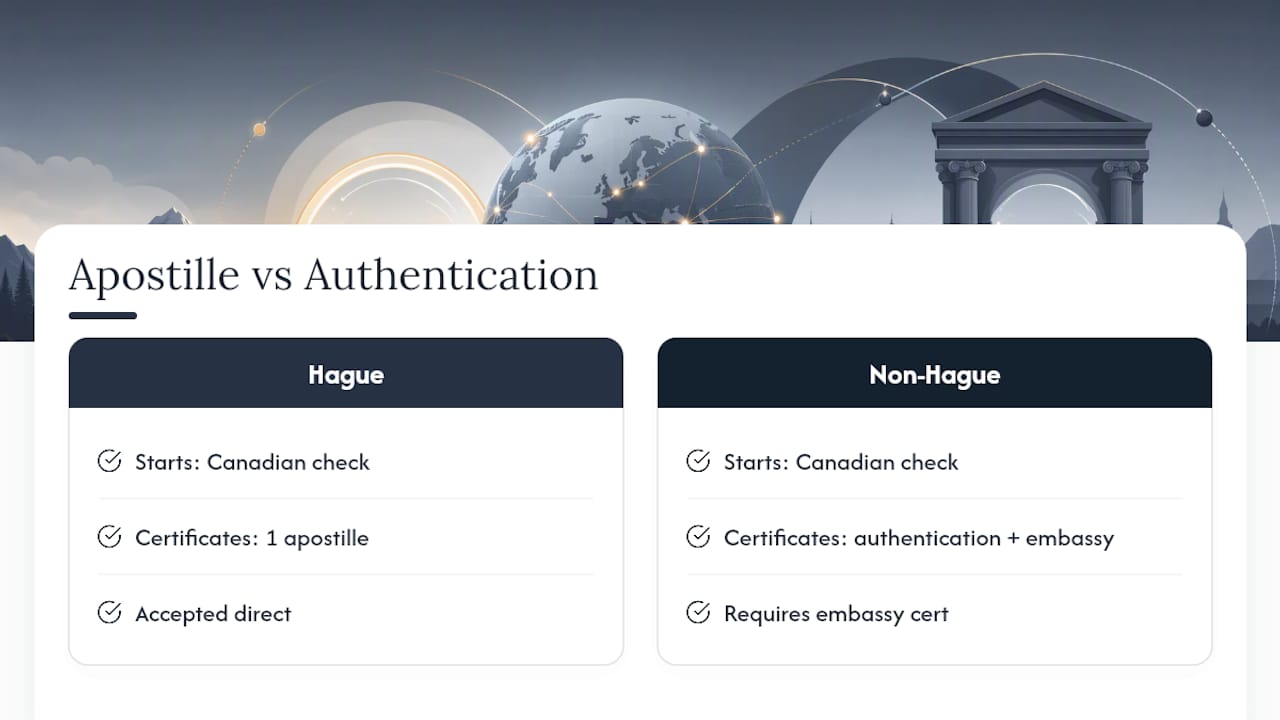
An apostille is a single certificate. Authentication and legalization is a two-certificate process. That's the entire distinction in practical terms, but it changes how much time and how many offices you're dealing with.
For a Hague member country, the Canadian competent authority attaches one apostille certificate to your document, and that document is done. The receiving country accepts the apostille on its face, without contacting Canada again. For a non-Hague country, the same Canadian authority still authenticates the document first, but that authentication alone doesn't satisfy the destination country. It then needs a second certificate from that country's embassy or consulate, confirming the Canadian authentication is valid.
Both processes start in the same place, at the same competent authority, checking the same things: an original signature, a proper seal, correct paper format. The fork happens only at the end, based entirely on whether the destination country belongs to the Convention. This is why confirming destination-country membership is the very first thing to check, not an afterthought. Get that wrong and you'll either wait on an unnecessary embassy appointment or submit a document with only half the certification it needs.
Canadian Authorities That Handle Authentication and Legalization
Five provinces run their own competent authority offices: Alberta, British Columbia, Ontario, Quebec, and Saskatchewan. Global Affairs Canada handles federal documents and covers every other province and territory that doesn't have its own office.
Ontario's Official Documents Services processes documents notarized or issued in Ontario. Quebec runs its apostille applications through its own justice ministry portal, with its own fee schedule and mailing address, distinct from every other province's process. British Columbia, Alberta, and Saskatchewan each operate similarly: their own intake process, their own processing estimates, and their own accepted payment methods.
For legalization on the non-Hague track, the relevant authority shifts to the destination country's own embassy or consulate located in Canada, most of which are based in Ottawa, with some maintaining consulates in Toronto, Montreal, or Vancouver. Contact details, appointment systems, and required forms vary by embassy, so check the specific country's consular website directly rather than relying on a general Canadian government contact. Our breakdown of which authority handles which documents maps this out by province and document type.
Common Rejection Reasons and How to Avoid Them
Most rejections trace back to a small number of repeated mistakes, and nearly all of them are avoidable with a five-minute check before mailing.
Missing an original signature tops the list. A photocopy, a scanned PDF printout, or a faxed signature will not pass, even if the underlying document is genuine. The remedy is a certified true copy from the issuing institution, not an appeal to the authentication office. Laminated documents cause the second most common rejection, since the authority physically needs to attach a certificate to the page. Never laminate a document you plan to authenticate.
Sending a document to the wrong competent authority wastes weeks. A document notarized in Ontario needs Ontario's office, not Global Affairs Canada, and vice versa for federal documents. Packaging mistakes matter too: folded documents, missing return envelopes, and incomplete service request forms all slow processing or trigger a rejection outright. Quebec specifically cancels applications that sit unclaimed past its three-month window, turning a simple mailing delay into a lost fee and a resubmission.
Translation gaps round out the list. Submitting a document in a language other than English or French without a certified translation, or without the translator's affidavit some countries demand, will stall the request at the authentication stage or later at the embassy for non-Hague cases.
How Long Does an Apostille Stay Valid?
Neither Global Affairs Canada nor the provincial authorities publish a fixed expiration date on the apostille certificate itself. The certificate authenticates the signature and seal that were valid at the time of issuance, and that fact doesn't change over time.
In practice, though, many receiving institutions, universities, immigration offices, foreign registries, impose their own freshness window, often requesting a document apostilled within the last three, six, or twelve months. This is a policy set by the receiving country or institution, not a rule from the Canadian issuing authority. If you're using a document for more than one purpose over a span of years, expect to request a fresh apostille each time, especially for anything tied to immigration, employment authorization, or academic credential recognition abroad. Re-authentication is generally required if the underlying document itself has been reissued or amended, since the apostille only certifies the specific signature and seal it was attached to.
What a Managed Service Can and Cannot Change
A managed service reviews your documents before submission, checks that signatures, seals, and formats meet requirements, and can arrange notarization or a certified translation referral in-house. That review catches the packaging and eligibility mistakes covered above before they turn into a rejected application.
What a service cannot do is speed up a government office's internal queue. Processing times are set by the issuing authority, not the applicant or the provider handling submission. The real value is fewer resubmissions and secure, tracked handling of the physical documents, not a shortcut through the government's own timeline.
— Ken
Get Your Documents Apostilled Without the Back and Forth
Some services review documents before submission to catch mistakes such as missing signatures, wrong competent authority, or folded packaging before they cause a rejected application or a lost fee. All-in pricing means the government fee is built into the quote upfront, with no separate invoice arriving later.

This works best for people on a deadline: a visa appointment next month, a job offer abroad with a start date, or a business closing a contract that needs corporate records authenticated fast. Document review, notarization coordination, and secure courier handling are sometimes bundled into one request, with turnaround times varying depending on the service provider. If your document needs an apostille or provincial authentication, start with a request through our apostille services page and get a clear quote before you commit.
Where to Verify the Rules Yourself
Check the Global Affairs Canada authentication page for federal forms and eligibility rules. For province-specific fees and submission steps, consult your issuing province's own competent authority page, such as Quebec's apostille application portal.
Sources
- Authentication of documents: Requirements — Global Affairs Canada
- Applying for an apostille | Gouvernement du Québec
FAQ
How Do I Get a Document Apostilled in Canada?
Confirm the destination country requires an apostille, then send your original paper document with a wet-ink signature to the correct competent authority, either Global Affairs Canada or your provincial office, depending on where the document was issued.
How Long Does It Take to Get an Apostille in Canada?
Government-published processing estimates vary by authority and do not include mailing time, so factor in courier transit both ways when planning your total timeline.
How Much Does an Apostille Cost in Canada?
Fees are set individually by each competent authority; Quebec, for example, charges $66.50 per document, while other provinces and Global Affairs Canada set their own separate fee schedules.
Does Service Ontario Do Apostilles?
Ontario's authentication and apostille requests go through its Official Documents Services rather than the general ServiceOntario counters; check Ontario's specific competent authority page for its submission process and current fees.
What Happens if My Document Isn't Eligible for an Apostille?
If the destination country isn't a Hague Convention member, the document needs authentication by the Canadian competent authority followed by legalization at that country's embassy or consulate, a longer two-step process than a straightforward apostille.