
Apostille Near Me: Where to Get One Fast in Canada
Apostille Near Me: Where to Get One Fast in Canada ! Woman reviewing Canadian apostille documents at desk Getting an apostille in Canada means sending your documents to the correct competent authority.

Apostille Near Me: Where to Get One Fast in Canada
Getting an apostille in Canada means sending your documents to the correct competent authority. For documents issued or notarized in Ontario, Alberta, British Columbia, Quebec, or Saskatchewan, the relevant provincial authority handles the request directly. For all other provinces and territories, Global Affairs Canada is the issuing body. If the deadline is urgent, a vetted private expediter such as Speedyapostilleservices can prepare and submit the package on your behalf.
Steps to take right now:
- Confirm the destination country is a Hague Apostille Convention member (if not, additional legalization may be required)
- Identify where the document was issued or notarized to determine the correct authority
- Arrange notarization if the document is not already a certified public record
- Choose a submission method: mail, in-person drop-off where available, or a private expediter for urgent cases
Pro Tip: Before preparing anything, check the destination authority's specific requirements. Some employers, universities, and embassies require translated copies or additional certifications beyond the apostille itself.
Table of Contents
- What changed when Canada joined the Hague Apostille Convention
- Which documents are eligible and which office issues the apostille
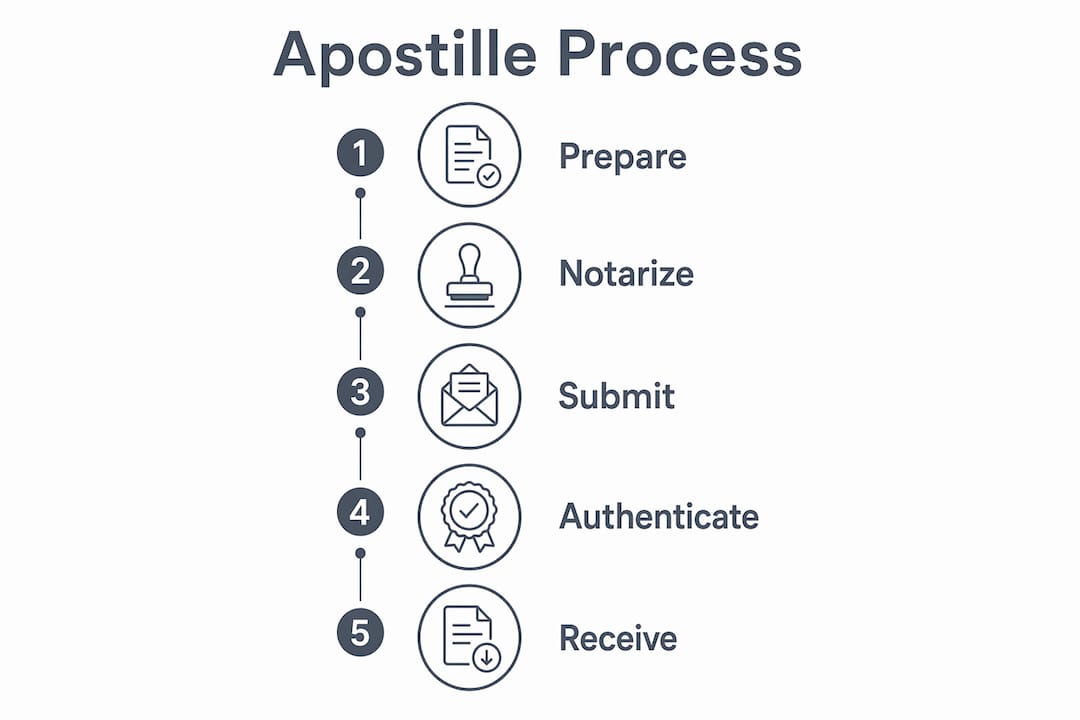
- How to get an apostille in Canada: step by step
- Where to send your documents and which submission options exist
- What processing times and fees look like in Canada
- Common causes of rejected apostille requests and quick fixes
- When a vetted private expediter makes sense
- Key Takeaways
- Why vetted expediters reduce risk in urgent cases
- Speedyapostilleservices handles the preparation so you submit right the first time
- Useful sources for official forms, addresses, and routing
- FAQ
What changed when Canada joined the Hague Apostille Convention
Canada joined the Hague Apostille Convention effective January 11, 2024. Before that date, Canadians needed embassy or consulate legalization to have documents recognized abroad. The apostille replaces that step for all countries that are also Hague signatories, which now covers over 120 nations.
An apostille authenticates the signature of a public official on a document. It does not verify the document's content. The apostille tells a foreign authority that the signature and seal on the document are genuine.
For destinations that are not Hague members, an apostille may still be issued, but additional legalization through the destination country's embassy or consulate will likely be required. Translations are a separate matter entirely and depend on the receiving institution's language requirements.
Pro Tip: Always confirm with the receiving institution, not just the destination country's government, whether they accept apostilled documents directly or require further steps.
Which documents are eligible and which office issues the apostille
Commonly eligible document types
- Birth certificates
- Marriage certificates and divorce decrees
- Diplomas, transcripts, and degrees
- Corporate records and certificates of incorporation
- Court documents and judgments
- Powers of attorney
- RCMP background checks and police clearance certificates
- Ministerial or registry-issued records
Documents issued outside Canada are not eligible for Canadian authentication. They must be authenticated by the jurisdiction where they were originally issued.
Federal vs. provincial routing
The routing rule is straightforward: the competent authority is determined by where the document was issued or notarized. Alberta, British Columbia, Ontario, Quebec, and Saskatchewan each operate as provincial competent authorities for documents issued or notarized within their borders. Documents from all other provinces and territories go to Global Affairs Canada.

There is a nuance worth noting. Ontario, Alberta, and Saskatchewan generally accept notarized documents even if the underlying document was issued elsewhere. British Columbia and Quebec typically authenticate only documents originally issued within their own province. If you are unsure, use the Global Affairs Canada triage portal to confirm routing before preparing your package.
Notarization is required for many document types before authentication. If the notary step is missing or the notarization style does not match the competent authority's requirements, the request will be rejected. For RCMP background checks, the process involves a separate police clearance certificate step before apostille submission.
How to get an apostille in Canada: step by step
- Verify destination requirements. Confirm the destination country is a Hague member and check what the receiving institution specifically requires (apostille only, translation, certified copy, or all three).
- Identify the correct competent authority. Use the Global Affairs Canada triage portal or the provincial authority's website to confirm where to send your documents based on where they were issued or notarized.
- Obtain notarization if required. Have the document notarized by an authorized notary public in the relevant province. The notarization style must match the authority's requirements.
- Arrange translations if needed. Some destination institutions require a certified translation alongside the apostilled document. This is separate from the apostille process.
- Prepare the submission package. Gather the original or certified copy, notarization certificate where required, a cover letter, the authority's request form, and a prepaid return envelope.
- Submit to the correct authority. Mail or drop off the package to the provincial competent authority or Global Affairs Canada, depending on the routing determined in step 2.
- Track the request. Keep the courier tracking number or service request receipt. Follow up with the authority if you have not received confirmation within the stated processing window.
Submission checklist:
- Original document or certified copy
- Notarization certificate (where required)
- Completed request form from the competent authority
- Payment in the form accepted by that authority
- Prepaid, addressed return envelope or courier label
Pro Tip: Label each document clearly and keep photocopies of everything before submitting. If using a courier, use a service with tracking and signature confirmation.
For a detailed walkthrough specific to birth certificates, the apostille birth certificate Canada guide covers document-specific requirements and timelines. Quebec residents should also review the Quebec apostille process, as provincial rules differ from the rest of Canada.

Where to send your documents and which submission options exist
Authority routing by document type
| Competent Authority | Example Document Types | Submission Methods |
|---|---|---|
| Ontario Official Documents Services (ODS) | Birth certificates, marriage certificates, diplomas, court documents, powers of attorney (issued or notarized in Ontario) | Mail, in-person drop-off |
| Alberta competent authority | Documents issued or notarized in Alberta | |
| British Columbia competent authority | Documents originally issued in BC | |
| Quebec competent authority | Documents originally issued in Quebec | |
| Saskatchewan competent authority | Documents issued or notarized in Saskatchewan | |
| Global Affairs Canada | Documents from all other provinces and territories |
Submission methods
- Mail-in: The standard method for most authorities. Use a tracked courier service and include a prepaid return envelope.
- In-person drop-off: Available at select provincial offices such as Ontario ODS. Drop-off requests are processed in order of receipt, not as a priority.
- Appointment-based counters: Some authorities offer scheduled appointments. Check the specific authority's website for current availability.
- Third-party expediters: Private services such as Speedyapostilleservices handle document preparation, notarization coordination, and courier submission on the applicant's behalf.
True same-day, over-the-counter apostilles are not generally available at Canadian government offices. Most require formal submission and process by order of receipt.
Common mailing mistakes to avoid:
- Sending documents to the wrong authority (the most frequent cause of delays)
- Omitting the request form or payment
- Failing to include a prepaid return envelope
- Using insufficient postage for the return package
- Submitting documents without required notarization
What processing times and fees look like in Canada
Ontario's Official Documents Services processes authentication and apostille requests within 15 business days after receipt. Other provincial authorities and Global Affairs Canada operate independently and may have different timelines. Processing times can vary by volume, time of year, and whether the submission is complete on arrival.
Factors that cause delays:
- Sending documents to the wrong office
- Missing or incorrect notarization
- Incomplete request forms
- Missing payment or wrong payment format
- Mail delays, especially during holidays
- Unsigned pages or mismatched signatures and seals
Government service vs. vetted expediter: a comparison
- Government service: Lower direct cost, authoritative issuance, but timelines of up to 15 business days or more depending on the authority and current volume.
- Vetted expediter: Higher all-in cost that typically bundles government fees, document review, notarization coordination, and courier handling. Turnaround can be 1–7 days depending on the service tier chosen.
Provincial and territorial services operate independently of the Government of Canada, so fees and timelines differ by authority. There is no single national fee schedule.
Pro Tip: If the document also needs translation or the destination country requires additional legalization beyond the apostille, build extra time into the plan. Translation alone can add several business days.
Common causes of rejected apostille requests and quick fixes
| Common Error | Quick Fix |
|---|---|
| Wrong competent authority | Use the Global Affairs Canada triage portal to confirm routing before submitting |
| Missing notarization | Have the document notarized by an authorized notary in the correct province before submission |
| Notarization style does not match authority requirements | Confirm the authority's specific notarization format requirements before visiting a notary |
| Unmatched signatures or seals | Verify that the signing official's credentials are on file with the competent authority |
| Unsigned or incomplete pages | Review every page of the document package before sealing the envelope |
| Foreign-issued originals submitted to a Canadian authority | Authenticate the document in the country where it was issued first |
What to do if a request is rejected
Contact the competent authority to confirm the specific reason for rejection. Most authorities will return the documents with a rejection notice explaining what is missing or incorrect. Correct the identified issue, prepare a new submission package, and resubmit. Do not resubmit without addressing the stated reason, as the same error will result in another rejection.
Verifying notarization standards and matching document origin to the correct competent authority prevents the majority of rejections. These two steps alone account for most processing problems.
When a vetted private expediter makes sense
Situations where an expediter adds real value
- Urgent travel or visa deadlines: Government processing can take up to 15 business days. An expediter with a rush tier can reduce total elapsed time significantly.
- Immigration or residency applications: Multi-document packages with tight deadlines, such as those needed for Paraguay residency proceedings, benefit from coordinated submission.
- Employer or university deadlines: Fixed start dates leave no room for a resubmission cycle if the first attempt is rejected.
- Complex notarization needs: Documents that require a notary step before apostille submission, or that involve multiple document types, are easier to manage through a single point of contact.
What a vetted expediter typically provides
- Pre-submission document review to identify missing or incorrect elements
- In-house notarization or referral to an authorized notary
- Courier handling and submission to the correct authority
- Processing monitoring and follow-up
- All-in pricing that bundles government fees, service fees, and courier costs
Speedyapostilleservices offers tiered turnaround options (standard, expedited, and rush) with a 1–7 day range, all-in pricing that includes government fees, and a pre-submission review designed to reduce rejection risk. The government authority still issues the apostille. The expediter prepares and submits the package correctly the first time.
Pro Tip: Before hiring any expediter, ask for their document chain-of-custody process, their policy if a submission is rejected, and whether their quoted price includes government fees. Any reputable service answers all three questions clearly.
Key Takeaways
Canada joined the Hague Apostille Convention on January 11, 2024, replacing embassy legalization for Hague member destinations, with provincial competent authorities or Global Affairs Canada issuing apostilles depending on where the document was issued or notarized.
| Point | Details |
|---|---|
| Canada joined in 2024 | Apostilles replaced embassy legalization for Hague member destinations effective January 11, 2024. |
| Routing depends on document origin | Alberta, BC, Ontario, Quebec, and Saskatchewan are competent authorities; all others route to Global Affairs Canada. |
| Ontario ODS processing time | Ontario ODS processes requests within 15 business days after receipt. |
| Notarization is the top rejection cause | Missing or incorrect notarization is the most frequent reason apostille requests are rejected. |
| Speedyapostilleservices option | Speedyapostilleservices offers all-in pricing, pre-submission review, and 1–7 day turnaround for urgent cases. |
Why vetted expediters reduce risk in urgent cases
The conventional advice is to go directly to the government office and handle everything yourself. That works well when there is no deadline pressure and the document package is straightforward. When there is a fixed deadline, a multi-document requirement, or any uncertainty about notarization, the self-submission path carries real risk. A single rejected submission can cost two to three weeks.
Vetted expediters do not issue apostilles. The government authority does. What an expediter provides is a pre-submission review that catches errors before they reach the authority's desk, coordination of any missing notarization, and courier handling that keeps the package moving. For readers in the Toronto area, Speedyapostilleservices has processed over 1,000 documented cases with a 5.0 rating, which reflects consistent accuracy in document preparation rather than any special relationship with government offices. The value is in the preparation, not the issuance.
Speedyapostilleservices handles the preparation so you submit right the first time

Speedyapostilleservices, based in Toronto, prepares Canadian documents for apostille submission with all-in pricing that includes government fees. There are no separate line items for the government fee added at the end. The service covers document review, notarization coordination where needed, secure handling, and courier submission to the correct provincial or federal authority. Turnaround options range from 1–7 days depending on the tier selected. The government authority issues the apostille. Speedyapostilleservices prepares and submits the package correctly.
Documents handled include birth certificates, marriage certificates, diplomas, transcripts, corporate records, court documents, and RCMP background checks. For readers in the GTA, local apostille service in Toronto is available with same-day options. To get started, visit speedyapostilleservices.com to submit documents or request a quote.
Useful sources for official forms, addresses, and routing
- Global Affairs Canada: Authenticate Your Documents: The primary federal resource for routing rules, the triage portal, and submission addresses for Global Affairs Canada. Use this to confirm whether your document routes to a provincial authority or the federal office.
- Ontario Official Documents Services (ontario.ca): Ontario's official page for authentication and apostille requests, including processing times, eligible document types, submission instructions, and office contact information.
- Hague Conference on Private International Law member list: Confirms whether the destination country is a Hague signatory. Available at hcch.net under the Apostille Convention section. Use this before preparing any document package to confirm whether an apostille is sufficient or whether additional legalization is required.
FAQ
Where can I get an apostille certificate in Canada?
Apostilles in Canada are issued by provincial competent authorities (Alberta, British Columbia, Ontario, Quebec, and Saskatchewan for documents issued or notarized in those provinces) or by Global Affairs Canada for all other provinces and territories. Use the Global Affairs Canada triage portal to confirm which office handles your specific document.
Can I walk in to get an apostille in Canada?
Same-day walk-in apostilles are not generally available at Canadian government offices. Most authorities require a formal mail-in or drop-off submission and process requests in order of receipt, with Ontario ODS typically processing requests within 15 business days after receipt.
How much does an apostille cost in Canada?
Fees vary by authority and document type, as provincial and territorial services operate independently of the federal government with no single national fee schedule. A vetted expediter such as Speedyapostilleservices offers all-in pricing that bundles government fees and service costs with no separate charges added at the end.
Does Service Ontario do apostilles?
Ontario's apostille and authentication services are handled by Ontario Official Documents Services (ODS), not Service Ontario directly. ODS processes requests within 15 business days after receipt for documents issued or notarized in Ontario.