
From Free to $32: Apostille Costs in Canada by Issuing Authority
From Free to $32: Apostille Costs in Canada by Issuing Authority ! Canadian document authentication service workspace The government fee for a Canadian apostille is small, often free at the federal level and $20 to $32 for most provincial documents.

From Free to $32: Apostille Costs in Canada by Issuing Authority
The government fee for a Canadian apostille is small, often free at the federal level and $20 to $32 for most provincial documents. Your total bill typically climbs once you add notarization, certified translation, courier and return shipping, and any expedited-service charge. A basic single-document authentication might run under a moderate amount in government fees alone; a rushed, translated, courier-handled file can cost significantly more once every add-on is counted.
TL;DR:
- The overall cost of an apostille includes notarization, translation, courier fees, and expedited services, which often surpass the government fee itself.
- Provincial authentication fees range from $20 to $32 per document, with fees payable in Canadian dollars and most requiring payment by mail or courier.
- Processing times vary from 1 to 7 business days for third-party services to about 25 business days at the federal level, depending on the service tier and mailing time.
- Mistakes such as missing signatures, unrecognized seals, or incorrect document origin are the leading causes of rejection, so verifying eligibility beforehand can prevent extra costs.
- Using a managed apostille service consolidates costs into one upfront quote, streamlining the process, especially when rapid turnaround is needed.
Table of Contents
- How Much Does an Apostille Cost by Issuing Authority?
- What Else Adds to the Final Apostille Price?
- How Long Does It Take to Get an Apostille?
- Where Do You Send Documents for Authentication?
- What Causes Apostille Rejections and How Do You Avoid Them?
- How Does a Managed Apostille Service Change the Math?
- Why the Cheapest Path Isn't Always the Government Fee
- Get an All-In Apostille Quote in Minutes
- Sources
- FAQ
How Much Does an Apostille Cost by Issuing Authority?
Canada is not a member of the Hague Apostille Convention in the way most applicants assume. Global Affairs Canada handles what most people call an apostille under the term "authentication," and which office you use depends on where your document originated.
Global Affairs Canada authenticates federal documents and documents from provinces or territories that don't have their own competent authority. It states plainly that its authentication service is free for the service itself, though mailing costs and any notarization you needed beforehand still apply.
Several provinces run their own authentication programs, and each sets its own price:
- British Columbia: a flat $20 per document, which includes standard return mail through Canada Post.
- Alberta: $25 per document through the province's Certificate of Apostille program.
- Ontario: fees vary by document type through the Official Documents Services office, with examples of $16 for a notarized legal document and $32 for an Ontario official document such as a birth certificate.
- Quebec: fees run higher than the other provinces, so budget more if your documents originate there.
Fees are charged per document, not per applicant, so a family authenticating three certificates pays three times the base rate. Most provincial offices require payment in Canadian dollars, and mailed submissions generally don't accept cash. If you're unsure whether a document falls under federal or provincial jurisdiction, our breakdown of GAC versus provincial authorities walks through the origin rules in more detail.
What Else Adds to the Final Apostille Price?
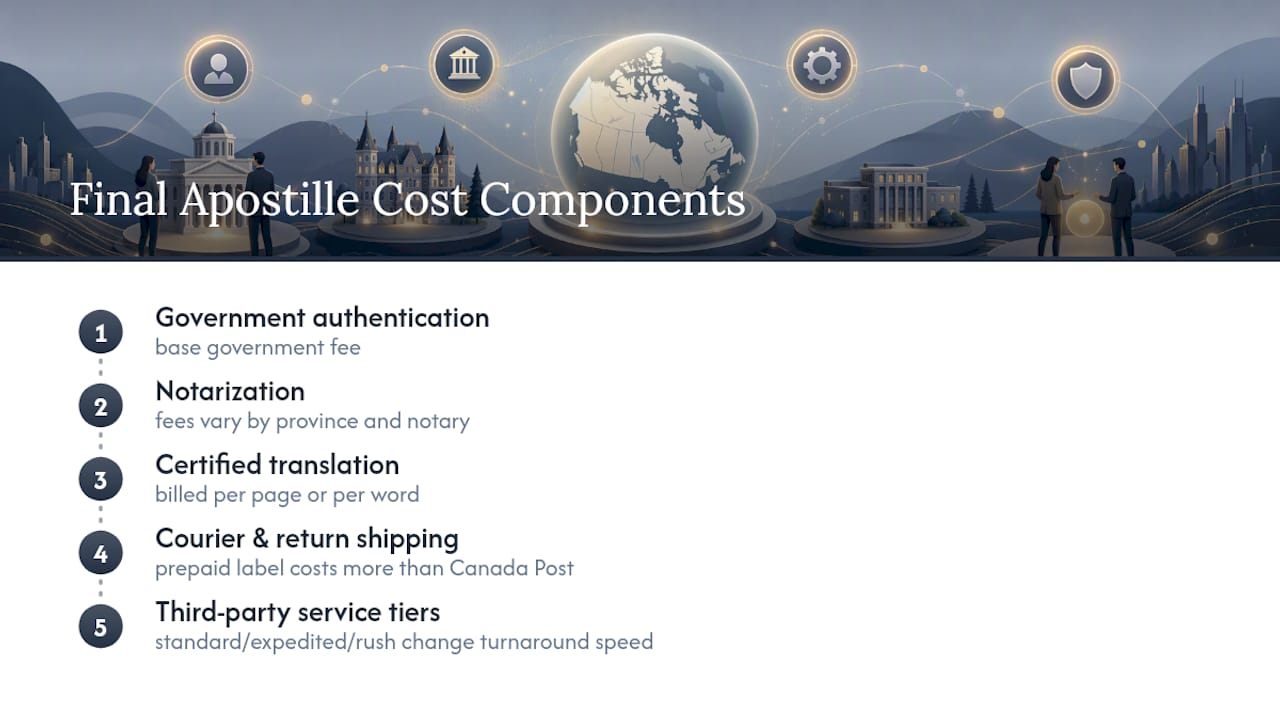
The government fee is rarely the whole story. Most applicants pay for at least one preliminary step before their document ever reaches an authentication office.
Notarization often comes first. If your document isn't already an original government-issued record with a recognized signature and seal, a notary public needs to certify a true copy or witness a signature before authentication can proceed. Notary fees vary by province and by the notary's own rate schedule.
Certified translation applies when the destination country requires the document in a language other than English or French. Translation is typically billed per page or per word, and it's a separate cost from the apostille itself.
Courier and return shipping change your total depending on how you submit. A prepaid courier label speeds up return delivery but costs more than standard Canada Post.
Service tiers matter too if you go through a third-party provider. Standard, expedited, and rush options usually differ by turnaround speed and handling priority, not by what's included in the base authentication.
Pro Tip: Get your notarization and translation done before you submit for authentication. Sending an incomplete package back and forth adds days and sometimes a second round of fees.
How Long Does It Take to Get an Apostille?
Global Affairs Canada reports standard processing of about 25 business days for authentication requests, not counting the time your document spends in the mail each direction.
Standard federal processing runs roughly 25 business days, while third-party expedited services commonly advertise 1 to 7 business days for the same authentication.
Provincial timelines vary and often move faster than the federal queue, but adding mail transit in both directions can still stretch a "quick" provincial authentication into two or three weeks in practice. Third-party services close that gap by managing courier logistics and using established submission channels rather than waiting in the general mail queue. That coordination is exactly why expedited tiers cost more than mailing it yourself. If your deadline is tight, our guide to expedited apostille turnaround breaks down which tier fits which timeline.
Where Do You Send Documents for Authentication?
Getting the destination right matters as much as getting the fee right. Documents issued federally, or from a province without its own program, go to Global Affairs Canada. Documents from provinces with their own competent authority, including Alberta, British Columbia, Ontario, Quebec, and Saskatchewan, go to that provincial office instead.
Before you mail anything:
- Confirm the correct competent authority based on where the document was issued.
- Assemble your package: the original document, a completed request form, and a copy of any service request or summary page.
- Include a prepaid return envelope or courier label if the authority requires one.
- Send originals, not photocopies, unless the specific office states copies are accepted.
- Choose your submission method: standard mail, prepaid courier, or in-person drop-off where a location offers it.
Cash is generally not accepted for mailed submissions, and some offices process one request per envelope. Our province-by-province mail-in checklist covers the specific packaging rules for each authority.
What Causes Apostille Rejections and How Do You Avoid Them?
Rejections cost money twice: once for the wasted attempt and again for the resubmission. The most common causes are avoidable.
- No original signature or an unrecognized seal on the document.
- Laminated, glued, or otherwise altered documents that authorities can't verify.
- Foreign-issued documents sent to the wrong Canadian office.
- Improper notarization, such as a notary stamp that doesn't match the jurisdiction's requirements.
- Missing translation when the destination country requires one.
Document eligibility, meaning the right signature, seal, and paper format, is the single most common reason authentication gets refused. A quick review against the office's own checklist before mailing catches most of these problems.
Pro Tip: Photocopy your entire package before you send it, and write the service request number on every page. If anything gets separated in processing, that reference number gets it reunited faster.
How Does a Managed Apostille Service Change the Math?
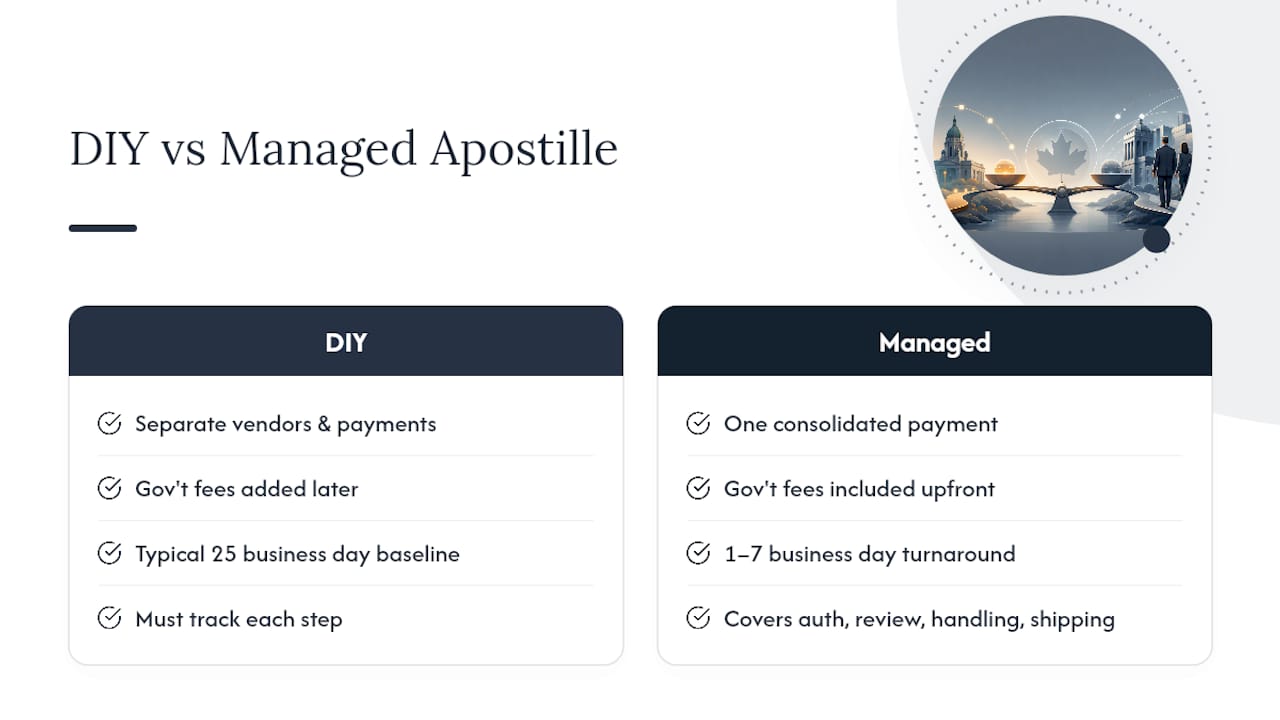
Handling authentication yourself means juggling separate payments to a notary, a translator, a courier, and a government office, then tracking each piece independently. A managed service consolidates those steps into one transaction.
A managed apostille service builds government fees into its quoted price upfront rather than adding them after the fact. The standard service model targets a 1 to 7 business day turnaround depending on the tier selected, well ahead of the federal 25 business day baseline.
An "all-in" quote typically covers the government authentication fee, document review, handling, and standard return shipping. It usually excludes certified translation unless that's specifically requested and quoted separately.
Going this route makes the most financial sense when your timeline is short, your document needs multiple steps (notarization plus authentication plus courier), or you'd rather pay one clear number than track several vendors yourself.
Why the Cheapest Path Isn't Always the Government Fee
The federal fee being free, or the provincial fee sitting at $20 or $25, creates a misleading impression that authentication is nearly costless. It rarely is once you count everything that has to happen before and after that government step.
The conventional advice treats the apostille fee as the cost. That's backwards. The real cost driver is almost always the sequence: notarization, then possibly translation, then authentication, then courier both ways. Miss a step or send the wrong document format, and you pay for the whole sequence twice.
What I'd prioritize first isn't the cheapest office. It's confirming eligibility before you spend a dollar on notarization or translation. A document that gets rejected for a bad seal or a missing signature wastes every dollar spent on the steps before it, not just the authentication fee itself. Budget for the full chain, not the line item that happens to be published on a government fee schedule.
— Ken
Get an All-In Apostille Quote in Minutes
Using a managed apostille service is an alternative to piecing together a notary, a translator, and a courier separately: one quoted price that already includes the government fee, with no line-item surprises after you've submitted your documents.

Before requesting a quote, have three things ready: the document type (birth certificate, diploma, RCMP background check, corporate record), whether it's already notarized, and your target turnaround. Standard, expedited, and rush tiers run 1 to 7 business days depending on urgency, and the instant quote calculator shows the full cost, government fee included, before you commit. If you're still weighing notarization against authentication requirements, the explainer on apostille versus notarization clears up which one your document actually needs first.
Sources
- Authentication of documents - Global Affairs Canada
- Document Authentication Fee - Province of British Columbia
- Alberta
- Authenticate a document for use outside Canada - Ontario ODS
FAQ
How Long Does It Take to Get an Apostille in Canada?
Global Affairs Canada's standard processing runs about 25 business days, not including mail transit time in either direction.
How Quickly Can I Get an Apostille?
Third-party expedited services commonly advertise 1 to 7 business days depending on the tier, compared to the federal government's roughly 25 business day standard timeline.
Does Service Ontario Do Apostilles?
No. Authentication for Ontario-issued documents goes through the province's Official Documents Services office, not Service Ontario, with fees such as $16 for notarized legal documents and $32 for Ontario official documents.
Can I Walk in to Get an Apostille?
Some provincial offices offer in-person drop-off, but availability varies by authority and location, so confirm drop-off options directly with the relevant office, whether Global Affairs Canada or your provincial competent authority, before making the trip.