
Apostille Canada: Your 2026 Step-by-Step Guide
Apostille Canada: Your 2026 Step-by-Step Guide ! Person reviewing apostille documents at home desk An apostille in Canada is an official certificate issued by designated government authorities that authenticates public documents for international use among Hague Apostille Convention member states.

Apostille Canada: Your 2026 Step-by-Step Guide
An apostille in Canada is an official certificate issued by designated government authorities that authenticates public documents for international use among Hague Apostille Convention member states. Canada joined the Hague Apostille Convention on january 11, 2024, replacing the old two-step authentication and legalization process with a single certificate. That change matters for students, immigrants, and families relocating abroad. Documents like birth certificates, marriage licenses, and diplomas now move through international systems faster and with less paperwork. Speedyapostilleservices, based in Toronto, helps Canadians get this done correctly and quickly.
What is apostille Canada and how does it work?
An apostille is a standardized certificate attached to or printed on a public document. It confirms the document is genuine and was issued by a recognized authority. The Hague Apostille Convention, which Canada joined in january 2024, now covers over 125 member countries. That means a Canadian birth certificate with an apostille is accepted in France, Mexico, Brazil, and dozens of other nations without any additional legalization step.
The apostille does not verify the content of a document. It verifies the origin. A notarized copy of a diploma, for example, gets an apostille that confirms the notary's signature is legitimate. The receiving country then accepts that confirmation. This distinction matters because many applicants confuse authentication with translation or content verification.

Only designated government authorities can issue apostilles. Private companies, law firms, and notaries prepare documents for apostille, but they cannot issue the certificate itself. That authority rests with Global Affairs Canada and five provincial bodies.
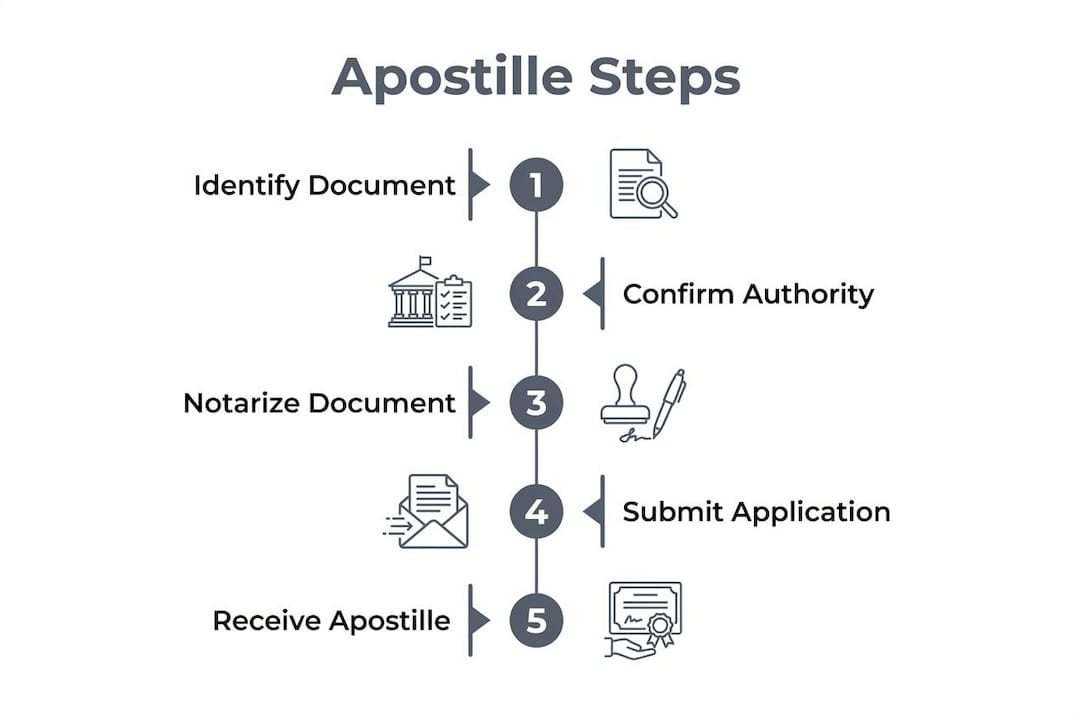
How to apostille a document in Canada: step by step
Getting documents apostilled in Canada follows a clear sequence. Skipping a step or submitting to the wrong office causes delays of weeks.
-
Confirm the document type. Determine whether your document is a federal document (like a passport or RCMP certificate) or a provincial document (like a birth certificate or marriage license). This determines which authority handles your request.
-
Notarize if required. Many documents need notarization before apostille. A notary public must sign and seal the document with a physical, wet-ink signature. Remote Online Notarization is not accepted in Ontario or most other provinces.
-
Identify the correct competent authority. Ontario, Quebec, Alberta, British Columbia, and Saskatchewan each have their own designated provincial authority. All other provinces and territories, plus federal documents, go through Global Affairs Canada.
-
Prepare your submission package. Include the original document or a certified true copy, a completed request form, and the applicable fee. Some authorities also require a self-addressed return envelope.
-
Submit by mail or in person. Most provincial authorities accept mail-in submissions. Some offer in-person drop-off. Tracked courier services are strongly recommended for both submission and return shipping.
-
Wait for processing. Processing times vary by jurisdiction. Federal processing through Global Affairs Canada typically takes several business days to a few weeks depending on volume.
-
Receive and verify the apostille. Once returned, confirm the apostille certificate is attached and contains the correct information before submitting to any foreign authority.
Pro Tip: Always use a tracked courier with signature confirmation when mailing original documents. Apostille authorities handle physical originals, and lost documents cannot be replaced quickly.
Who issues apostilles: federal vs. provincial authorities
Five provinces have their own designated authorities for issuing apostilles. Understanding this split is the single most important step in the process. Sending a document to the wrong office results in rejection and delays that can stretch into weeks.
The breakdown works as follows:
-
Ontario: Official Documents Services, Ministry of Public and Business Service Delivery
-
Quebec: Ministère de la Justice du Québec
-
Alberta: Service Alberta
-
British Columbia: BC Vital Statistics Agency or the Ministry of Attorney General, depending on document type
-
Saskatchewan: Information Services Corporation
-
All other provinces and territories: Global Affairs Canada handles apostille requests
-
Federal documents: Global Affairs Canada regardless of where the applicant lives
The key rule is this: the authority is determined by where the document was issued, not where the applicant currently lives. A person living in Manitoba who holds an Ontario-issued birth certificate must submit to Ontario's Official Documents Services, not Global Affairs Canada.
Submission mistakes like sending documents to the wrong authority are among the most common causes of rejection. The notary who signs the document must also be recognized by the competent authority in that province. Using a notary from a different province can trigger rejection even if the document itself is valid.
Pro Tip: Before preparing any documents, confirm the issuing province on the document itself. That province determines your competent authority, not your current address.
Apostille fees and processing times by jurisdiction
Fees and timelines differ across Canadian jurisdictions. The table below reflects current rates as of 2026.
| Jurisdiction | Authority | Fee | Notes |
|---|---|---|---|
| Ontario | Official Documents Services | $16 per notarized doc / $32 per government-issued doc | Mail-in only |
| British Columbia | Ministry of Attorney General | $20 flat | Mail-in or in person |
| Saskatchewan | Information Services Corporation | $50 flat | Mail-in |
| Global Affairs Canada | Federal authority | No fee | Federal and non-designated provinces |
| Quebec, Alberta | Provincial authorities | Varies | Check current authority websites |
Fees differ by jurisdiction and by document type within the same province. Ontario charges more for government-issued documents than for notarized copies. That distinction catches many applicants off guard.
Global Affairs Canada does not charge a fee for apostille services. That makes it the lowest-cost option for eligible documents, but processing times through the federal office can be longer during peak periods. Some provincial authorities offer faster in-person processing where available.
Do you need a certified translation with your apostille?
An apostille authenticates origin. It does not translate content. Certified translations are often required alongside apostilled documents when the destination country's official language differs from the document's language.
The requirements vary by country and by document type:
- Some countries accept an apostilled document plus a separate certified translation with no additional apostille on the translation.
- Other countries require the certified translation itself to be notarized and then apostilled separately.
- A small number of countries require the translation to be done by a court-certified or sworn translator recognized in the destination country.
An apostille authenticates origin but does not translate, so the sequencing of steps matters. The standard approach is to apostille the original document first, then have a certified translator produce a translation of the apostilled document. Some destination countries reverse this requirement. Always confirm with the receiving institution or embassy before starting.
Finding a certified translator in Canada is straightforward. The Association of Translators and Interpreters of Ontario (ATIO) and equivalent provincial bodies maintain directories of certified professionals. Using a translator not recognized by the destination country can result in rejection even if the apostille is valid.
Common pitfalls in the Canadian apostille process
Most rejections and delays come from a small set of avoidable errors. Knowing them in advance saves weeks of reprocessing.
-
Digital notarization is not accepted. Ontario's Official Documents Services rejects documents notarized online or bearing digital signatures. Physical, wet-ink signatures and embossed seals are required. Remote Online Notarization, which became common during the pandemic, does not meet this standard.
-
Wrong authority submissions. Sending a provincial document to Global Affairs Canada, or vice versa, results in the document being returned unprocessed. The delay can add two to four weeks to the timeline.
-
Unrecognized notaries. Each provincial authority recognizes notaries within its jurisdiction. A British Columbia notary cannot notarize a document that will be apostilled in Ontario.
-
Photocopies instead of originals. Most authorities require original documents or certified true copies. Plain photocopies are rejected without exception.
-
Missing return shipping materials. Some authorities require a prepaid, self-addressed return envelope. Omitting it stalls the return of your documents.
Pro Tip: Before submitting, call or check the official website of your competent authority to confirm current requirements. Procedures can change, and the cost of a phone call is far less than the cost of a rejected submission.
Key Takeaways
Getting an apostille in Canada requires matching your document to the correct competent authority, meeting physical notarization standards, and accounting for certified translation requirements before submitting to any foreign institution.
| Point | Details |
|---|---|
| Canada joined the Hague Convention | Canada's apostille system came into force january 11, 2024, covering 125+ member countries. |
| Jurisdiction determines authority | The issuing province, not your current address, determines which authority handles your apostille. |
| Digital notarization is rejected | Ontario and most provinces require wet-ink signatures; Remote Online Notarization is not accepted. |
| Fees vary by province | Ontario charges $16–$32, BC charges $20, Saskatchewan charges $50; Global Affairs Canada is free. |
| Translation may need its own apostille | Some destination countries require the certified translation to be apostilled separately. |
My take on navigating the Canadian apostille process
The most common mistake I see is applicants assuming the process is uniform across Canada. It is not. The jurisdictional split between Global Affairs Canada and five provincial authorities trips up even organized, detail-oriented people. A family in Toronto preparing documents for a move to Spain will have a completely different experience than a student in Winnipeg apostilling a diploma for a university in Brazil.
The digital notarization issue deserves more attention than it gets. Many Canadians used Remote Online Notarization services after 2020 and assume those documents are valid for all purposes. They are not valid for apostille in Ontario. If you have documents notarized remotely, you need to redo the notarization in person before submitting. Finding this out after submission costs weeks.
Start earlier than you think you need to. If you have a visa appointment, a university enrollment deadline, or a work permit submission date, count backward from that date and add a buffer of at least three weeks. Apostille processing is not instant, and courier transit adds time on both ends. The applicants who have the smoothest experience are the ones who treat the apostille step as the first thing to complete, not the last.
— Ken
Speedyapostilleservices: apostille processing made straightforward
Speedyapostilleservices handles the Canadian apostille process for individuals and families who need documents authenticated without managing the jurisdictional details themselves.

The service covers document review, notarization coordination, and submission to the correct competent authority, whether that is a provincial office or Global Affairs Canada. Speedyapostilleservices uses an all-in pricing model that includes government fees upfront, so there are no surprise costs at the end. The typical turnaround is 2–3 days, and the service holds a 5.0 rating backed by over 1,000 reviews. For families, students, and immigrants who need documents processed correctly the first time, submit your documents directly through the Speedyapostilleservices portal to get started.
FAQ
What is an apostille in Canada?
An apostille is an official certificate issued by a designated government authority that authenticates a Canadian public document for use in Hague Apostille Convention member countries. Canada's apostille system came into force on january 11, 2024.
How do I get an apostille in Canada?
Identify the issuing province of your document, confirm the correct competent authority (provincial or Global Affairs Canada), notarize the document if required, and submit with the applicable fee. Processing times and fees vary by jurisdiction.
Does Canada accept apostille documents from other countries?
Yes. As a member of the Hague Apostille Convention, Canada recognizes apostilles issued by other member states. The apostille replaces the need for additional legalization by Canadian consular offices.
How long does it take to get an apostille in Canada?
Processing times vary by authority and volume. Provincial authorities may process requests in a few business days to several weeks. Global Affairs Canada timelines depend on current demand.
Do I need a certified translation with my apostilled document?
Many destination countries require a certified translation alongside an apostilled document. In some cases, the translation itself must also be apostilled. Confirm requirements with the receiving institution or embassy before submitting.