
Apostille Birth Certificate: Canada Guide for 2026
Apostille Birth Certificate: Canada Guide for 2026 ! Woman reviewing Canadian birth certificate at home office desk An apostille birth certificate is an officially authenticated document that foreign governments accept as legally valid under the Hague Convention.

Apostille Birth Certificate: Canada Guide for 2026
An apostille birth certificate is an officially authenticated document that foreign governments accept as legally valid under the Hague Convention. Canadians applying for dual citizenship, registering a marriage abroad, or enrolling children in foreign schools all need this authentication. The apostille confirms document legitimacy but does not verify the factual content of the certificate itself. That distinction matters because some countries also require a certified translation on top of the apostille. Getting the process right from the start saves weeks of delays.
What is an apostille birth certificate and why does it matter?
An apostille is a standardized certificate attached to a public document to confirm its authenticity for use in another country. The Hague Convention of 1961 created this system so that member countries would recognize each other's official documents without going through lengthy embassy procedures. Canada is a signatory, and so are over 120 other nations, which means a properly apostilled Canadian birth certificate carries legal weight in countries from France to Mexico to Japan.
The apostille does not translate your document. It does not confirm that the facts recorded on the certificate are accurate. It only confirms that the signature and seal on the document are genuine. This is why some destination countries require both an apostille and a certified translation before they will accept a birth certificate for legal purposes.

Common uses for an apostilled birth certificate include applying for dual citizenship, registering a marriage in a foreign country, obtaining a residency permit, and enrolling in a foreign university. Each of these situations requires the receiving authority to trust that your Canadian document is real. The apostille provides that trust in a format recognized across borders.
Which birth certificates qualify for apostille processing?
Not every birth certificate qualifies. Only government-issued certified copies with an original seal and an original registrar signature are accepted. Hospital-issued commemorative birth records, photocopies, and digital printouts are all invalid for apostille purposes. This is one of the most common reasons applications get rejected before processing even begins.
In Canada, certified copies of birth certificates are issued by provincial and territorial vital statistics offices. The specific office depends on the province where the birth was registered. For example, a birth registered in Ontario is handled by ServiceOntario, while a birth registered in British Columbia goes through the BC Vital Statistics Agency.
The document you submit must meet these requirements:
- Issued by the provincial or territorial vital statistics office, not a hospital
- Bearing an original government seal (not a photocopy of a seal)
- Signed by an authorized registrar
- A physical original document, since digital copies are not accepted for apostille processing
Pro Tip: Order a freshly issued certified copy if your existing certificate is more than a few years old, damaged, or shows signs of wear. Some destination countries require a recently issued copy, and a fresh one eliminates any question about document condition.
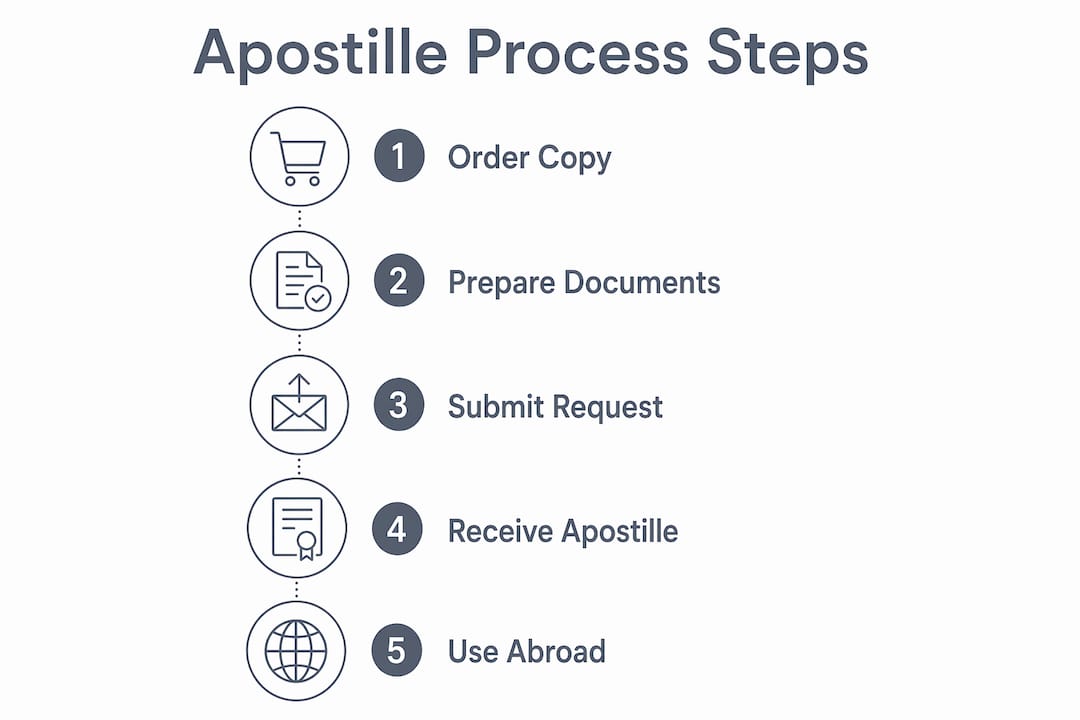
How to apostille a birth certificate: step-by-step
The process follows a clear sequence. Skipping or reordering steps causes rejections and delays.
-
Obtain a certified copy from the correct vital statistics office. Contact the provincial office in the province where the birth was registered. Processing times for certified copies vary. Turnaround ranges from several business days to a couple of weeks depending on the office and current volume.
-
Confirm the destination country accepts apostilles. Verifying Hague Convention membership before you start is critical. If the destination country is not a member, apostille processing will not satisfy their requirements. A separate legalization process applies in those cases.
-
Submit the certified copy to the correct authentication authority. In Canada, the federal government handles apostille processing through Global Affairs Canada. The apostille process is geographically tied to the issuing jurisdiction, so a birth certificate issued in Ontario must follow the Canadian federal apostille procedure, not a provincial one.
-
Pay the applicable fees and wait for processing. Federal apostille fees in the United States are $20 per document, and state fees range from approximately $6 to $40. Canadian federal fees follow a separate schedule. Check the current Global Affairs Canada fee schedule before submitting.
-
Receive the apostilled document and verify its condition. The apostille certificate is physically attached to your birth certificate. Check that the seal, signature, and attachment are intact before forwarding the document to the receiving authority abroad.
| Step | Action | Typical timeframe |
|---|---|---|
| Certified copy | Order from vital statistics office | Several days to 2 weeks |
| Hague check | Confirm destination country membership | Same day |
| Submission | Send to authentication authority with fee | 1–3 business days processing |
| Receipt | Verify document integrity on return | Same day |
Pro Tip: Use a trackable courier service when mailing your original certified copy. Original documents cannot be replaced quickly, and tracking gives you proof of delivery and return.
What to do when the destination country does not accept apostilles
Non-Hague countries such as China, UAE, and Vietnam require a different process entirely. An apostille alone is not sufficient for these destinations. Submitting an apostilled document to a non-Hague country will result in rejection.
The alternative is called embassy legalization or consular legalization. It involves multiple steps and takes longer than a standard apostille. For families dealing with UAE document requirements, the legalization process for UAE involves authentication at the national level followed by consular endorsement.
The general process for non-Hague countries works as follows:
- Obtain a certified copy from the provincial vital statistics office
- Have the document authenticated by the relevant Canadian authority (Global Affairs Canada)
- Submit the authenticated document to the embassy or consulate of the destination country in Canada
- In some cases, obtain a certified translation into the destination country's official language before or after legalization
For families planning residency in countries like Paraguay, the required documents for residency include apostilled originals, which confirms that Paraguay is a Hague member and apostille processing applies there. Always verify the specific country's requirements directly with their embassy or consulate before starting any process.
Certified translations add time and cost to the process. Plan for this early. Some countries require the translation to be completed before legalization; others accept it after. Confirming this sequence with the receiving authority prevents having to redo work.
Common mistakes that delay or reject apostille applications
Many delays come from incorrect documents and overlooked country-specific rules. These are the errors that appear most often:
- Submitting a hospital birth record. Hospital-issued commemorative records are not legally valid for apostille. Only certified copies from the provincial vital statistics office qualify.
- Using a photocopy or digital printout. Physical originals are required. A scanned copy sent by email or printed at home will be rejected immediately.
- Submitting to the wrong authority. The apostille process is geographically locked. A birth certificate issued in Ontario must go through the correct Canadian federal channel, not a provincial office or a foreign authority.
- Ignoring destination-country requirements. Some countries require the certified copy to have been issued within the past six months. Others require specific translations or additional notarization. Checking these requirements before submission prevents rejected filings.
- Confusing notarization with apostille. A notary public confirms a signature on a document. An apostille confirms that the government seal and signature on a public document are genuine. These are different processes and one does not substitute for the other.
Pro Tip: Contact the receiving authority in the destination country directly before submitting anything. Ask specifically whether they require a recently issued certified copy, a translation, or any additional steps beyond the apostille itself. This one call can save weeks.
Key Takeaways
Getting an apostille birth certificate right the first time depends on using the correct certified copy, submitting to the correct authority, and confirming destination-country requirements before you start.
| Point | Details |
|---|---|
| Certified copy is mandatory | Only provincial vital statistics offices issue valid certified copies for apostille processing. |
| Apostille confirms authenticity only | The apostille validates the seal and signature, not the factual content of the certificate. |
| Non-Hague countries need legalization | Countries like China, UAE, and Vietnam require embassy legalization, not an apostille. |
| Geographic rules apply | The birth certificate must be processed through the correct Canadian federal authority. |
| Verify destination requirements first | Some countries require recent issue dates, translations, or additional steps beyond the apostille. |
What I have learned from watching this process go wrong
The apostille process looks simple on paper. In practice, the details trip people up constantly. The single most common problem I see is families submitting the wrong type of birth certificate. They find an old hospital record in a filing cabinet, assume it is official, and mail it in. It comes back rejected, and now they have lost two to three weeks and still need to order the correct document from the vital statistics office.
The second most common problem is not checking the destination country's requirements before starting. Someone goes through the full apostille process, receives the authenticated document, and then discovers the receiving country requires the certified copy to have been issued within the past six months. Their certificate is two years old. The whole process starts over.
My recommendation is to order at least two certified copies when you place your initial order with the vital statistics office. The cost difference is small. Having a backup copy means that if one gets lost in transit or rejected for a condition issue, you are not waiting weeks for a replacement before you can resubmit.
For complex cases, particularly those involving non-Hague countries, multiple documents, or tight deadlines, professional services handle the submission logistics and catch document issues before they cause rejections. The time saved is usually worth more than the service fee.
— Ken
Speedyapostilleservices can handle your birth certificate apostille
Speedyapostilleservices, based in Toronto, processes apostille requests for Canadian birth certificates with a typical turnaround of 2–3 days. The service includes document review before submission, which catches the errors described above before they cause delays.

The all-in pricing model covers government fees upfront, so there are no surprise costs after submission. Speedyapostilleservices has processed documents for recognition in over 120 Hague Convention countries and holds a 5.0 rating backed by over 1,000 client reviews. Families who need a birth certificate authenticated quickly for citizenship applications, marriage registration, or school enrollment can submit documents directly through the Speedyapostilleservices website to get started.
FAQ
What is an apostille birth certificate?
An apostille birth certificate is a government-issued certified copy of a birth certificate that has been authenticated under the Hague Convention for use in foreign countries. The apostille confirms the document's seal and signature are genuine.
Can I apostille a hospital birth record?
No. Hospital-issued birth records are not valid for apostille processing. You must obtain a certified copy from the provincial vital statistics office where the birth was registered.
How long does the apostille process take in Canada?
The total time depends on two steps. Obtaining a certified copy from the vital statistics office takes several days to a couple of weeks. Apostille processing through the federal authority typically adds a few additional business days.
What if my destination country does not accept apostilles?
Countries outside the Hague Convention, such as China, UAE, and Vietnam, require embassy or consular legalization instead. This is a multi-step process involving federal authentication followed by the destination country's consulate in Canada.
Do I need a translation along with the apostille?
Some countries require a certified translation of the birth certificate in addition to the apostille. The requirement depends on the destination country. Confirm this directly with the receiving authority or the country's embassy before submitting your documents.