
Avoid Weeks of Delay: Apostille Canadian Adoption Documents Checklist
Avoid Weeks of Delay: Apostille Canadian Adoption Documents Checklist ! Canadian adoption dossier arranged for review Yes, if the destination country belongs to the Hague Apostille Convention, Canadian adoption documents can receive an apostille from the correct competent authority.

Avoid Weeks of Delay: Apostille Canadian Adoption Documents Checklist
Yes, if the destination country belongs to the Hague Apostille Convention, Canadian adoption documents can receive an apostille from the correct competent authority. If the destination is not a member, the documents need authentication followed by consular legalization instead. Start by confirming the destination country's Hague status, then gather originals or certified copies of every document in the adoption dossier.
TL;DR:
- Documents issued by provincial authorities, like birth certificates and court orders, should be routed to the relevant provincial office for apostille, not Global Affairs Canada.
- Federal records such as RCMP background checks must be processed through Global Affairs Canada, which handles apostilles for federal documents.
- For Hague countries, verify their acceptance of apostilles before submitting, and ensure private documents are notarized only if required, with current notary commissions.
- Non-Hague countries require a multilayered legalization process involving provincial certification, federal authentication, and embassy legalization, which is slower and more expensive.
- Proper document preparation includes checking expiry dates, matching names across documents, including a cover letter, and mailing with proof and tracking to avoid delays.
Table of Contents
- What Adoption Documents Need an Apostille?
- Who Issues an Apostille in Canada: GAC or Your Province?
- How to Apostille Adoption Documents for Hague Countries
- What If the Destination Country Isn't a Hague Member?
- How Long Does It Take and What Does It Cost?
- Common Mistakes That Delay Adoption Apostilles
- Pre-Submission Checklist for Adoption Apostille Documents
- A Practitioner's Note on Timing
- How Speedy Apostille Services Can Help With Your Adoption Dossier
- Sources
- FAQ
What Adoption Documents Need an Apostille?
An adoption dossier usually contains a mix of government-issued records and privately drafted documents, and each type follows different rules. The final adoption decree or court order, the adoptive child's birth certificate, background checks, medical reports, and marriage or divorce certificates are the items most often flagged for apostille for adoption papers.
Government originals, like vital records issued by a provincial registrar, generally do not need notarization before apostille. Private documents, such as home study reports or affidavits, usually need a commissioner or notary's signature first.
Federal documents deserve separate attention. RCMP background checks, for example, are federal records and follow a different routing path than a provincial birth certificate, which matters once you get to submission.
A working checklist for adoption paperwork apostille requests typically includes:
- Final adoption decree or court order (certified copy from the issuing court)
- Adoptive child's birth certificate (government original or certified copy)
- Home study report (notarized, since it is a private document)
- Police or background checks, including RCMP records (federal handling)
- Medical reports and any supporting affidavits (notarized)
- Marriage or divorce certificates for the adoptive parents, if requested by the destination
Who Issues an Apostille in Canada: GAC or Your Province?
Canada does not have one office handling every apostille for adoptions. Global Affairs Canada issues apostilles for federal documents and for cases where no provincial authority applies. Provinces handle documents they issued themselves.
That routing distinction is the single biggest source of confusion in this process, and getting it wrong is the fastest way to lose weeks. A few examples make the split clearer:
- An Ontario-issued birth certificate goes to ServiceOntario's Official Documents Services, not Global Affairs Canada.
- An RCMP background check, being a federal record, goes to Global Affairs Canada.
- A home study written by a provincially licensed adoption agency typically follows the provincial office, once notarized.
Before mailing anything, check the issuing authority's own guidance page and note the destination country by name on your submission. Provincial and federal offices sometimes publish slightly different processing estimates, so confirm timelines directly with whichever office you are using rather than relying on secondhand summaries.
How to Apostille Adoption Documents for Hague Countries
Canada joined the Hague Apostille Convention on January 11, 2024, which replaced the old multi-step legalization chain with a single certificate for member countries. Here is the practical adoption apostille process for the more than 120 Hague-member destinations:
- Confirm Hague membership. Use a Hague country checker to verify the destination accepts apostilles rather than full legalization.
- Sort your documents. Separate government originals (birth certificates, court decrees) from private documents needing notarization (home studies, affidavits).
- Notarize where required. Confirm the notary's commission is current, since an expired commission is grounds for rejection.
- Check names and dates. Adoption files often mix legal names, birth names, and court-file numbers. A single mismatch between the decree and the birth certificate can stall the whole package.
- Build the submission packet. Include a cover letter naming the destination country, an itemized document list, payment for authority fees, and a self-addressed return envelope with tracking.
- Send to the correct authority. Route provincial documents to the province, federal documents to Global Affairs Canada, and choose standard or expedited processing based on your deadline.
- Verify on receipt. Check that the apostille certificate is attached correctly, that names match across every document, and that the certificate references the right instrument.
Pro Tip: Photocopy or photograph every original before you mail it. If a document gets lost in transit, you will need proof of what you sent and a backup for reissuing the request.
What If the Destination Country Isn't a Hague Member?
Not every adoption destination has joined the Convention, and for those countries, the older process still applies in full. Instead of one certificate, you need a layered chain: provincial certification of the document, then federal authentication through Global Affairs Canada, then legalization at the destination country's embassy or consulate in Canada.
This route is slower and pricier than an apostille, often stretching into months rather than weeks, especially once embassy appointment availability and certified translations enter the picture. Some embassies only accept legalization requests on specific days or by appointment only, which adds unpredictable lag time to an already long process.
Key points to plan around:
- Certified translations are frequently required before the embassy will legalize a document.
- Embassy processing times vary widely and are outside Canada's control.
- Skipping a step in the chain, or notarizing a document that should have stayed a plain government original, is a common reason legalization packages get bounced back.
How Long Does It Take and What Does It Cost?
Processing timelines vary by authority and by document type, so build in buffer room around any adoption or visa deadline. Global Affairs Canada's own guidance notes that processing can reach roughly 25 business days, not counting mailing time in either direction. Provincial offices publish their own separate estimates, which can run shorter or longer depending on volume.
Total cost usually breaks into a few pieces: the authority's apostille fee, a notary fee for any private documents, courier or mailing charges, and translation costs if the destination requires them. Expedited paths exist at some offices through in-person drop-off windows or paid rush service, and third-party expeditors can also compress timelines, though usually at a premium over standard processing.
Common Mistakes That Delay Adoption Apostilles
Misrouting documents between provincial and federal offices is the single most frequent cause of rejected adoption apostille submissions. Sending an RCMP check to a provincial office, or a provincial birth certificate to Global Affairs Canada, guarantees a bounce and a restart.
A close second is notarizing a document that should have stayed untouched. Government originals like vital records typically don't need a notary's signature. Adding one can actually complicate acceptance. Name and date mismatches across the adoption decree, birth certificate, and background check round out the top three issues.
- Verify a notary's commission is current before relying on their signature for an apostille.
- Confirm the acknowledgment wording the notary uses matches what the destination authority expects.
- Send federal documents to Global Affairs Canada and provincial documents to the issuing province, never the reverse.
Pro Tip: Write a one-page cover letter naming the destination country and listing every enclosed document by title. Reviewers move faster when they know exactly what they're looking at and why.
Pre-Submission Checklist for Adoption Apostille Documents
Print this before you seal an envelope:
- Confirm every document is an original or a properly certified copy, not a plain photocopy.
- Complete notarization on private documents only; leave government originals untouched.
- Arrange certified translations if the destination country has asked for them.
- Check expiry windows on background checks and medical reports, since some destinations reject documents older than a set number of months.
- Write a cover letter naming the destination country and listing each enclosed item.
- Include payment for authority fees and a self-addressed return envelope with tracking.
- Ship with a courier that provides proof of delivery, and add at least two weeks of buffer before any court or visa deadline.
A Practitioner's Note on Timing
Most delays trace back to the same handful of mistakes: wrong office, unnecessary notarization, or a name that doesn't match across documents. A document review before submission catches those problems while they're still cheap to fix.
Adoption cases carry court dates and visa windows that don't move. If your timeline is tight, expedited help is worth the cost. If it isn't, confirm your destination country's rules early and build your own checklist from there.
— Ken
How Speedy Apostille Services Can Help With Your Adoption Dossier
Adoption files rarely arrive as a single tidy stack of paper. They mix provincial vital records, federal background checks, and notarized private documents, each with its own routing rule. Speedy Apostille Services reviews the full dossier, flags anything that needs notarization or correction before submission, and handles the government filing directly.
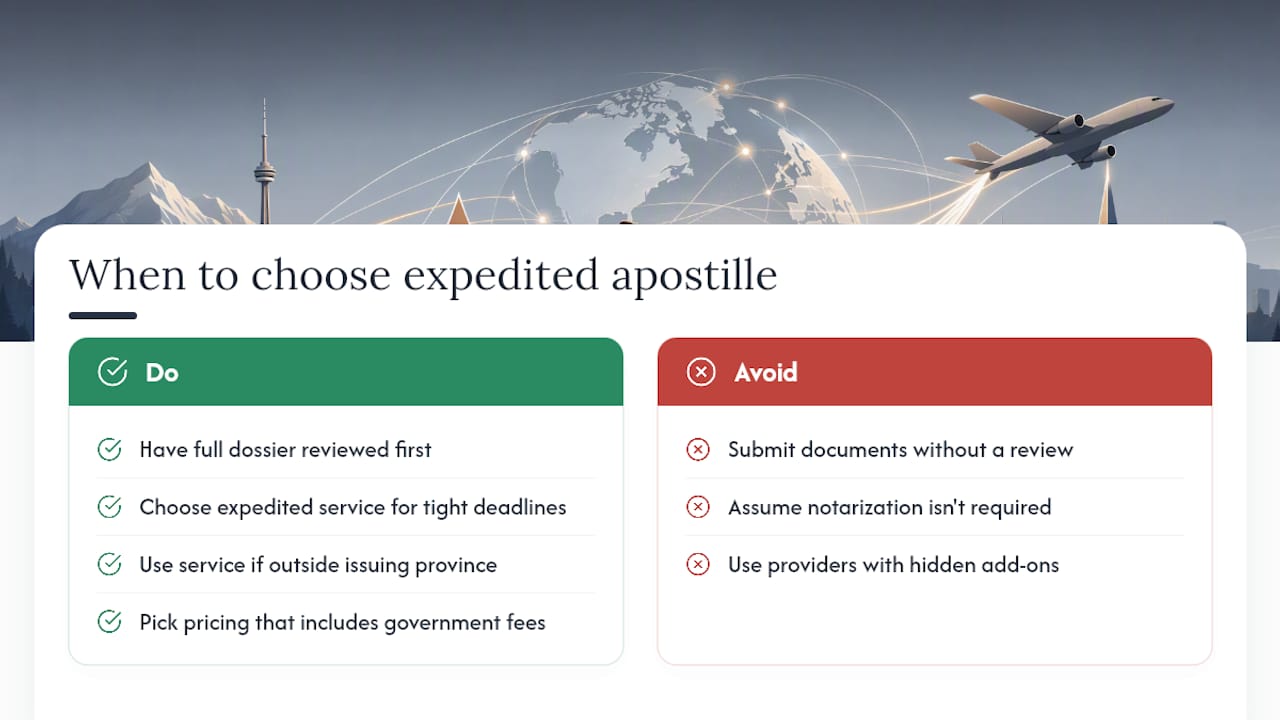
Such services may include document review, notarization referrals where needed, secure handling, and pricing that includes government fees in one quote, avoiding surprise add-ons later. Typical turnaround times vary depending on document type and service tier, which matters when a court date or a foreign adoption authority's deadline isn't flexible.
If you're managing a complex dossier, live outside the province that issued your documents, or simply don't have weeks to spare for back-and-forth corrections, a paid expedited service closes that gap. Visit the Speedy Apostille Services site to review pricing and start an order for your adoption documents.
This article is general information, not a substitute for advice from a qualified lawyer. Consult a qualified legal professional about your own circumstances before acting on anything here.
Sources
- Five Tips for Authenticating Canadian Documents to Use Abroad — Global Affairs Canada
- Authentication of documents — Global Affairs Canada
- Authenticate a document for use outside Canada — Government of Ontario (Official Documents Services)
FAQ
Can I Get an Apostille on Adoption Documents in Canada?
Yes. Global Affairs Canada or the relevant provincial office can issue an apostille for adoption documents headed to a Hague Convention member country, depending on which authority issued the original document.
How Long Does It Take to Get an Apostille in Canada?
Global Affairs Canada's processing can reach about 25 business days, not including mailing time, while provincial offices publish their own separate estimates. Some expedited services typically complete requests in one to seven days.
Does ServiceOntario Do Apostilles?
ServiceOntario's Official Documents Services handles authentication for documents issued in Ontario, acting as the provincial competent authority rather than Global Affairs Canada for those specific records.
How Much Does It Cost to Get an Apostille on a Document in Canada?
Total cost depends on the authority fee, any notary charges for private documents, courier costs, and translation fees if the destination requires them, so the total varies by document type and how many pieces the adoption dossier contains.
What Happens If My Adoption's Destination Country Isn't a Hague Member?
The document needs provincial certification, federal authentication, and consulate legalization instead of a single apostille, a process that generally takes longer and costs more due to translation and embassy scheduling.